
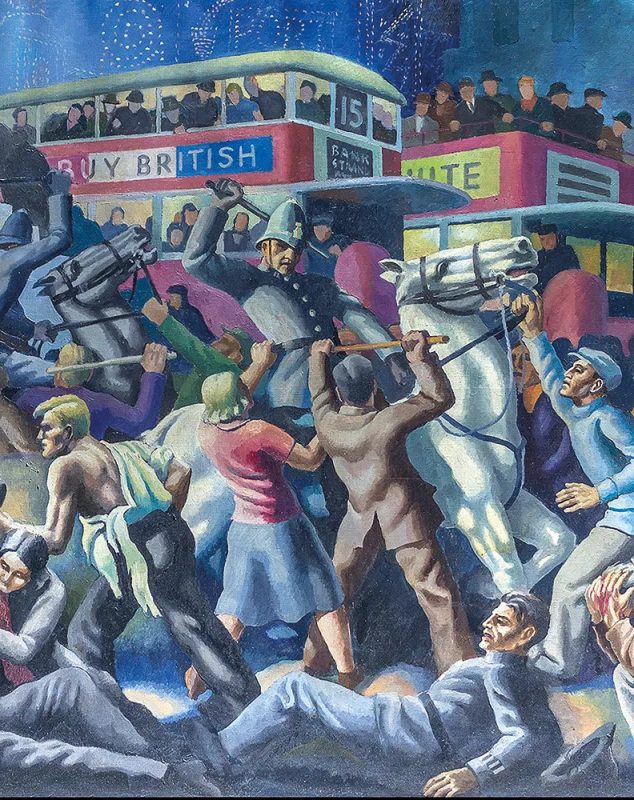
Review: COMRADES IN ART: ARTISTS AGAINST FASCISM
20 August 2026 • Herbert Wright
Comrades in Art reveals how artists united against fascism — and why their story feels urgently relevant again.
Paul Nash was one of the most important British artists of the twentieth century, renowned for landscapes that transformed the English countryside into mysterious, psychologically charged spaces. Working across painting, drawing, photography and design, Nash combined close observation of the natural world with an increasingly imaginative and Surrealist sensibility. Trees, stones, ancient monuments and strange configurations of objects recur throughout his work, turning familiar landscapes into places charged with memory, symbolism and a sense of the uncanny.
Born in London in 1889, Nash developed a deep attachment to the landscape from an early age, particularly the countryside of southern England. His experience as an official war artist during both World Wars profoundly shaped his practice. During the First World War, he depicted the devastated landscapes of the Western Front in works including We Are Making a New World, transforming shattered trees, trenches and flooded battlefields into powerful images of destruction. Returning as a war artist during the Second World War, he created works such as Totes Meer (Dead Sea), in which wrecked German aircraft become an eerie metallic landscape.
Between the wars, Nash became increasingly engaged with European modernism and Surrealism while remaining rooted in the British landscape. He was instrumental in establishing the modernist group Unit One in 1933 and participated in the landmark International Surrealist Exhibition in London in 1936. Ancient sites including Avebury, standing stones, coastal landscapes and found objects became recurring subjects, allowing him to explore connections between the physical world, history and imagination.
Nash’s later paintings pushed landscape towards dreamlike abstraction, combining natural forms with moons, sunflowers, reflections and celestial imagery. Throughout his career, landscape was never simply something to record; it became a means of accessing another reality beneath the visible world. Through this fusion of British landscape traditions, modernism and Surrealism, Paul Nash created a singular body of work that continues to influence contemporary artists and remains central to the development of modern British art.
20 August 2026 • Herbert Wright
Comrades in Art reveals how artists united against fascism — and why their story feels urgently relevant again.

19 February 2026 • Mark Westall
Southampton City Art Gallery will present a major exhibition of more than 100 works exploring how British artists absorbed, resisted… Read More
24 March 2025 • Paul Carey-Kent
In chronological order, are eight items I like at Somerset House. The fair isn’t restricted to editions, incidentally: five of these are unique works

1 July 2020 • Paul Carey-Kent
Art UK is the online home for every public art collection in the UK, recently represented to make 250,000 works easily searchable with a facility to curate your own show. Faced with so many options, I took took the simple approach of looking for less usual examples from some of my favourite C20th artists.

26 February 2017 • Tabish Khan
War, Chairman Mao, lost children, figurative drawings and Feminism.

1 January 2017 • Mark Westall
It’s not news that 2016 was a turbulent year, but it was also a very creative year, so we asked the… Read More
28 January 2014 • Paul Carey-Kent
The London Art Fair has improved a little each year recently, with more adventurous and fewer dire galleries in the mix and a good curated photo exhibition.
6 February 2010 • Staff
Paul Nash (1889 – 1946) painted beautiful landscapes of the Downs, strange flooded rooms, and classic images of two World… Read More