Gordon VeneKlasen, former co-owner of Michael Werner Gallery, now operates separately under his own name in London and New York – and you can currently see exhibitions of Sigmar Polke (1941-2010) in both locations. Very much ‘an artist’s artist’, he emerged alongside Gerhard Richter as a ‘Capitalist Realist’ from East Germany whose paintings directly confronted Germany’s fraught history while casting a critical eye on contemporary society in the West. The London show, a testament to his variety and wit, ranges from a humorous early sculpture to a parody-come-homage to abstract expressionism to a painting made in the dark with light-sensitive chemicals.
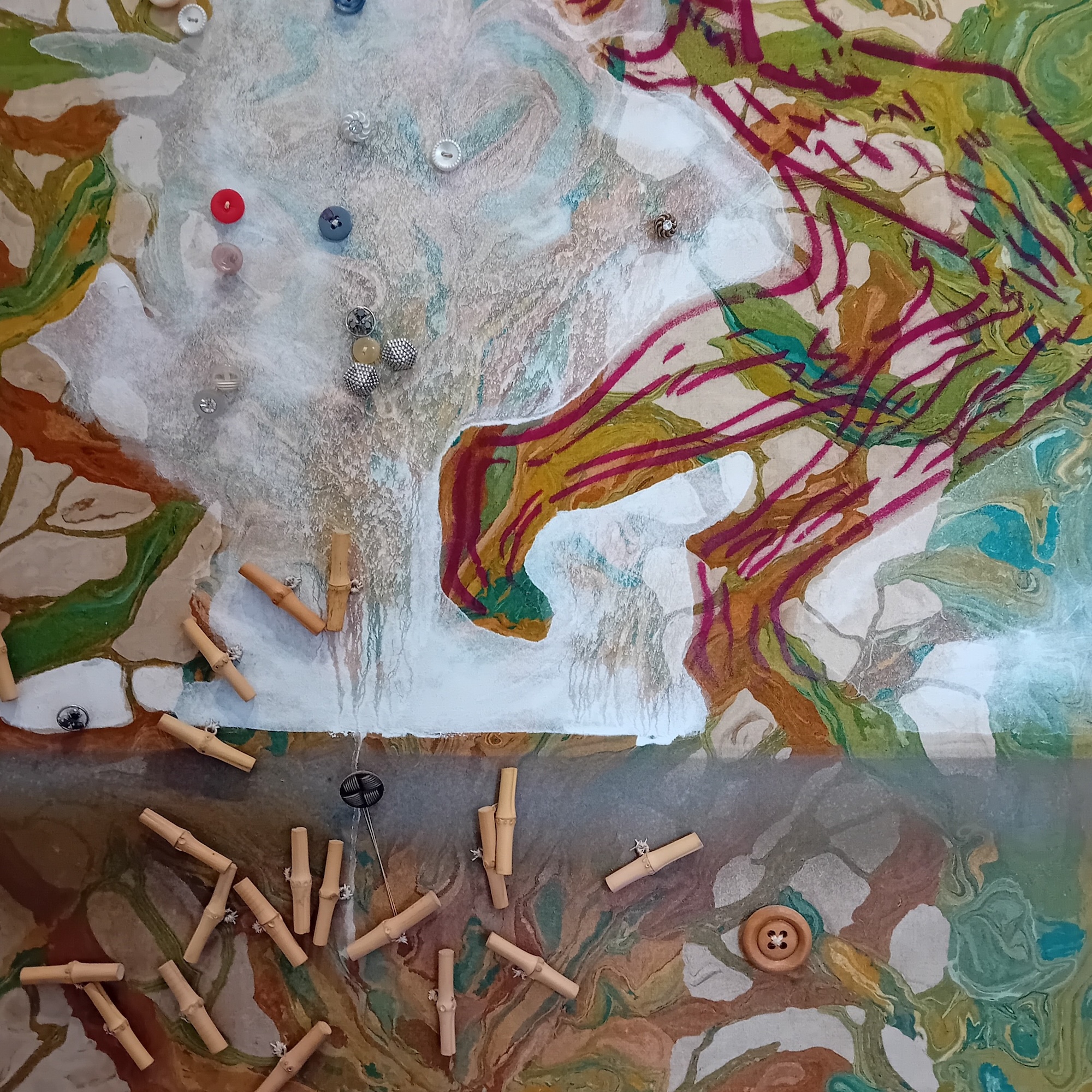
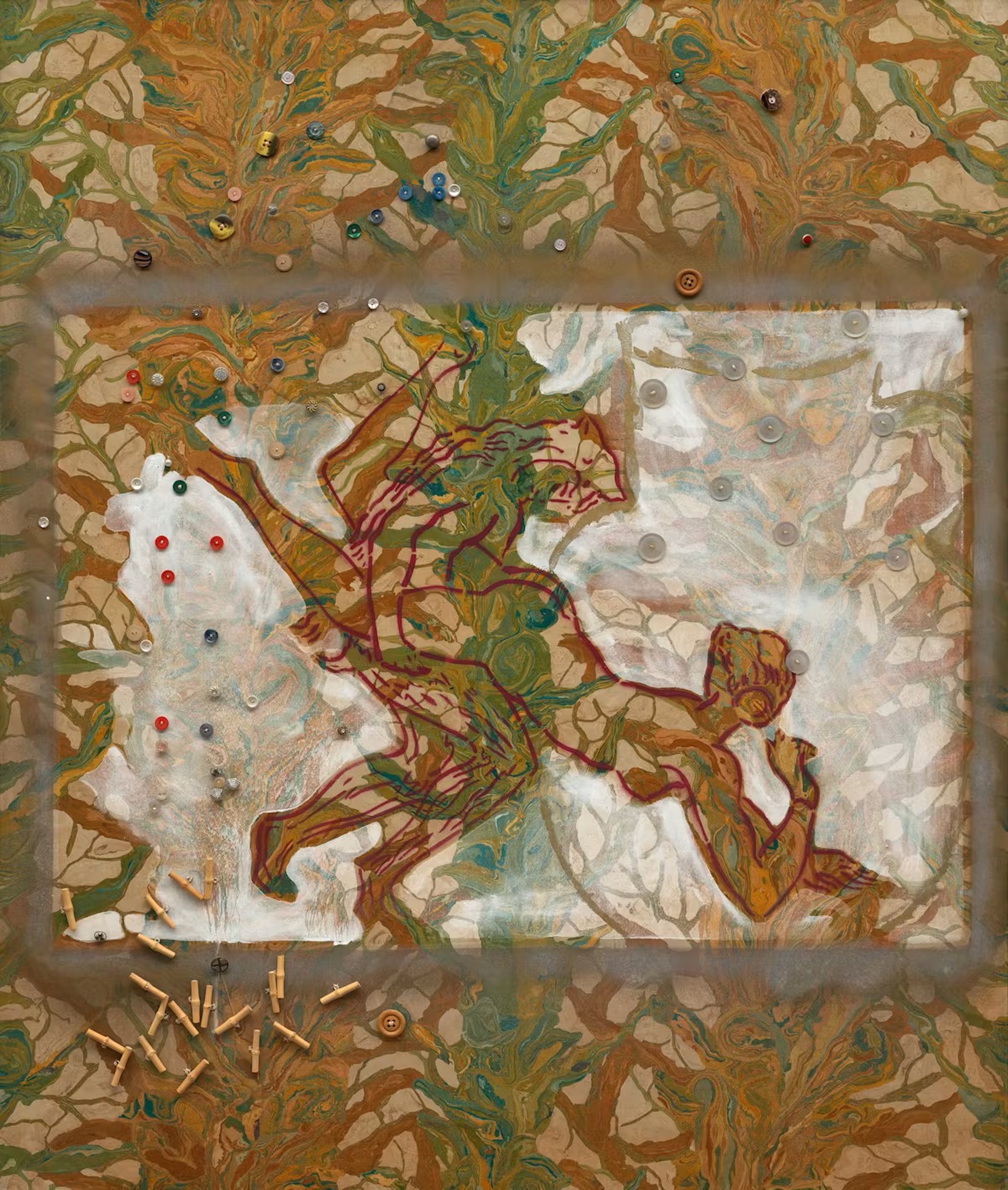
This untitled work follows a typical strategy of moving back and forth between high and low reference points. The mixture has a Dada spirit, the layering within which may owe something to Picabia’s ‘transparency’ paintings. Polke starts with the collision between a found fabric – featuring a somewhat kitschy marbled effect – and an image borrowed from Pierre Klossowski. According to the gallery’s Associate Director Jordan Bosher, Balthus’s de Sade-loving elder brother derived it from considerations of the role of women in Ancient Rome. The couple – at least in Polke’s template-sprayed rendering – are ambiguously posed between sex and play, making it classical yet not straightforwardly serious. Polke has sprayed a veil of white, partly following the lines of the marbling. That might suggest a blind being lowered over the scene – consistent with the wooden window toggles. Polke has also sketched in the outline of a jug, such as we might find in a museum display of Roman artefacts. The register changes again with the application of buttons, operating attractively in formal terms and playfully suggesting clothing for the characters shown, who appear far from ‘buttoned up’.
Paul Carey-Kent selects a ‘Gallery of the Month’, a ‘Show of the Month’, a ‘Work of the Month’ and a ‘Book of the Month’ for his weekly column in FAD.