Flora Yukhnovich arrived in New York in 2024 — just as Donald Trump won a second term — and, according to curator Eleanor Nairne, the timing mattered. “While He was promising a ‘golden age of America,’” Nairne writes in the exhibition catalog, “the English artist Flora Yukhnovich was at work on a new body of paintings in a former factory of Pierce Arrow in Long Island City.”
The British painter (b. 1990) began reimagining the centuries-old theme of the Bacchanal not as a Rococo fantasy of satin limbs and ripe fruit, but as a contemporary drama of excess, overload, and visual saturation. The result is Bacchanalia, her first Los Angeles solo exhibition and debut with Hauser & Wirth: a suite of large-scale canvases in which beauty and pleasure tilt toward collapse.
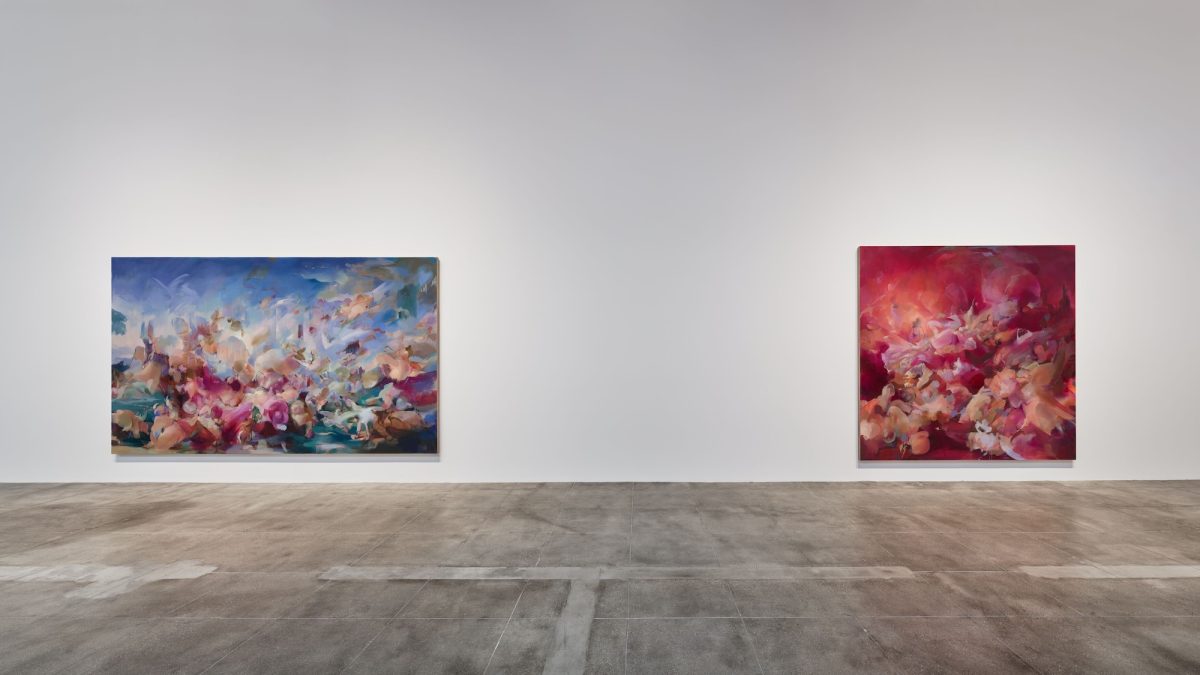
Yukhnovich has built her following by remixing art-historical languages for the age of the scroll. Her brushwork borrows the powdered-sugar decadence of 18th-century Rococo painting, but also the swipe-blur liquidity of Instagram, where imagery bleeds, glitches, and never fully resolves. As she explained during a recent walkthrough: “I gather all these images, samples I’m going to be making… and then at a certain point it dissolves. If I didn’t stop it, it could go on forever.” Like the algorithm, the paintings threaten infinity.
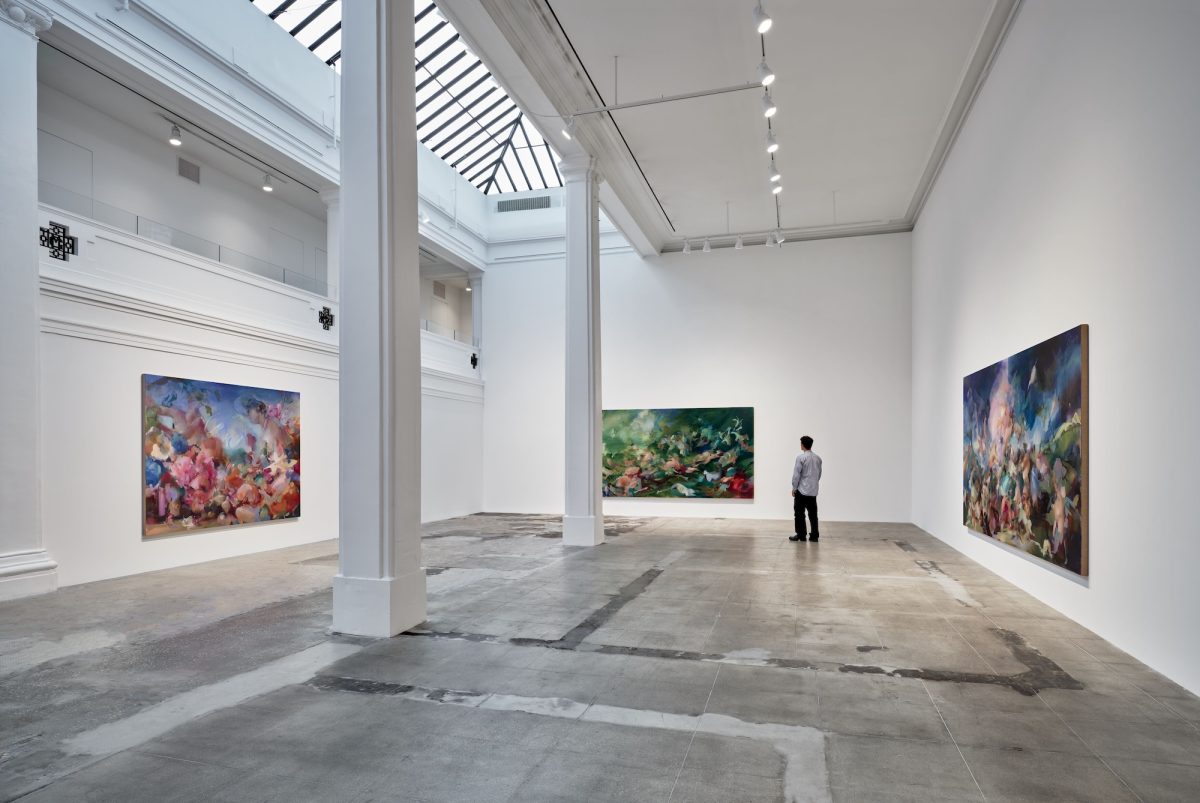
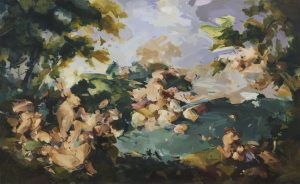
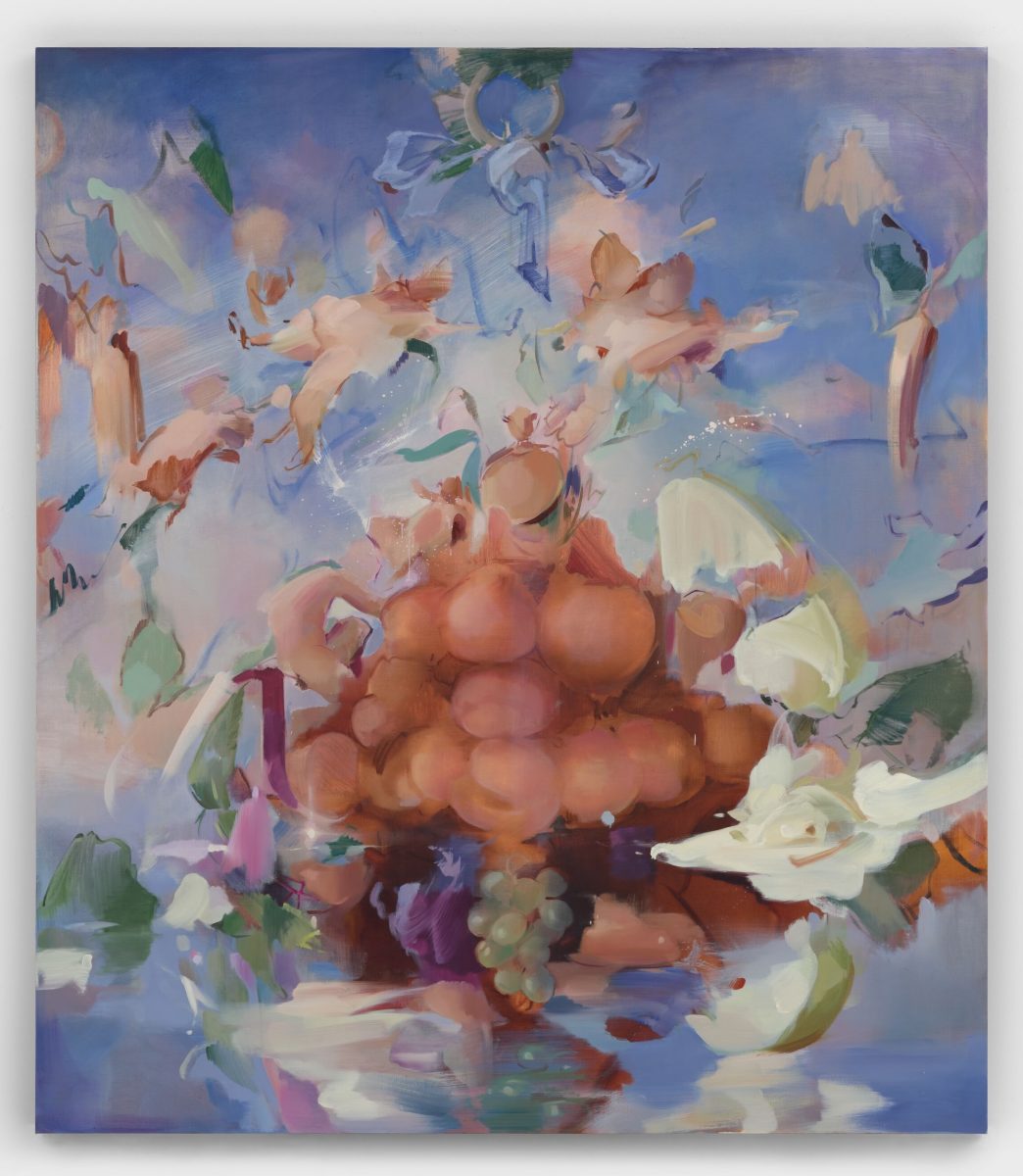
The works in Bacchanalia oscillate between ornament and unease. In Party in the U.S.A. (2025), the Columbia Pictures Torch Lady becomes a faint afterimage, swallowed by clouds, columns, and a froth of pastel strokes. Trifle (2025) channels the precarious balance of a Flemish still life—peaches stacked to the point of collapse, grapes slipping off the edge — while Luncheon (2025) pushes that instability into the register of advertising: a woman’s head drifts above a haze of florals and backward cursive text, echoing the Gucci Flora perfume campaign disintegrating mid-air. The Last Days of Disco (2025) darkens the palette entirely, turning revelry into combustion —lilac, flesh, and arterial red spiraling toward flame.
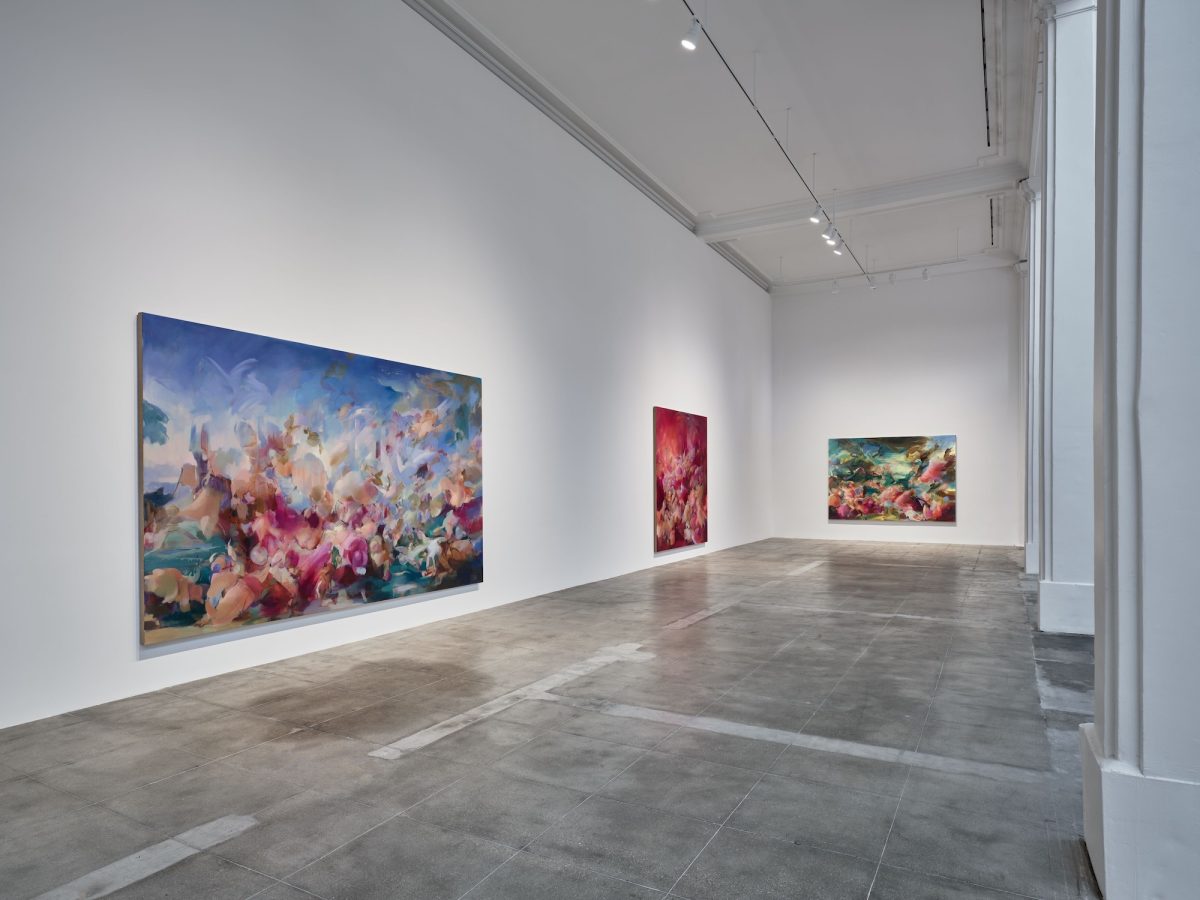
Yukhnovich’s references range from Lawrence Alma-Tadema’s The Roses of Heliogabalus (1888) to Willem de Kooning abstraction, and the overstimulation of the 24-hour feed. Nairne summarizes in the catalog: “The wisdom of the ancients is that luxury quickly cedes to corruption and chaos, and from the wreckage a phoenix could arise. What is a painter to do but submerge in the whorl of revelries and see what might emerge?”
What emerges is pastel-coded calamity — paint as sugar rush, myth as feedback loop. It’s a timely counterpoint to Yukhnovich’s simultaneous project at The Frick Collection in New York, where she responds to Boucher’s Four Seasons. If the Frick work engages Rococo surface, Bacchanalia shows what happens when surface overloads the system.
Auction prices have already anointed her — Warm, Wet ’N’ Wild (2020) fetched £2.69 million — but Bacchanalia makes the case that Yukhnovich is less a market phenomenon than a painter genuinely grappling with the visual economy we live inside: the glut, the glamour, the exhaustion, the seduction that curdles into static.
If the Rococo once gilded aristocratic fantasy, Yukhnovich gilds a different empire —celebrity, commerce, late-capitalist spectacle — at the exact moment it slips from control.
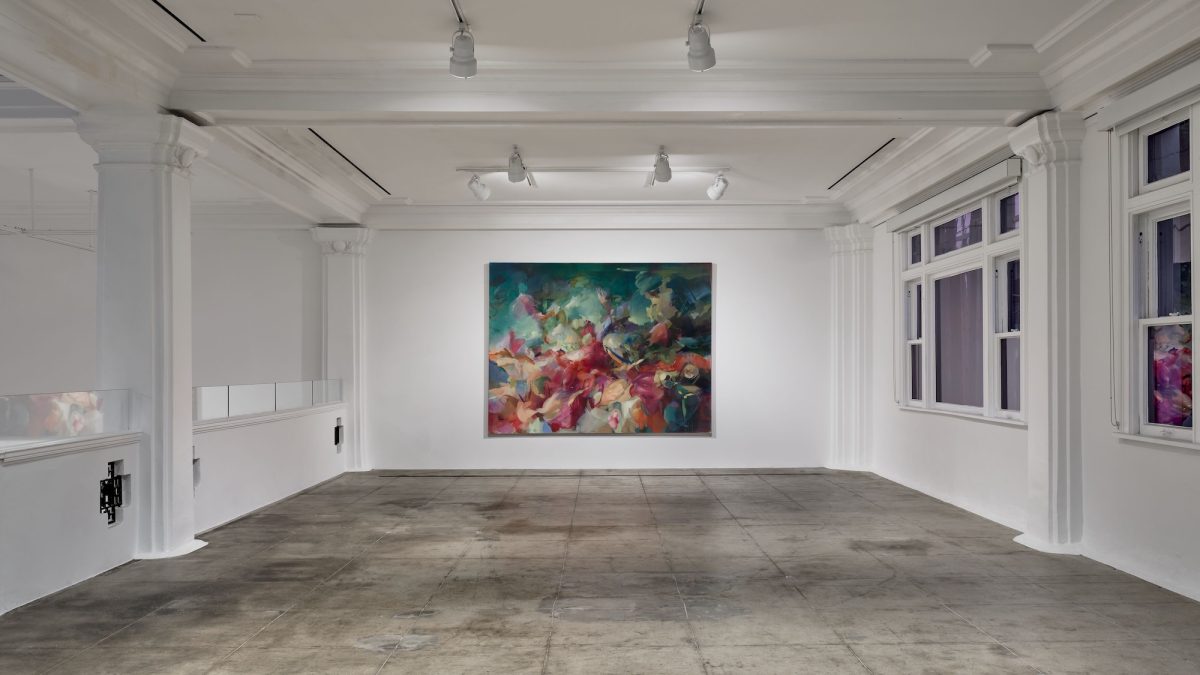
Flora Yukhnovich Bacchanalia 30th October 2025 – 18th January 2026 Hauser & Wirth
Flora Yukhnovich’s Four Seasons 3rd September – 9th March 2026 The Frick Collection
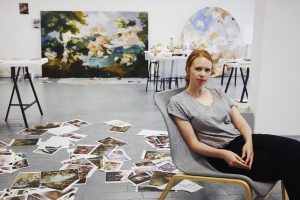
All images: Installation view, ‘Flora Yukhnovich. Bacchanalia,’ Hauser & Wirth Downtown Los Angeles 30th October 2025–18th January2026 © Flora Yukhnovich Courtesy the artist, Hauser & Wirth and Victoria Miro Photo: Keith Lubow