We live in a time when conflict hums quietly in the background. Power travels silently – through cables, logistics chains, recommendation algorithms. What appears to be stability often masks the violence that props it up: diffuse, procedural, and financed.
Li Yu’s work echoes the stillness of the time in which we live. Using colours that are calm and neutral materials, Li Yu’s work stages the systems we inhabit without pronouncement. In the form of tension, her sculptural works don’t enact violence; they absorb it, concentrate it and hold it in place.
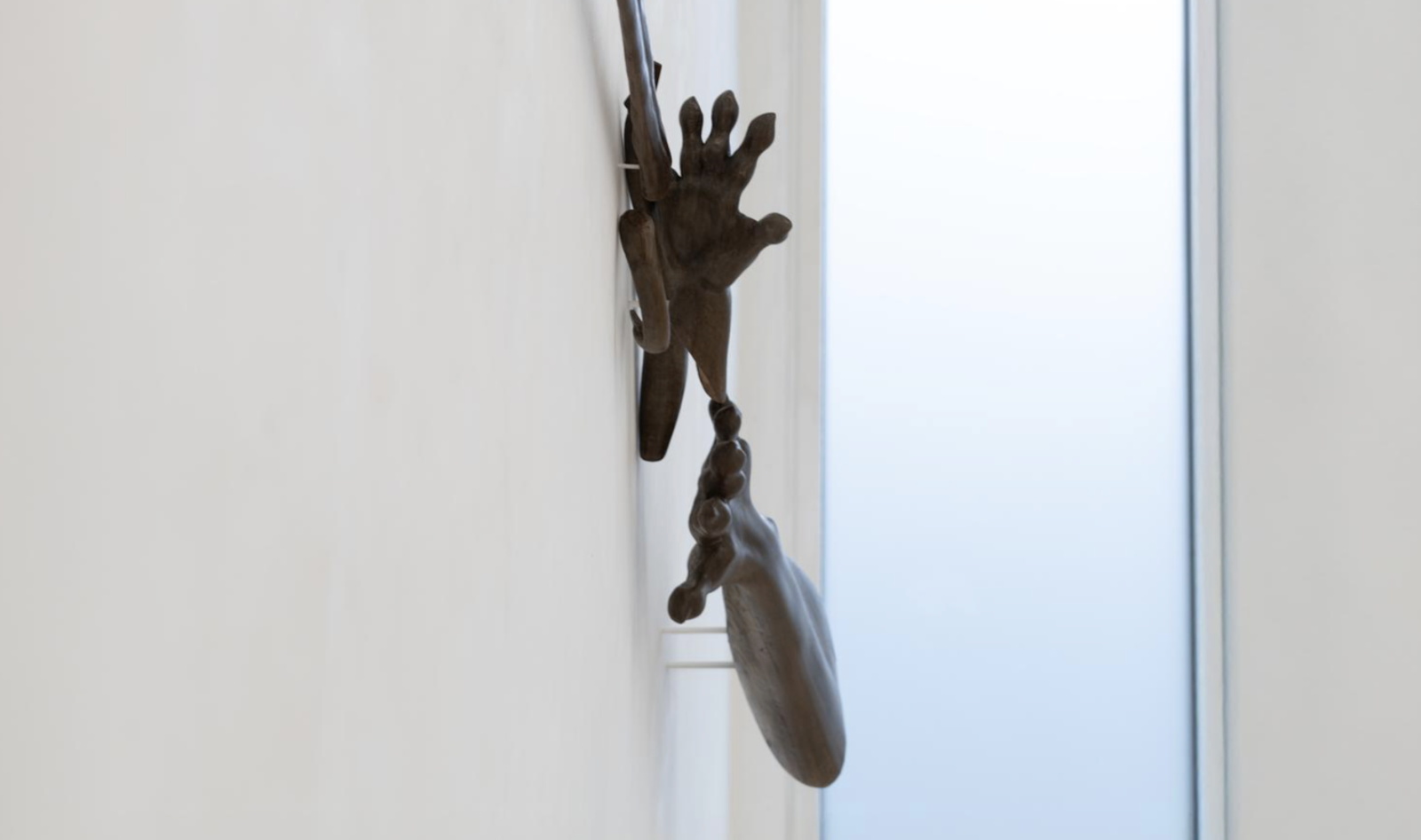
Her latest work, Contact I (2025), occupies the wall, measuring 170 cm across. It is crafted from dark teak, iron-oxidised and varnished to a high polish. The surface recalls antique gun racks – lacquered, ceremonial, worn smooth through repeated touch, aged through use.
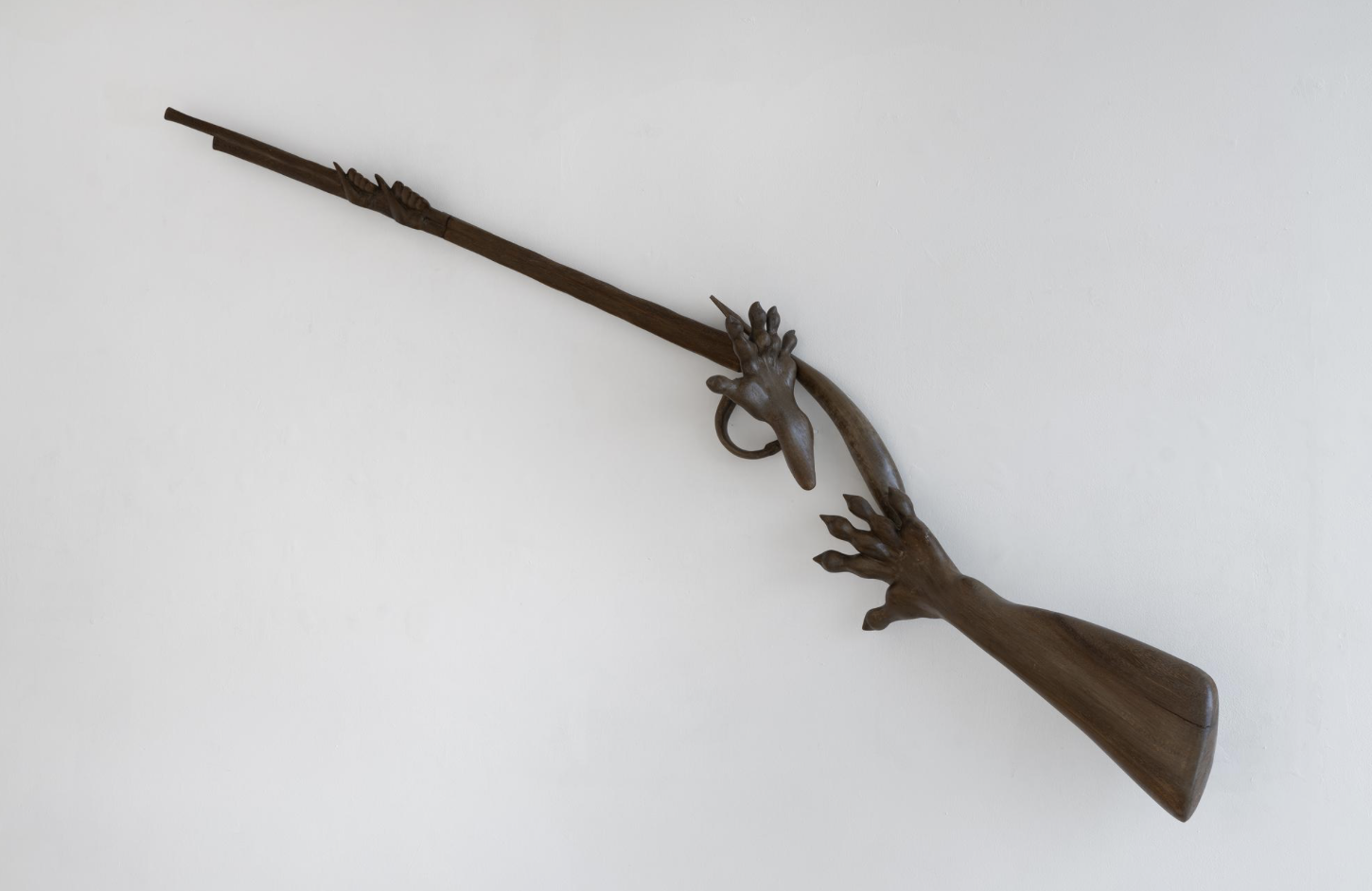
As a form of three-dimensional collage, Contact I draws on motifs from Assyrian sculpture panels depicting a portrait of an encounter between a weapon and monstrous paws. With Li Yu’s reassembling of those elements, the sculpture assumes the shape of a gun, with a dynamic that hovers between states: weapon and monster, controller and controlled. Power shifts within it, never settling.
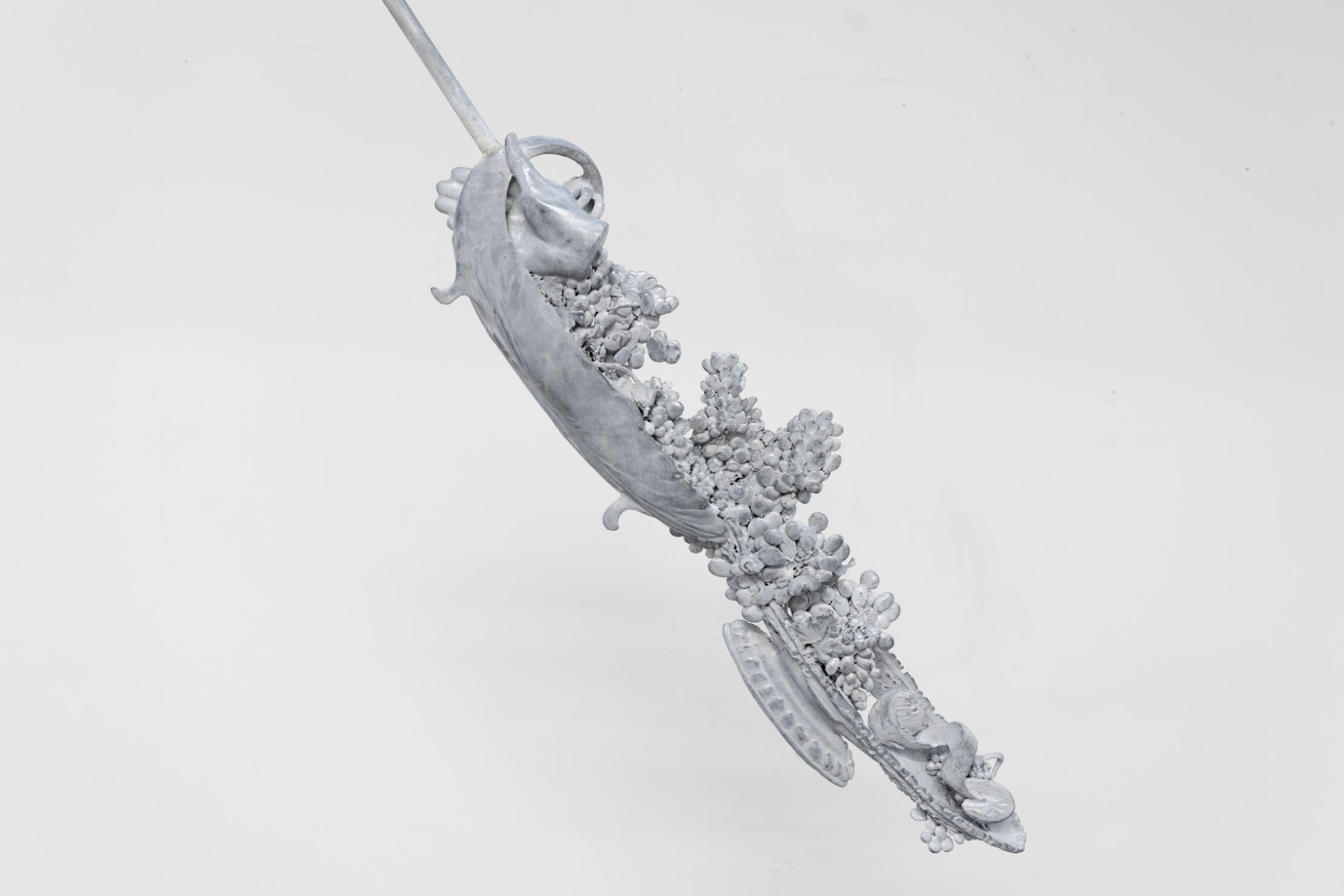
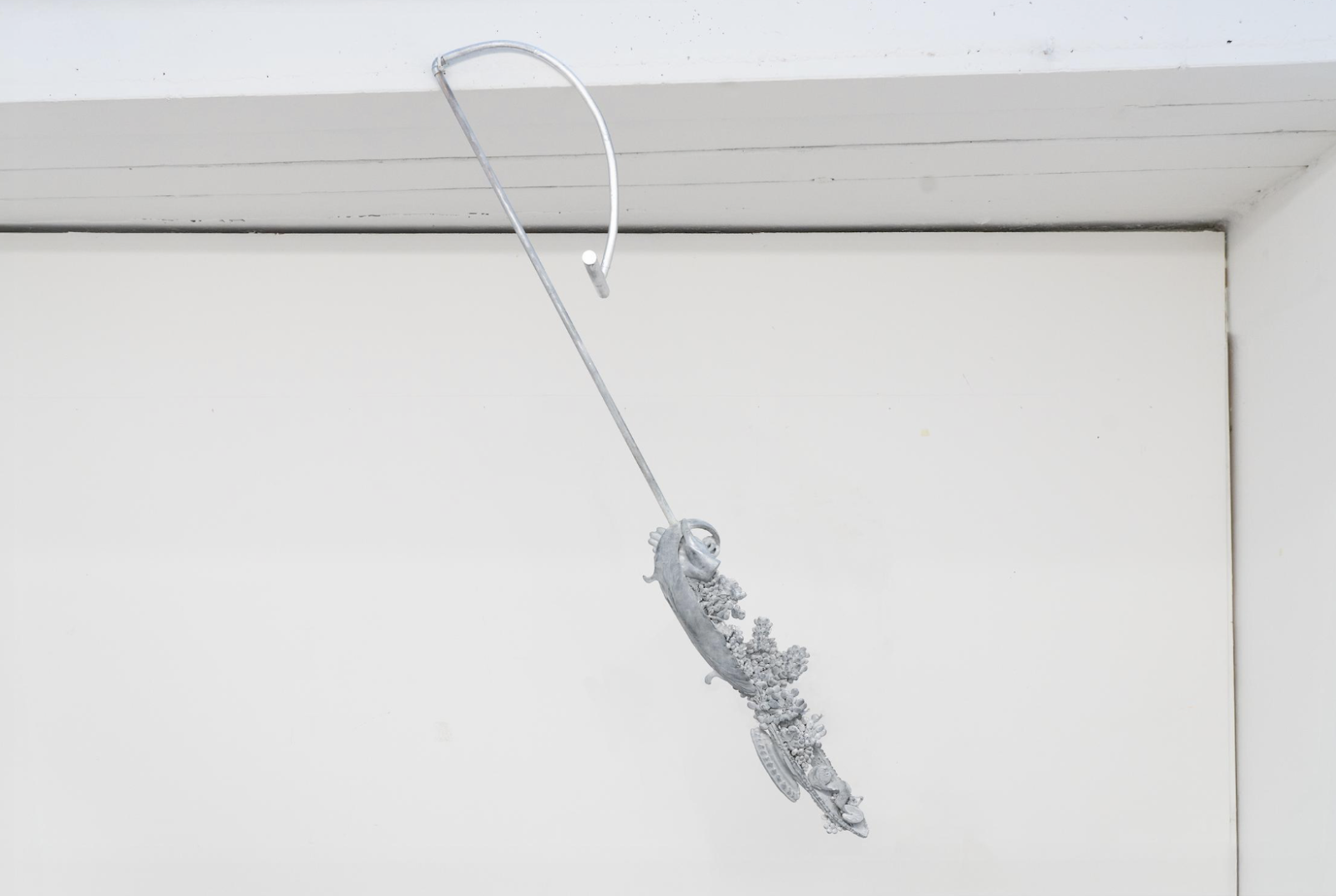
Contact II (2025) continues this inquiry more directly, standing taller and narrower. Its metallic surface appears worn and compressed. One end connects to a handle, the other to a mass of distorted, decorative debris. This dynamic invites the viewer into an imagination of participation – as if reaching out, lifting, or offering something to someone. The gesture alludes to the historical asymmetry of power, recalling gestures inherited from empire – tributes to kings, subjects to rulers. In Li Yu’s choreography, echoing those historical events, she asks the audience to consider how power is tested and made interchangeable.
Both pieces reveal the broader theoretical scope of Yu’s practice, where the artist looks into the formation of historical authorship and control over narrative. In her work, the notion of authorship is never a neutral one.
On the other hand, Contact I and II depict power not as an adversary but as its (pre-)condition. By slowing this active force to a near stillness, she transforms stillness into a conspirator in the silent continuation of power. It is this contradictory stillness – most of the time it is mistaken for one of peace – that she so delicately unfolds in her works.
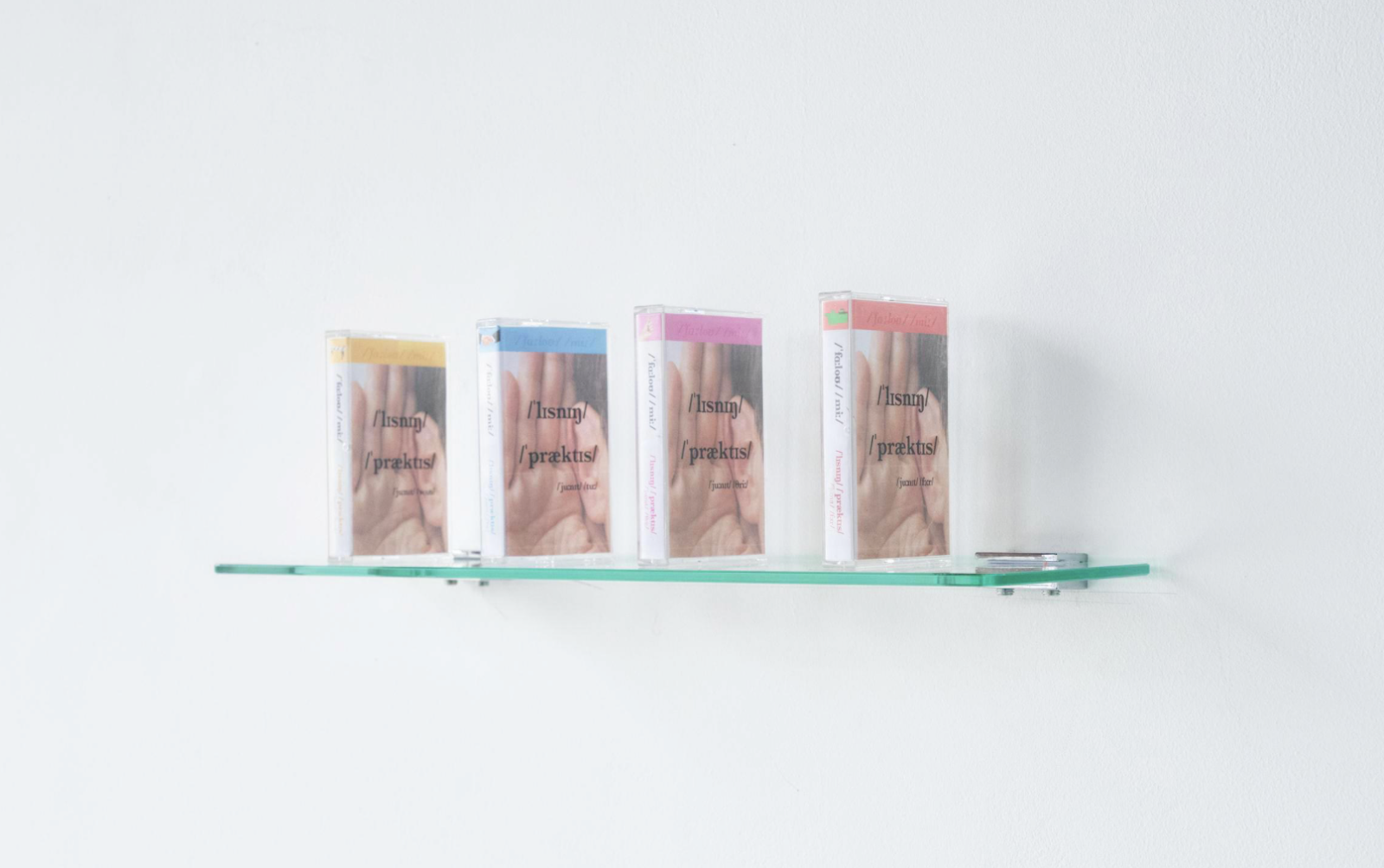
In the language-based works of Li Yu, the tension is still felt and the political presence can be sensed not through an overtly thematic portrayal, but through the use of mundane tools and habits – those that we grow up with, practice, and rarely question. If Contact I and II were her works that unveiled the mask of the imperial legacy’s inheritance, then her works like Pronunciation Practice (2022), Listening Practice (2023), and In Other Words (2023) shift the scene to reveal how that political structure was operated daily
History, in this context, is not something grand. It is often very carried, performed, and ingrained in things that are as simple as a cassette tape or a textbook. These are the works that depict the tools through which children acquire knowledge as instruments that not only put pressure on the institutions but also from which the institutions exert that pressure. Learning, which is the most apparent phenomenon, is the practice of the social system.
Listening Practice (2023) was a strange and somewhat distressing experience to watch – cassette tapes looped, with the chopped-up speech of a parrot that had been trained to speak a language it had never been used to communicate before. The resemblance is obvious to someone who has undergone the process of learning a second language and has had to repeat words, phrases, or sentences just to achieve the proper accent and cadence. The artist used actual voice recordings of a parrot named Einstein, sourced online and organised by themes: food, greetings, and instructions.
The art piece views the parrot’s repetition not just as copying but as something influenced by its surroundings: it was trained, rewarded, and displayed. The retro cassette format, once a standard tool in English learning, is here transformed into a device through which the animal’s rights and its communicative agency are staged in relation to the human listener. The parrot thus becomes an allegory for people in systems, learning to communicate through controlled feeding, commands, and feedback loops.
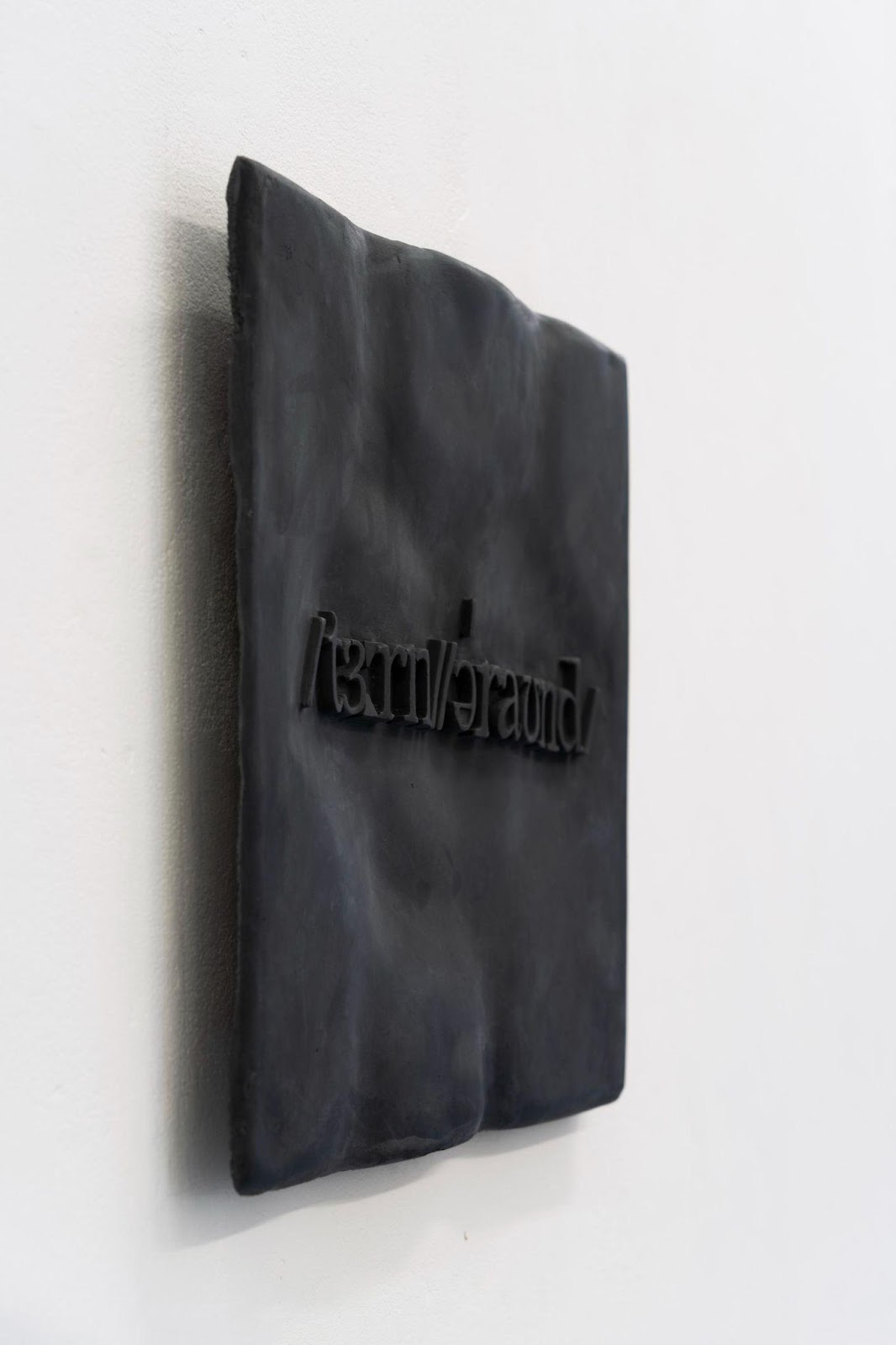
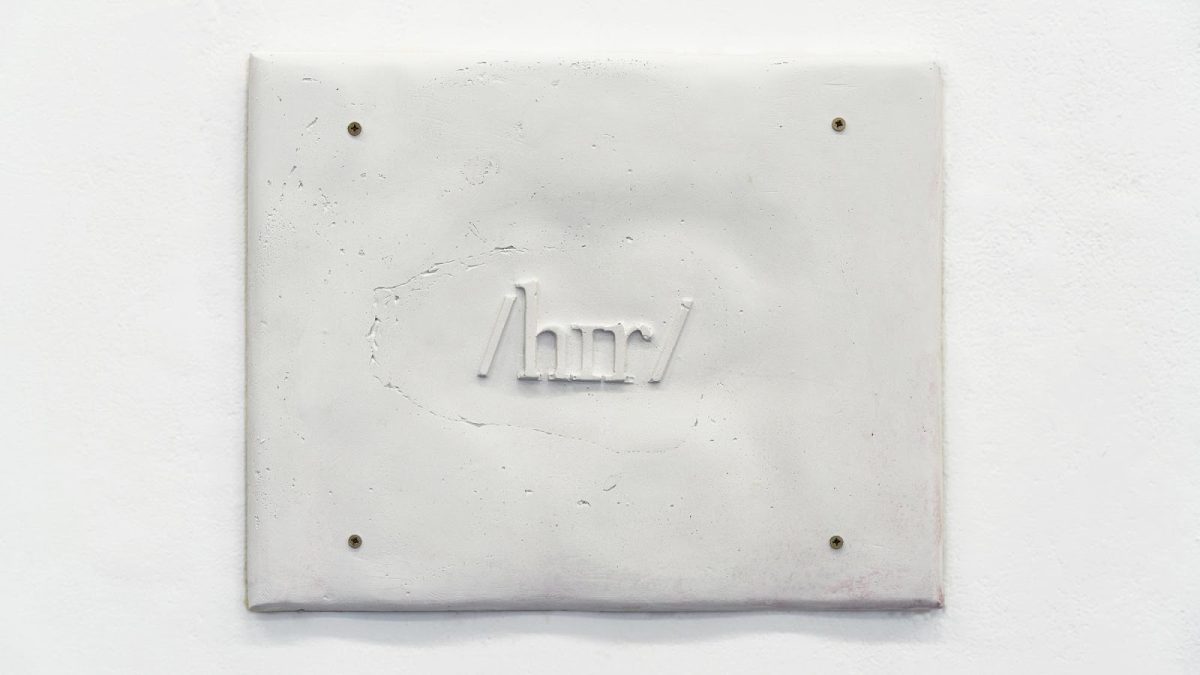
In Other Words (2023) is an ambiguous visual piece consisting of instruction panels, where the depiction of the command ‘turn around’ is represented by a hand-embossed phonetic symbol. The inscriptions can be interpreted in various ways and are not exact, requiring more time to understand their meaning.
However, once they are understood, they are clear as to what the reader is supposed to do. This work also shares qualities with Pronunciation Practice; both focus on how language is absorbed not only as knowledge but also as command. While Yu’s experience of learning English in the UK may provide one way of understanding it, the bigger question is how systems – whether pedagogical or social – utilise language as a tool of alignment, thereby not only changing what is said but also altering the way one responds
Yu retains these fractured gestures ‘in suspension,’ questioning how meaning is constructed when communication is learned through repetition and reward. The artist works on those pieces to examine language as a system dominated by power: who speaks, who listens, who corrects, and who is corrected.
In Yu’s art, language gradually becomes one of the geopolitical imbalances: not what is said, but what cannot be fully expressed. Even the most basic sentence turns into an example of asymmetrical access: to meaning, to clarity, to belonging. She is searching for the soft side of violence in teaching, especially in the postcolonial world, where the mastery of the dominant language is the key to success, the right to speak, and the feeling of being part of the community. Her works reveal how the everyday can become a vehicle of political asymmetry, exposing the quiet mechanics of observance and linguistic inheritance.
We live in a world today where control mechanisms are often silent, distributed, and beautiful. Power, in most cases, does not reveal itself through shock or protest but rather by slowly taking form, going through the protocol, and becoming part of our interfaces.
The artist Li Yu’s work is worth considering here; her pieces will not drown out the loud interruptions of the noise, but instead draw one’s attention to the frequency at which the noise becomes less audible.
The artist’s work prompts us to recall that what appears to be stable could be the most perilous when it resists questioning – that silence, neutrality, and quietness may conceal entire histories. The question is not whether we are trapped within these systems but whether we have learned to observe and recognise them when they speak.
MORE: @liiiiiiiyuu_ & @helloo0dump