In front of a wall in the graduation exhibition hall of the Royal College of Art, five groups of sculptures made of glass, metal and translucent acrylic panels were neatly arranged in the exhibition space. They were spaced apart from each other, yet they echoed each other. The audience would involuntarily slow down, walk around and approach, as if waiting for these static sculptures to start breathing at some point.
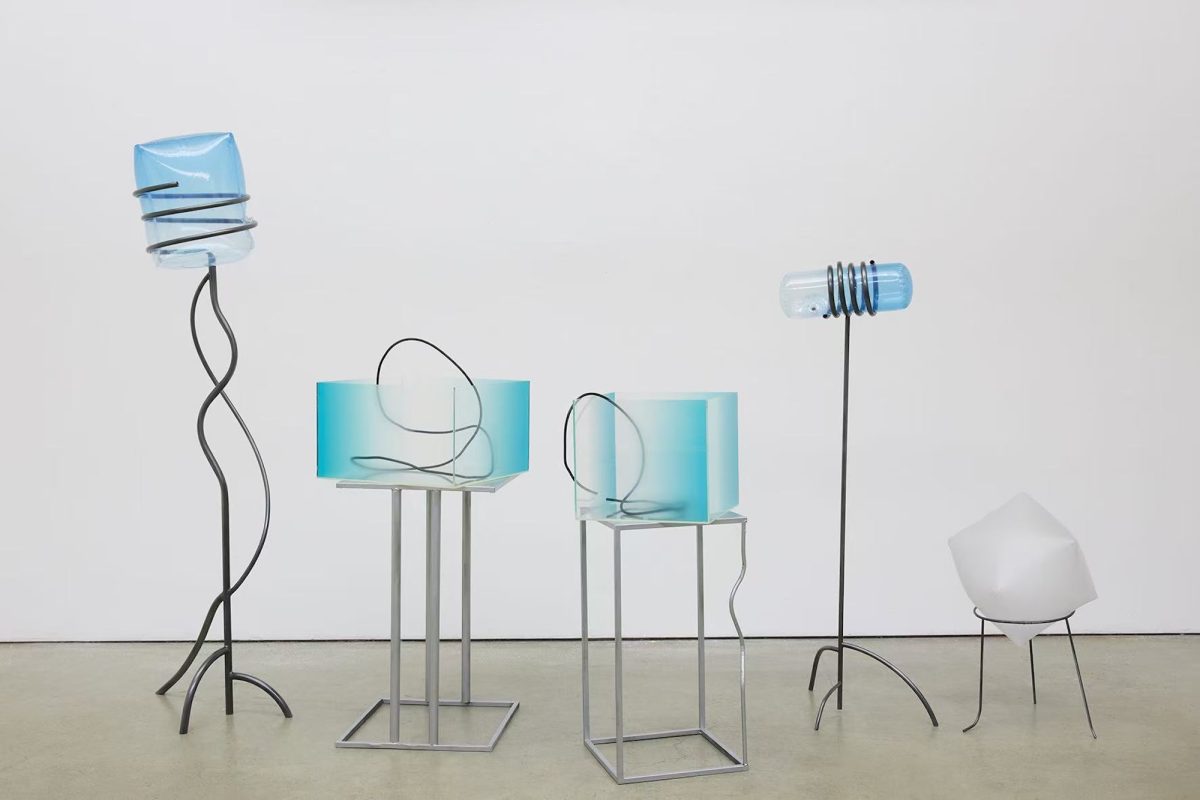
This group of works titled The Receiver are both a sculpture and a metaphor. Yuan chose this name to remind people that ‘receiving’ is not a passive state but an active stance. The works are independent of each other, yet they seem to be ‘listening’ to the outside world: slightly tilted, and gently stretched, as if waiting for some signal to pass through. They are minimalist but not cold; the language is contemporary – industrial plastic, gradient acrylic, steel support – but the tone is gentle. The fine metal lines, hollow rectangles, and translucent three-dimensional space jointly create a ‘controlled vitality’.
The Shape of Signals
The premise of the work seems simple, but it is actually quite complex. Yuan believes that we live in an era where ‘signals’ are everywhere – the boundary between nature and technology has long been broken. Rocks, birds, and flowers are releasing their own signals; buildings, vehicles, and humans in the city are also sending their own signals. Moreover, humans are not only sending signals but also receiving them, but often lose the ability to distinguish them. This concept of ‘signal’ is both physical and psychological. She does not directly depict data or screens; instead, she uses the breathing of space and the tension of materials to imply the ubiquity of information. In her works, the signal becomes a poetic existence – invisible yet omnipresent. The rhythm, lines, and gaps of the works together form a ‘perceptual frequency’.
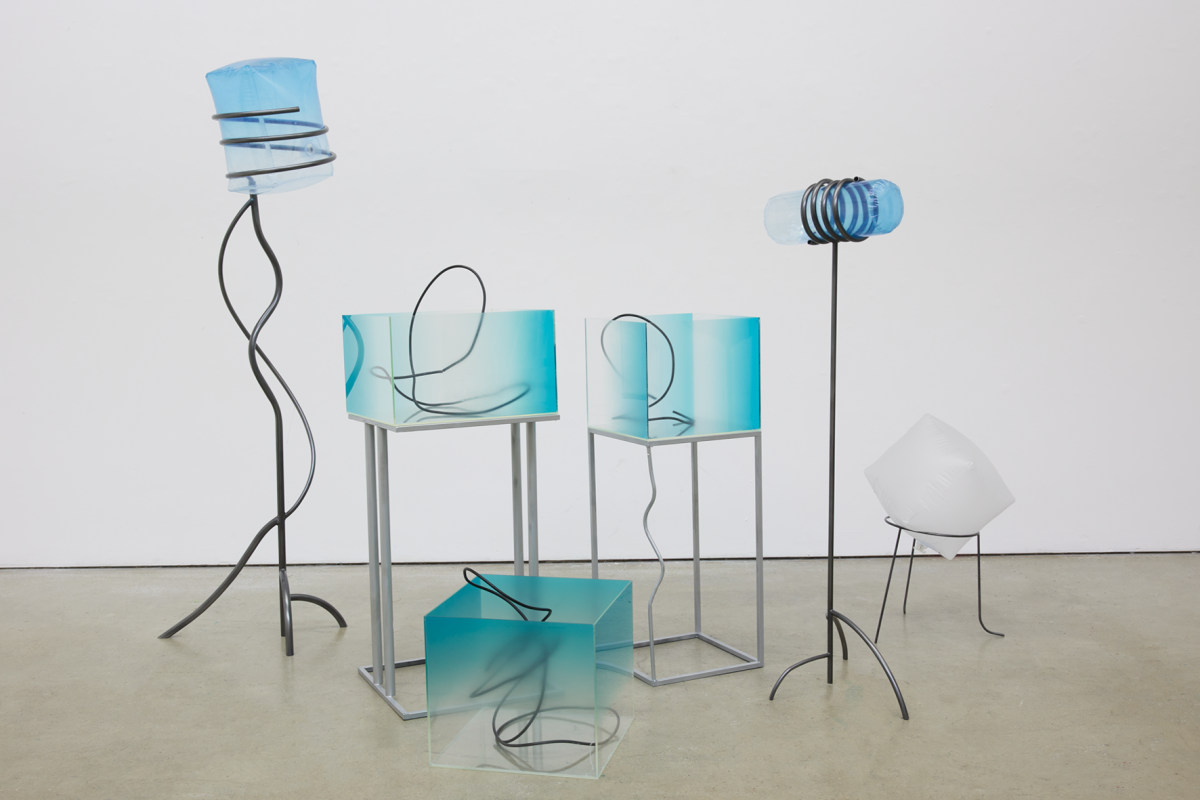
The Receiver was born under this circumstance – she attempted to translate the ‘receiving form of the signal’ into sculptural language. These works are composed of irregular rectangular acrylic plates and metal lines. They are hollow inside and transparent outside, with an almost impossible structural balance, yet this creates a strange harmony. They are orderly, but do not make one feel mechanical. It was precisely in this ‘state of approaching imbalance’ that Yuan found the tension between freedom and control.
The Language of Materials
Acrylic and steel are her signature materials. She prefers those smooth-surfaced and clean-lined industrial materials – they represent rationality, modernity and transparent order. The translucent acrylic sheet refracts a gradient of blue under the light, resembling the breath of a technological society – restrained, clear, yet always flowing.
In her installation, viewers can see the back and internal structure of the sculpture through the acrylic sheet and plastic. Transparency is not for showcasing the craftsmanship, but rather an ethical stance – meaning ‘let the structure be seen’, presenting the internal logic of the work honestly. People can see the ‘backside’, just as when we think about information systems, we must also see its support and limitations.
The transparency of the work creates a sense of unease, but this actually makes one more perceptive. Every line and every angle are suggesting: ‘Seeing’ does not equal ‘understanding’; “structure” may also conceal instability. Yuan’s sculptures maintain a slight tremor under a calm order – a kind of breathing that could potentially lose control at any moment.
This ‘breathing’ is precisely the life of the work. Light reflects and refracts between the acrylic board and the plastic, metal rods cast blurry shadows, and the movements of the audience all become part of the signals. As the viewing angle and the light change, its blue color also changes accordingly, just like the fluctuation of frequency. The sculpture receives the messages from the space and also emits resonances of perception outward.
Between Control and Freedom
In terms of form, The Receiver continues the spirit of Alexander Calder’s dynamic sculptures- The ‘pre-stretched’ state is reinterpreted in her works. Although the installation does not actually move, the audience can sense the latent energy within: each structure seems to be tending towards the ‘edge of movement’.
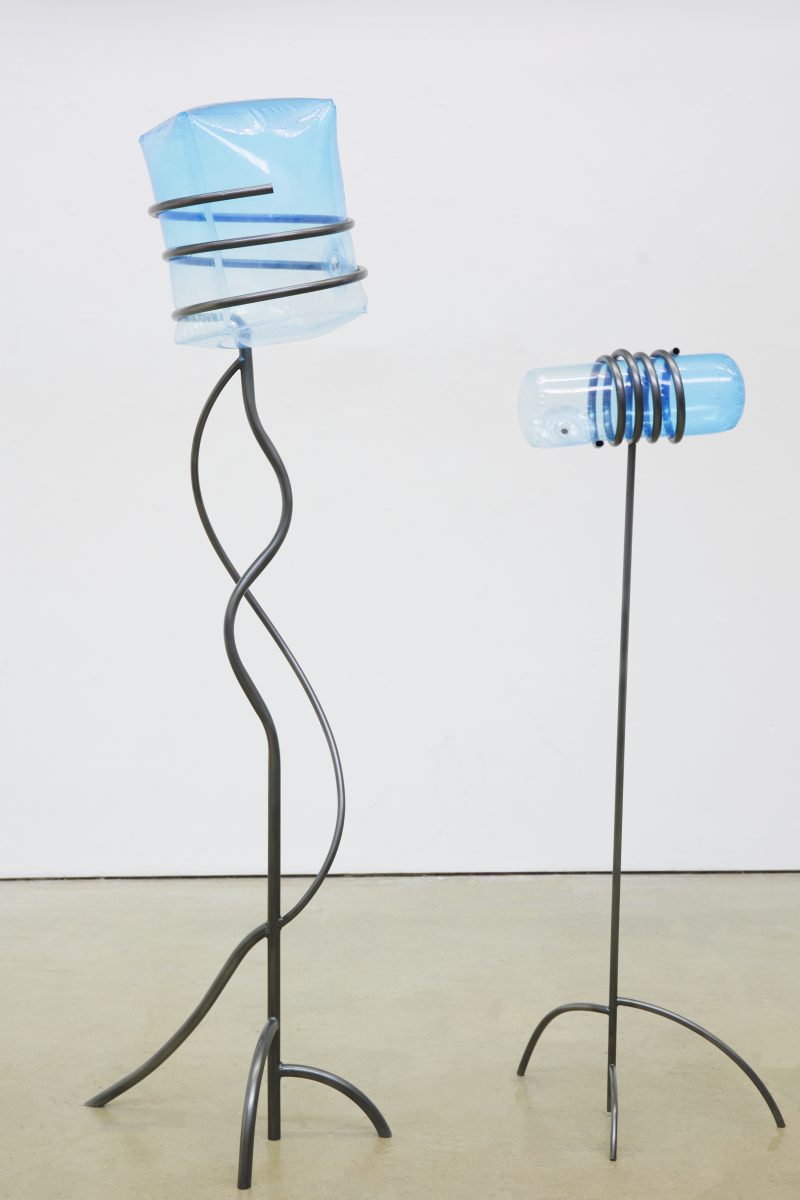
Some acrylic boxes are supported by extremely thin metal rods; others resemble plastic balloons suspended in the air, with their centers of gravity slightly off-balance. The balance was precisely calculated, yet seemed accidental. The tension that was almost about to break created a subtle physical resonance in the viewers as they gazed – their shoulders tightened, their breathing slowed, and their steps slightly shifted. As one of the audience members put it, “She made balance become the very meaning itself.”
This obsession with ‘balance’ is not merely a formal exploration, but also a metaphor for the social state. Life in the information age is like her installations: seemingly stable, yet constantly on the verge of collapse. Yuan’s sculptures give form to this uncertainty – they calmly display a fragility constrained by a high degree of rationality. She expressed sensitive themes – freedom and order; control and chaos – in a rational manner. Her sculptures are like projections of human consciousness: in the midst of external stimuli, maintaining balance becomes a form of existence practice.
The Contemporary Signal
Yuan’s creation stems from an observation: Our experiences are increasingly dependent on information signals, but at the same time, they are also constrained by them. People search for the world within the information network, but gradually get trapped in the “cocoon-like” environment shaped by algorithms. Information becomes a double-edged sword – it provides connections, but also creates isolation.
Inspired by minimalism and modern design language, Yuan decided to compare ‘people’ to receivers. Those translucent structures are like the bodies of people in this world filled with signals: open, sensitive, and always ready to be penetrated by the signals. She attempts to convey an attitude through her works: when filtering information, one needs to remain calm and rational.
Her sculptures are both physical and a psychological model – they symbolize how we ‘receive’ in a complex world. She does not ask the audience to reject the signals, but rather prompts them to rethink: What is worthy of being received? What needs to be filtered?
Space and Audience
At the exhibition site, the five sculptures were independent of each other, but the light and space connected them into a whole. As the audience moved through the area, their lines of sight were constantly interrupted and then reconnected by the translucent acrylic panels and plastics. Through one work, people could see another, and their fields of vision overlapped to create new compositions. The sculptures and the space seemed to be breathing together, with the reflections on the white walls and the lights on the ceiling becoming part of the works. And the audience’s actions themselves became an extension of the works. That rhythm of hesitating to approach and then slowly circling around was precisely the process of ‘receiving’. Yuan trained the audience to become ‘receivers’: they tuned in, searched, and confirmed the existence of the signals in the space.
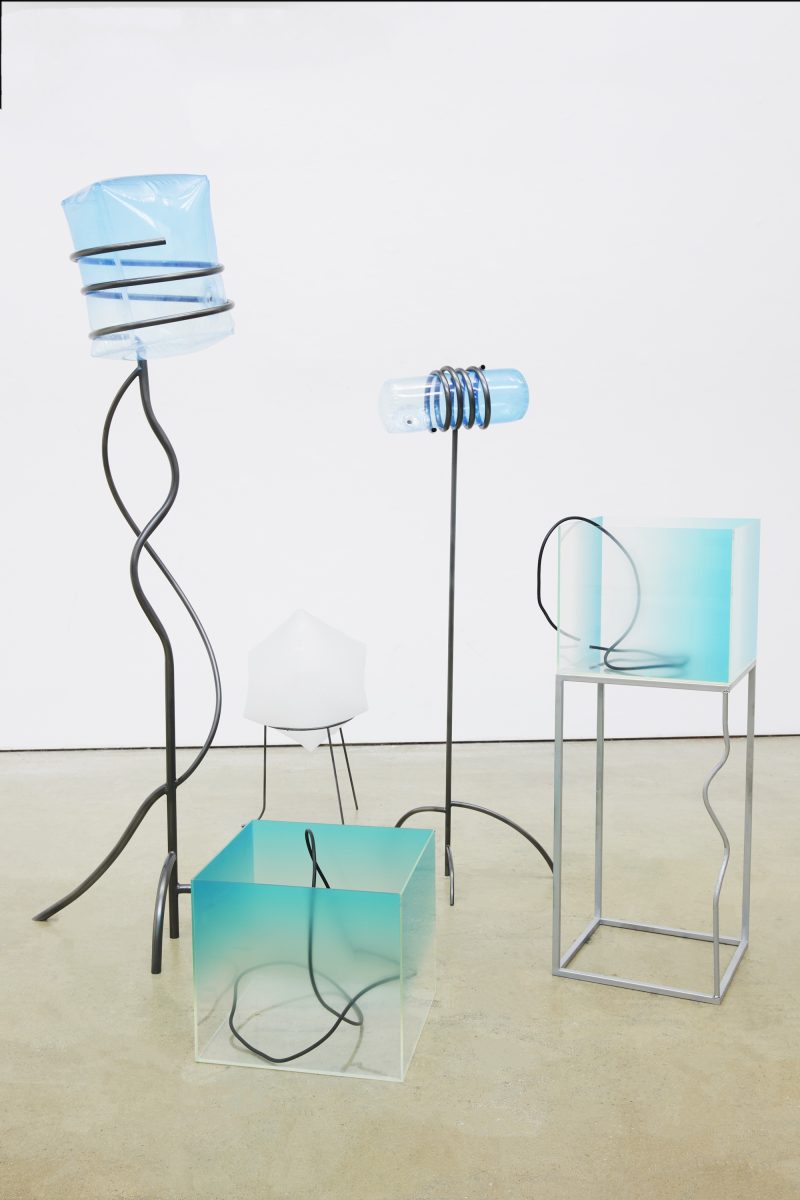
Some people carefully examined the internal structure, while others circled around to find the best reflection angle. Children would squat down and look at the sculpture from its horizontal line, while adults would raise their phones to try taking pictures. However, the camera could never fully capture the depth of the acrylic box. As one viewer said, “This series of works must be seen with your own eyes because it is like a signal that is constantly fluctuating.”
The Poise of Form
Yuan’s aesthetics are extremely restrained, almost as calm as industrial design but there is still warmth within. The gradient shades of blue make people feel calm and clear-headed. It seems that it is able to filter out complicated emotions and signals.
From different perspectives, the blue color changes with the movement of the viewer – sometimes deeper, sometimes lighter. This change is not only a visual change, but a symbol: state of reception is changing always. People never will be able to know the world from a fixed angle like these sculptures represent different states under different light conditions. At any moment, however, when the reflections of this or that work are so coincident that they overlap, suddenly the space is thick, and the blue shimmers in the air, as if the frequency of the world were briefly changed. It is an experience that cannot be caught – it is right here, and is only for “the person who is looking”
The Ethics of Minimalism
Yuan’s works remind us of the fact that minimalism is not a disinterest, but an ethics. It leaves thinking space in terms of ‘removal’. Her sculptures eschew any great amount of decoration or feelings and present issues using the most basic lines, structures, and transparency.
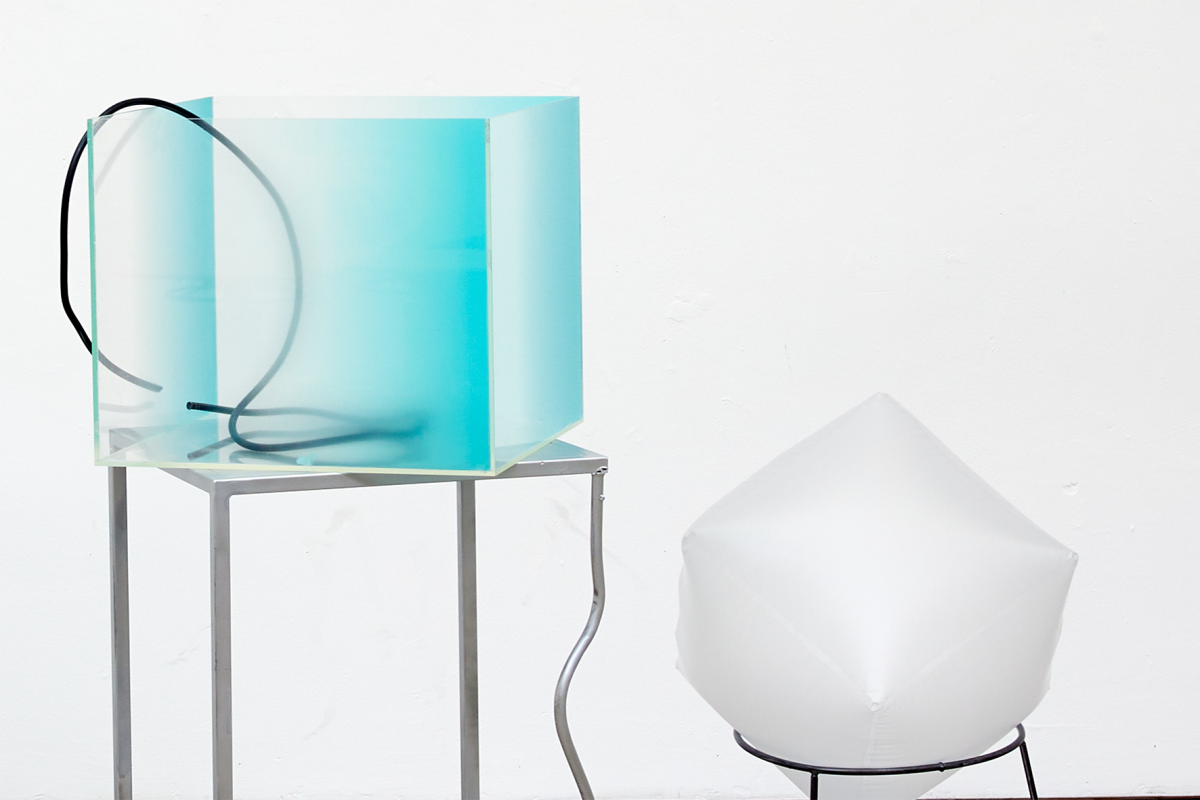
This objectivity of minimalism has a certain aesthetic of self-reflection: In a world overwhelmed by information, a restraint is itself a form of resistance. It makes one understand that being transparent about information does not mean being truthful, instead, too much exposure can lead to clouding the meaning. Her sculptures are like a carrier of self-reflection, in constant reception and constant filtering.
Critique
In contemporary art, insight is replaced by ‘criticism’ in many works. However, Yuan’s Receiver is unique because, even though it is not free from criticism, what is said is so, in a way, calmly. In letting the materials speak for themselves, she gives the means of speech to the materials: the delicacy of acrylic, the strength of steel, the play with the light – all of these become metaphors for “control and freedom”.
Some people say her sculptures are too perfect – dangerous even – in that they might completely lose sight of the play of emotions in the perfect control. But Yuan overcame this problem in the details, the slightly out of shape angles, and the slightly curved line, all make the viewers realize that there is no perfection, and just a relative balance.
Between Reason and Empathy
The Receiver is a heartfelt work, not visually yet spiritually, in the way it is a plea to stay alert amid complexity without suppressing the complexity of the signals around us, still willing to listen despite the noise. This is a sort of tender of the present day. It does not preach slogans or provide solutions, but asks the audience to enter into a slow process – to rethink our relationship to information and the world.
We can stand in front of those blue acrylic boxes and our bodies will slow down subconsciously. This is not the passive state of being ‘controlled’, but an active state of balance. Yuan wishes that through these sculptures, people can tune into their own frequency in the overwhelming amount of information. She uses the peaceful components to form the mild thoughts
Epilogue: Continuous Signals
The Receiver is not a proposed solution. It is not a celebration of technology nor is it a rejection of reality. It simply brings to the fore in a minimalist way the relationship between “signal” and “perception”, so that we may re-recognize it.
At the end of the exhibition hall the five sculptures stood reflecting the light. The surface of the acrylic was dotted with the ripple of the viewers, like passing radio waves. At that moment, the works, the space and the people became the channels of the signals.
Yuan’s sculptures do not instruct us on how to shut our ears to noise, but rather open our minds to reason and focus on what is unneeded.