Opening Marilyn Monroe: A Portrait, the National Portrait Gallery’s exhibition marking 100 years since the Hollywood icon’s birth, is Warhol screenprint Monroe Nine Multicoloured Marilyns (Reversal Series) (1979-86). Warhol created some of the most unforgettable images of Marilyn, first depicting her after her death in 1962 with a screenprint based on a promotional headshot for 1953 film noir Niagara.
A label on the wall quotes Warhol:
“When Marilyn Monroe happened to die that month, I got the idea to make screens of her beautiful face – the first ‘Marilyns’.”
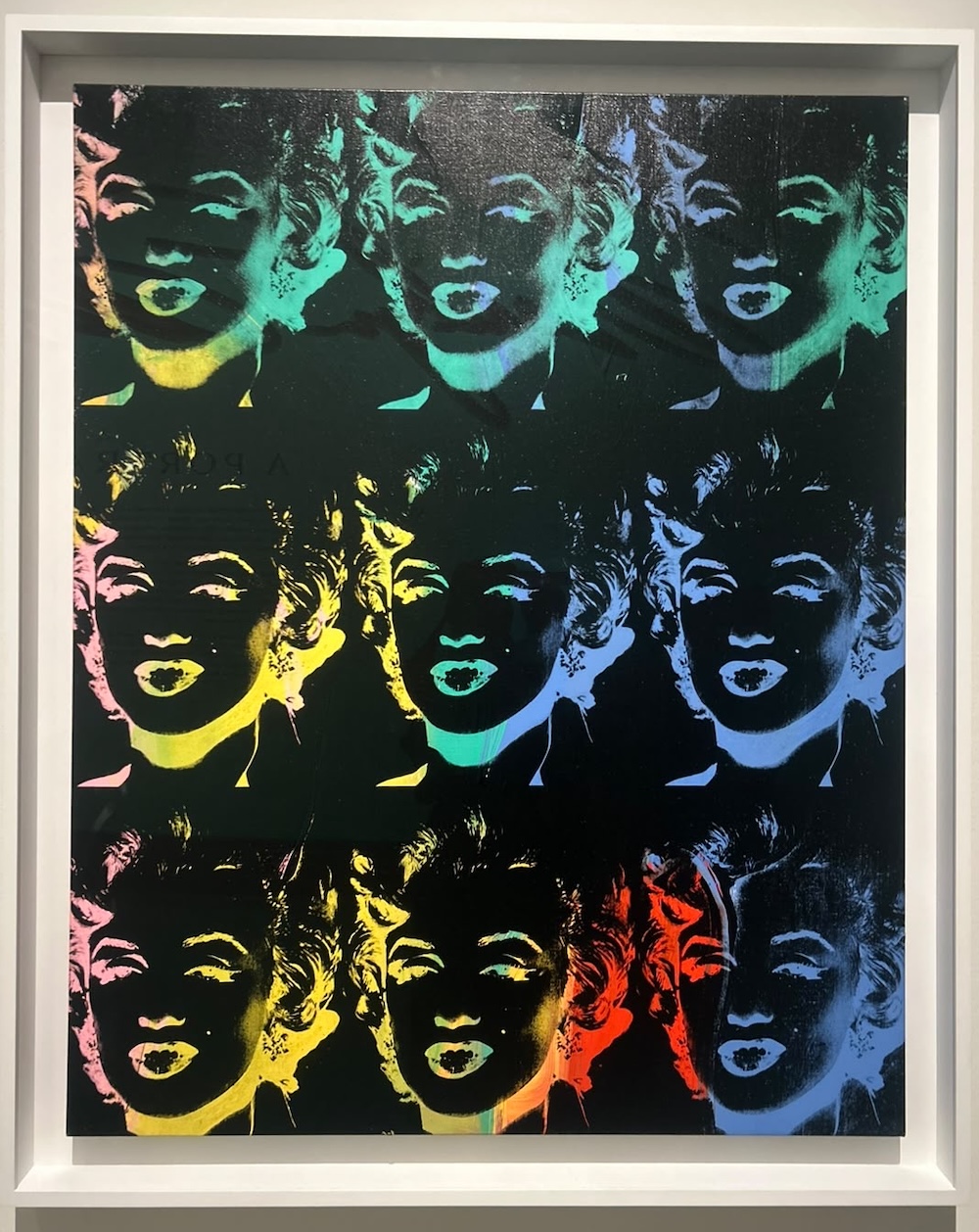
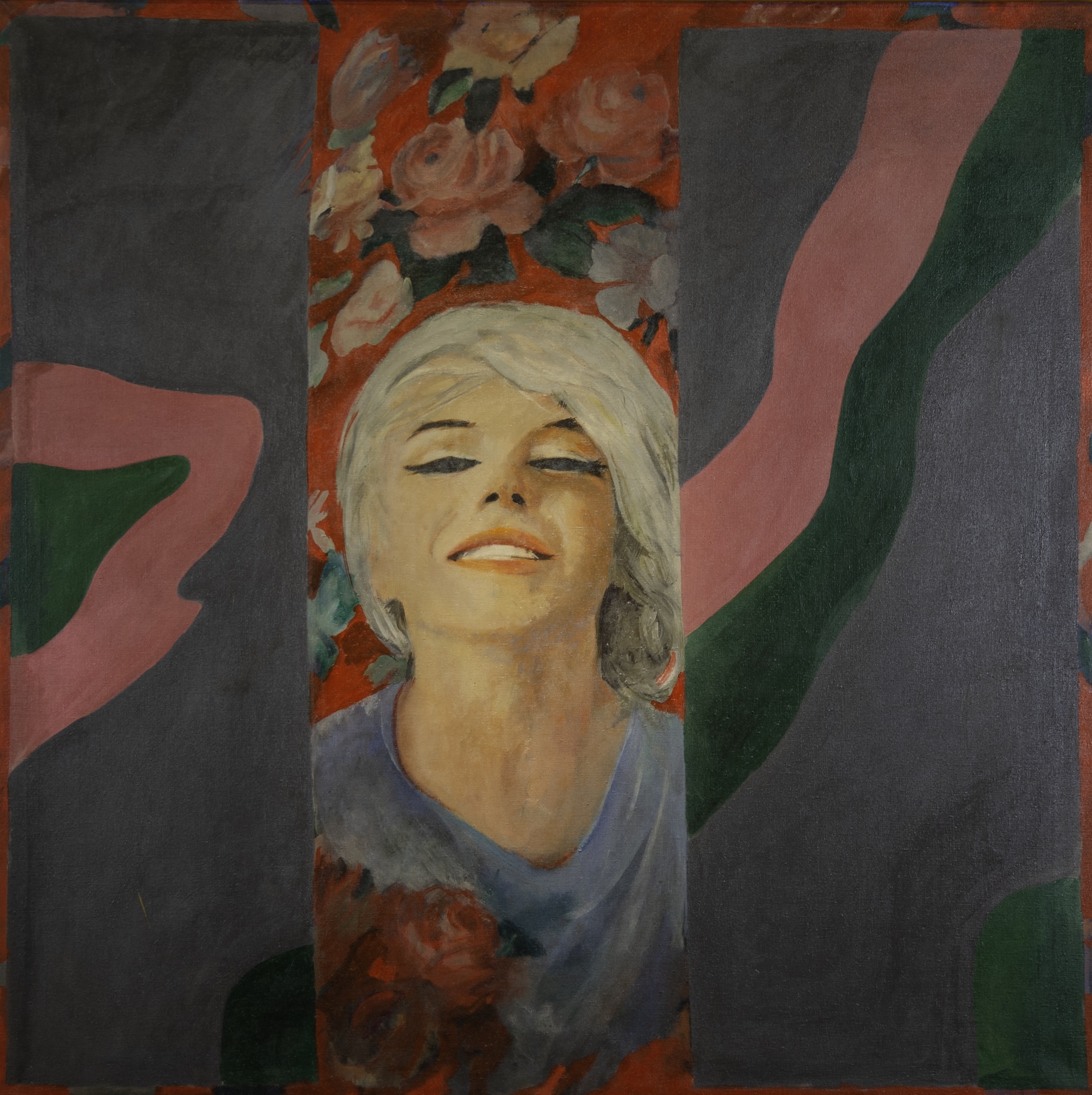
Although Warhol’s screenprint portrait of the Monroe immortalised on celluloid – perfect red pout, wide long-lashed eyes and signature bombshell blonde curls – is one of the most recognisable images of the actress, British Pop Artist Pauline Boty’s large painting of her is more poignant.
In Colour her Gone – the name taken from Fred Ebb’s 1962 lyric ‘And this is the girl that once I depended upon. You can colour her gone’ – Boty captures the innocence and impending tragedy of Monroe, which in some way mirrors the tragic and premature end of Boty herself, who died of cancer in 1966 at the young age of 28 before her talent as a Pop Artist was truly appreciated, passing away five months after giving birth to her daughter, after refusing cancer treatment for fear of harming her unborn child.
Monroe died at home in Los Angeles in 1962 at the age of 36 from an overdose, leaving behind her an indelible legacy of unforgettable movie appearances and countless conspiracy theories about her premature and tragic death. Everyone visiting the exhibition can’t fail to be mesmerised by the unforgettable images of Marilyn’s perfectly symmetrical, classically beautiful face, while at the same time unable to escape the tragedy of her life with undertones of loss of innocence and exploitation by the men in her life and the Hollywood star system.
Next to Boty’s vast portrait is a small framed 1962 TOWN magazine cover featuring Monroe, which inspired the portrait. Boty took the portrait as her starting point and surrounded Monroe’s unmistakable face with a frame of flowers, symbolising the transience of beauty and turning her into a Pre-Raphaelite tragi-heroine, almost like a premonition of Marilyn as Ophelia meeting a premature demise.
Projected in an adjacent room is a joyful series of frieze frames from a photo shoot with photographer Philippe Halsman, which made the cover of Life magazine. Halsman said of Marilyn, “She knew how to woo this lens better than any actress I ever photographed,” a sentiment which is echoed by the energy of his photos. Halsman worked with Marilyn on several occasions, documenting her rise to superstardom. The ‘jump’ series photographed in 1959 was their last and happiest collaboration.
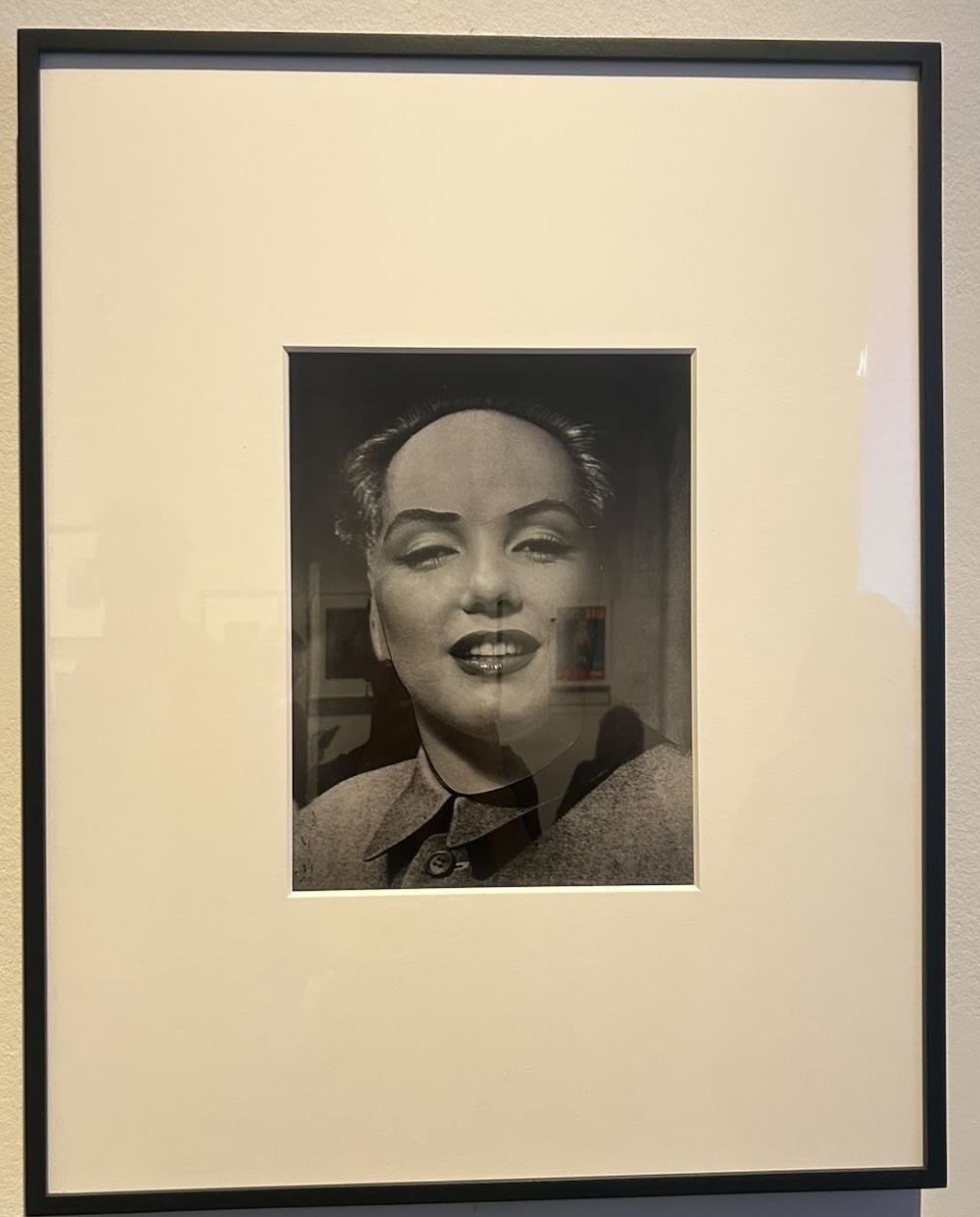
On the walls are displayed various interpretations of Marilyn by Halsman, some veering towards Surrealism, such as Marilyn Monroe as Chairman Mao Zedong, created with Salvador Dali. Dali and Halsman were friends, and in this photocollage they merged Monroe’s face from Halsman’s Life magazine cover portrait with an image of Mao Zedong, founder of the People’s Republic of China. Even by merging Monroe’s face with Mao’s unattractive visage, it’s impossible to hide her beauty.
What follows is a corridor filled with images of Marilyn lensed by legendary photographers of the era, Eve Arnold, Cecil Beaton and Milton H. Greene. We see varying interpretations of Monroe, but whoever points their camera at her can’t fail to take a captivating image. For her star quality shines through in every frame. This magnetic attraction to the camera comes alive in the next room, where clips from some of her most iconic movies are projected onto a wall, from Some Like It Hot to Gentlemen Prefer Blondes. Displayed in a case is Marilyn’s seductive silver dress from Gentlemen Prefer Blondes, which legend has it she had to be sewn into.
The photographer who seems to have captured the pure innocence of young Marilyn is French André de Dienes, who explains that he asked her to imagine different scenarios when he photographed the ingenue on a beach near Malibu in California. He captures her pure, naïve nature in a series of images showing her make-up free, natural hair, running around the beach. The most poignant image shows her with a blanket over her head, obscuring her face, which was Marilyn’s response when he asked her to imagine what it was like to be dead.
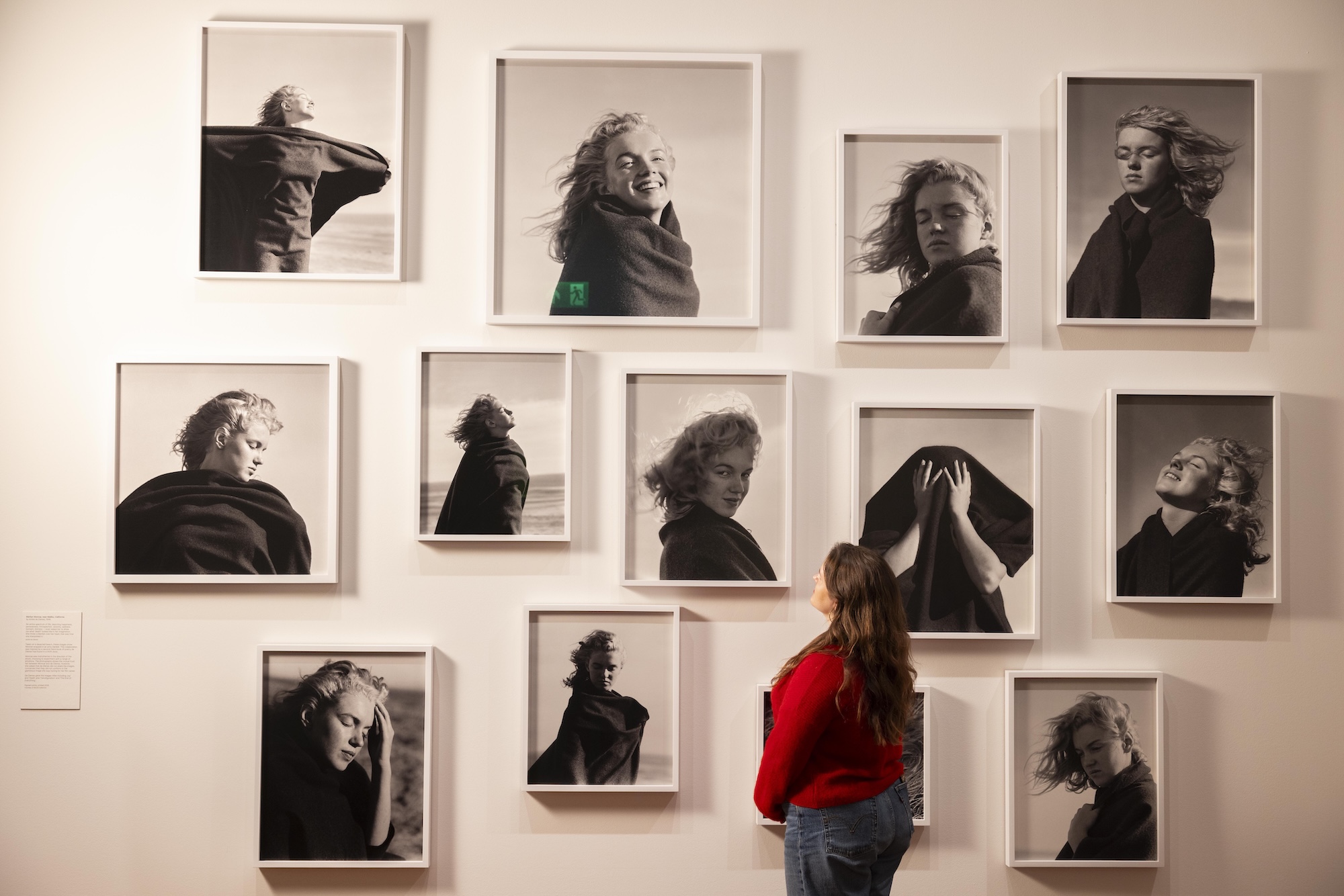
“An entire spectrum of life, depicting happiness, pensiveness, introspection, serenity, sadness, torment, distress – I even asked her to show me what ‘death’ looked like in her imagination. She threw a blanket over her head; that was how she interpreted it.”
André de Dienes
On a wall opposite are framed photos of Marilyn as a nude pinup girl, and their juxtaposition to de Dienes’s images evokes a feeling that this was the beginning of a journey where she was exploited by men for her looks and her naivety taken advantage of. The gallery leads into a smaller room with more pinup images, and a small screen showing a screen test of Marilyn flirting with the camera.
Previously unseen photographs from Life magazine, intimate portraits taken by Allan Grant at Monroe’s Brentwood residence only a day before her death in August 1962, are exhibited in the final room. Grant’s photographic session accompanied Marilyn’s final interview with Life magazine.
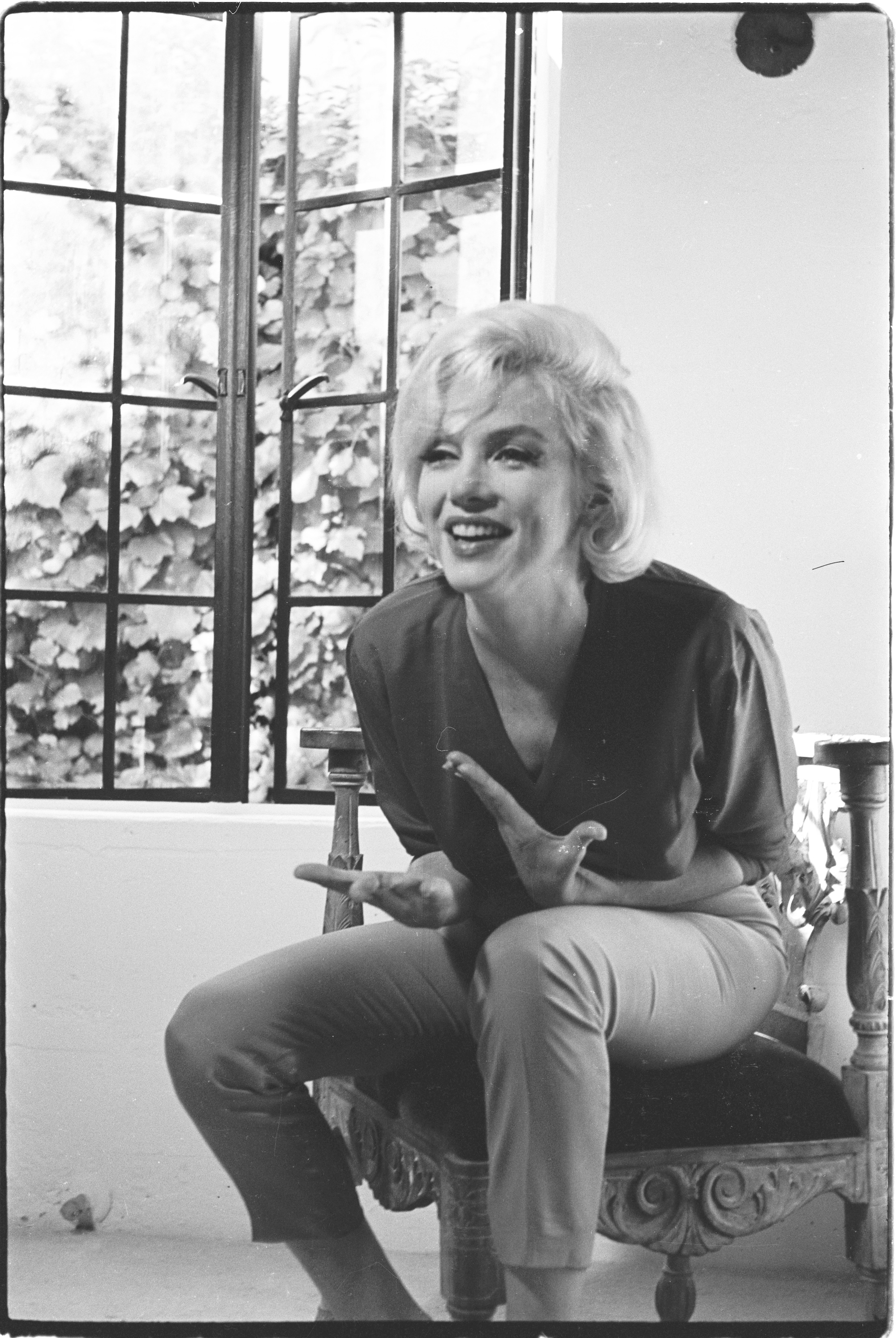
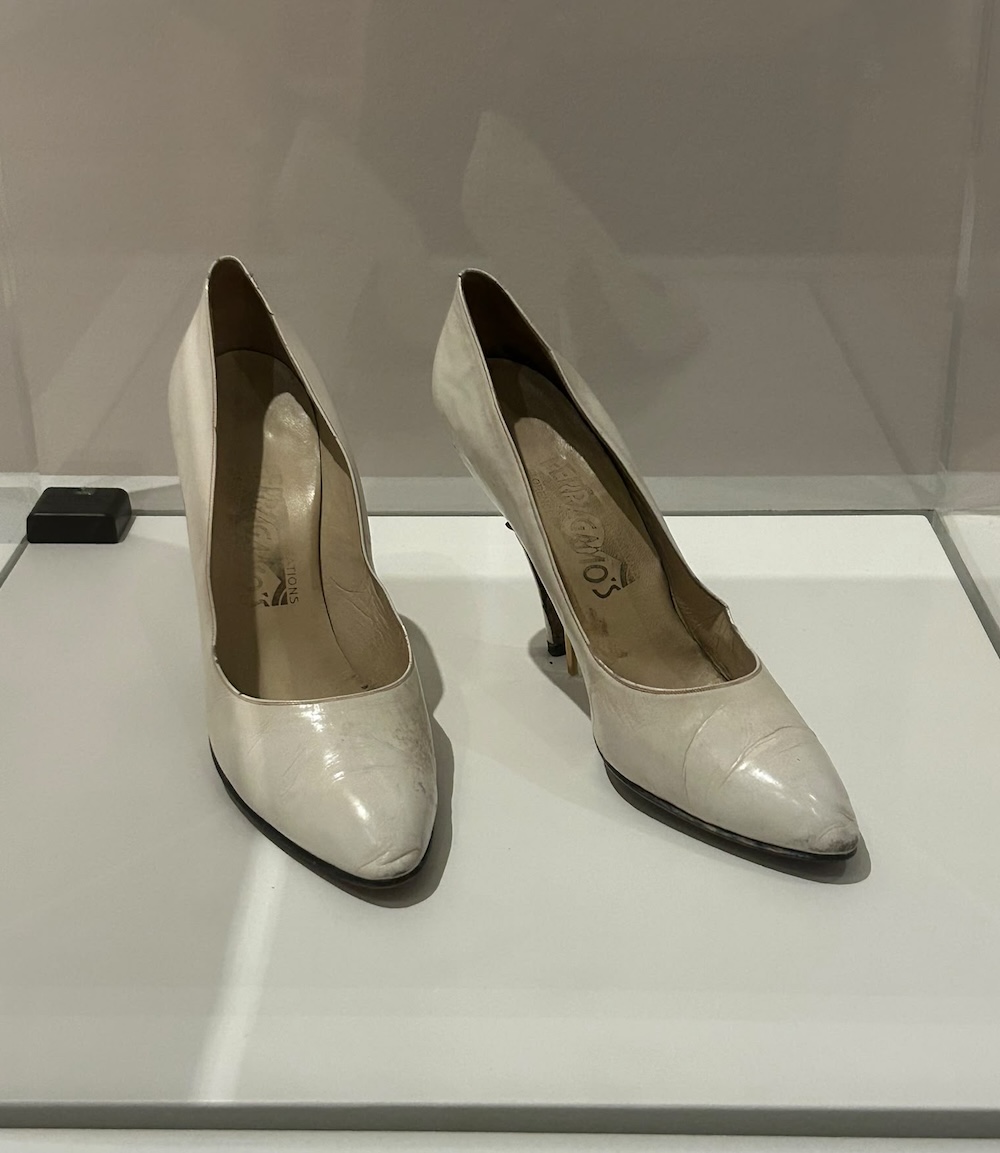
Poignant photographs of Monroe, including her last sitting with Bert Stern and more Warhol screenprints, as well as paintings by Richard Hamilton and Peter Blake, another Pauline Boty painting The Only Blonde in the World (1963) and a deeply unflattering abstract depiction of Monroe by Willem de Kooning are also displayed in the final rooms of the exhibition. Perhaps the most poignant object on display in the final room is a tiny pair of white heeled Ferragamo shoes, the ones she wore on the set of The Seven-Year Itch. Displayed in a small Perspex case on a plinth, like Monroe’s version of Dorothy’s sparkly red slippers.
Unsurprisingly, since it features images by some of the most celebrated 20th and 21st century photographers and artists of the most feted movie star of all time, The National Portrait Gallery exhibition is a sellout blockbuster show. Yet the thoughtful curation of the NPG exhibition ( by Rosie Broadley and Georgia Atienza) delves a bit deeper behind the glossy celluloid surface image, by featuring portraits of Marilyn that capture her inner beauty, intelligence and the ingenue within. Like Princess Diana, who was photographed and pursued to the point of a physical car chase which ended her life far too early, Marilyn’s surface perfection is captured by a million lenses for infinity. Yet both these immortalised Goddess figures forever carry with them an undercurrent of tragedy worthy of a Greek myth.
Marilyn Monroe: A Portrait, in association with the Marilyn Monroe Estate, is at the National Portrait Gallery in London until 6th September, 2026.