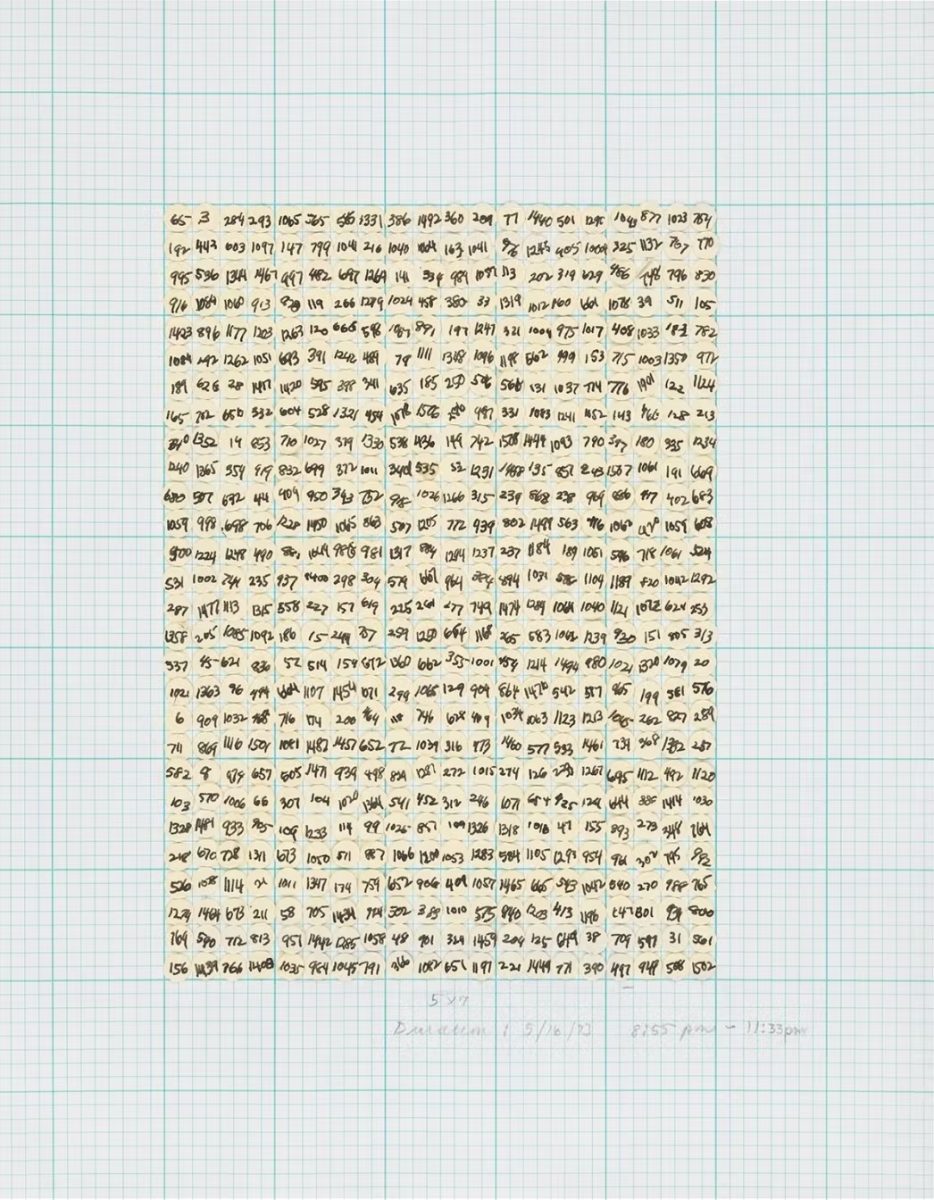
This is from White Cube Bermondsey’s comprehensive account of pioneering black American artist Howardena Pindell’s practice: it includes all three of her exceptionally hard-hitting films dealing with racism, as well as many recent and some older paintings. Here she plays with both the grid and the role of numerals in 1970’s conceptual art, which tended to employ them for measurement (e.g. Mel Bochner) or ordering (e.g. Roman Opa?ka). Pindel randomly sequences 560 numbers, for each of which she had to take a ready-cut chad in a pair of tweezers with one hand while writing on it with a technical drawing pen with the other, then laying it onto the graph paper’s grid. Her annotation states that it took 2 hours 38 minutes – fairly fast work, I’d say, at some 20 seconds per number. The systematic and impersonal style typical of minimalism is undermined both by the apparently arbitrary choice of numbers, which don’t go 1-560 but include many higher values, rendering them an incomplete part of a larger set; and by an open embrace of errors and visible corrections (and coffee spills on some comparable works).
Another way in which ‘Duration 5/16/73’ counters the prevailing tropes of minimalism is that it can be read autobiographically, both by its reference to African patterning and through its blending of studio and office work. That points to the type of administrative tasks typically undertaken at low pay rates by women – and by Pindell herself at MoMA at the time – cheekily equating their status with that of art. Moreover, while the chads are a quotidian product of the hole punches used in offices, Pindell linked her recurring use of circles to a traumatic childhood memory of segregated drinkware marked with red circles in the Jim Crow South.
Paul Carey-Kent will select a ‘Work of the Month’ and a ‘Show of the Month’, as well as writing about his ‘Gallery of the Week’ in between…