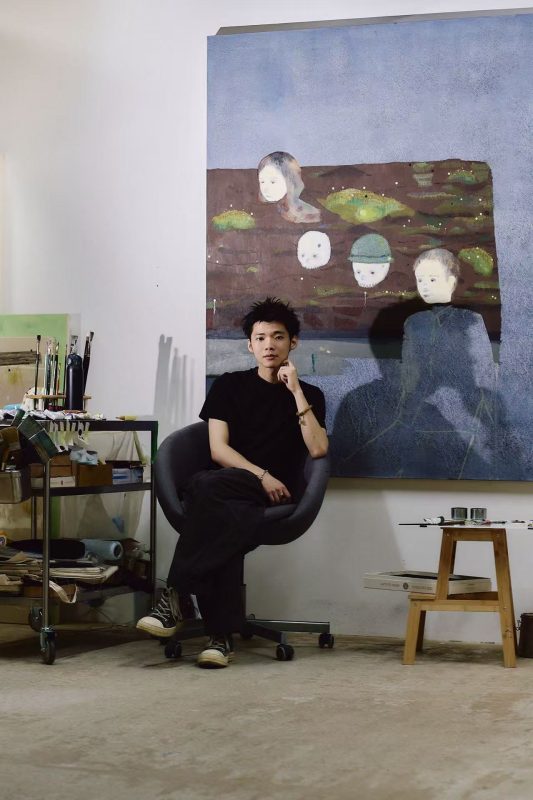
A few days ago, I had a long conversation with the artist Tong Kunniao. His works are playful, unruly, and free, often refusing to follow any conventional path. Yet, the feeling I get from him always brings Neptune to mind. In astrology, Neptune governs art, the subconscious, illusion, intuition, and a certain addictive, intoxicating quality. Seen through this lens, Neptune’s relationship to “addiction” aligns perfectly with the artistic process: what becomes truly addictive is never pure pleasure, but the entanglement of joy and pain. It emerges from an unspeakable emotional realm—arriving first, with consciousness always running behind it.
Neptune also rules the twelfth house, an archetypal space associated with the unknown, the unformed, and the intuitive. In this sense, a sound artist often carries a Neptunian aura: sensitive, fluid, ambiguous, and guided by an inner force that resists articulation.
Despite the humour and light absurdity that often surface in Tong Kunniao’s work, what truly sustains his practice is an exceptionally sensitive and finely tuned perceptual capacity. His ability to catch nuances—of materials, spaces, imagery, and even the faintest emotional vibrations—feels almost instinctual, as if he were receiving signals from both daily life and the subconscious. This sensitivity extends beyond his observations of the present; it reaches toward an intuitive understanding of the future and of the shifting condition of humanity—those aspects that language has yet to grasp but already appear in his work as form, structure, or energy.
In his practice, human bodies, mechanical devices, discarded objects, and motifs from nature often coexist, like subtle conversations between different species, eras, or civilisations. His works seem to summon a kind of future experience: a hybrid state in which the human and the non-human, the material and the immaterial, consciousness and technology intersect. Tong Kunniao does not attempt to predict the future directly; instead, through a heightened sensorial attunement, he captures the earliest tremors of potential futures and gives them their first shapes within his artworks.

Tong Kunniao: There don’t seem to be many artists who enjoy writing, right?
YH: Very few. I didn’t like writing before either. I only started to enjoy it after writing more and realising it could be fun.
Tong Kunniao: I feel like when artists write, it’s like milking a cow—squeezing a few words out.
YH: Did you write randomly when you were in school?
Tong Kunniao: Yes. Sometimes I would piece together words from dreams or daily life. Back then, I even wanted to invent my own poetic forms—like a “tornado poem,” where you start with a long sentence and each line shortens by one character until it becomes a cone shape. And sometimes I’d write notes around sketches.
Did those writing habits continue into your current work?
Not precisely, but the method is similar to how I make my works: collecting materials, selecting, filling, and deleting until it becomes something relatively complete. There’s never a “final” form, but eventually there’s a stage where it feels ready for exhibition. That method is remarkably similar to how I make installations.

Do your works come from conscious decision-making, or do they emerge from the subconscious?
Tong Kunniao: I think the initial impulse—the desire to create—often comes from the unconscious. You can’t force it; it appears in a single moment of deviation, when suddenly you feel a particular direction a work could take.
When I first started making art, things were even more unconscious. If something seemed interesting, I would keep digging into it.
But in recent years, my work has branched into more defined series—installations, paintings, sculptures, performance works. When organising these directions, I start thinking about connections between them, bringing in a bit more rationality.
Overall, though, creation still comes from those inexplicable ideas that appear in life. Sometimes you think through an experiment, but the final result may not be what you want—and then you overthrow it.

Do you think your works relate to your daily life or your state of mind?
Yes, they relate. But I don’t really try to figure out precisely what I’m making. I move through the process quite muddled, maybe even avoiding too much clarity. Creation cannot be entirely clear—it’s like a river.
You flow past sharp stones and pause to think, but once you pass them, you continue moving. My work moves in this flowing way.
Sometimes I focus more on imagery, mineral pigments, or silk. Other times I think about sculptural balance, or revisit installation ideas. I jump between different modes.
I don’t feel like I’m working in a straight line. But when I look back—or when friends mention it—there does seem to be a consistent thread. I think that “thread” is more like an intuitive impression others have of me.

I feel your work is very sensorial—full of your own energy. What’s your zodiac sign?
Sagittarius. My graduation piece was called Sagittarius. I originally wanted to make all twelve zodiac signs, but after making my own sign, I felt it was enough. Sagittarius feels inclusive—it can contain other signs, just as I interact with people of all signs in my life. Later, I also made a work titled The Lover of Sagittarius.
I find your works serious and not-serious at the same time—very intriguing.
Tong Kunniao: I make them very seriously, but people often think I’m just messing around—like I’m creating things casually. But actually, I think a lot.
People who understand art should be able to see the depth and rigour behind your practice.
Tong Kunniao: Different people interpret my works from different angles—philosophers look at the body, sociologists look at materiality and consumption. Sometimes the media emphasises the environmental aspect because I was part of an environmental club in school. I find it amusing.

Do you hope viewers interpret your work from any particular perspective?
Tong Kunniao: Not really. As long as they feel “this is interesting” or smile a little, that’s enough.
My works are often created in a muddled state, but they give me a kind of joy—a joy that usually comes after a period of difficulty.

What kind of difficulty?
When making something, you may constantly overthrow ideas, doubt yourself, modify, and redo. The final form is never what you initially imagined or planned.
But eventually something appears—and when it feels right, you sense it can still move forward, still be explored further.
Works push one another forward. It’s not like you think of a piece, make it, and that’s it. It’s more like crossing the river by feeling the stones. You jump from one stone to the next; sometimes you fall into the water, climb back up, and continue.
Do you experience more joy or pain while creating?
Ten per cent joy, thirty per cent pain, and sixty per cent is something I can’t categorise. Pain is normal; I don’t think it isn’t good. When it comes, I accept it—not passively, but as something to face.
How did the title Roundworm Delights in the Landscape come about?
It just popped out unexpectedly. But there’s some logic—like the saying “I’m the worm in your belly,” meaning “I understand you deeply.”
I paint green mountains, so if I imagine myself as a worm inside them, maybe I understand them more.
Other titles like In the belly of pigeon, there is not only poop but also bread (2017, Paris) or Why Don’t You Eat Stinky Tofu? (2016, LA) also seem illogical at first, but they carry their own reasoning.
Stinky tofu, for example, is a “smelly” food but delicious—much like discarded materials that become beautiful when transformed into artworks.
As our conversation continued, I learned that Tong only started studying art in high school because his middle school girlfriend—an art student—took him along to an entrance exam. He passed; she didn’t.
As a child, he loved dismantling four-wheel-drive toy cars and motors, which naturally led him toward installation art in university. He laughed, saying he barely knew what the 798 Art District was back then—he simply made whatever he liked.
His working habits: an introvert, homebody, loves cleaning, INTJ. When abroad for more than a week, he wants to go home. Cleaning puts him into a creative state. He paints in winter and makes installations when the weather is good.
A piece may change form unexpectedly—like the painting with the moving eye in his exhibition. The painted eye was never right—too fierce, too odd—so he eventually cut it out with an electric saw and replaced it with a movable one.
Tong Kunniao: Sometimes what seems intentional is simply the result of having no better option. Life works the same way.
When something good comes, digest it. When something bad comes, don’t be afraid. Focus on creating—put your energy into the work.

After the conversation ended, I kept thinking: why do we need art in our lives? I believe the artistic process is a form of dialogue with oneself. In those moments of full concentration, we return to our true energetic state.
For artists, the fleeting unconscious impulses, the persistent connection with daily life, and the long-term commitment to creation are forms of returning to the inner self. Works, life, subconsciousness, destruction and reconstruction weave together into an open, forward-moving force.
It resembles the Daoist principle of wu wei: not passivity, but flowing with the river of life, acting in alignment with energy. We are merely a small part of the vast cosmic current; in our most focused moments, we breathe with the universe.
About the Artist
Tong Kunniao (b. 1990, Changsha, China) lives and works in Beijing. He graduated from the Central Academy of Fine Arts (CAFA), Sculpture Department, Studio No. 3, in 2015, and briefly pursued graduate studies.
His practice spans installation, performance, video, sculpture, and painting, moving fluidly across media. Humour and absurdity often coexist in his work, challenging structures of society, consumer culture, and identity through seemingly playful yet sharply perceptive configurations.
Tong frequently employs surplus industrial products, recyclable materials, and found objects—dismantling and reassembling them into forms that introduce notions of mechanism, balance, and freedom. His works generate both visual and conceptual tension.
He has exhibited in China, Germany, the United States, France, and beyond, with solo and group exhibitions in Berlin, Düsseldorf, Paris, and institutions across China. He is regarded as one of the notable emerging artists in contemporary Chinese art today.
MORE: @tongkunniao