By visiting an art fair you can effectively tour the whole world from a single place. I’m going one better this year, as – due to ill-timed chemotherapy – I haven’t been able to visit the fair at all. This, then, is my even more convenient world tour, undertaken virtually from the cancer unit in Southampton General Hospital… Having said which, there’s no substitute for a direct encounter – and I hope to get to Frieze at the weekend to find out how my ten choices strike me for real.
EGYPT
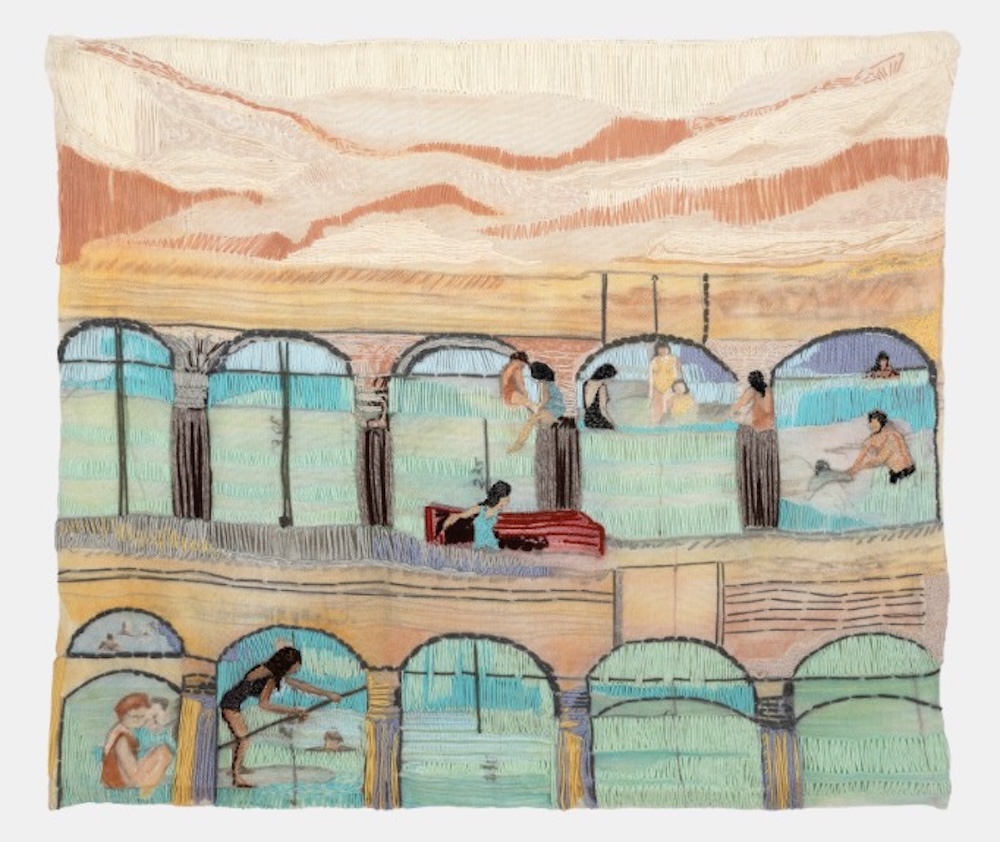
Marianne Fahmy: Alexandrian Desert Dreams – monk’s cloth tapestry painted in soft pastels with hand-embroidered thread and yarn, at Gypsum
The multi-media artist Marianne Fahmy’s film ‘Laws of Ruins’ will feature in the Frieze X ICA Artists’ Film Programme. Her work borrows from the Deleuzian notion of fabulation, employing fiction and imagination to invent a future people or nation – and, back in the fair’s Focus section, she’s showing tapestries that imagine a possible future for her home city. Rising sea levels are expected to flood Alexandria, and that explains the arid setting of this scene: displaced residents, as climate refugees, have relocated inland to satellite cities in the desert. The image draws from various archival sources: 1960’s postcards of local beach scnes; motifs and colour palettes from ancient Greek frescos; and architectural plans of Alexandria’s cisterns. But the nostalgia that might suggest is sharply undermined by the parafictional context: these are people making the most of a tragic situation.
AUSTRALIA
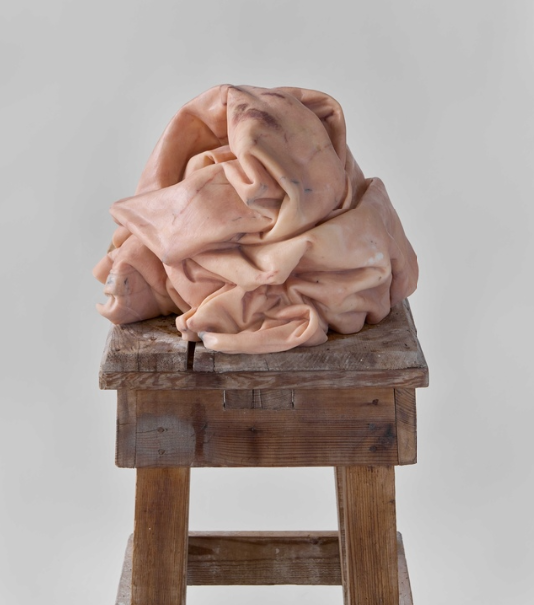
Alex Seton: ‘The Thickness of Flesh’, 2025 – Rosa Portugal Marble, 36 × 52 × 54 cm at Sullivan+Strumpf
Alex Seton grew up in the Australian bush close to an old marble quarry that his parents encouraged him to tackle with a chisel. Now, he’s known for carving marble into to unexpected forms, infusing the historic heft of classical statuary with contemporary concerns such as conflict, migration and homelessness: hoodies, life jackets, poolside toys and national flags have featured – during 2011-14 he carved a folded flag in response to each of 47 announcements of an Australian combat death in Afghanistan. This blanket is one of three in his recent ‘Tenderness Series’, produced in Pietrasanta, Italy with Portuguese pink marble. They are, says the gallery, ‘everyday objects routinely shed. Each form considers this act of shedding; how we shed and slough our clothes and skin, but also our morals, ethics and humanity. Beautiful in their fleshy materiality, the series questions whether we shed too easily.’
UNITED STATES
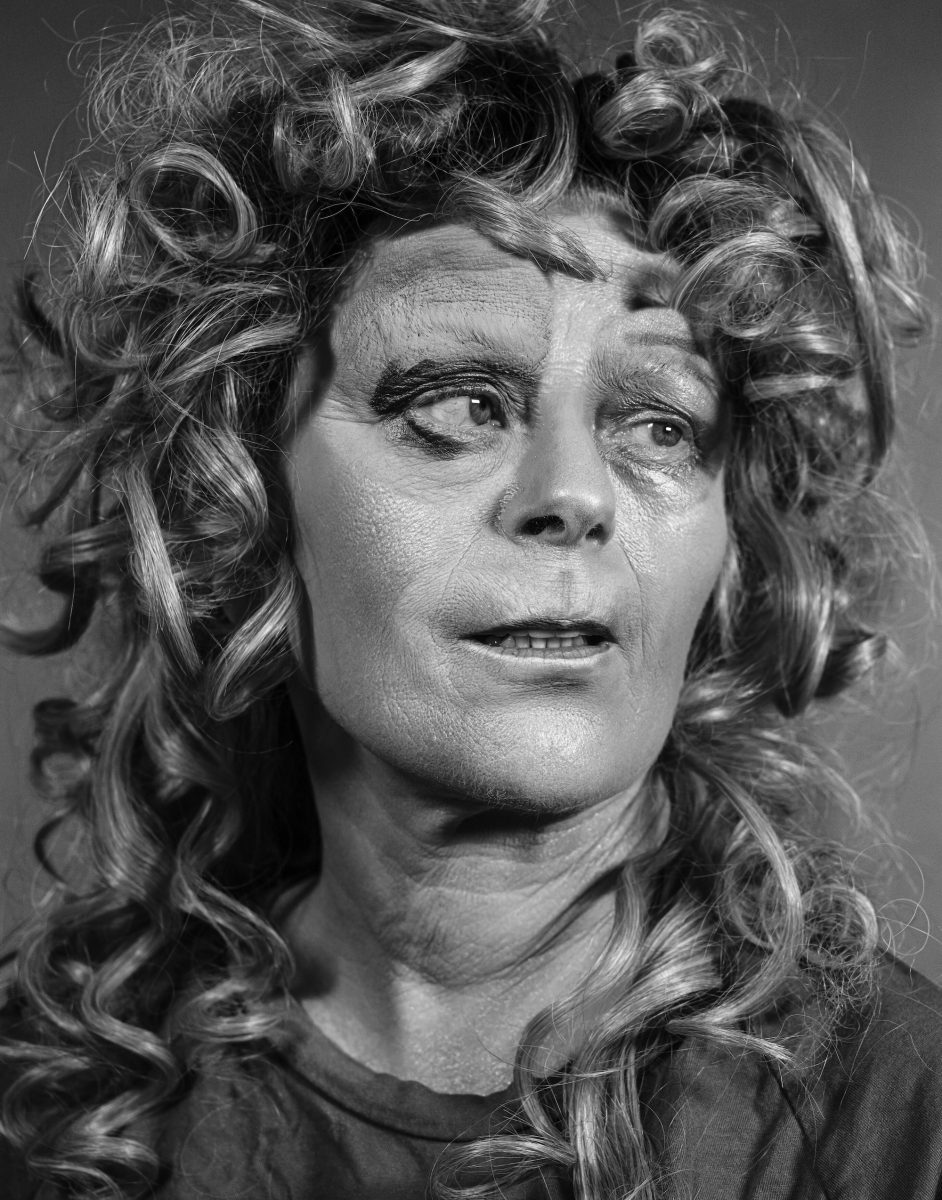
Cindy Sherman: Untitled #650, 2023 – Gelatin silver print and chromogenic colour print, 102 × 80 cm, at Hauser & Wirth
It’s over 50 years since Cindy Sherman started the ‘Film Stills’ which established her way of deconstructing personhood through her own image. Since the early 2000s, she has used digital technology to extend the range of manipulation possible; and, from 2017, incorporated face-tuning apps and AI on her Instagram account to related effect, highlighting how social media undermines reality, and the fractured sense of self in modern society. This is from her most recent series of artworks: 30 composite photographs from 2010-23 that combine different parts of Sherman’s own face, digitally manipulating both black and white and colour prints – this is the most monochrome example. They suggest plastic surgery and AI without involving either; skewer the disparity between who we are and how we present ourselves; and address aging by visibly combining wrinkles and creases alongside attempts to conceal them.
SOUTH AFRICA
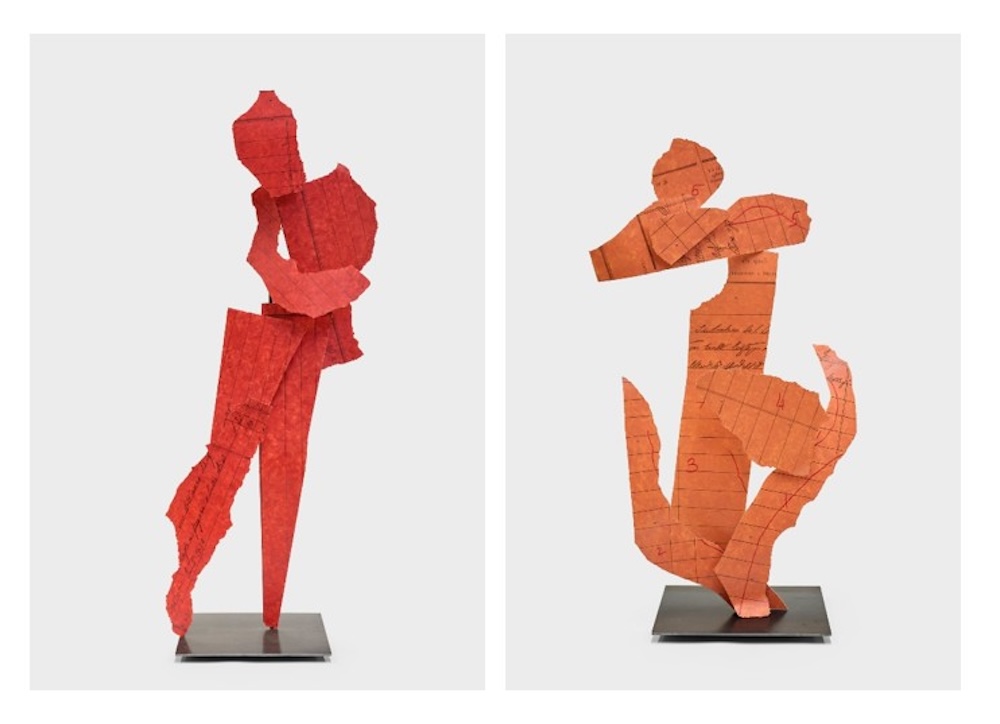
William Kentridge: from the series Paper Procession, 2023 – each steel, aluminium and oil paint, c. 108 x 44 x 39 cm, at Goodman Gallery
William Kentridge is a master of original drawing-derived processes. This series is, in his words, ‘about recognizing an image as it emerges rather than knowing it in advance’, so he tore sheets of paper in order to achieve the right degree of imprecision. ‘If you’re cutting with a knife or a pair scissors, you have to kind of know where your cut is going’, whereas ‘a tear is has to do with the fibre of the paper, and with how close together your fingers are’. The paper was from a 19th century Italian cash book, and the writing remained visible through the watercolour and crayon. The original paper forms were held in place with masking tape and wire – but Frieze features enlarged aluminium versions that reproduce the writing, and seek to retain that original lightness.
HONG KONG
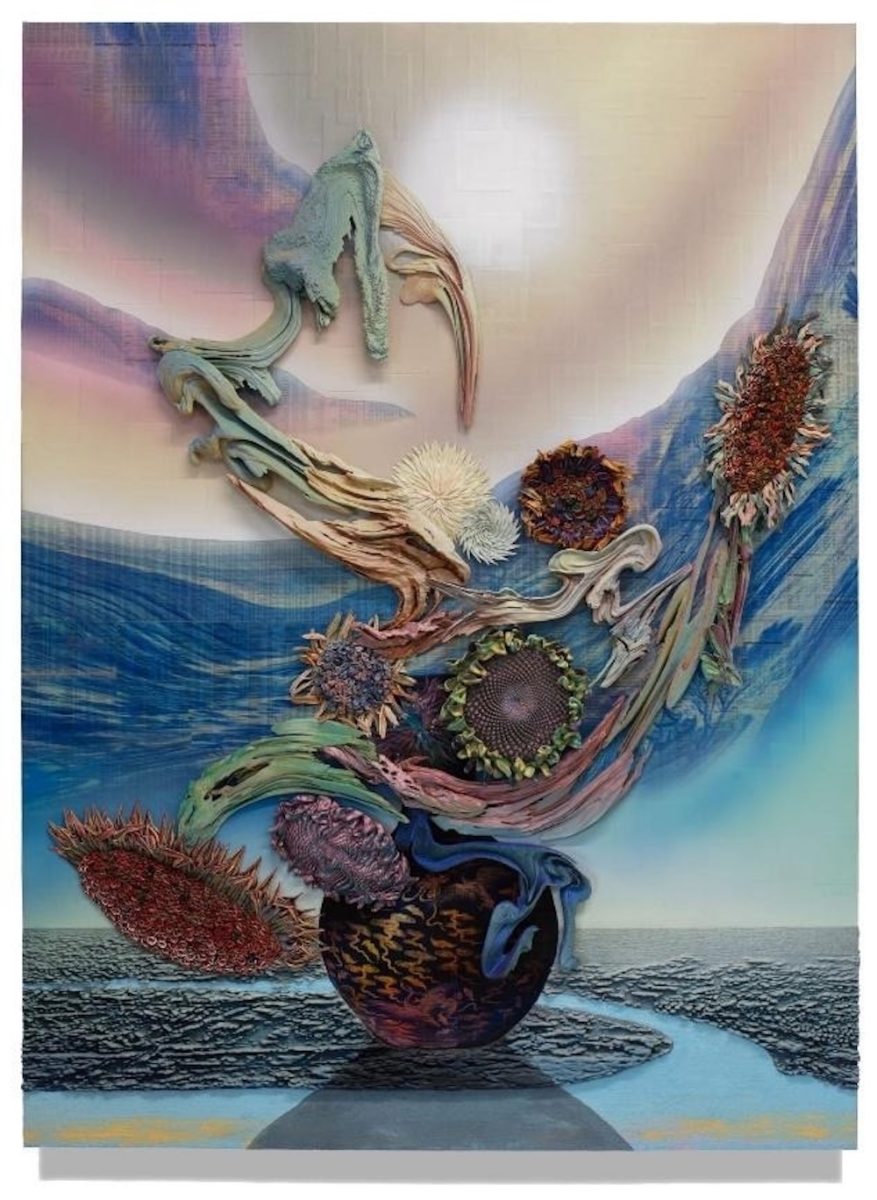
Gordon Cheung: Mortal Balance, 2025 – Financial newspaper, archival inkjet, 3D prints, acrylic and sand on linen, 135 x 100 cm at Edel Assanti
Gordon Cheung recently relocated from London to Hong Kong, where his parents live. He continues to build on the complexity of his multi-media floral works – history paintings made with digital and 3D printing, and paint applied directly and by adding sculpturally prepared strokes. Their founding combination was of the share listings in the Financial Times, still incorporated in the backdrop, and a reference to the 17th century ‘tulipmania’ that saw flowers absurdly valued in capitalism’s first cycle of bubble and collapse. This is from a recent series in which flowers combine with mapping of the highest GDP-producing cities in mainland China and images of scrolls from the imperial period of Chinese history. ‘They are about the rise and fall of civilisations’, summarises Cheung, ‘as well as the romantic language of still-life painting: futile materialism and fragile mortality reflected by the transient beauty of flowers.’
MEXICO
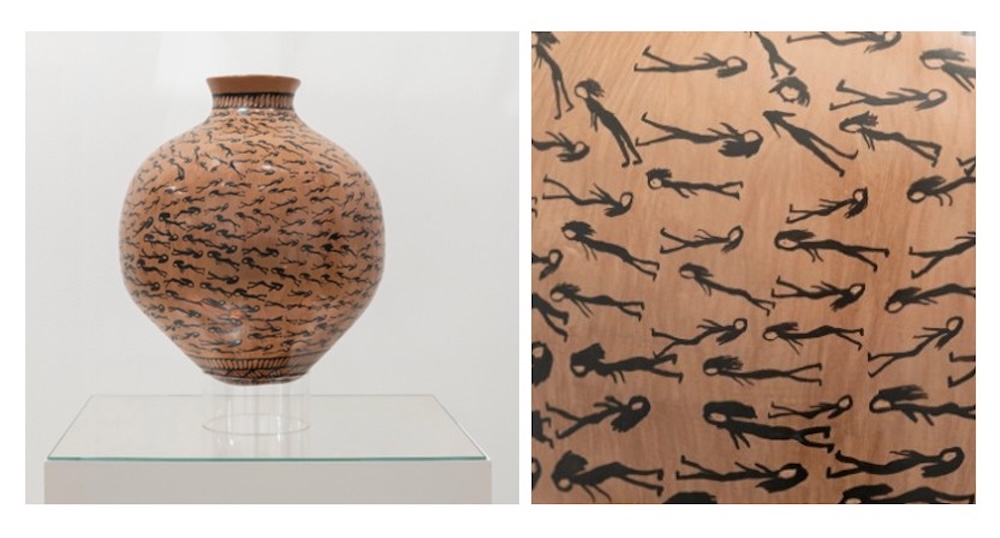
Teresa Margolles: Women without faces, 2025 – Ceramic pot made with clay and mineral pigments from Paquimé (Chihuahua), 42 x 45 x 45 cm, at Galerie Peter Kilchmann
Teresa Margolles, a trained forensic pathologist once employed as a mortician in Mexico City, is known for work dealing with violent crime – often incorporating physical remnants to memorialise the otherwise-invisible victims. This ceramic was crafted by two artisans from Paquimé, a region in northern Mexico renowned for its ancestral pottery traditions, using clay from the surrounding mountains, mineral pigments, surfaces polished with deer bones, and brushes made from their children’s hair. Each one of the 386 figures in ‘Mujeres sin rostro’ represents a victim of femicide in the preceding year. Upon its completion, Margoles asked that the faces of the women be scratched off, their erasure speaking to the pervasive and indiscriminate nature of gender-based violence. According to Margolles: ‘The geometric patterns are what they are allowed to show; the narrative—the dead bodies—is what they are asked to talk about.’
JAPAN
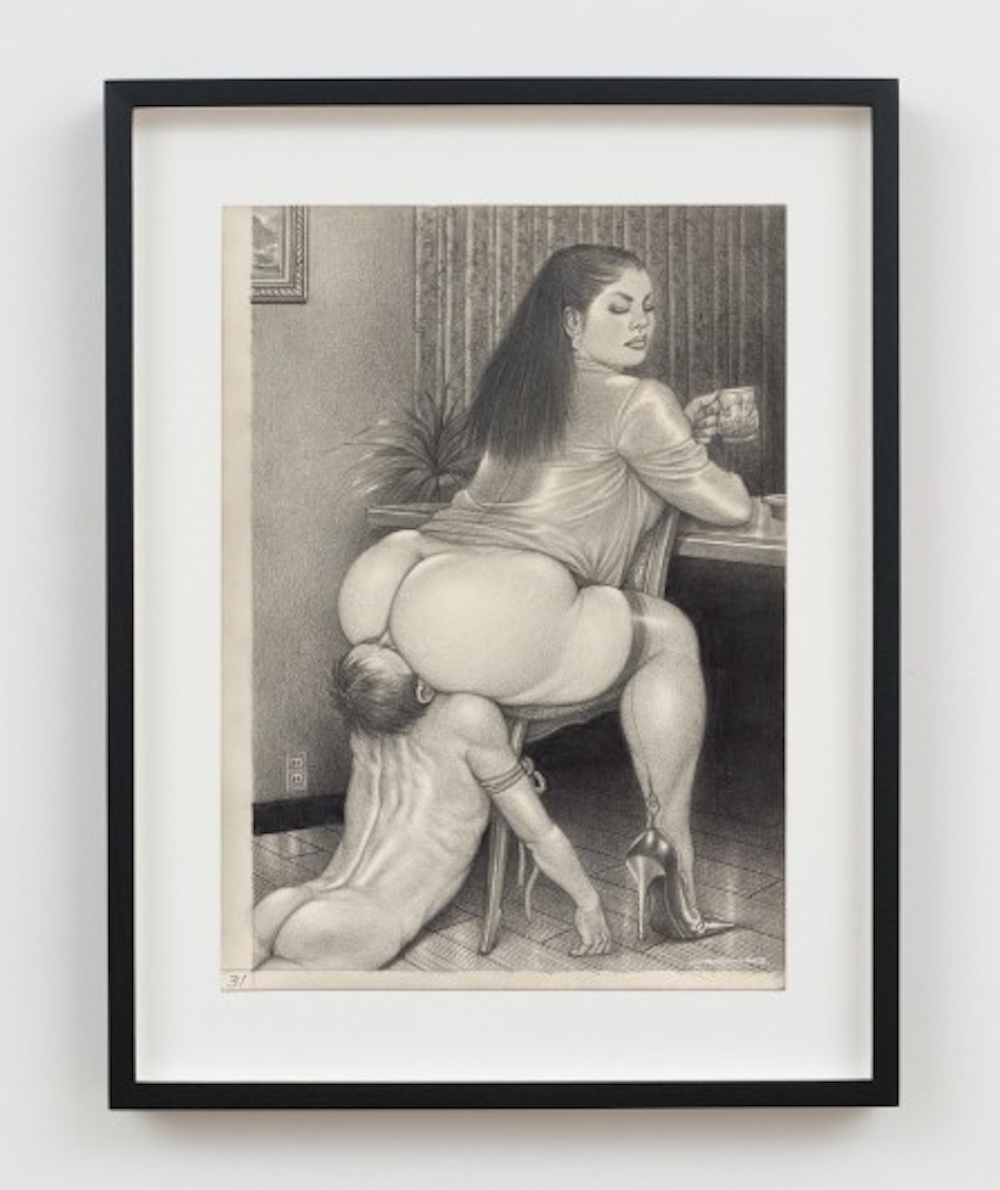
Namio Harukawa: Untitled 31, 2011 – pencil on paper, 36 x 27.5 cm framed, at Emalin
Given the widespread art world recognition that Tom of Finland has gained this century, it makes sense that the drawings of Namio Harukawa (1947 – 2020) might have a comparable trajectory. He was a pseudonymous Osaka-born fetish artist who developed his career in the 1960’s and 70’s by contributing illustrations to pornographic magazines. Harukawa is best known for showing big, voluptuous and dominant women sitting on the faces of small, weak and submissive men eager to be sexually smothered and crushed – though his depictions of female domination also include erotic asphyxiation and men being used as human furniture. All of which allows for inversion of expected relativities, striking poses and a non-conformist charge that might be read as feminist – even if Harukawa’s own fantasies are involved. Add his impressive technique, and the revaluation makes sense…
ALBANIA
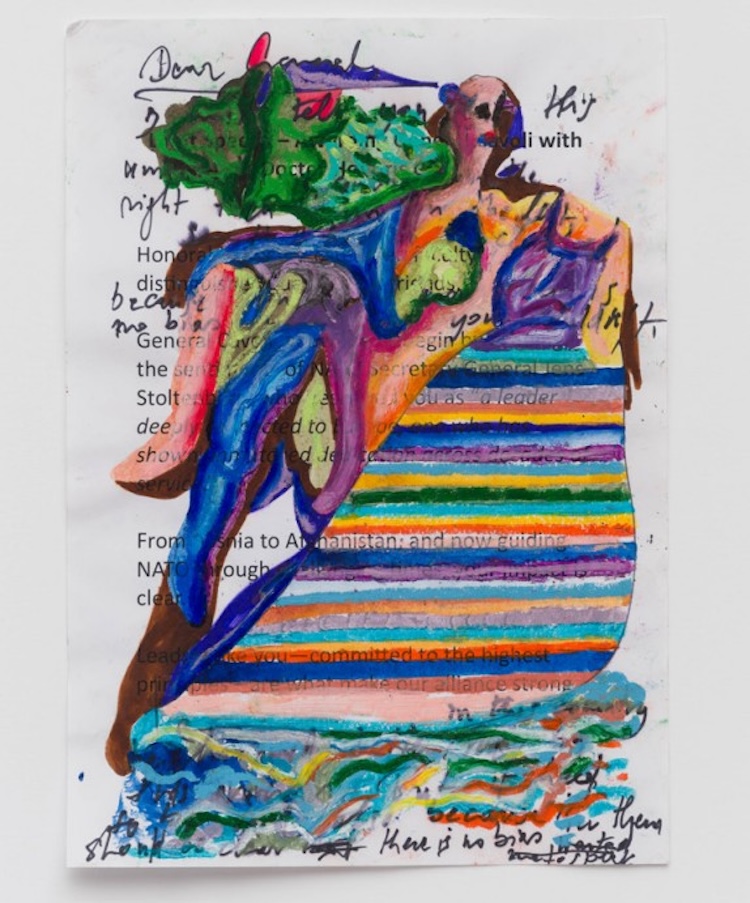
Edi Rama: ‘Untitled’, 2025 – Oil stick and felt pen on paper 43 x 34 x 3 cm, at Société
Edi Rama is one of the world’s most successful politicians, having won the four consecutive general elections to serve as prime Minister of Albania since 2013. But this is not an amateur’s drawing: he graduated from the Academy of Arts in Tirana and worked as an artist in Paris during the 1990’s. Now he improvises on agenda printouts, meeting notes, memos, and email correspondence to juxtapose liberated, exuberant abstractions with the structural essence of a politician’s daily work. In his gallery’s words ‘rather than treating textual notation as a literal reference, he uses it as a preliminary landscape and springboard’ for his ‘improvisational reaction to a singular moment… with the highly intimate, personal act of drawing serving as a means of focusing and steadying the mind for work with collective consequences. Through their contextual ambiguity, these diaristic drawings carry a distinct speculative quality, compelling us to imagine the diplomatic mise-en-scène in which they were brought to life.’
INDIA
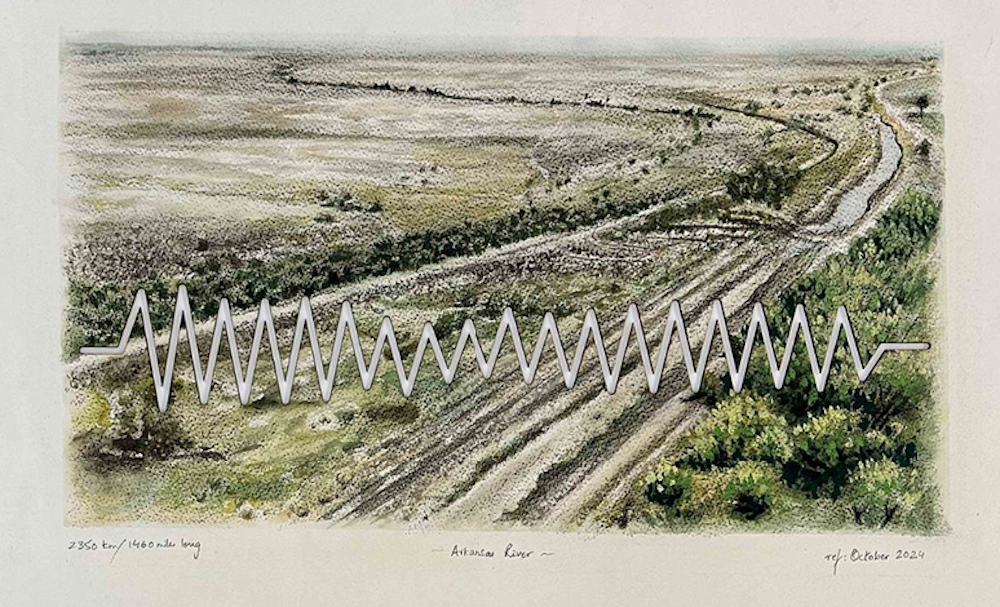
Reena Saini Kallat: from the series River Morphologies, 2025 – Gouache, charcoal, pencil on laser cut arches paper, 63.5 x 63.5 cm at Nature Morte
Mumbai-based Reena Saini Kallat – who’s also in the Sculpture Park – draws attention to drying rivers around the world through paintings of arid riverbeds, once life-bearing arteries, now reduced to delicate contours of ecosystems in retreat. These desiccated terrains are overlaid with laser-cut soundwave forms derived from archival field recordings of the rivers’ original sounds, ‘like an echocardiogram’, says her gallery, ‘capturing the river’s last pulses’ . Obviously there’s an ecological mourning and warning here, but Kallat’s broader practise often focuses on political borders, and she has examined how the natural flows of water are repeatedly disrupted by the imposition of bureaucratic borderlines, the construction of dams for hydroelectric projects and the intensive exploitation of water for agriculture and industry. These interventions, often leading to drought and displacement have further accelerated the impacts of climate change. The drawings, concludes the gallery, ask ‘what happens when natural systems, once vital and shared, go mute?’
PERU
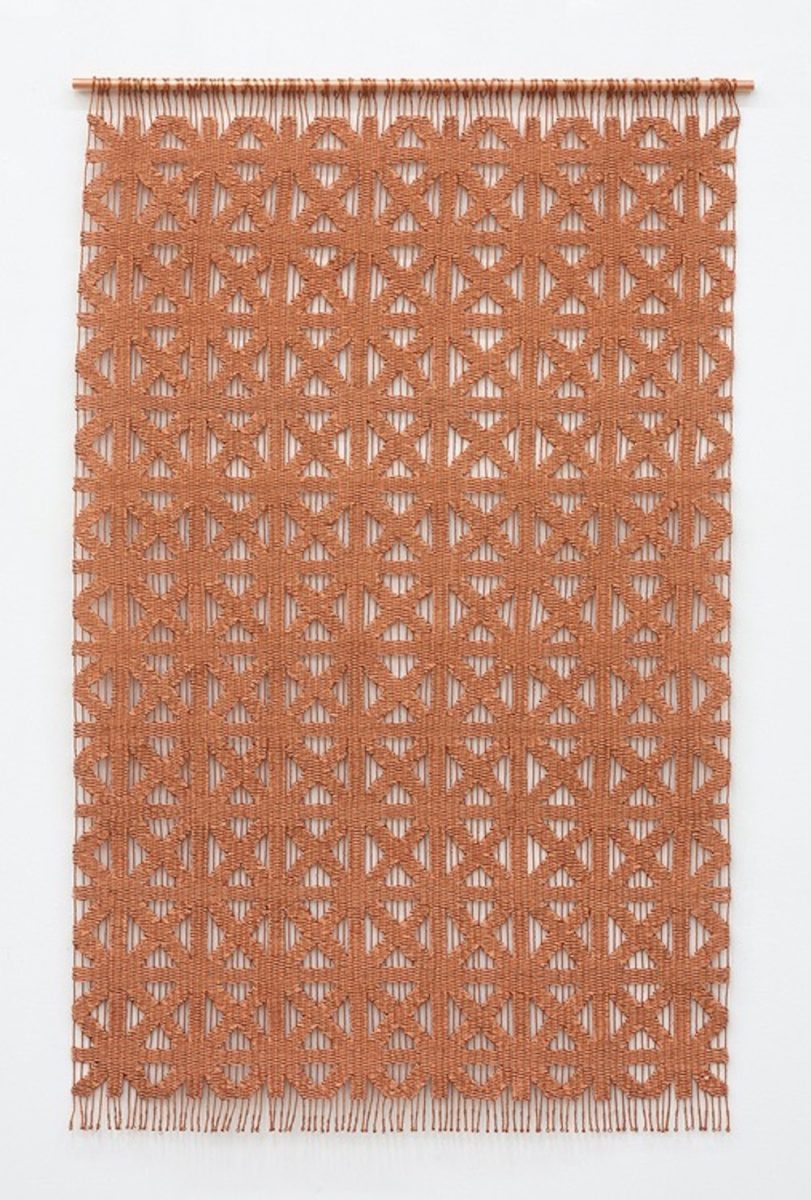
Ximena Garrido-Lecca: Modulaciones – secuencia X, 2024 – Woven copper wire, 154 x 96 cm at Galerie Gisela Capitain
Textile works are prominent currently, and this is woven – but in copper. The in-between status extends to the content: the aggrandisements of globalised neo-colonial big business are set in the critical context of the native cultures of Garrido-Lecca’s home country, Peru. ‘Modulaciones’ is a series of works that developed from an investigation of the copper mining city of Cerro de Pasco, using industrialized copper to create artisanal weaves of abstract symbols. On the one hand, they are based on the traditional woven forms of pre-Columbian geometric abstraction; on the other hand, the particular symbols seen here are derived from the logos of corporate entities. Thus, says the gallery, ‘while the references are highly local, her work speaks to contemporary global concerns of struggles over natural resources, public services and private access for those living on its borders’.
GREAT BRITAIN
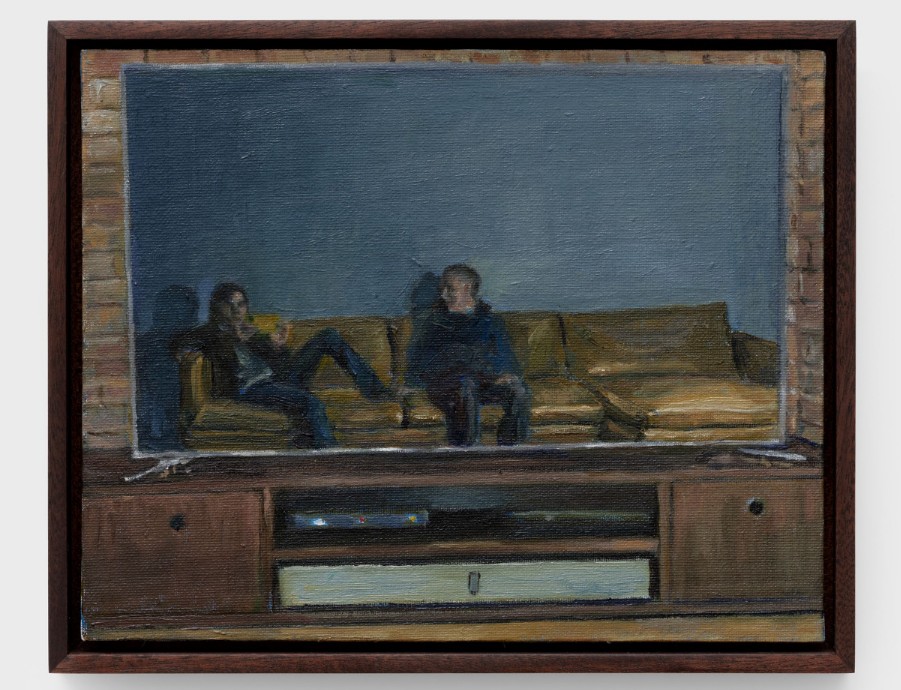
Gillian Wearing: Self and Michael (sitting room), 2024 – oil on canvas and board, canvas 20 x 25 cm, at Maureen Paley
Gillian Wearing turned to painting – for the first time in 33 years – during the Covid lockdown, and has continued since. ‘Having represented myself in photography both as myself and as others, I wanted to see how paint and even the manner of painting could change my appearance’, she said. Sometimes, as here, Wearing extends her scope to include her partner, fellow artist Michael Landy. Given her wider explorations of the role of the media, it is a neat touch that they appear reflected in the screen of a turned-off TV – making it an original combination of still life and double portrait, as well as suggesting that, long after they met at Goldsmiths in the late 80’s, they still have things to talk about. That looks, incidentally, like a VHS player beneath the TV, making it old enough to have been destroyed in Landy’s 2001 ‘Breakdown’ performance – so I assume it was one of Wearing’s possessions.
Frieze London & Frieze Masters, 15th- 19th October 2025, Regents Park @friezeofficial