There are equations on the wall of Dali Schonfelder’s London studio. Not the vague approximation of mathematics you sometimes find deployed as an artistic motif, but numbers she actually understands — and loves.
“I actually really love maths a lot,” she tells me. “I remember in high school, I would memorise hundreds of digits of pi.” There was also the occasion when a teacher promised her an A if she could become the fastest in the class at solving a Rubik’s Cube. Schonfelder effectively abandoned the semester and concentrated on the cube instead. Her time? Around 41 seconds.
This matters because once you start looking around her studio, structure is everywhere. Buildings, maps, musical notation, Fibonacci sequences: systems through which an apparently chaotic world can be organised, measured or understood.
Schonfelder is a London-based painter of Dutch and Australian heritage who grew up between the Netherlands and Bali (where she painted with Mersuka Dopazo), before studying at Parsons School of Design in New York. Her paintings have already travelled considerably further, entering collections in the UK, Singapore, Bali, Miami, Australia, Germany and New York.
But biography only gets you so far. The more interesting question is why someone raised in what sounds like an almost impossibly free environment should become so attracted to order.
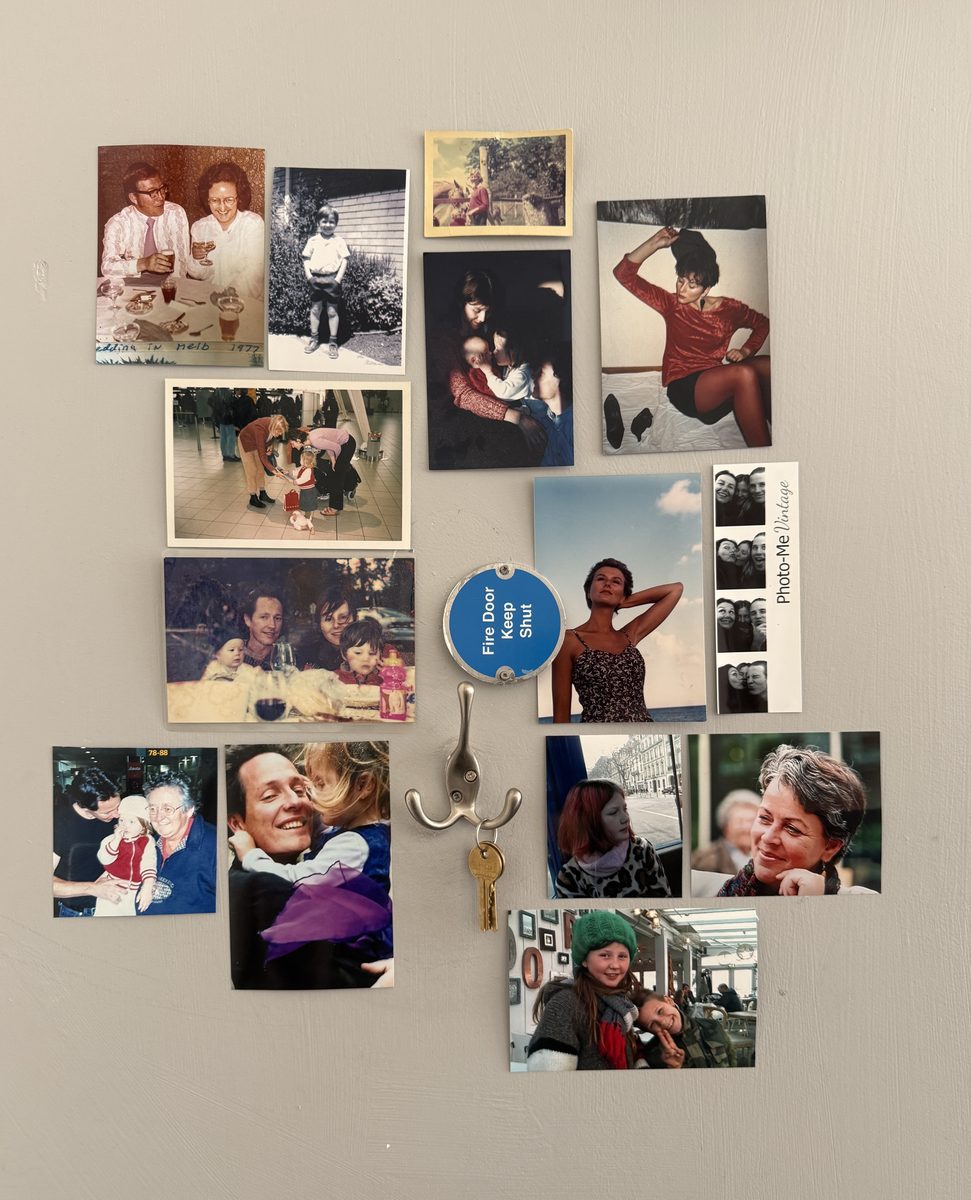
Schonfelder lived in the Netherlands until she was around 11, when her family stopped in Bali on what was supposed to be a move to Australia. Six months became something more permanent. She attended Green School, an extraordinary bamboo-built school where classrooms had no walls, shoes weren’t required and her classmates represented more than 50 nationalities.
It sounds idyllic. It was also, by Schonfelder’s own account, “a crazy environment to grow up in”.
Perhaps that is why buildings became important.
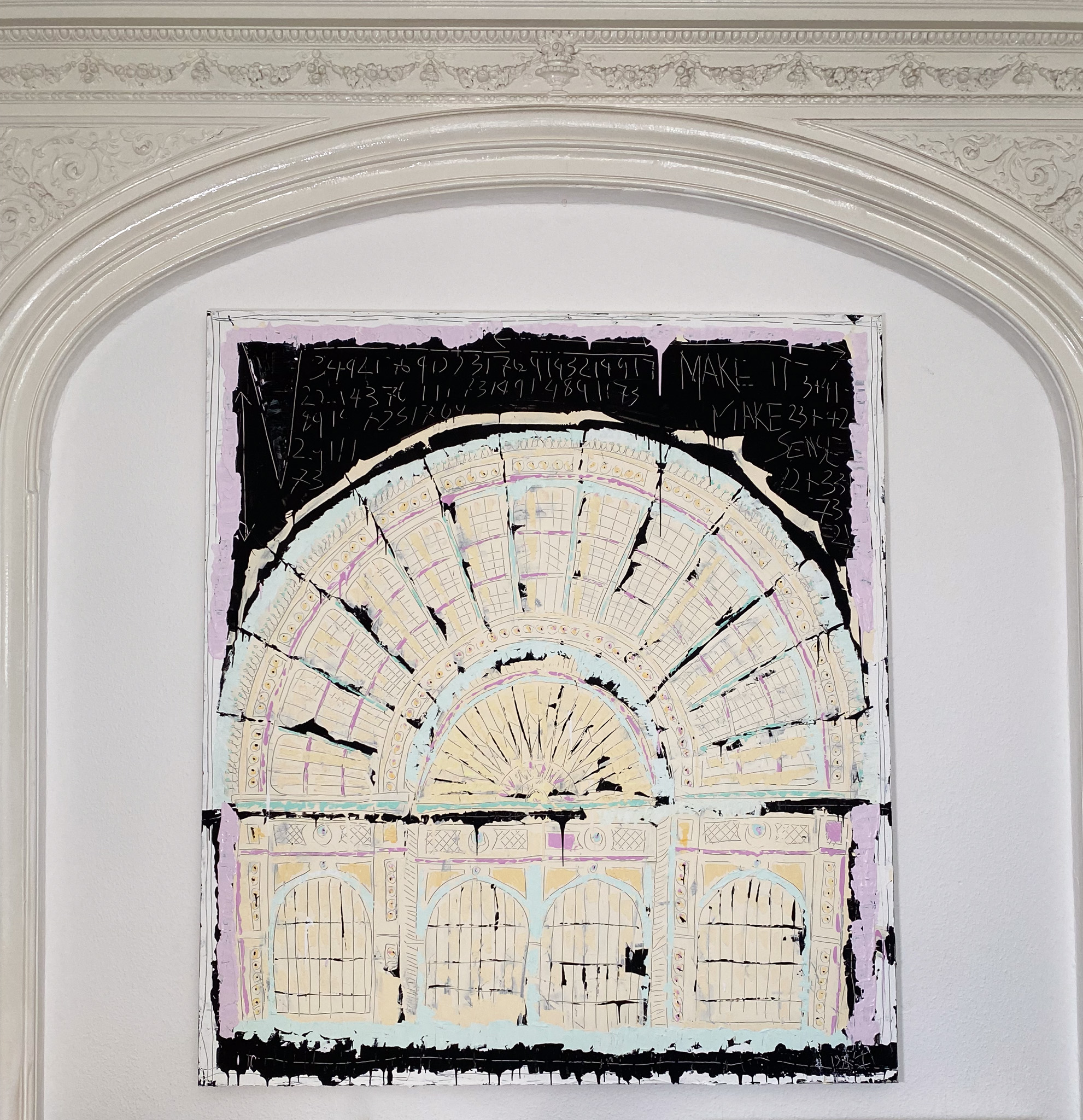
“I think that’s why I lean towards structure in buildings,” she says. “In my personal life, I get so much structure in my life from my home and my surroundings. That’s where I find the grounding of everything because I’m quite possibly sporadic in my thinking. I have to pull myself back down.”
Architecture in Schonfelder’s paintings therefore feels like more than subject matter. It is an anchor.
Her relationship with mathematics goes deeper still. As a child she struggled academically until a teacher unlocked something in maths. Suddenly the student who found much of school difficult became obsessed with numbers. When she later sat the Dutch examinations used to determine secondary-school level, her language results were at the bottom while her mathematics and reasoning score reached the highest level.
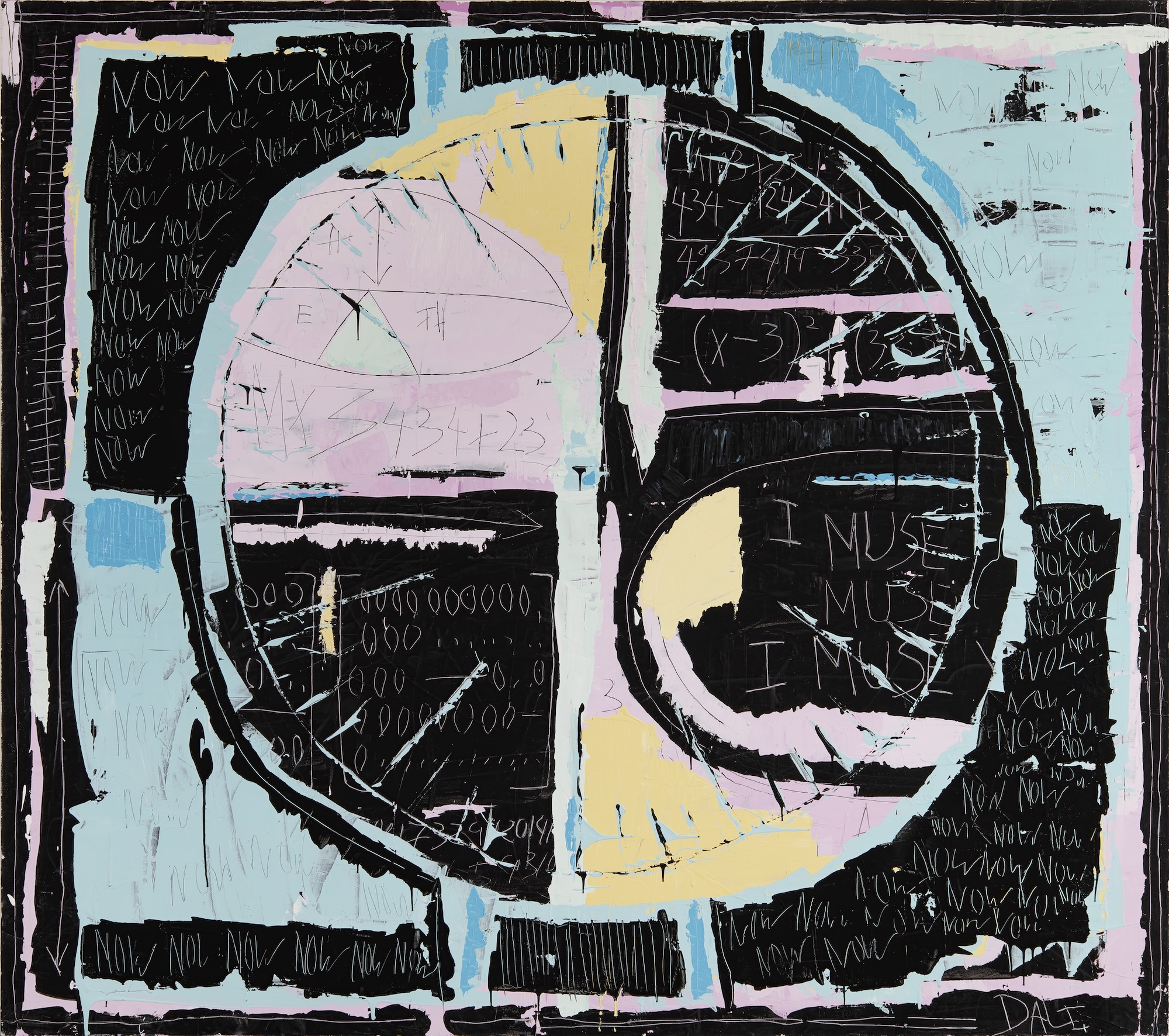
“I found comfort in understanding numbers as a kid,” she says. “Now I find comfort in not having to.”
That last sentence may be the key to where her work is heading.
Schonfelder’s current paintings operate within a recognisable visual language. Architecture is reduced and reconstructed through strong lines, layers and areas of colour. Music becomes visual pattern. Maps turn cities into systems. Her palette is deliberately restricted: blacks set against pale pinks, blues and other pastel tones.
“I love contrast,” she explains. “If I use more solid colours, it doesn’t have as much contrast.” Attempts to push the palette further have, she says, simply not felt right.
There is an appealing contradiction here. Her paintings can look instinctive, but underneath them sits someone intensely attracted to systems.
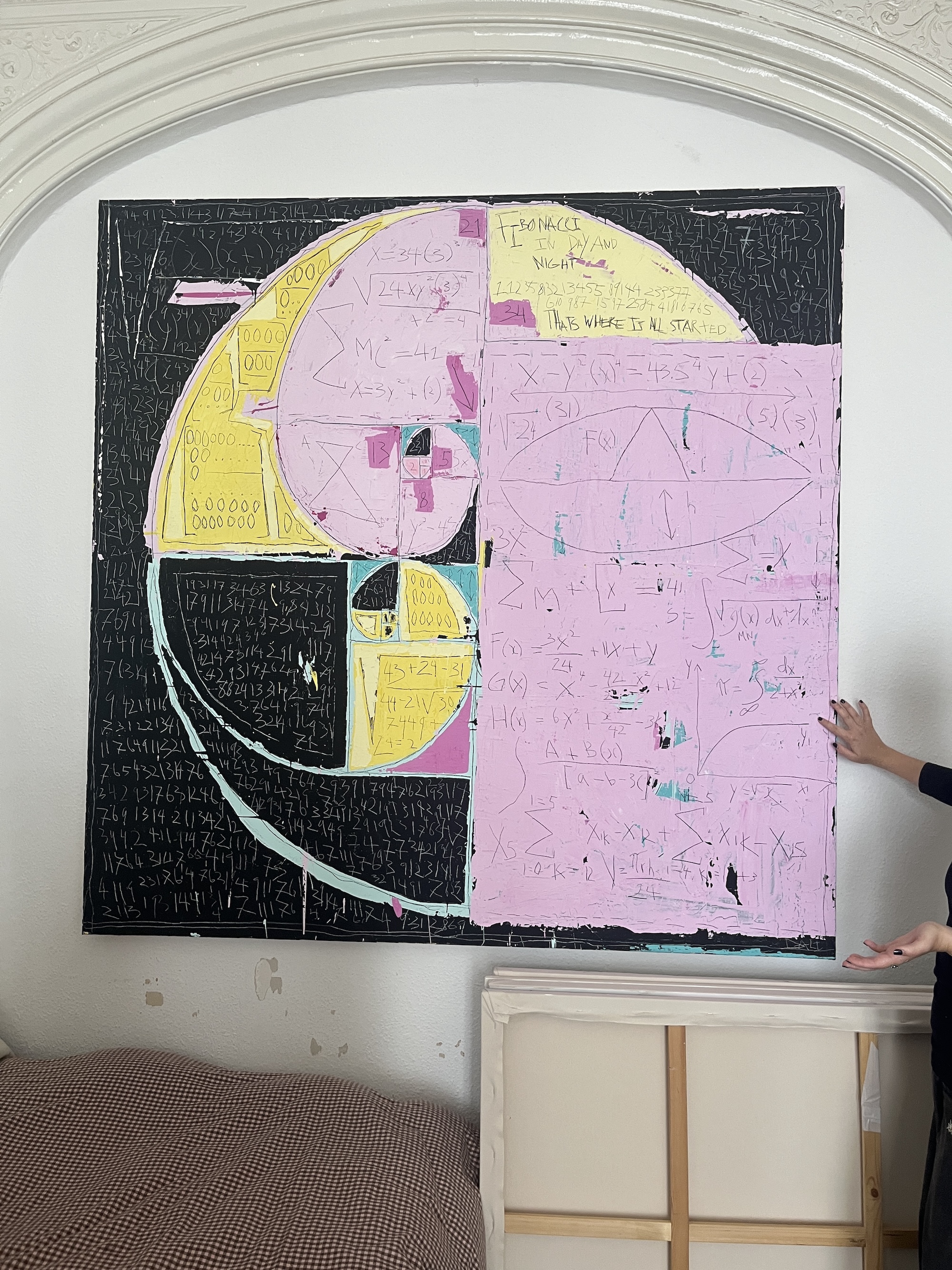
In Fibonacci in Day and Night, the familiar sequence becomes a way of thinking about growth. Schonfelder sees life as expanding through something resembling a Fibonacci spiral: beginnings accumulating into larger structures, interrupted by periods of resistance, darkness and change but continuing nevertheless. The painting itself is constructed through six or seven layers, with paint applied and scratched back so previous colours re-emerge through the surface.
Music provides another system. Schonfelder has made works around Mahler and, at the opposite end of the musical spectrum, We Are Family. That particular song has another connection: Nile Rodgers, who co-wrote it, became an early collector of her work.
Her wider influences make the apparent contradictions in the work easier to understand. Gustav Mahler, Beethoven and Mozart sit alongside Hans Zimmer; Leonardo da Vinci alongside Monet and Matisse; Carl Jung alongside Vadim Zeland; and cinema — particularly Sofia Coppola and David Lynch.
It is a list that moves between mathematical order, emotion, consciousness, perception and constructed worlds.
Cinema is particularly revealing. Schonfelder studied fashion design at Parsons but found its structures ultimately too restrictive. During Covid she returned to Bali and began painting, initially working large because, while physically confined, she felt the need to make something expansive. A hotel under construction bought seven paintings for $7,000 — a price she says she initially suggested almost as a joke. That money enabled her to move to London.
She arrived with the money from those first paintings and talked her way into an empty upstairs space in Shoreditch to use as a studio. From there things began moving remarkably quickly. Her CV now includes exhibitions in London and Singapore and art fair presentations in London, New York and Singapore.
Yet what makes Schonfelder particularly interesting now isn’t what she has already accomplished. It’s the palpable sense that she wants to move somewhere else.
Among her existing bodies of work are dark, almost monochromatic storyboard paintings. She talks about them differently. They are less obviously decorative, less dependent on the seductive colour contrasts of the architectural works, and closer to the territory she seems increasingly determined to explore.
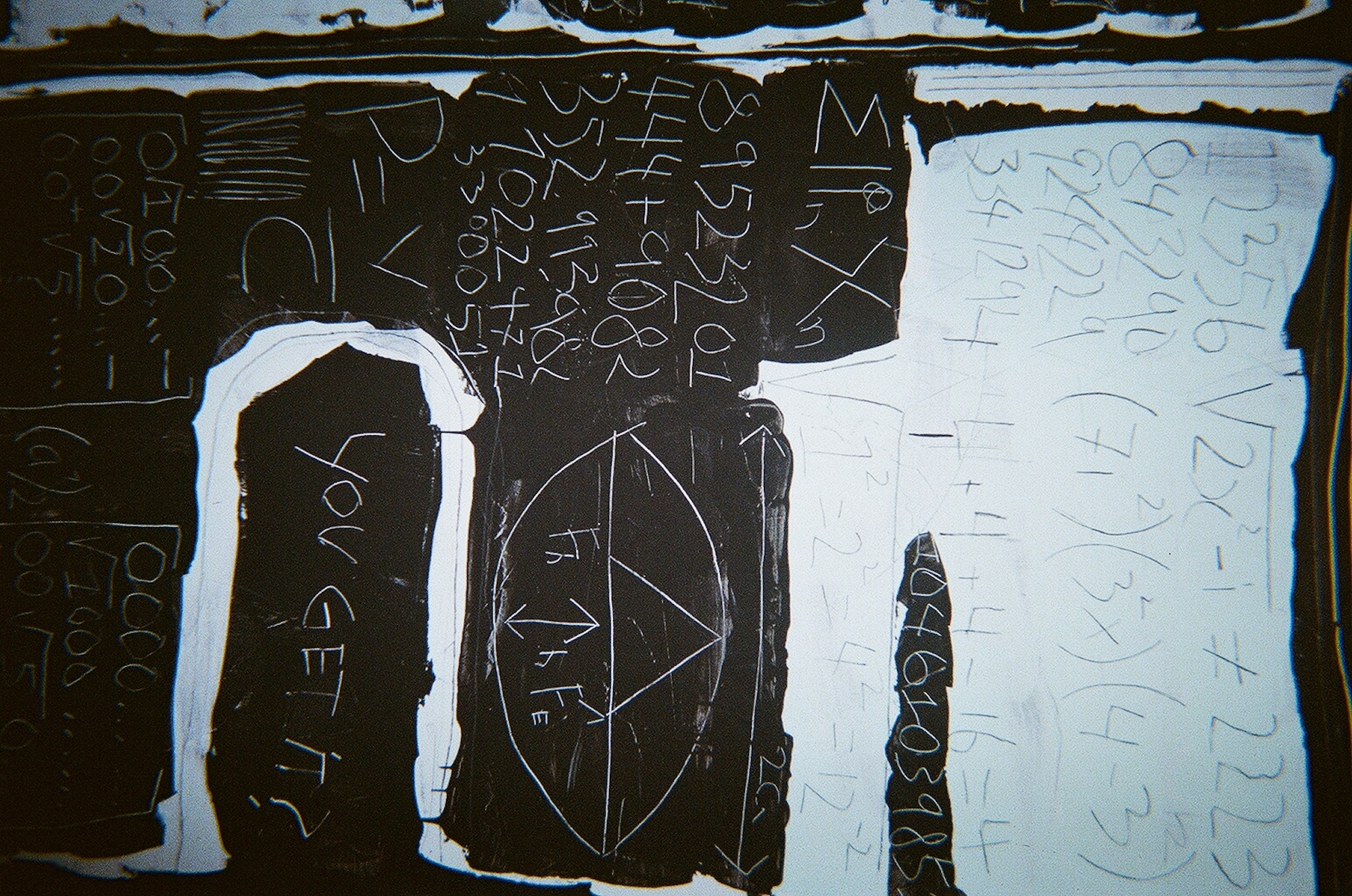
“I prefer doing more, I guess, dark pieces myself personally,” she says. “I weave them in with all my other work.”
And then there is mathematics.
At one point in our conversation she gestures towards three new canvases. Nothing has happened to them yet. The paintings exist only in her head.
“What I want to do is I’m really into the mathematics behind space and time and the structure of physical reality,” she says. “I actually just got three new canvases… I want to do all the maths of how physical reality is structured.”
It is an ambitious jump, but perhaps not such a strange one.
Schonfelder’s paintings have always been concerned with systems: the structure of a building, the organisation of a city, musical notation, numerical sequences. Architecture gives physical order to space; maps impose order on geography; notation gives visible structure to something as intangible as music. Mathematics may simply allow her to push that instinct further, from representing the structures we construct to asking about the structures underneath reality itself.
That connects to another side of Schonfelder: her interest in Jung, synchronicity, consciousness and questions around what we perceive as reality. These aren’t yet fully resolved into the work, and that’s precisely why they are interesting. She is talking about ideas faster than she can currently paint them.
“I think if I painted every single day for the rest of my life, I would still have too many things to paint,” she says. “There’s so much to make.”
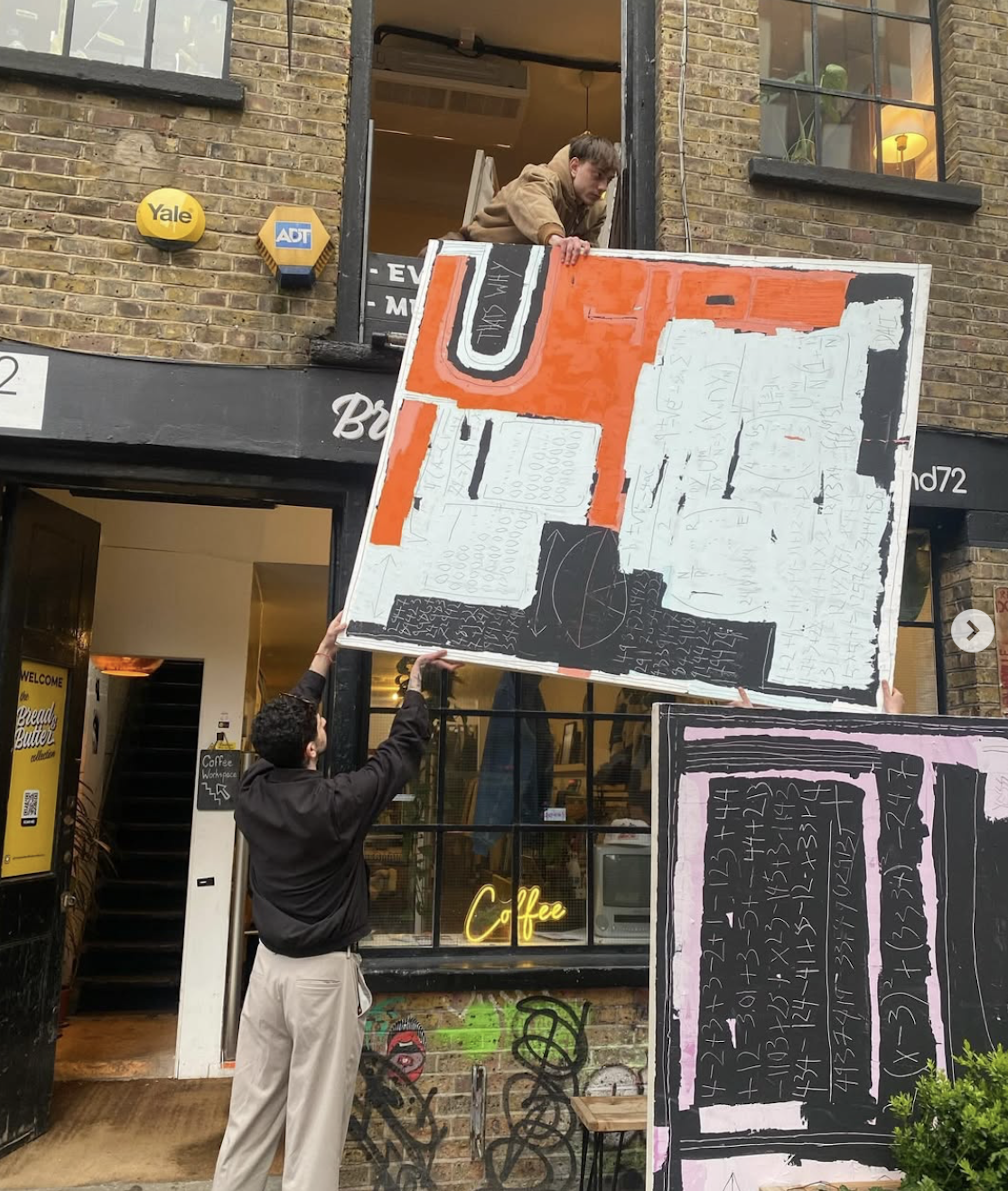
There is also a sense that she knows she is at a transition point.
“I have to make that leap,” she says. “I think I’m in a transition period.”
That may be the most interesting thing about visiting Schonfelder’s studio now. The polished architectural paintings and tightly controlled palette show an artist who has already found a language that works. The black paintings, equations and empty canvases suggest someone increasingly tempted to disrupt it.
For an artist whose life has moved from the Netherlands to Bali, New York and London, perhaps another shift shouldn’t be surprising. The difference is that this one may happen entirely inside the work.
The equations are already on the wall. The paintings are still waiting to get out.