

High above the courtyard of a building complex on Berlin’s Potsdamer Straße, I stand with Berlin-based, Guadaloupe-born artist Thomias Radin in front of a small bookshelf. The books comprise a dense, cross-disciplinary mix of history, colonial violence, and the body, tracing an arc from Caribbean embodied knowledge and dance philosophy through to myth, spirituality, and radical critiques of post-colonial identity.
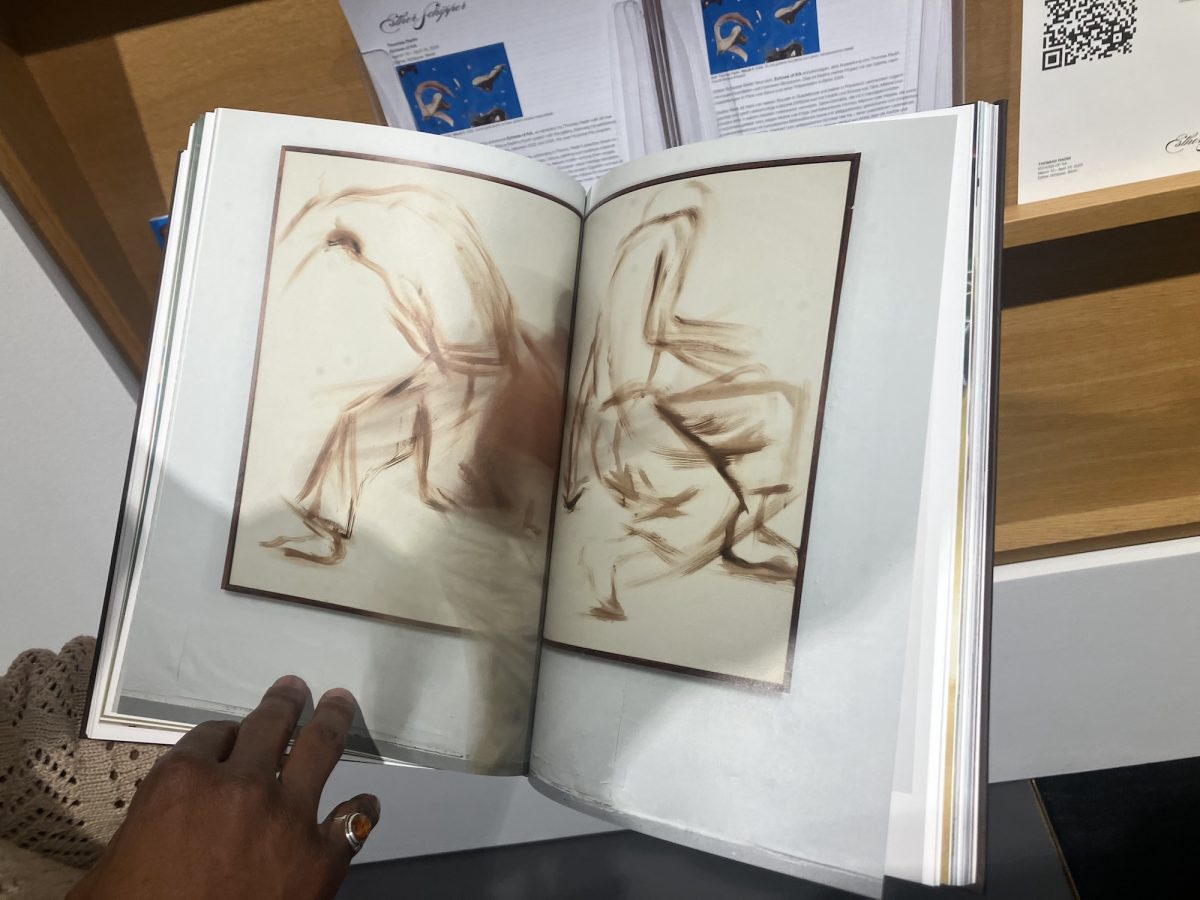
The artist opens his monograph to a full-page spread of a diptych: two oil paintings on creamy raw linen, executed in quick, gestural strokes, each under ten minutes. Among the other books he shows me is a Guadeloupean dance guide written by dance scholar Léna Blou. Radin, who refers to Blou as Guadeloupe’s national treasure and recently collaborated with her on the short film SOUKOUSS, sourced the books from his private collection, their worn, softened pages marked by years of handling. He selected them as a supplementary bibliography of his current exhibition, Echoes of Ka, the artist’s fourth solo exhibition with the gallery since 2024, which combines painting, woodwork, and installation.
Reaching Esther Schipper Gallery feels a bit like arriving at the top of Jack’s beanstalk. The main exhibition space, slightly sunken yet located on the top floor, feels quietly set apart from the world without withdrawing from it entirely: a kind of ascent to descent into what currently resembles a colourful courtyard in the sky.
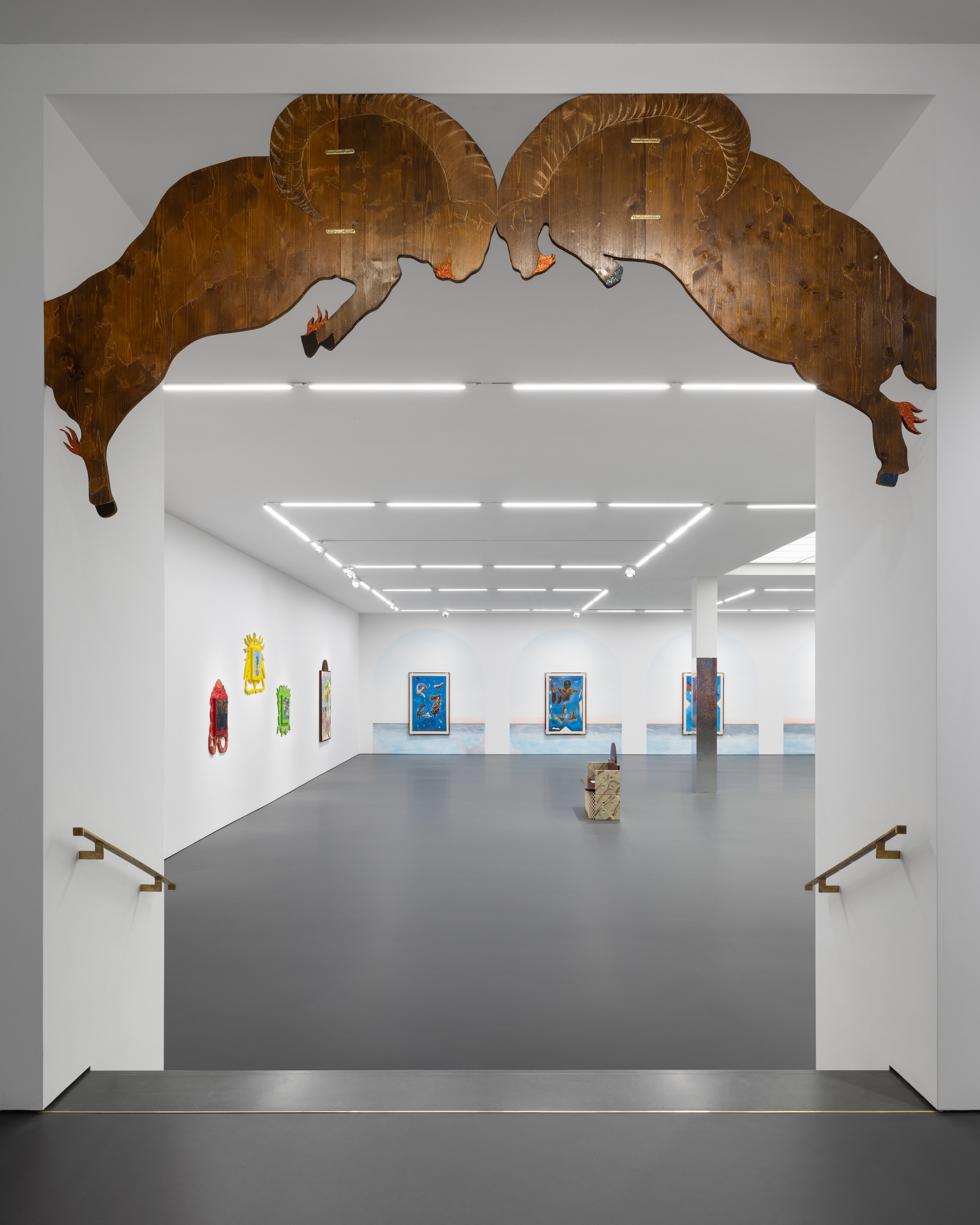
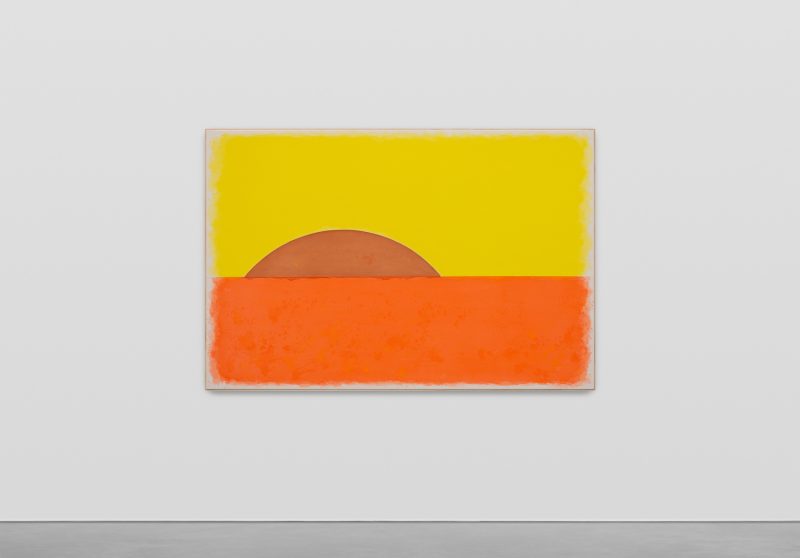
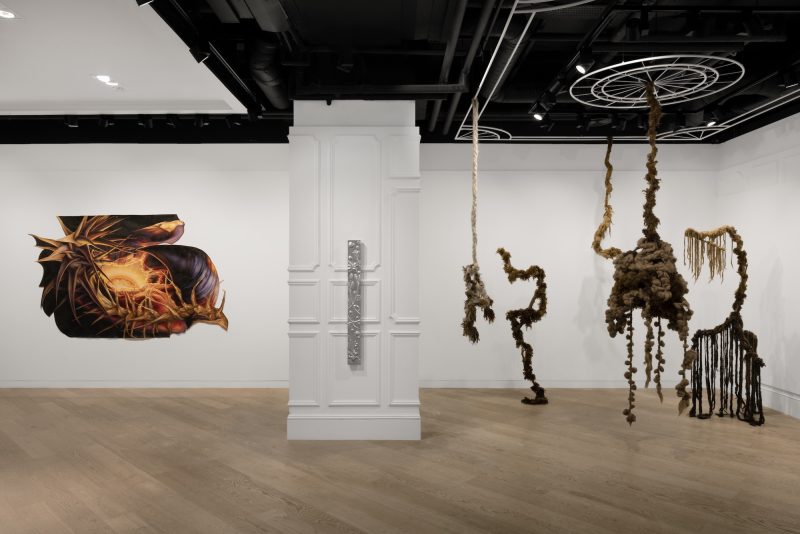
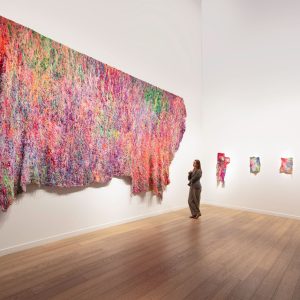
The space has been curated as a sort of secret garden, with furniture, millwork accents, and murals opening onto ocean views. Vibrant, abstract canvases reveal more figural elements the longer you look at them. The room’s central pillars are treated with reflective surfaces, which fragment and multiply the visual field, creating subtle shifts in perception. While the reflections reproduce the surroundings, they also redirect attention and introduce a sense of deflection, enabling the viewer to see the space from multiple angles — including themselves. It’s just one of many ways the space feels like it has not only been staged but also choreographed.
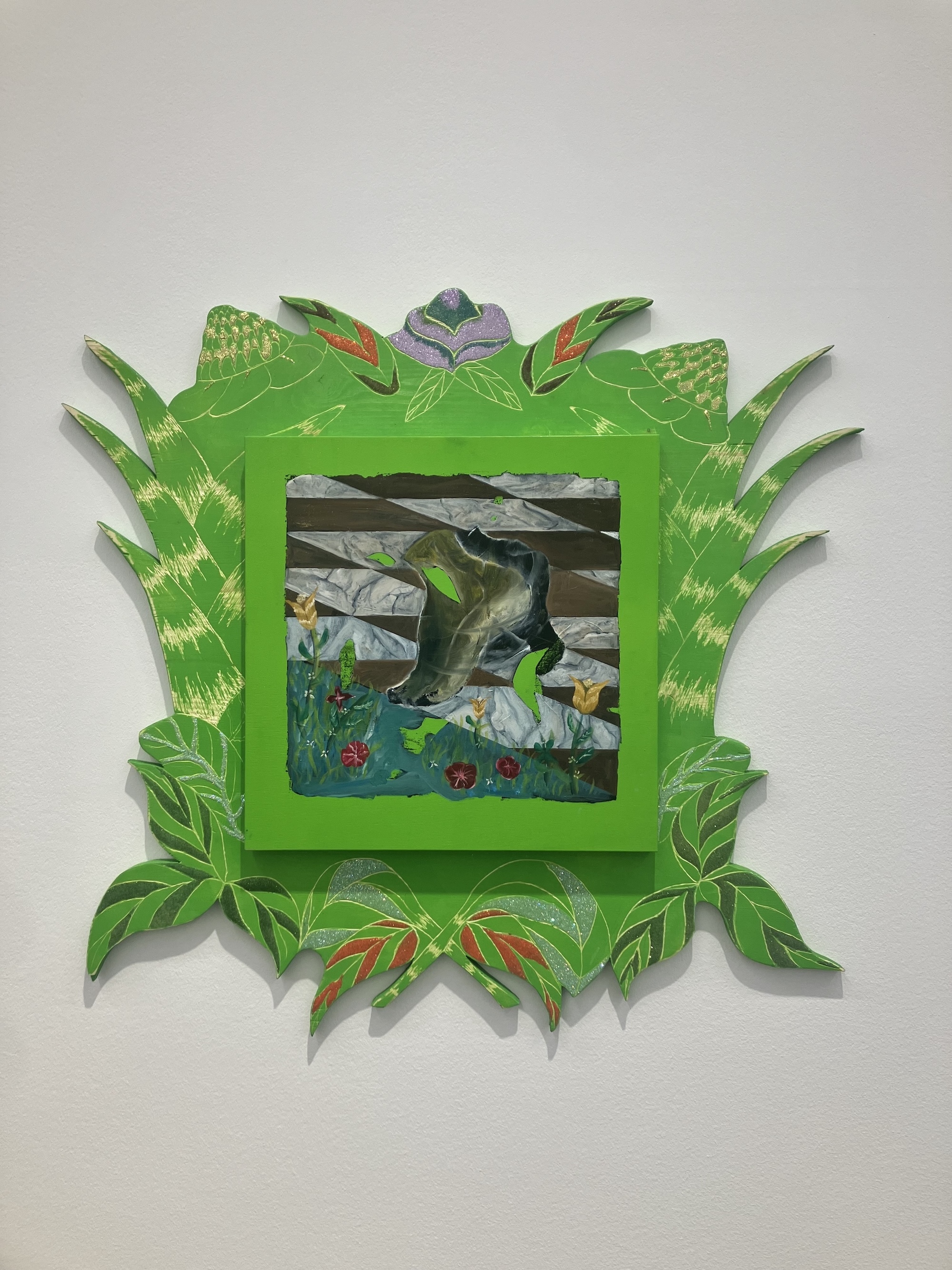
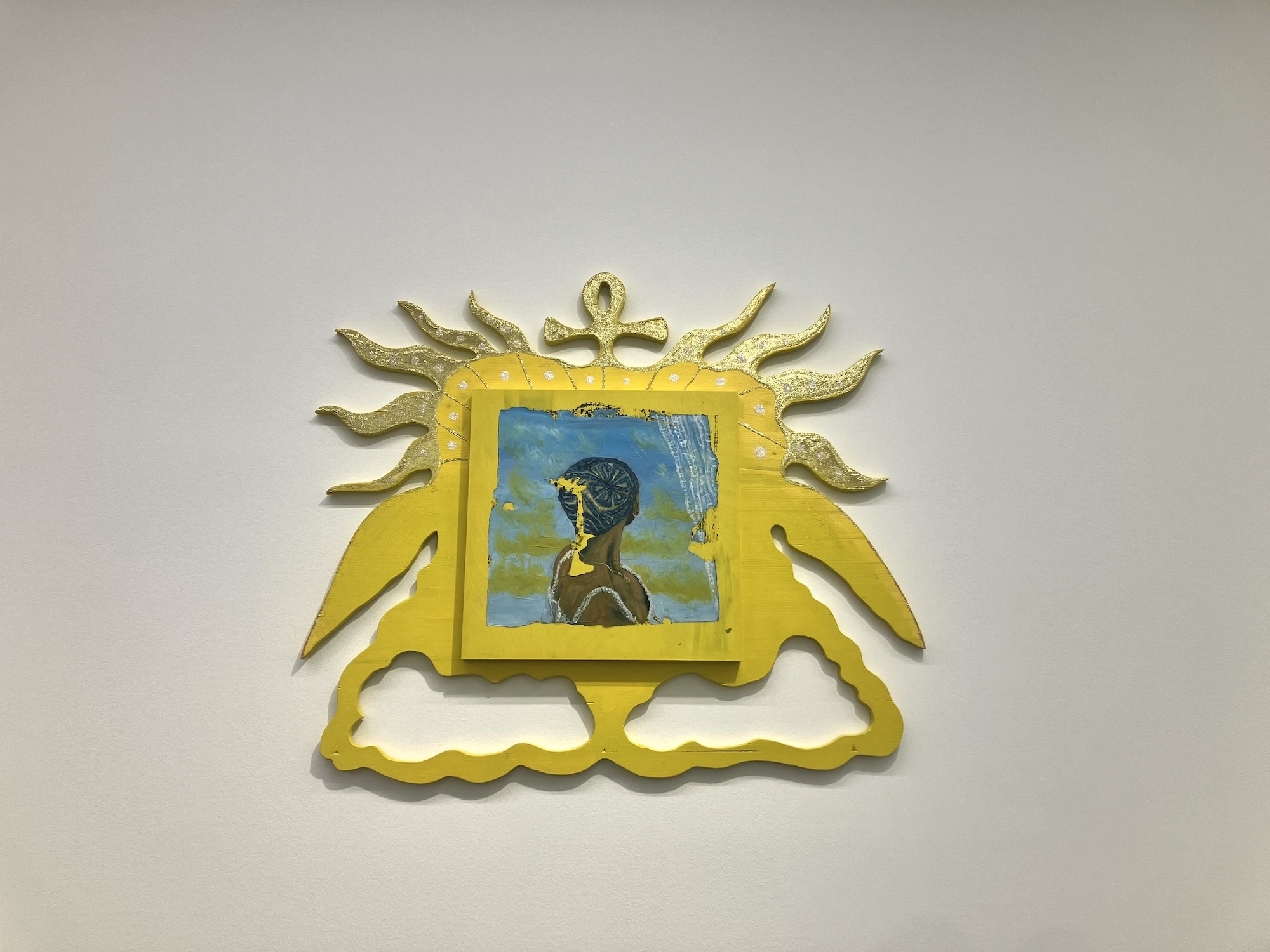
The exhibition unfolds through Radin’s engagement with Ka, a concept rooted in ancient cosmologies and preserved across West African and Caribbean traditions. In ancient Egyptian thought, Ka described a vital life force — a presence animating not only human beings but also objects, landscapes, and gestures. In Radin’s interpretation, the term becomes both a metaphysical principle and an artistic method. Everything contains energy: a room, a plant, a stone, even silence. Silence itself can carry weight, shaping the atmosphere of a space without ever becoming visible.
This belief informs the logic of Echoes of Ka. Rather than mirror the anxieties of the present moment through darkness, Radin frames the exhibition as a counterforce. Colour becomes a balancing gesture — a response to instability rather than a depiction of it. His canvases often begin in chaos: pigment poured onto stretched linen and allowed to spread outward before resolving into compositions where horizon lines, figures, and gestures slowly emerge.
Improvisation is central to this process. Radin frequently paints without sketching, allowing each brushstroke to function as a decision made in real time. The method parallels dance improvisation, particularly the Gwoka traditions of Guadeloupe, where movement arises in response to rhythm rather than predetermined choreography.
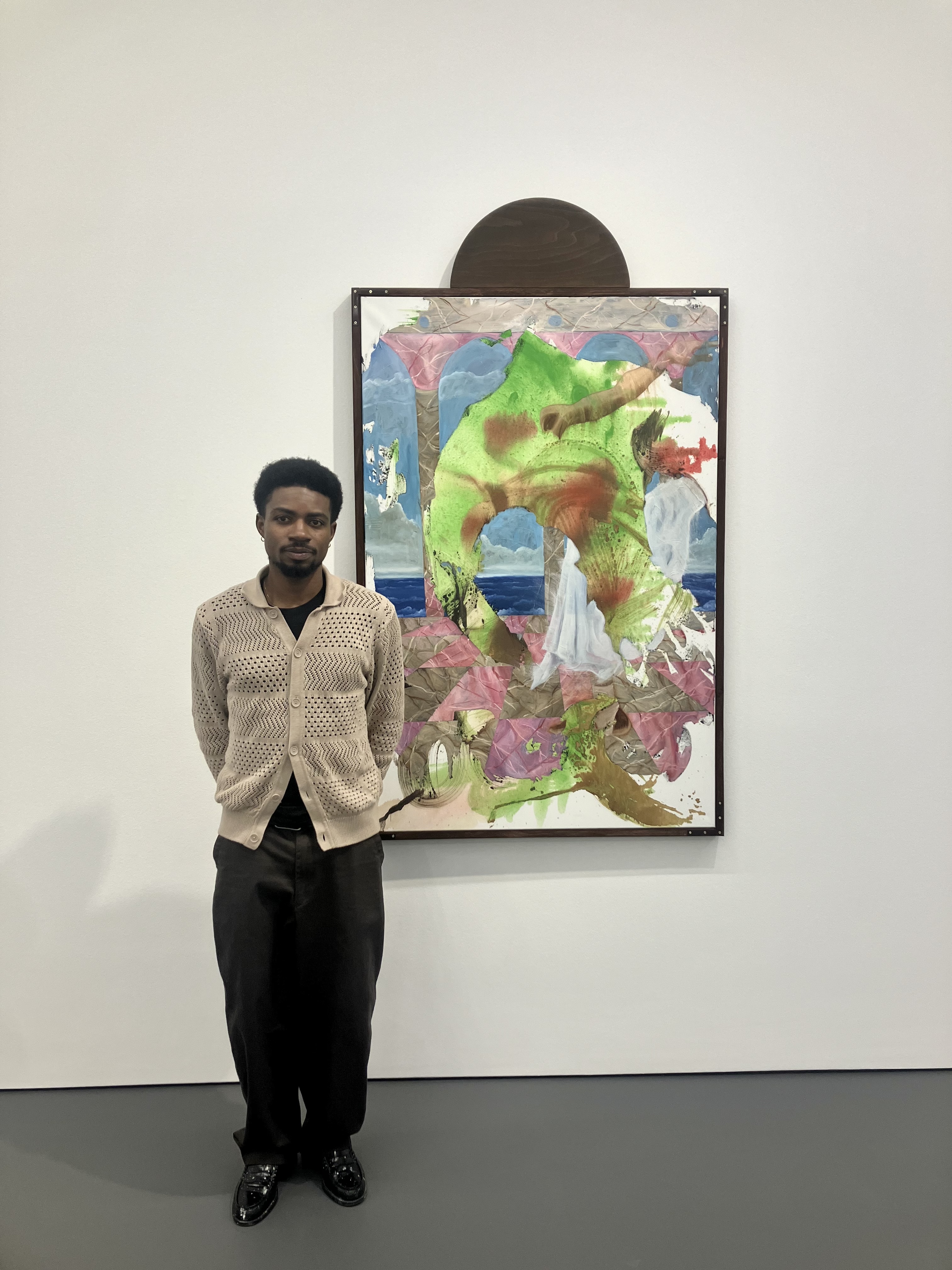
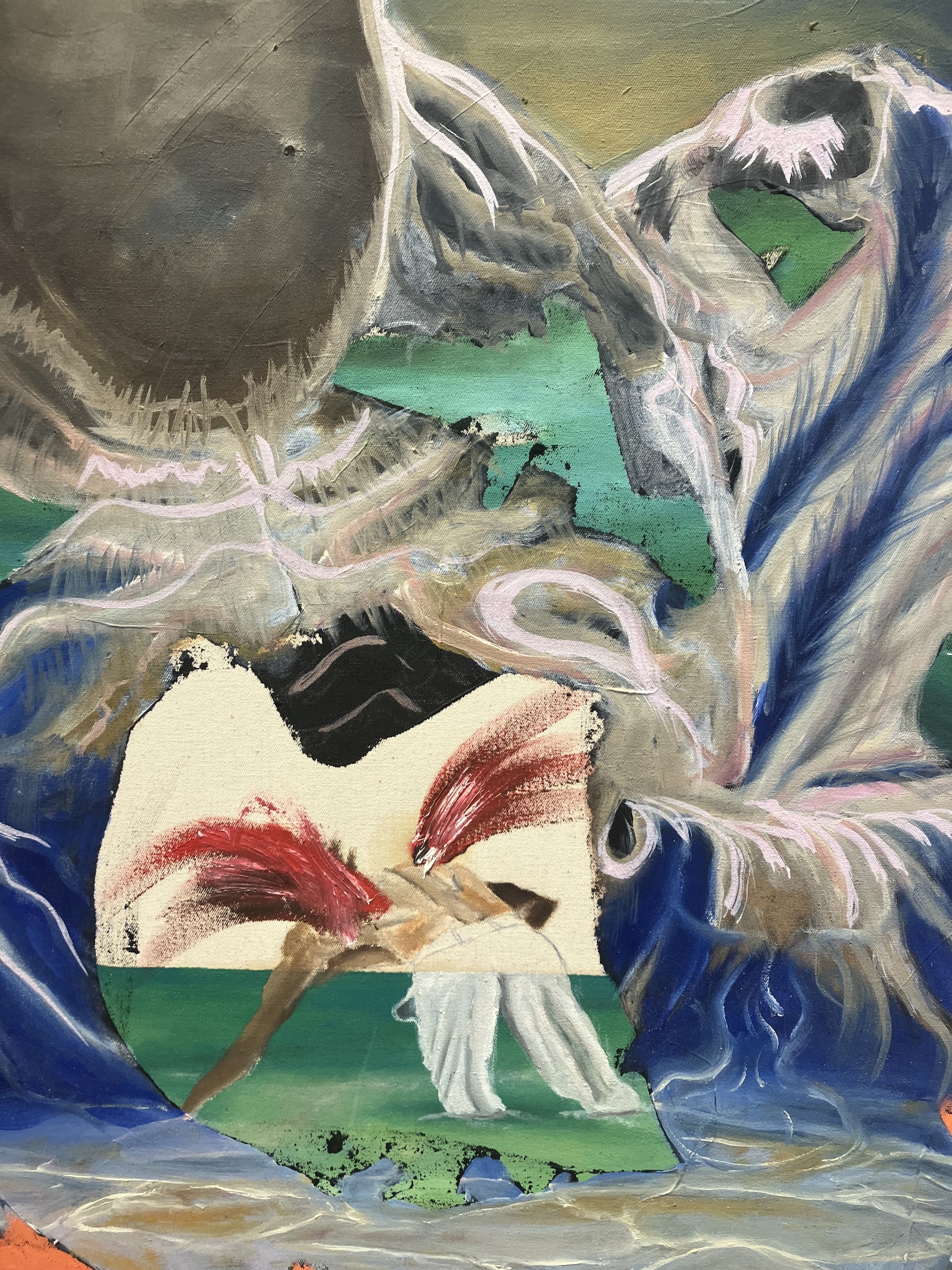
In Gwoka culture, the drum activates the body. Movement does not precede music; it emerges from it. This reversal challenges dominant Western hierarchies of dance, in which movement is often treated as autonomous from sound. Through the research of Blou, Gwoka dance has increasingly been understood as a philosophical system: a way of thinking through the body.
Blou identifies seven foundational rhythms — Léwòz, Kaladja, Toumblak, Woulé, Mendé, Graj, and Padjanbèl — each tied to emotional states, labour, grief, and communal memory. Improvisation becomes a survival strategy as much as an aesthetic choice, reflecting the social instability that shaped Caribbean histories of enslavement, migration, and environmental volatility.
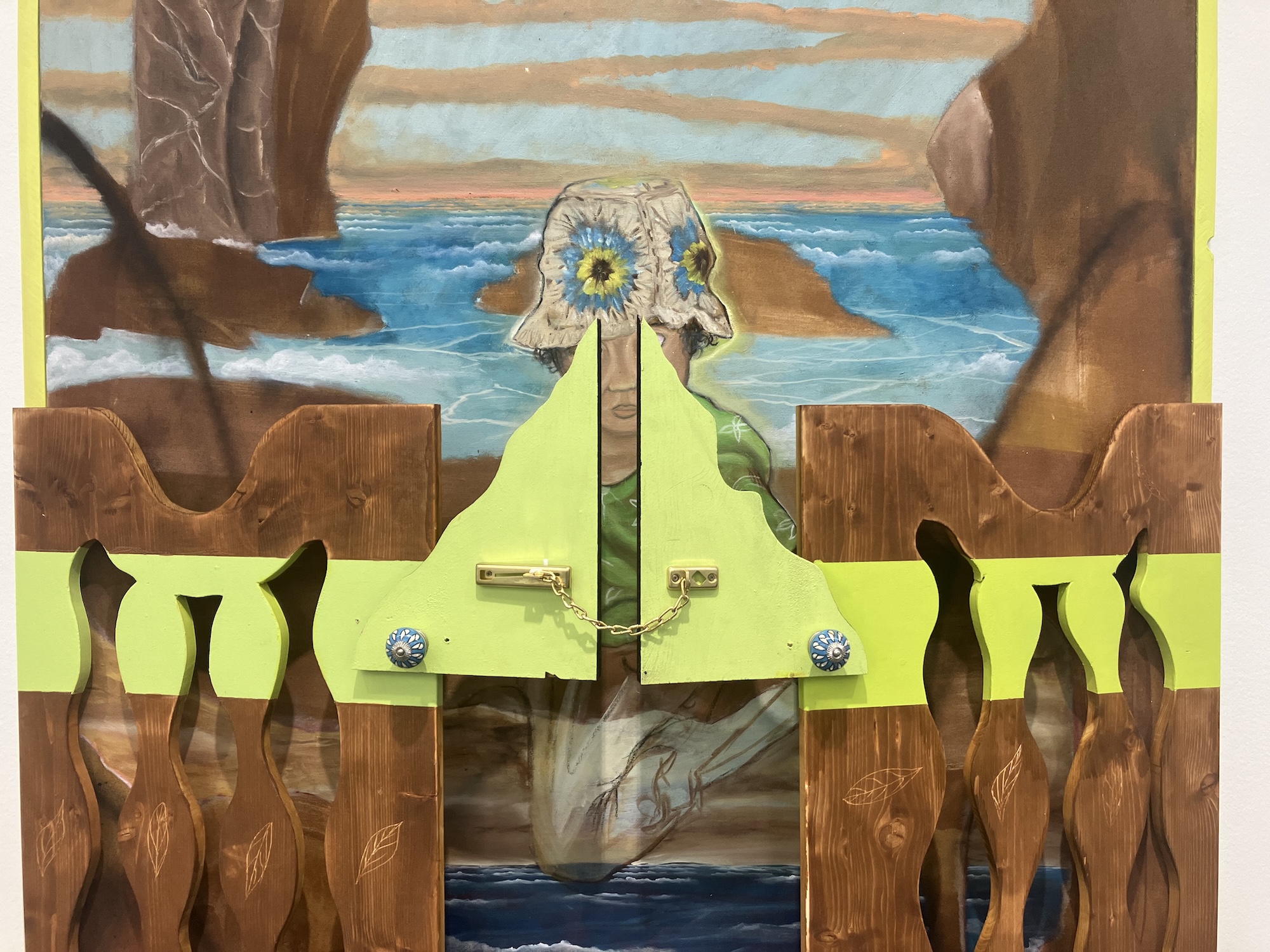
Radin summarises this ethos through a Creole expression: Bigidi, pa tonbé — tremble, but do not fall. For this, the dancer must exercise balance. Balance in the exhibition is continually negotiated, particularly through its role in the choreography of architecture. The installation incorporates sculptural arches that structure the viewer’s movement through the gallery. Radin connects them to cosmic cycles, drawing loosely on the Chinese zodiac: the entrance corresponds to the Year of the Fire Horse, while the exit gestures toward the Fire Goat. Walking through the exhibition becomes a passage through time as much as space.
For the artist, this spatial thinking connects to a broader interest in architecture’s ability to shape behaviour. Modernist systems — from modular housing to the spatial theories of Le Corbusier — often discipline the body through proportion, circulation, and constraint. Radin’s installations instead seek to open the environment, encouraging movement, rest, and tactile engagement.
His practice approaches the scale of a Gesamtkunstwerk: a total work in which painting, architecture, and design extend into one another. Seating elements, surfaces, and spatial structures are intended not only to be seen but to be used, allowing the exhibition to enter the viewer’s physical world rather than remain confined to the neutrality of the gallery’s perfect walls.
This emphasis on intuition and free movement echoes the philosophical dimension of Ka. The mind, in this framework, functions as a vast internal landscape — something closer to a forest or labyrinth than a physical organ. In this sense, the exhibition’s title gestures toward temporal reverberation. Echoes of Ka suggests that energy travels through history, through bodies, and through gestures repeated across generations.
Radin’s response to what can only be described in the most generous light as turbulent present is an energetic calibration: an attempt to rebalance forces that feel out of alignment. If darkness defines the moment, the exhibition proposes light as a counterweight. Like the Gwoka dancer navigating instability, the work trembles. But it does not fall.
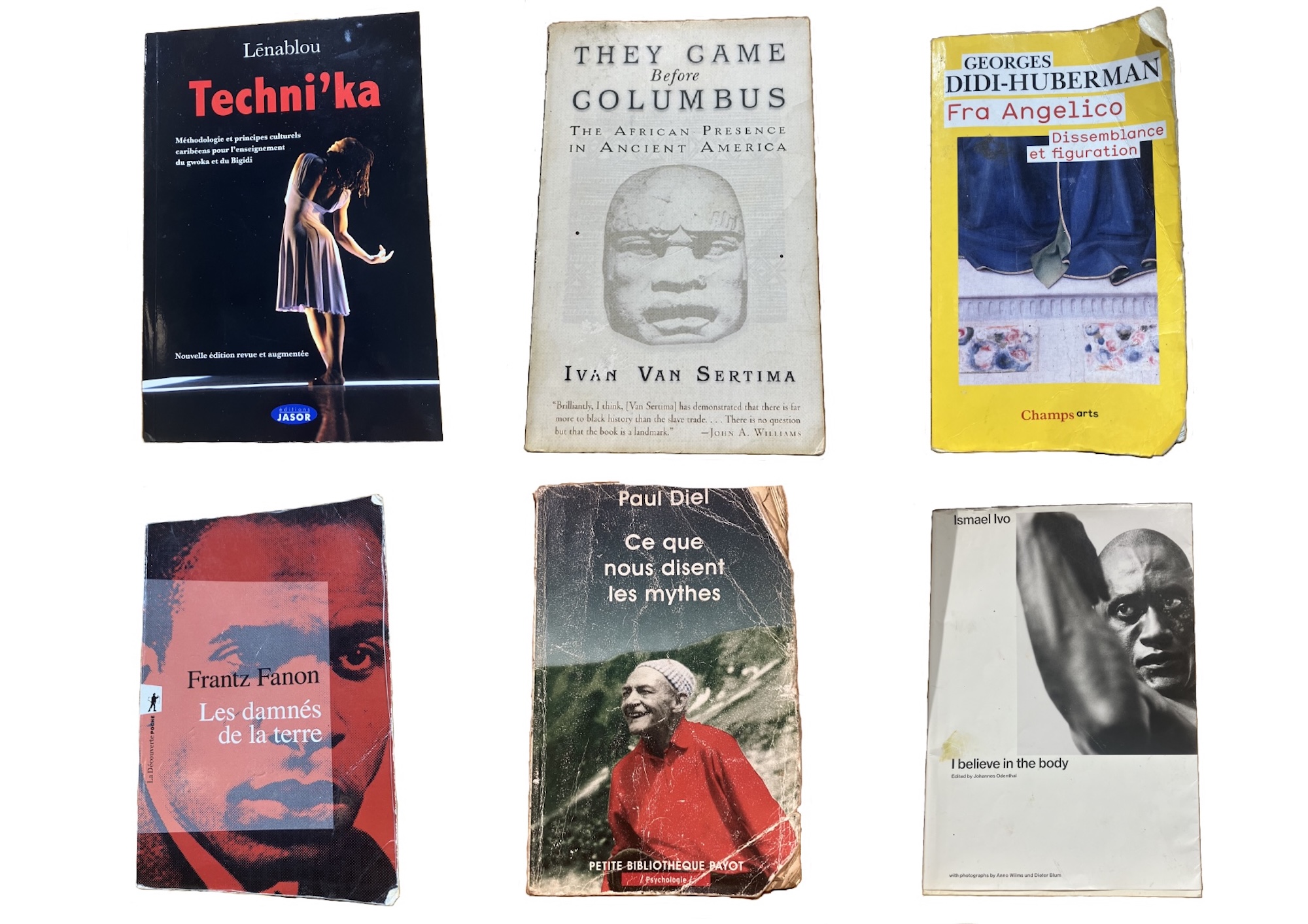
Radin’s bibliography includes:
This work is a poetic, theoretical, and pedagogical exploration of Caribbean dance, centred on Lénablou’s concepts of Techni’ka and Bigidi. Blending cultural history with philosophy, she presents gwoka dance as a carrier of Guadeloupean identity and worldview. The book develops a structured terminology and teaching method for these practices, while also framing them as tools of cultural affirmation, resistance, and embodied thought, extending beyond dance into a broader reflection on how the body expresses history and meaning.
2. They Came Before Columbus by Ivan Van Sertima
This controversial historical work argues that Africans reached the Americas before Columbus. Van Sertima presents linguistic, botanical, and archaeological evidence—such as similarities between African and Indigenous American cultures and the Olmec colossal heads—to suggest pre-Columbian transatlantic contact. The book challenges Eurocentric narratives of “discovery” and emphasizes cross-cultural exchanges.
3. Fra Angelico by Georges Didi-Huberman
This philosophical art study examines the paintings of Renaissance monk Fra Angelico. Didi-Huberman explores how images function in Christianity, especially the tension between iconoclasm (rejection of images) and the religion’s intense production of visual forms. The book reflects on seeing, belief, incarnation, and the power of images in shaping spiritual experience.
4. Les Damnés de la Terre (The Wretched of the Earth) by Frantz Fanon
A foundational anti-colonial text, this book analyzes the psychological and political effects of colonialism. Fanon argues that violence is an inevitable and even necessary tool of decolonization, as colonized people reclaim agency and identity. He also critiques national elites and warns about post-independence corruption, making it both a revolutionary manifesto and a psychological study of oppression.
5. Ce que nous disent les mythes by Paul Diel
Diel interprets myths from various cultures as symbolic expressions of human psychological conflicts and moral struggles. Rather than literal stories, myths reveal inner truths about desire, guilt, and spiritual development. The book proposes that mythology is a universal language of the psyche, helping individuals understand their own inner life.
6. I Believe in the Body by Ismael Ivo
Part manifesto, part artistic reflection, this work centers on the body as a site of memory, identity, and resistance. Drawing from dance, performance, and Afro-diasporic experience, Ivo explores how the body carries history—especially trauma and cultural heritage—and becomes a tool for expression, liberation, and transformation.
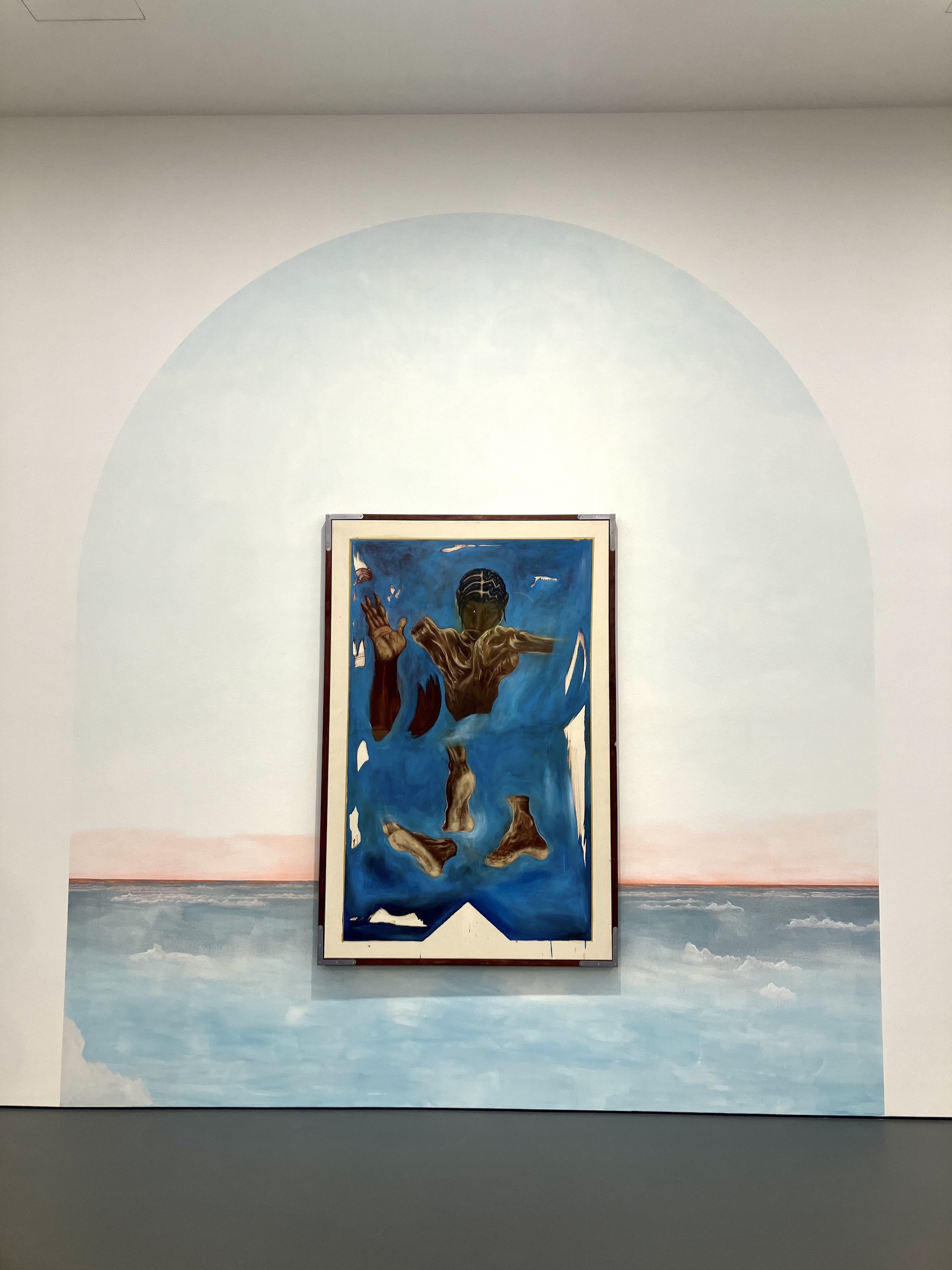
Thomias Radin, Echoes of KA, March 13th—April 18th, 2026, Esther Schipper, Berlin