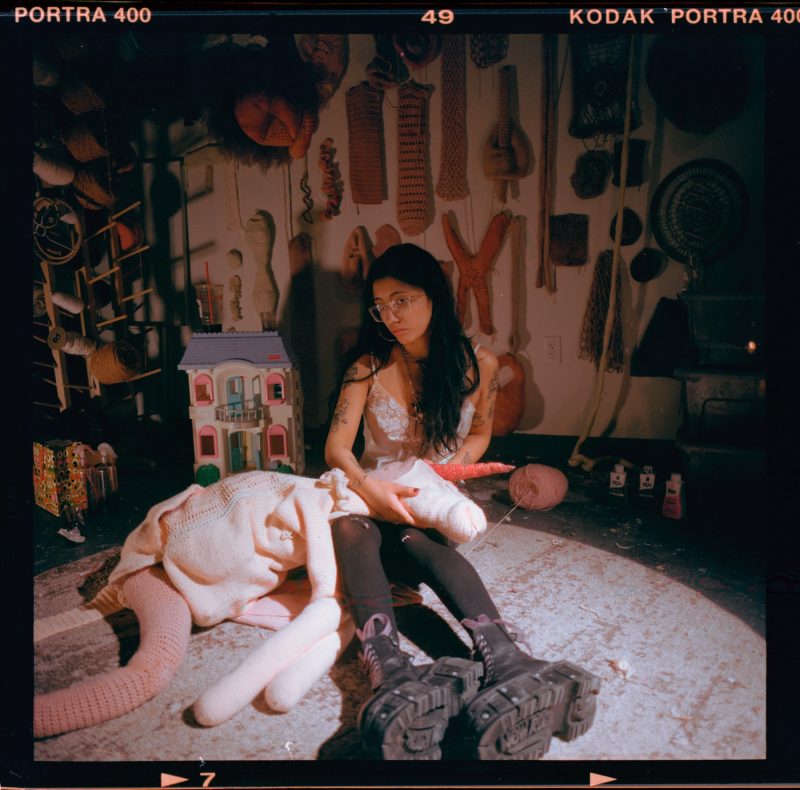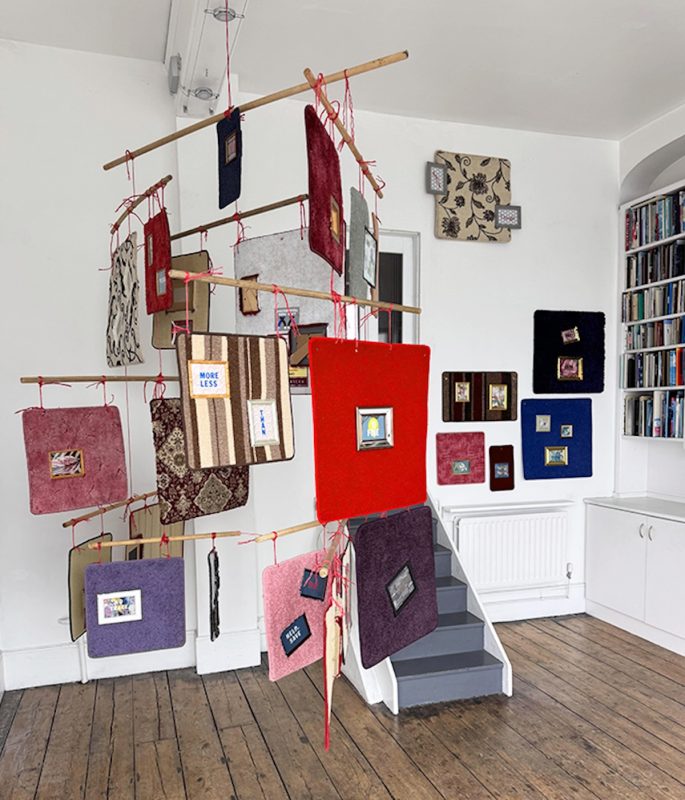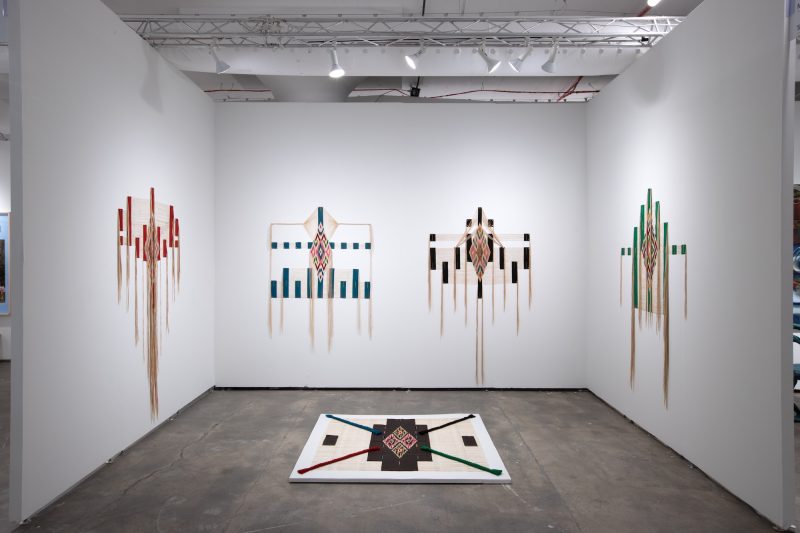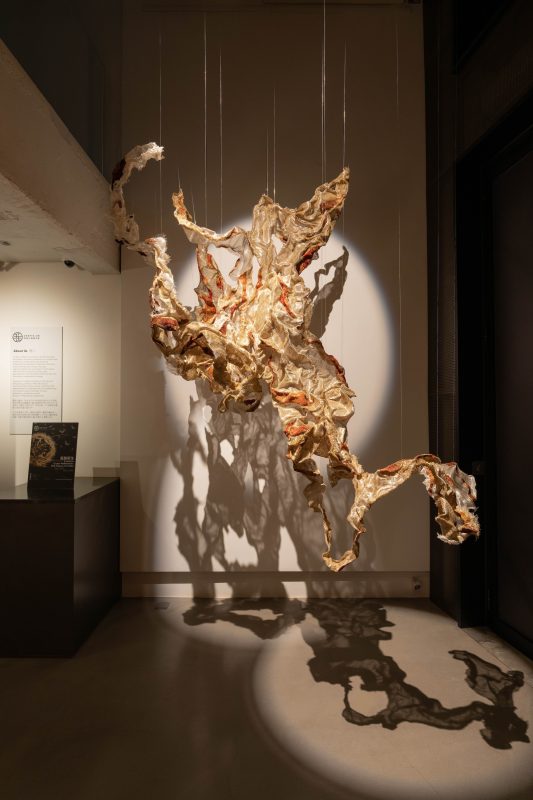

For Condo London 2026, Public Gallery and Proyectos Ultravioleta present The Fold, a group exhibition bringing together eleven international artists whose work moves between textiles, sculpture, installation and performance. Taking its title from Gilles Deleuze’s concept of “the fold”, the exhibition imagines reality as a single, continuous fabric — a surface endlessly folding in on itself, without inside or outside, beginning or end.
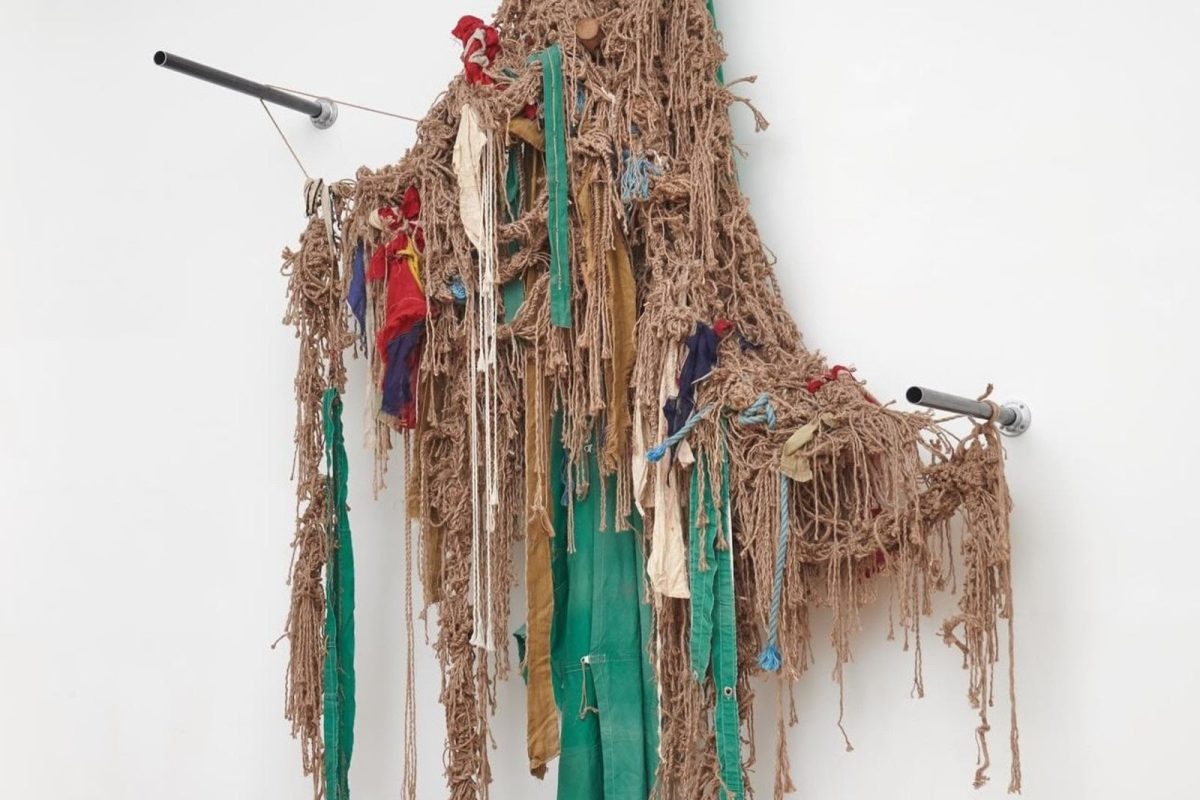
Across the exhibition, woven forms, fibres and fabric become tools for thinking about space, time and embodied knowledge. Rather than treating textiles as decorative or secondary, The Fold positions them as a structural logic — a way of organising experience, memory and relation. As Pennina Barnett writes, the Deleuzian fold is “a virtual, even cinematic image… an infinity of folds always in motion,” and it is this restless movement that runs through the exhibition.
In Felipe Mujica’s hanging textile works, abstraction becomes architecture. His Curtains — often described as “drawings in space” — suspend geometric compositions in fabric, transforming colour and form into spatial propositions. Rooted in histories of craft and collective labour, Mujica’s works draw on collaborations with embroidery collectives and Indigenous artisans, turning modernist abstraction into a living, social surface.
Maya Gurung-Russell Campbell’s Black Standard (2026) uses jute and cotton rope to construct a knotted installation that resists the grid in favour of repetition and endurance. The materials carry the weight of colonial histories and labour, while fragments of British flags pull questions of identity and belonging into the work. What emerges is a fragile but insistent model of collectivity — a network held together by tension, effort and shared time.
In contrast, Sarah Crowner approaches textiles through the expanded field of painting. Her wool-embroidered canvases are built stitch by stitch, forming subtle shifts of colour and curved threadwork that read as both surface and object. Her “stitch maps” on paper act as choreographic scores, guiding the movement of the needle across the canvas. Balancing order and improvisation, Crowner’s work traces what Deleuze and Guattari call smooth and striated space — structured yet alive to touch.
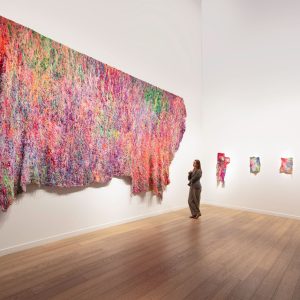
This logic of cut, join and transformation continues in Elisabeth Wild’s kaleidoscopic collages. Her Fantasías assemble altars, doorways and totem-like forms into quilted, architectural fields. Drawing on her life of migration — from Austria to Argentina, Basel to Guatemala — Wild’s fragments carry the spectral weight of displacement, turning collage into a haunted, shimmering archive.
The spectral becomes bodily in Regina José Galindo’s ongoing performance series Aparición, in which veiled figures appear in public space as living monuments to victims of femicide. Wrapped in heavy fabric, these figures collapse past and present into a single moment of urgency, questioning how memory, violence and visibility are held in place. The fold here becomes temporal as much as spatial — a way of holding loss within the now.
Mark Corfield-Moore’s woven works push textiles toward language and code. His ikat tapestries incorporate fragmented text and hand-painted warp threads that blur legibility, echoing the shared roots of “text” and “textile.” Like pixelated screens, his glitch-like patterns sit between meaning and abstraction, inviting viewers into a space where interpretation remains deliberately unresolved.
Together, The Fold proposes textiles not as material alone but as a way of thinking — a method for connecting bodies, histories and spaces without fixing them in place. Across these practices, folding becomes a tool for relation rather than closure, weaving the poetics of fibre into the politics of how things — and people — are held together.
Exhibiting artists: Hellen Ascoli, Maya Gurung-Russell Campbell, Sayan Chanda, Mark Corfield-Moore, Sarah Crowner, Regina José Galindo, Xin Liu, Felipe Mujica, Rose Nestler, Johanna Unzueta, Elisabeth Wild
The Fold : January 17th — February 14th 2026
Public Gallery
The exhibition will be accompanied by a conversation with artist Hellen Ascoli and Wells Fray-Smith co-curator of Unravel: The Power and Politics of Textiles in Art at the Barbican, Monday, January 19th, 6 – 8 pm, 91 Middlesex St, London E1 7DA Register your interest here