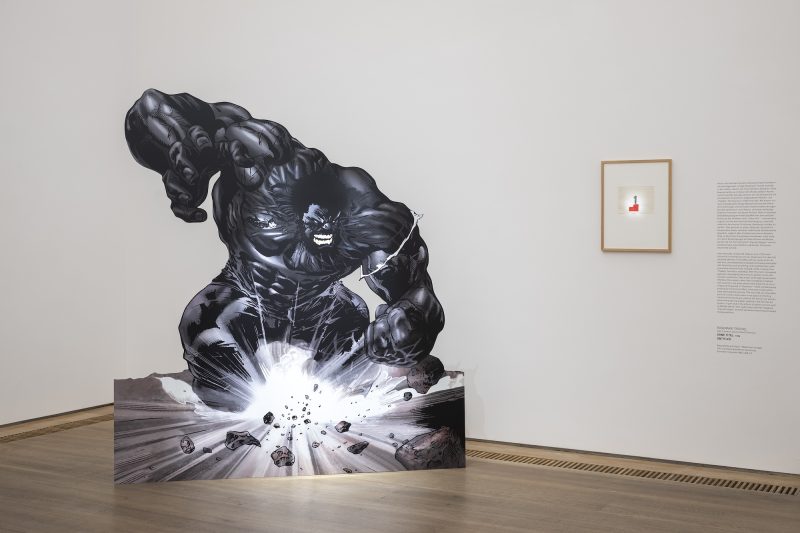
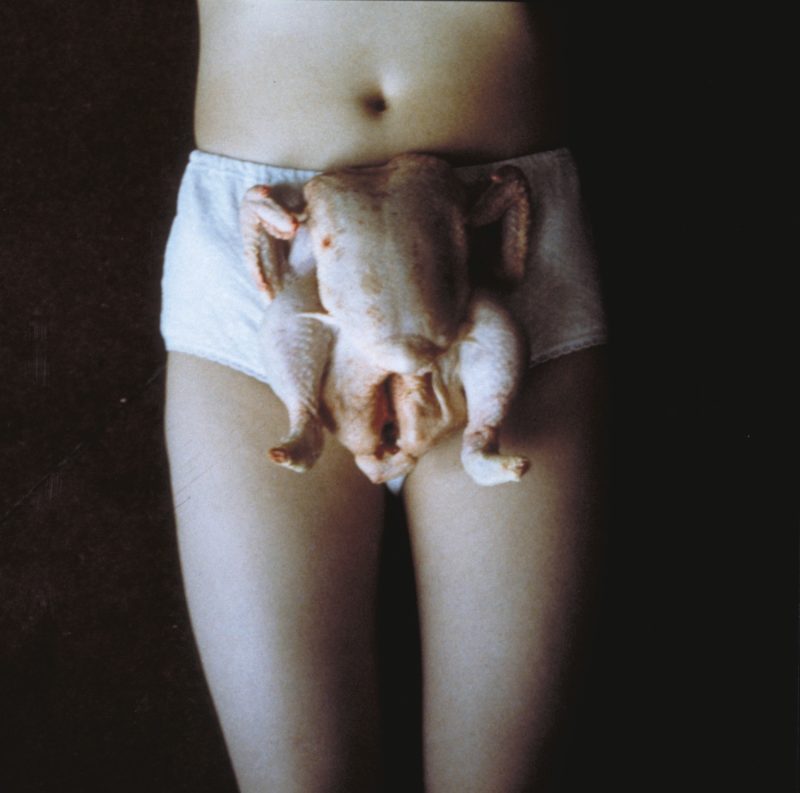
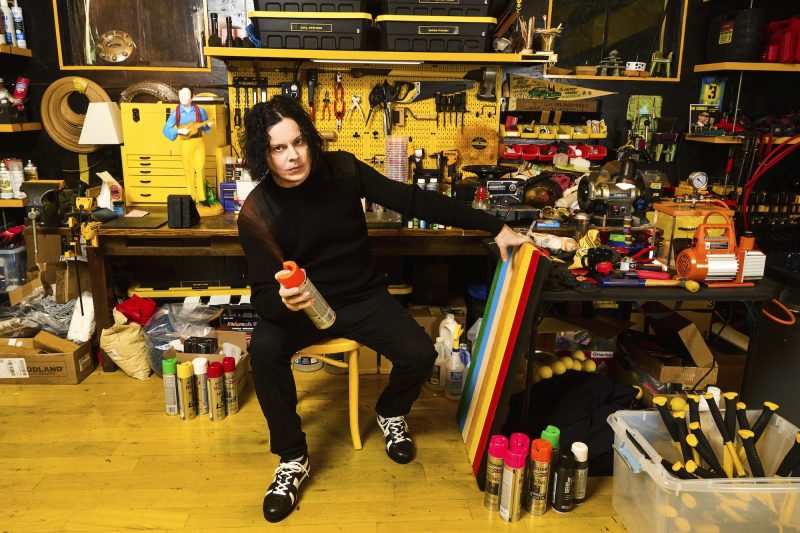
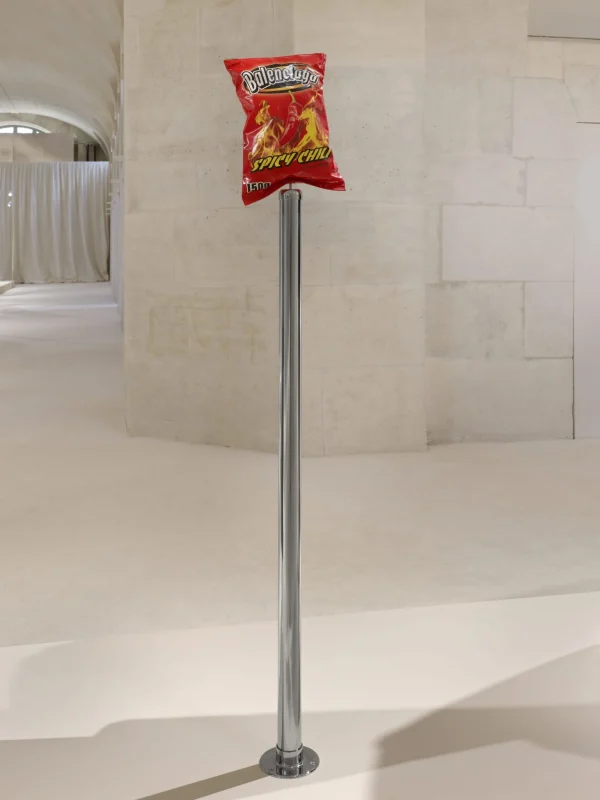
At Newport Street Gallery, Triple Trouble brings together three giants of contemporary visual culture — Shepard Fairey, Damien Hirst, and Invader — in an unexpected meeting of worlds. It’s a show about play and precision, ego and exchange: where street art collides with conceptual cool and pixel mosaics hum alongside butterfly mandalas.
Ahead of the opening, Mark Westall sat down with Shepard Fairey to talk about the art of collaboration, the joy of creative risk, and why finding common ground might just be the most radical act left.
Mark Westall: What was it like collaborating? That feels like the biggest element of this show.
Shepard Fairey: It was fun — and remarkably painless. We all have very different styles and strong visions, but somehow found the right zones of compatibility. Even where things could have clashed, they did so in a way that was exciting rather than awkward. We’re all relentless about making something work, willing to throw things out no matter how much energy we’ve put in.
One thing about Damien and Invader — they both want to make sure that if you’re going to share it, it’s good. “Good” is subjective, of course, but we had a consistent sense of what that meant. That’s how we got across the finish line with this show.
Did you actually work together in the same space?
A few times, yes. Mostly, we’d comp up ideas and send them to each other. Sometimes I’d start a piece and pass it to Damien, or Invader would begin something and send it to me. Other times the whole thing was produced in one of our studios, but with input from the others.
Some people define art as something that must be done by your own hand — paintbrush, beret, candlelight. None of us believe that. Invader has a couple of assistants, I have three, Damien has a hundred-plus. We’re all able to produce ambitious work without being limited by old notions of craft. Damien’s technical capabilities are incredible — they pushed me to raise my own game.
Invader’s world is much more structured, but finding ways to push his parameters — or letting me reinterpret his aesthetic — was generous on his part. There was real flexibility from everyone. It might sound too good to be true, but I’d challenge anyone to come to the show and see if they don’t agree.
It looks like fun — like three people playing.
Exactly. It was joyful.
That brings to mind Picasso’s idea of wanting to paint like a child — free from adult restrictions.
Yes, and I think that’s part of it. Normally my work addresses heavy issues — threats to democracy, the planet, human rights, equality. Some pieces in this show still touch on that, but much of it celebrates joy and creative common ground. In a way, it’s a microcosm of what the world needs more of.
Collaboration, community — those ideas feel powerful now. You can’t fix the world at the macro level, but you can plant seeds and influence people one by one.
Absolutely. That’s the essence of this show.
The energy almost feels like musicians jamming.
You’re not the first to say that! As a punk rocker, the idea of “jamming” always seemed dangerous — indulgent — but it’s a good analogy. When you jam, you’re not precious; you didn’t come in with a finished song. Things mutate in interesting ways.
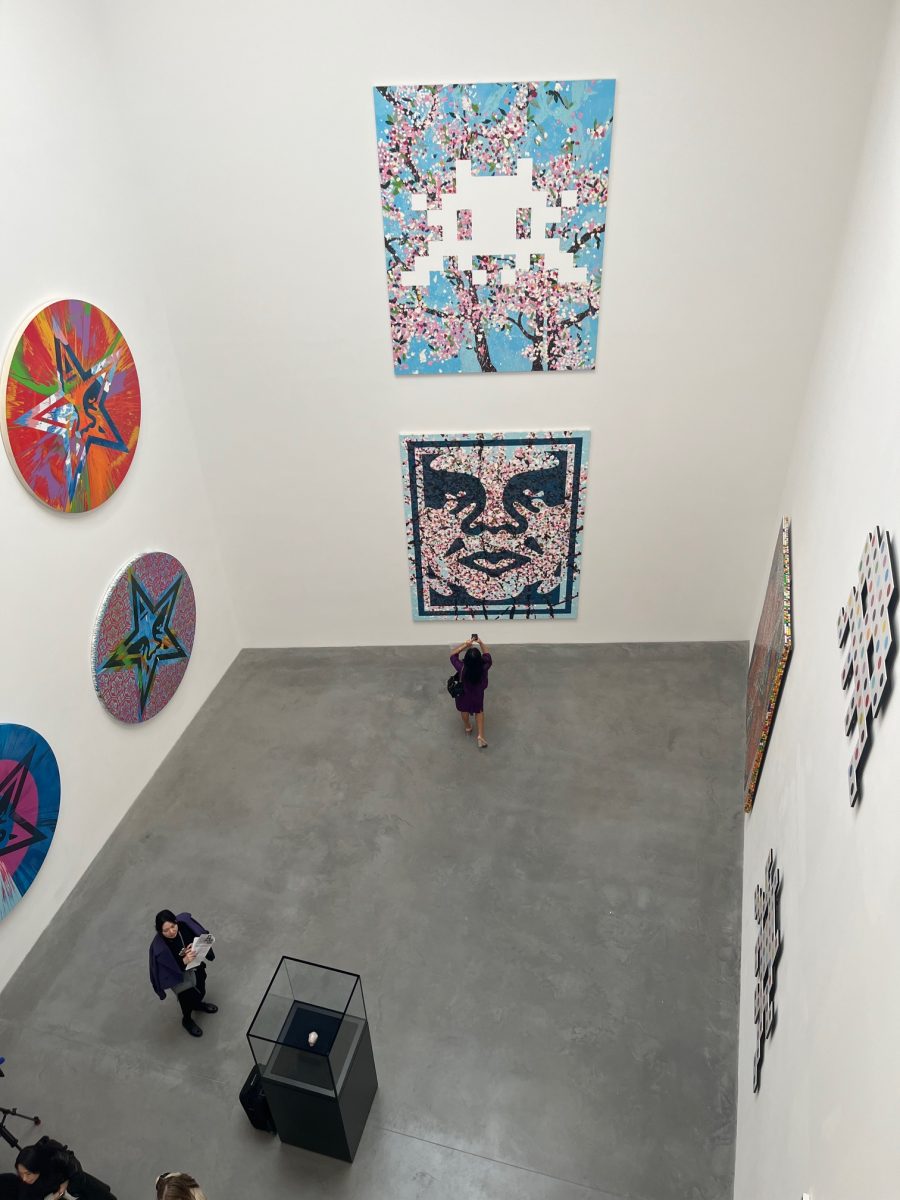
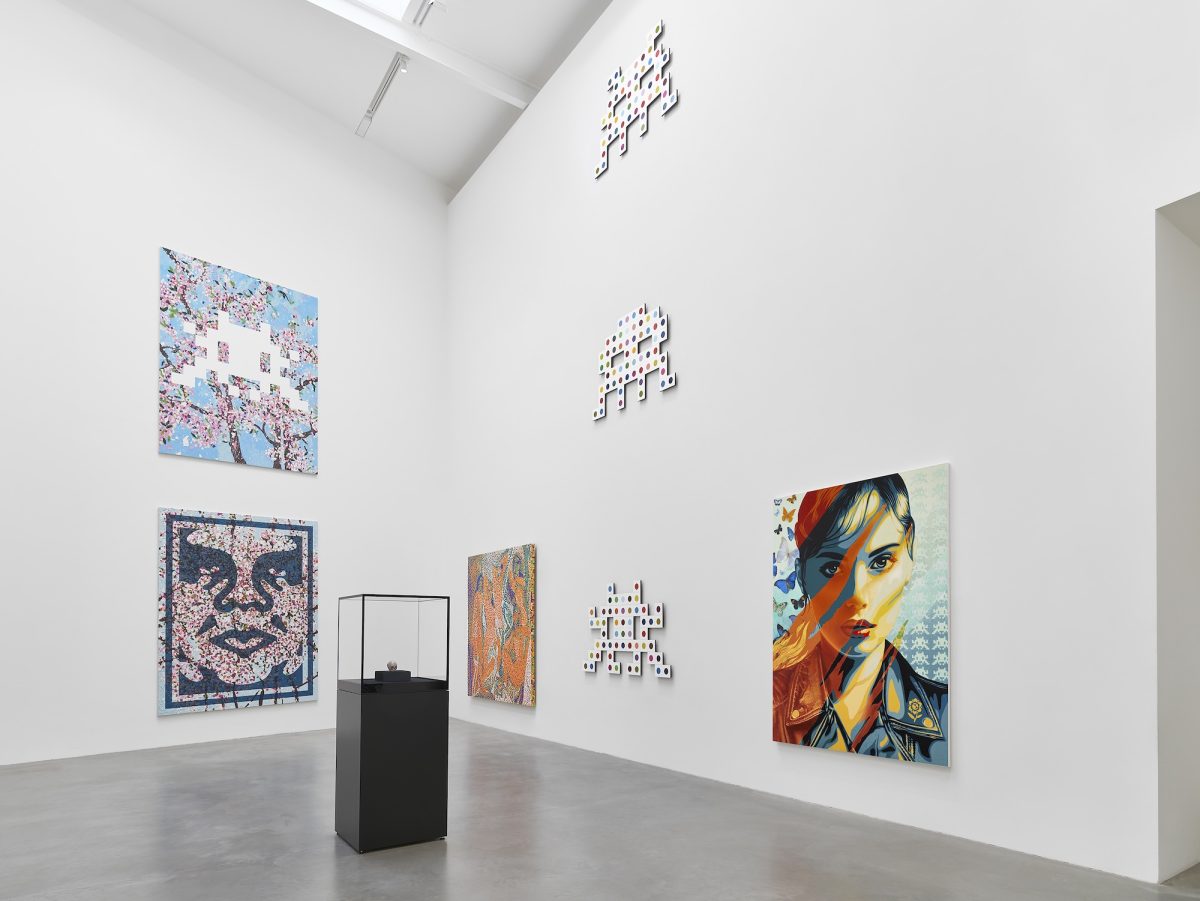
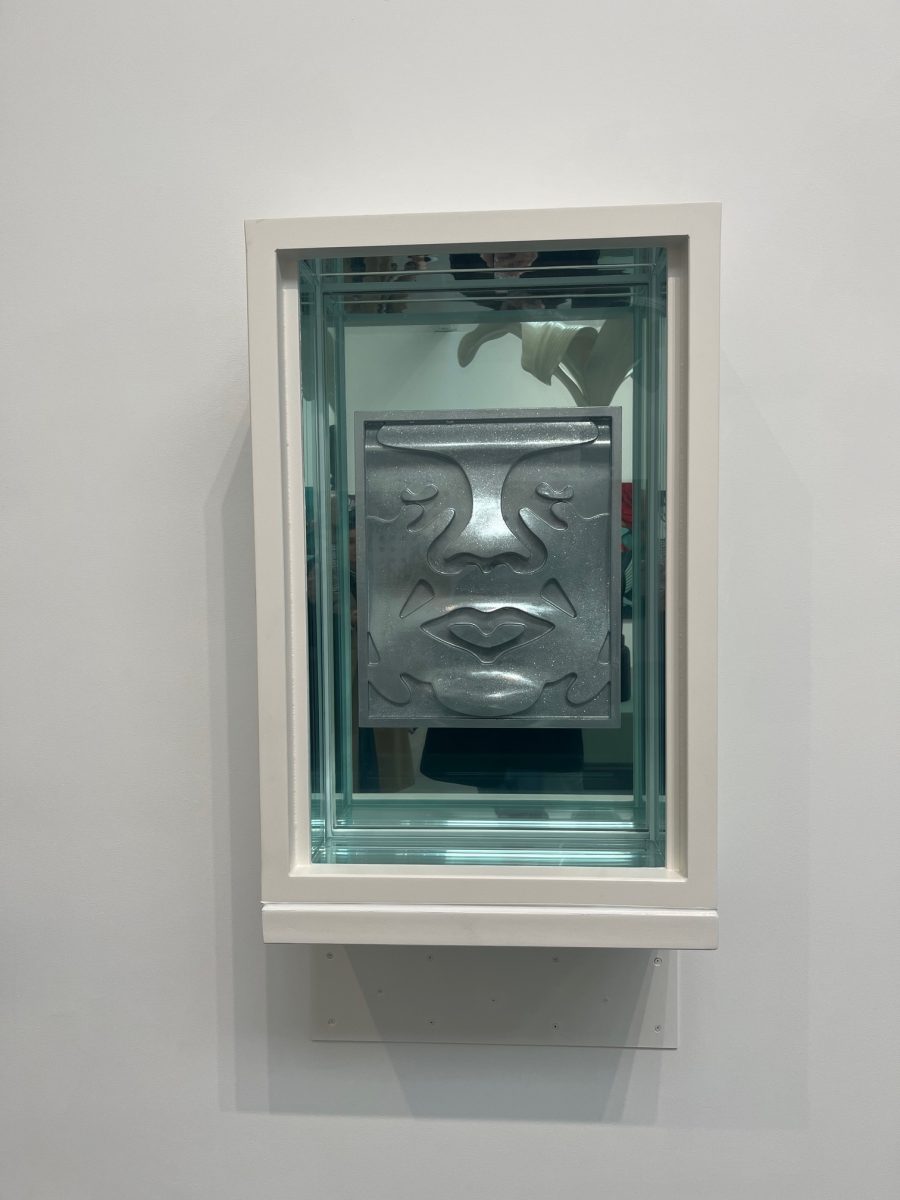
People will recognise our iconography — my OBEY face, Damien’s spots, Invader’s mosaics — but there are also subtle hybrids that surprise me.
What’s an example of that?
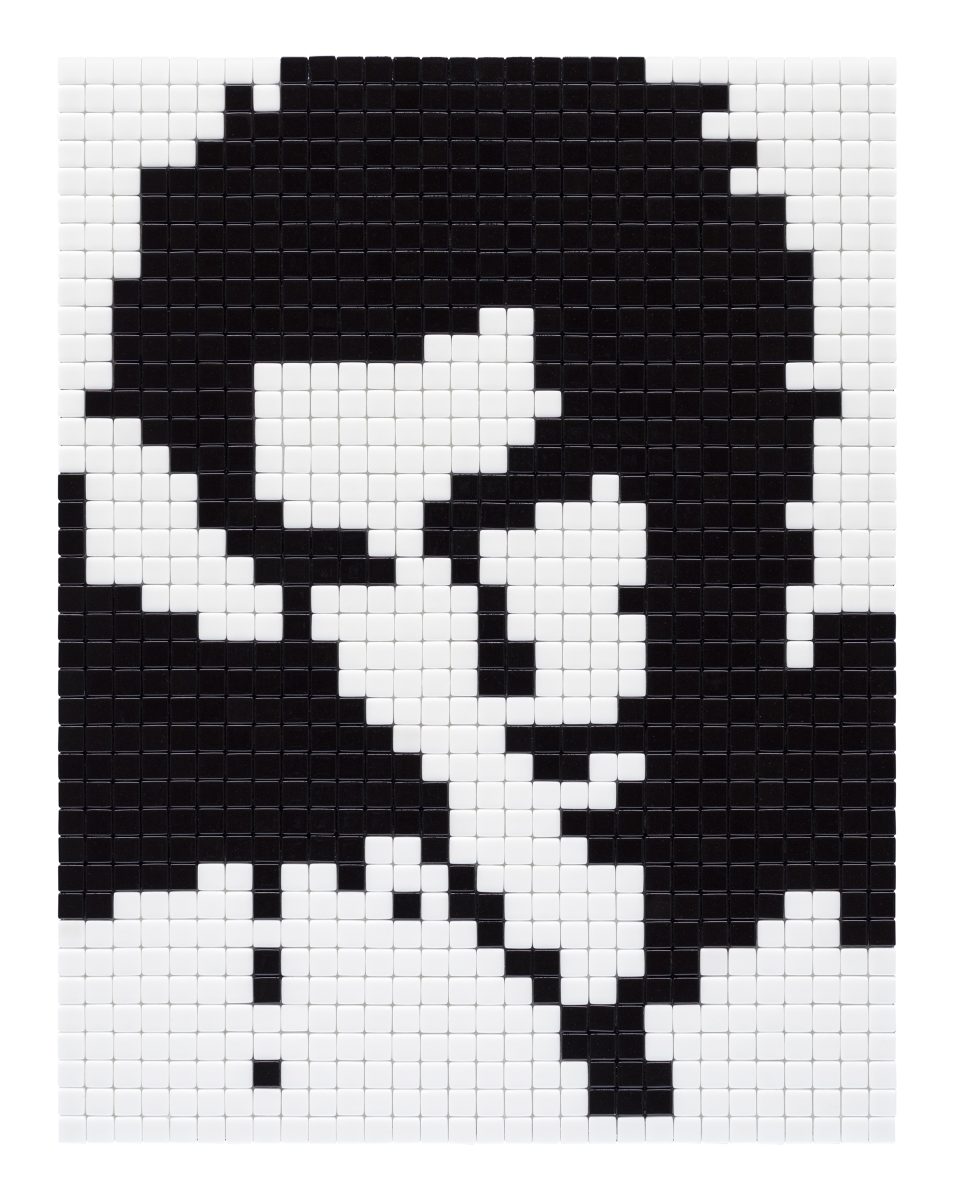
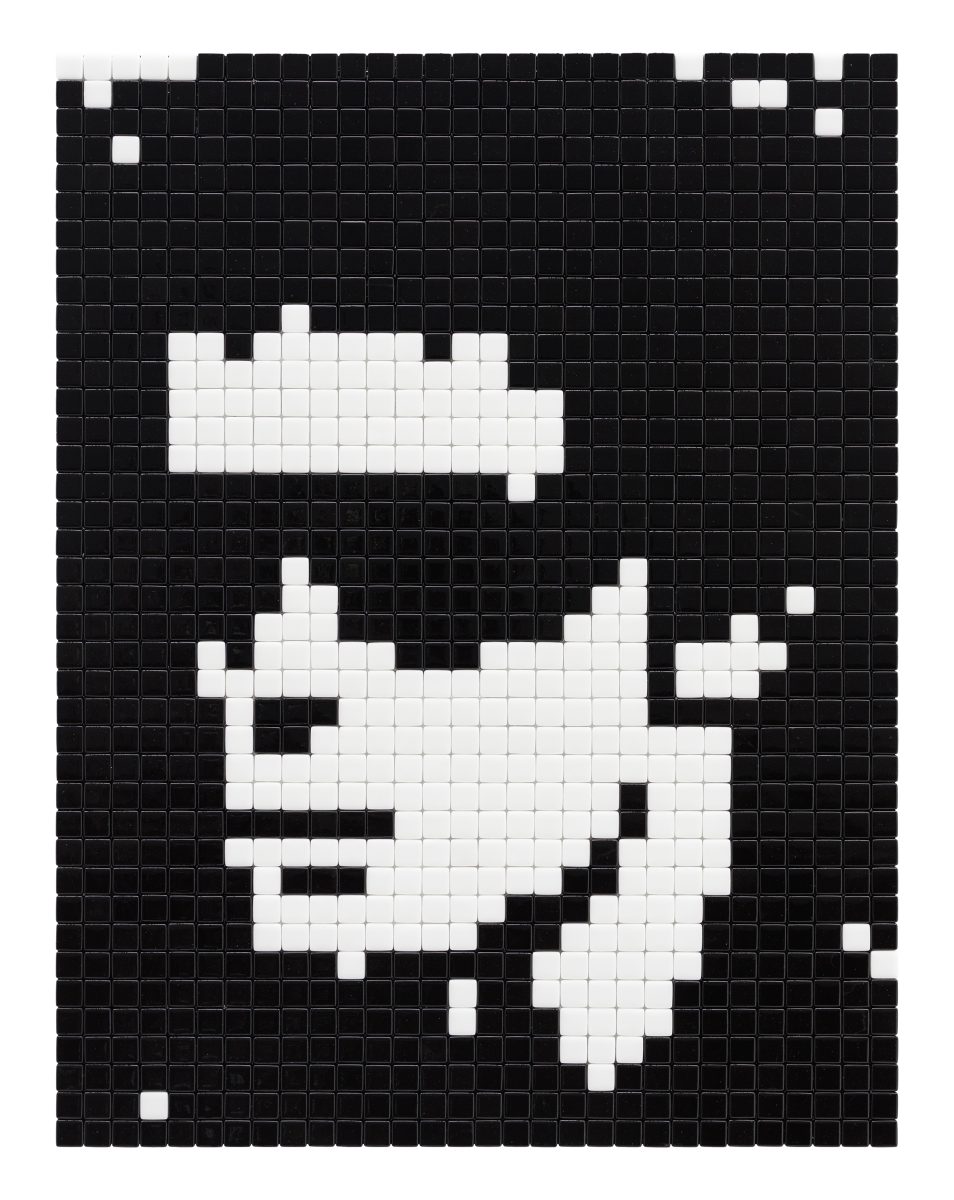
One of my favourites is a series of portraits of David Bowie, Iggy Pop, and Lou Reed — another “triple trouble” group who collaborated like we have. I used Invader’s mosaic structure for the portraits, then added my own stencilling, cut paper, and ink washes. Up close, it’s clearly Invader; from a distance, it reads as a Shepard piece.
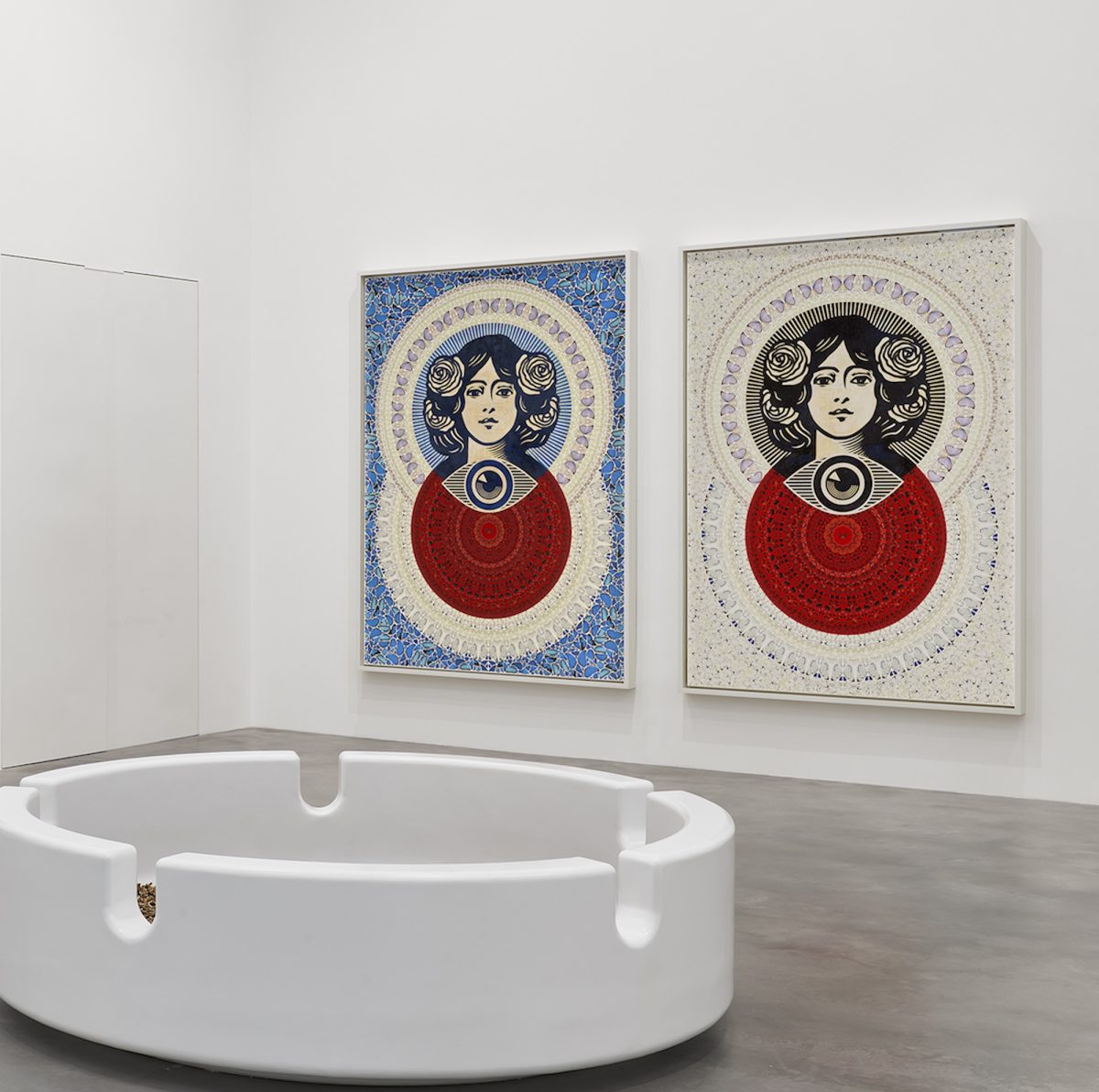
Two other favourites are Third Eye, Butterfly Mandala (Blue) and Cream, which combine my Make Art Not War woman with Damien’s butterfly mandalas. His mandalas usually have no focal point — they’re hypnotic, all-over fields. I introduced a dominant image that converges with his forms, the two hemispheres meeting at an eye. It’s a blend people won’t expect, but it works beautifully.
What’s next for you?
I’m heading to Berlin for a show at Fotografiska Museum called Photo Synthesis. It focuses on how photography feeds into my work. Fotografiska began as a photography museum, and this is their first fine art show that’s not purely photography. I’ve used photos for years — for reference, for street documentation, for collage. This show brings that to the surface. It’s toured Stockholm and Tallinn, and Berlin is the final stop.
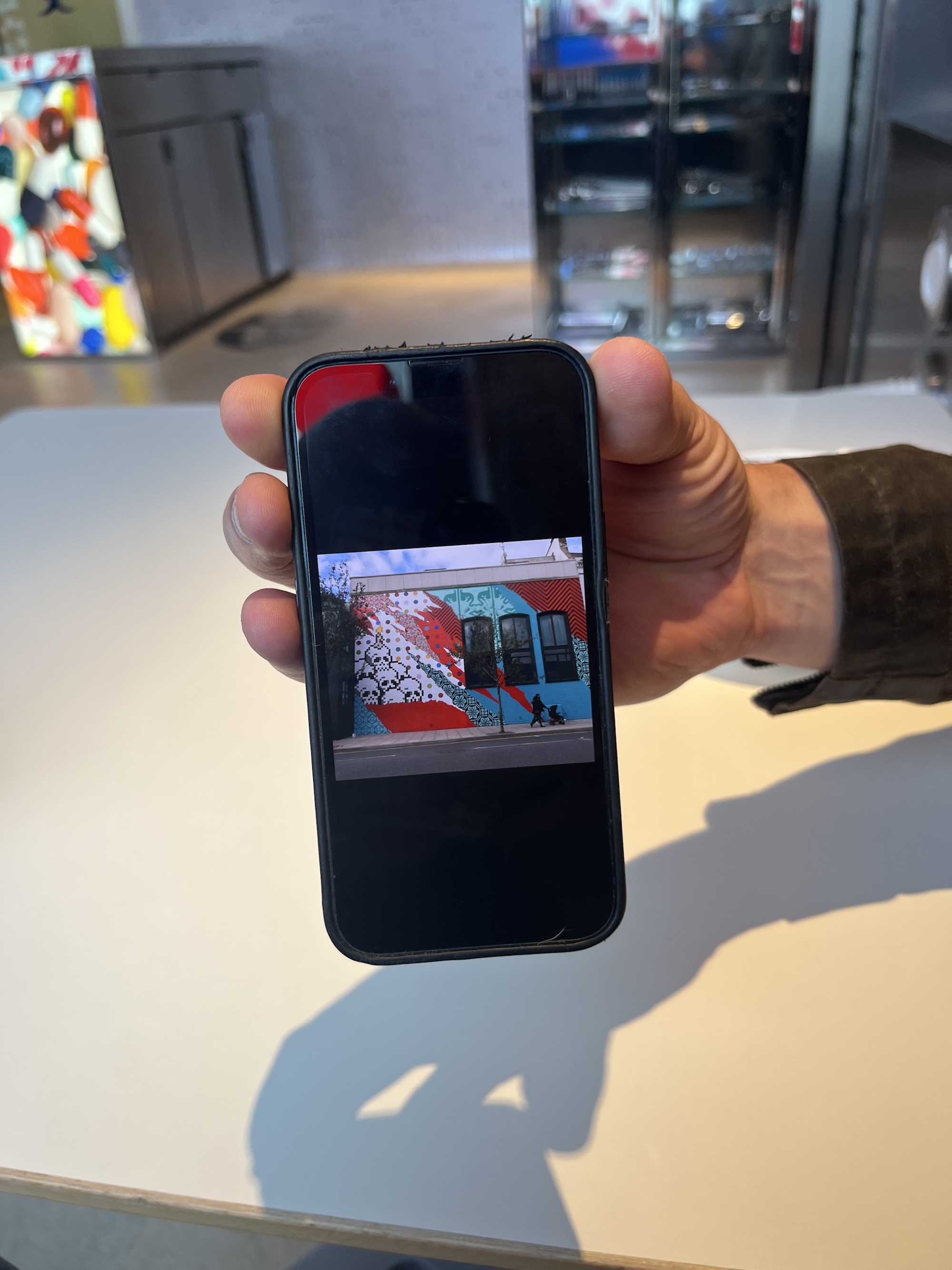
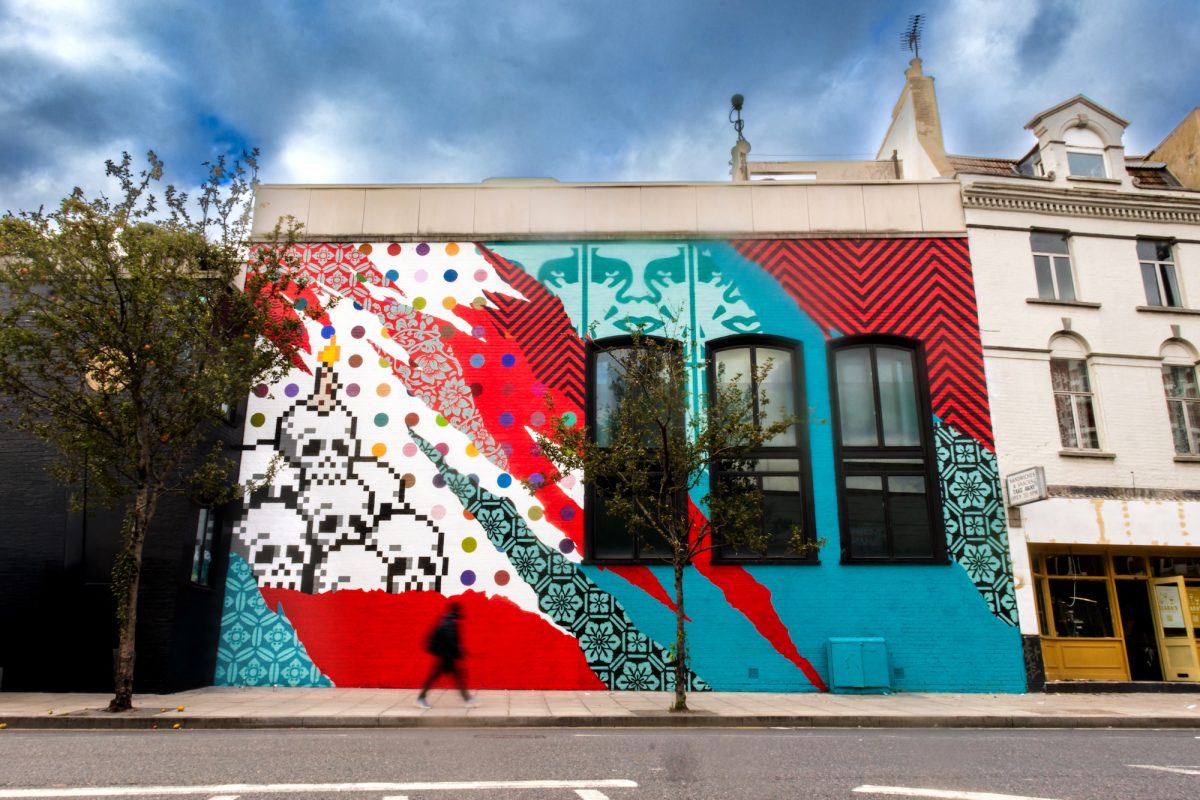
Of course, I’m always juggling projects — new art, prints, murals, clothing, and work with progressive organisations. I even painted a mural here in Shoreditch featuring all three of our visual languages. (first image above)
Where is it?
Right across from Boxpark. You’ll see the spots, the Invaders, my icons — all mixed together.
Has this show given you more appetite for collaboration?
SF: I’ve always collaborated. Often with younger artists I want to help get attention. I don’t see it as being superior — just helping accelerate recognition for people who deserve it.
A lot has changed since the ’70s, when artists in Britain didn’t expect to make money. Now many see it as a career.
I came from punk, skateboarding, street art — worlds where you expected to be broke forever. Money was just a tool. If I could live cheaply, I could make less and have more freedom.
It’s harder now though — the cost of living is wild.
Totally. I live in Los Angeles, and it’s insane. I feel for younger artists — so many talented people can’t afford homes or a decent lifestyle.
It takes time. So many cultural figures didn’t make money for years — Jarvis Cocker, Frieze, Dazed — they built ecosystems others later benefited from.
Exactly. And no artist should feel ashamed for needing to make money or doing brand collaborations, as long as it’s ethical. I wouldn’t work with a gun company or cigarette brand, for example.
That’s funny — no one in Britain would even think of working with a gun company.
In the US, it’s a huge issue. And when the art market booms, it can warp people’s intentions. The key is to stay grounded — balance honesty with survival. Everyone has to find their way.
The fashion industry seems to be pouring money into art now.
It should. Fashion moves fast — it needs ideas with longevity and cultural weight, otherwise it burns out.
I’ve always said I like ideas more than art itself. The scary thing in America now is the attack on education — people like Trump don’t want people to think.
Trump’s goal is dictatorship — a fascist state where freedom only exists in service of the “supreme leader.” It’s a hybrid of authoritarianism and capitalism. A narcissistic sociopath with power is one of the most dangerous forces there is.
And the system rewards people like that.
Exactly. Trump’s celebrated because he “does what he wants.” But it’s a warped model of success. For me — married, with two daughters and so many women on my team — that culture is barbaric.
It’s the illusion of power.
Yes — people will accept injustice if they have a comfortable position within it. The Handmaid’s Tale showed that perfectly — the chickens coming home to roost.
We could talk about this all day.
SF: [laughs] Totally.
You must be exhausted — it’s a big show.
It’s been busy, but I’m thrilled. There’s so much work in it, and we managed to hang it beautifully. I’m proud of what we achieved.
What happens to the works now?
We’re hoping to sell them. I’ve spent a year and a half on this project, so it’s time to recoup a bit. What’s really touching is that instead of being sick of each other, Damien texted me saying he’s sad it’s over — that he misses the exchange of ideas. That meant a lot.
It can be a lonely process otherwise.
Definitely.
Are you working with HENI too?
Yes. I produced these pieces in LA with Invader — you’ll see them downstairs. They’re tile-based works combining my iconography with his. We also made limited edition screen prints of four variations — debossed with letterpress, using translucent black ink to echo the tile grooves. They’re elegant, and more affordable than originals. HENI’s handling the framing and sales of those, plus a few other pieces.
They’re great at that.
They really are.
At its core, Triple Trouble is about creative chemistry — three distinct voices finding harmony through friction. In Fairey’s words, it’s “the joy of people finding common ground,” a reminder that collaboration, when it works, can feel as vital and subversive as protest itself.
Triple Trouble -16th February 2026 Newport Street Gallery, London
Admission is free.
The original works in the Triple Trouble show will be available by application on HENI Primary. HENI Editions will also release several new print editions by Shepard Fairey, Damien Hirst and Invader throughout the five-month run of the exhibition. A registration form is available on the HENI website for those who wish to be notified when the works are released for sale.