Hauser & Wirth is to present its first exhibition with Lee Bul this September, bringing together major new sculptures, paintings and recent bodies of work exploring technology, utopian ambition and the inevitable failure of our attempts to control the future.
Opening at Hauser & Wirth’s West 22nd Street gallery in New York on 10th September 2026, The Anatomy of Every Setting Sun is organised by guest curator Dr. Jiyoon Lee and continues the Seoul-based artist’s longstanding fascination with the promises — and ruins — of modernity.
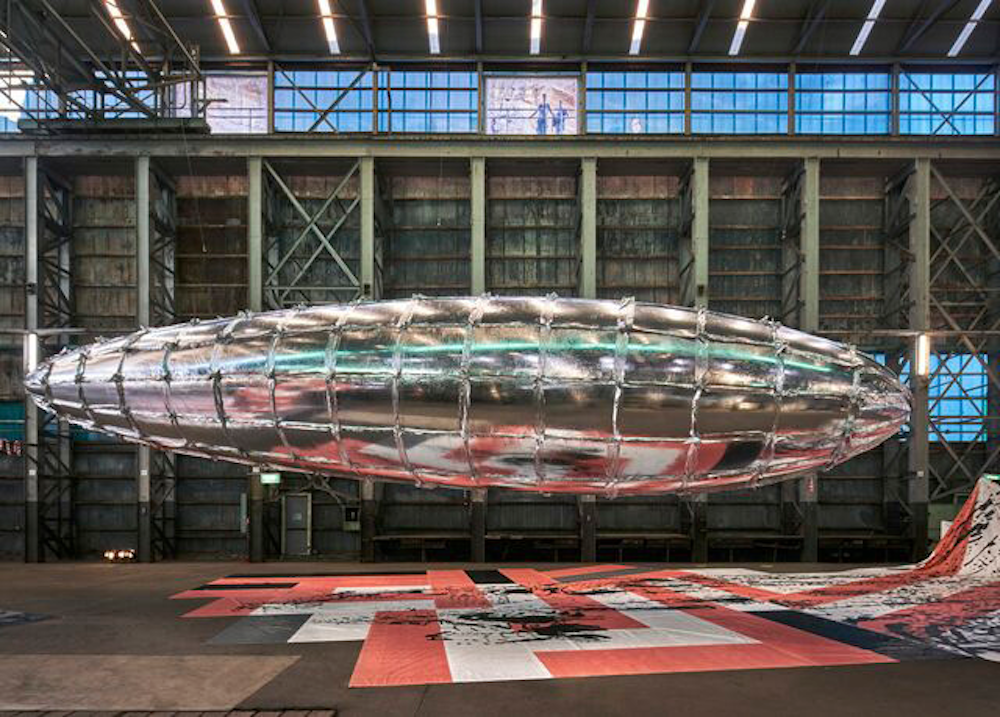
At the centre of the exhibition, literally hovering inside the gallery’s ground floor, will be Willing To Be Vulnerable—Metalized Balloon (2015–2016/2020), Lee’s enormous silver zeppelin-like sculpture constructed from lightweight materials including PET film.
The airship takes one of the great symbols of technological progress and transforms it into something altogether more precarious. Monumental but lightweight, futuristic yet haunted by historical catastrophe, it sits somewhere between an object of technological optimism and the remains of a failed future.
Alongside it, Lee will debut new paintings from her ongoing Untitled (Willing To Be Vulnerable—Velvet) series. Each can take months, sometimes years, to complete, beginning with photographs of Lee’s own sculptures and installations before accumulating source imagery, material from her studio and intricately cut mother-of-pearl across silk velvet.
The resulting surfaces resemble strange landscapes from imagined future worlds, where crystalline architectures emerge and disappear among layers of organic and synthetic material.
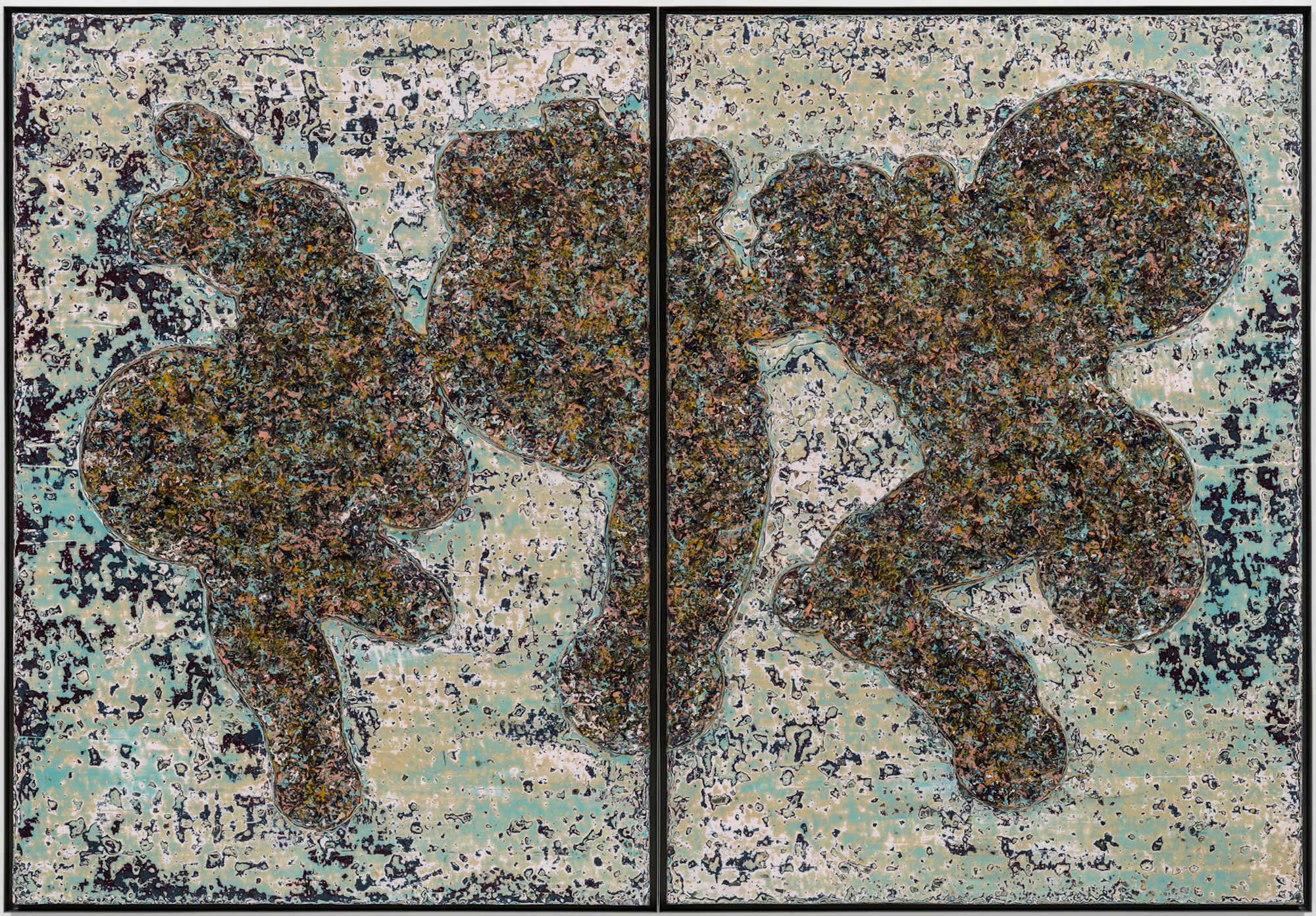
New works from Lee’s Perdu series similarly move between painting and sculpture. Mother-of-pearl is embedded into repeated layers of acrylic paint, which are applied and sanded back to produce shifting surfaces. While earlier works drew heavily on the biomorphic forms of Lee’s sculptures, the latest pieces move towards more abstract architectural landscapes.
A group of new large-scale sculptures will also develop ideas first explored in Lee Bul’s 2024 Long Tail Halo commission for The Metropolitan Museum of Art’s Fifth Avenue façade. Combining bodily, mechanical and architectural forms, the hybrid structures examine the monuments through which societies express power while imagining forms that appear simultaneously futuristic and fragmentary.
The exhibition arrives at a significant moment for Lee Bul. Just weeks after the New York show closes, her major travelling survey Lee Bul: From 1998 to Now will open at the Museum of Contemporary Art Antwerp on 13th November, before travelling internationally.
Born in Yeongju in 1964 and now based in Seoul, Lee emerged internationally during the 1990s with work spanning sculpture, installation and performance. Her practice has subsequently become closely associated with ideas around utopian modernity, technology, the body and the remnants left behind by failed visions of progress.
For The Anatomy of Every Setting Sun, those concerns come together as a landscape of airships, hybrid bodies, seductive surfaces and imagined architectural ruins — visions of the future that already appear to contain the seeds of their own collapse.
Lee Bul: The Anatomy of Every Setting Sun, 10th September–24th October 2026
Hauser & Wirth New York, 22nd Street
About the artist
Lee Bul (b. 1964, Yeongju) lives and works in Seoul, South Korea. Having graduated from Seoul’s Hongik University with a BFA in sculpture, she made early breakthroughs to create multi-faceted, provocative works that crossed genres and disciplines exploring themes of beauty, corruption, and decay.
Some of Lee’s now-iconic works from this period were considered integral in the emergence of a global contemporary art of the 1990s, as advocated by supporters of her work, influential curators including Harald Szeemann, Hans Ulrich Obrist, and Okwui Enwezor.
Lee’s ‘Majestic Splendor’ (1997), an installation featuring decomposing fish adorned with sequins that was shown at the Museum of Modern Art, New York, was selected by Szeemann for his Venice Art Biennale exhibition in 1999, ‘dAPERTutto.’ The same year, her karaoke installation ‘Gravity Greater Than Velocity I, II’ (1999) and ‘Amateurs’ (1999), featured in the Korean national pavilion and she received honorable mentions for both projects.
Since then, Lee’s work has increasingly explored the enduring themes of utopian modernity and the rise and fall of progressivist projects, influenced by her own experience as the daughter of political dissidents during Korea’s turbulent social and political transformation.
Following an artistic residency in New Zealand in 2005, Lee embarked on a series of sculptures and related works on paper and canvas furthering her artistic inquiry on the ruins of historical projects to build a better civilization. Lee’s current practice continues to delve into this expansive topic, reflecting on the ‘melancholic traces’ of these failed progressivist ideals.
In 2024, Lee was commissioned by the Metropolitan Museum of Art, New York, to create sculptures for the niches of its landmark Fifth Avenue facade. ‘The Genesis Facade Commission: Lee Bul, Long Tail Halo’ on view from 12 September 2024 to 10 June 2025.
A major touring survey co-curated by Leeum Museum of Art, Seoul, and M+, Hong Kong, opens in Belgium at the Museum of Contemporary Art Antwerp on 13 November, before touring to other international venues.
Lee’s work is held in prominent public collections throughout the world, including the Metropolitan Museum of Art, New York; Solomon R. Guggenheim Museum, New York; Los Angeles County Museum of Art; Walker Art Center, Minneapolis; Tate Modern, London; British Museum, London; Musée d’Art Moderne Grand Duc Jean, Luxembourg; National Gallery of Canada, Ottawa; National Gallery of Victoria, Melbourne; M+, Hong Kong; Mori Art Museum, Tokyo; 21st Century Museum of Contemporary Art, Kanazawa; Leeum Museum of Art, Seoul; Amorepacific Museum of Art, Seoul; National Museum of Modern and Contemporary Art, Korea.
She is the recipient of the 9th Ruth Baumgarte Art Award (2023); Honorary Doctorate from the School of the Art Institute of Chicago (2022); Ho-Am Prize in the Arts (2019); Insignia of Officier, Ordre des Arts et des Lettres (2016), presented by the Ministry of Culture, France; and the Noon Award (2014), presented by the Gwangju Biennale Foundation. She was awarded a Menzione d’Onore (1999) for her contribution to the 48th Venice Biennale.