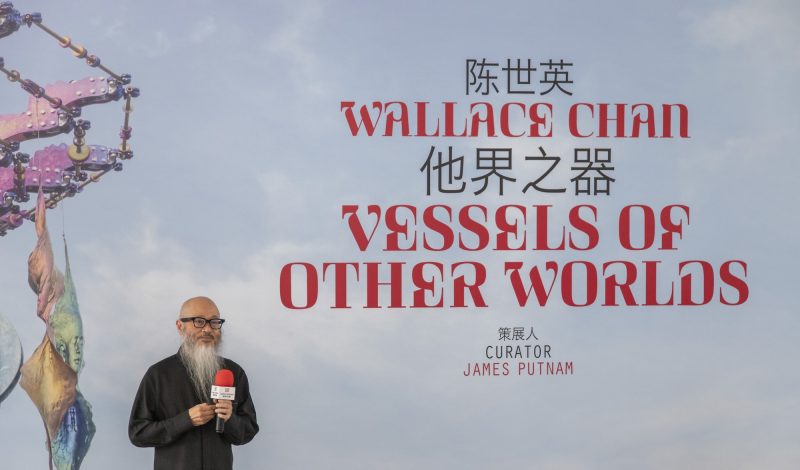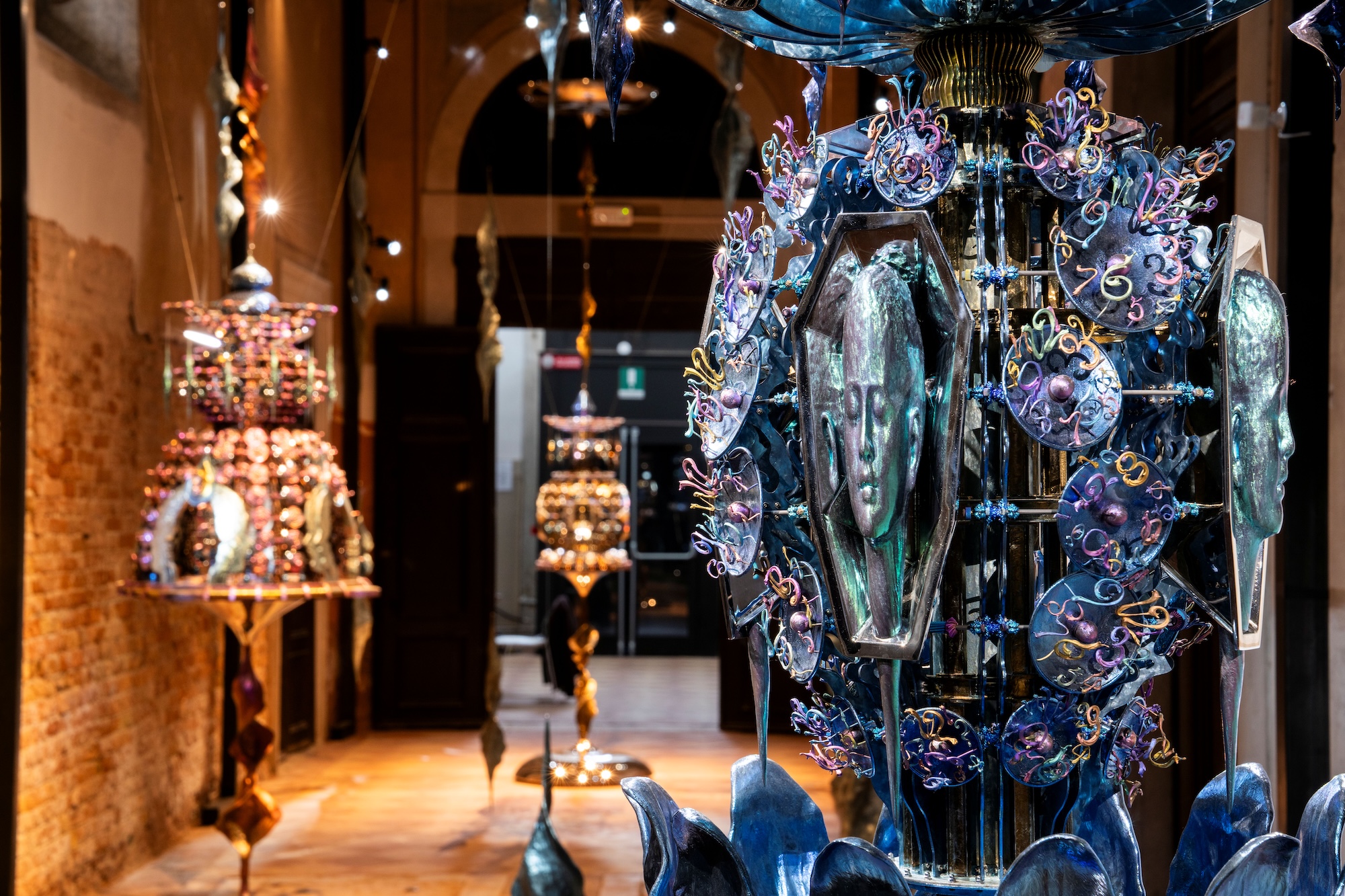
Wallace Chan is hosting his fourth exhibition in Venice, once again coinciding with the Venice Biennale. This year, his work is back in the Chapel of Santa Maria della Pietà, and he also has works in the iconic Scala Contarini del Bovolo building with its famous spiral staircase.
This year marks Wallace’s 70th birthday, and the exhibition will continue with even larger works unveiled in his July exhibition at the Long Museum in Shanghai. We caught up with him in Venice, among his latest works, which have evolved to incorporate colour, become more intricate, and reference the distinct styles found in his jewellery. Several works feature the motif from his famous ‘Wallace Cut’, a design that creates a reflected face within a gemstone.
As I have interviewed him twice before in Venice, in 2022 and 2024, I began by asking Wallace, through his translator, what’s new about his latest works, and how he has changed how he works with titanium:
“In the last three exhibitions, I’ve brought sculptures that are the natural silver-grey colour of titanium. This time, they are in colour, because the three main sculptures represent birth, growth, and rebirth, and life is colourful.
The previous exhibitions were about contemplating time, materials, and space, but this time I wanted it to be about life. The work representing birth has more yellow, and that representing growth has more pink, denoting the energy and passion you display as you grow. Rebirth is blue. Before the end of life, we need to reach a place of calm and spiritual enlightenment, and blue is the right colour for that.
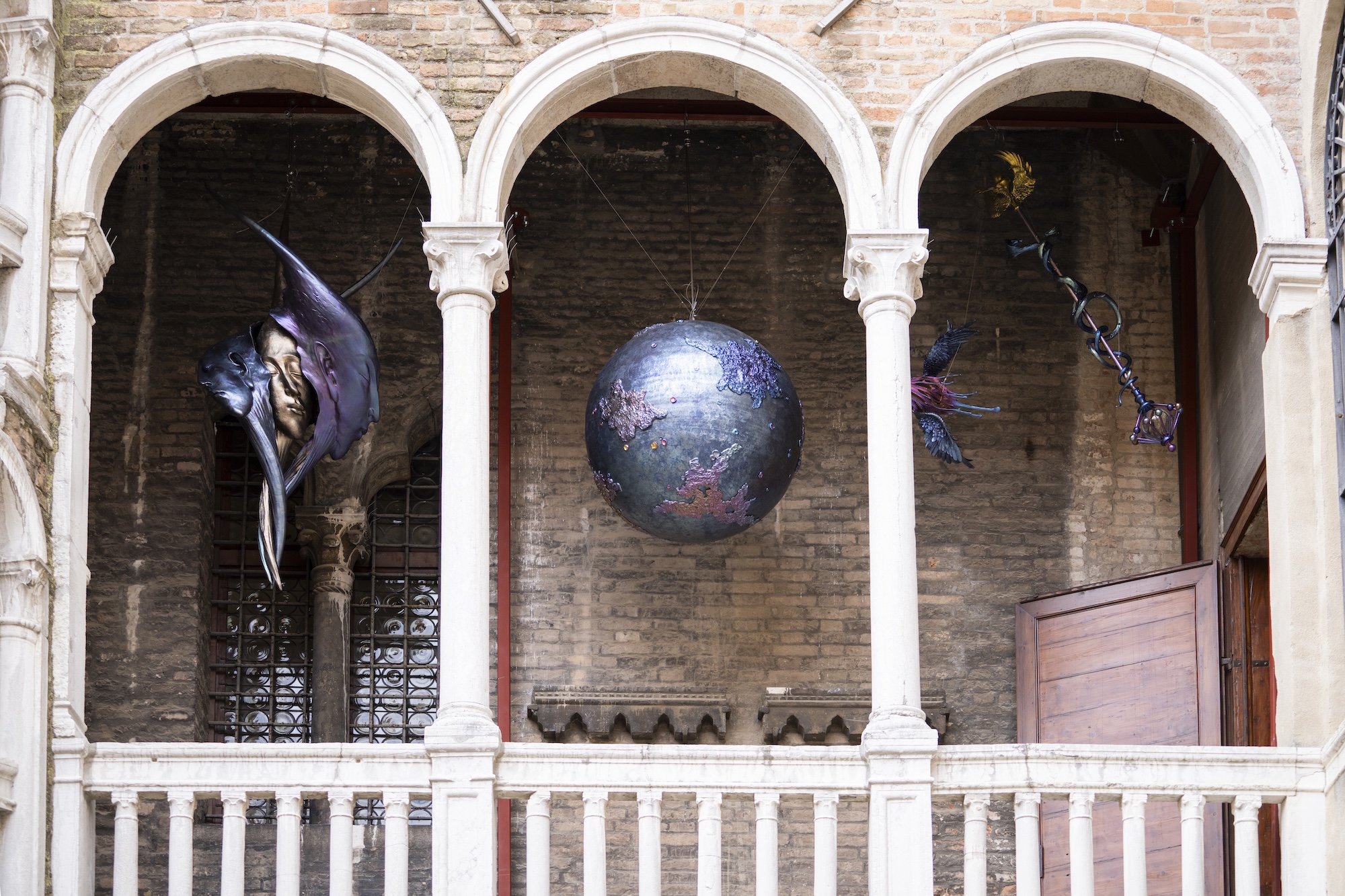
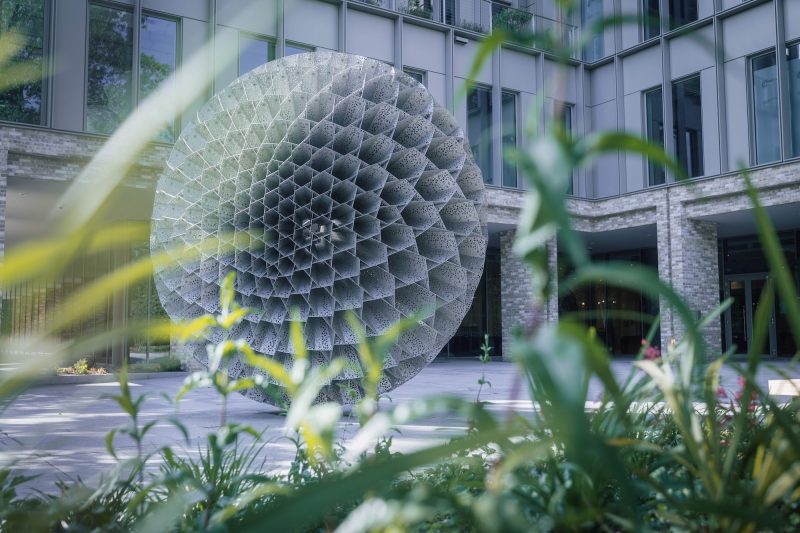
I’m also inspired by light and water, as these are the two elements that sustain us, and that’s why you can see water droplets in the works. The lightness of the sculpture means they are constantly moving in the space, so that your reflection in the mirrors is distorted, just as it would be if you looked at your reflection in water.
Water is always transforming, including when it falls through the air as rain or ripples are created on its surface, and that’s why I think it’s the perfect metaphor for reincarnation”.
There are more references to his jewellery in his latest pieces, and we spoke about how the two sides of his creative output are aligning:
“The jewellery is an important part of my practice, and through my work with gemstones, I’ve learned a lot about light, so it’s natural to see that come through in my sculpture. In the same way, my sculptures also influence my jewellery. The two aren’t separable, and when you practice a craft, it’s a spiritual process.”
I asked him whether this is why he’s hosting this exhibition in a chapel once again.
“Yes, every time I’m here, I feel inspired by the space. It’s why I’ve returned to the space, because we have an ongoing narrative that isn’t finished yet. When I’m in here, I feel inspired by the history of the space and the music from the church next door, where they play Vivaldi”.
I spotted some numbers on all of the sculptures and asked him what they symbolise, and the challenges of working with titanium:
“When I meditate, I can lose track of time; sometimes it’s five minutes, other times six hours. These numbers illustrate how time becomes distorted when you surrender to a practice such as meditation.
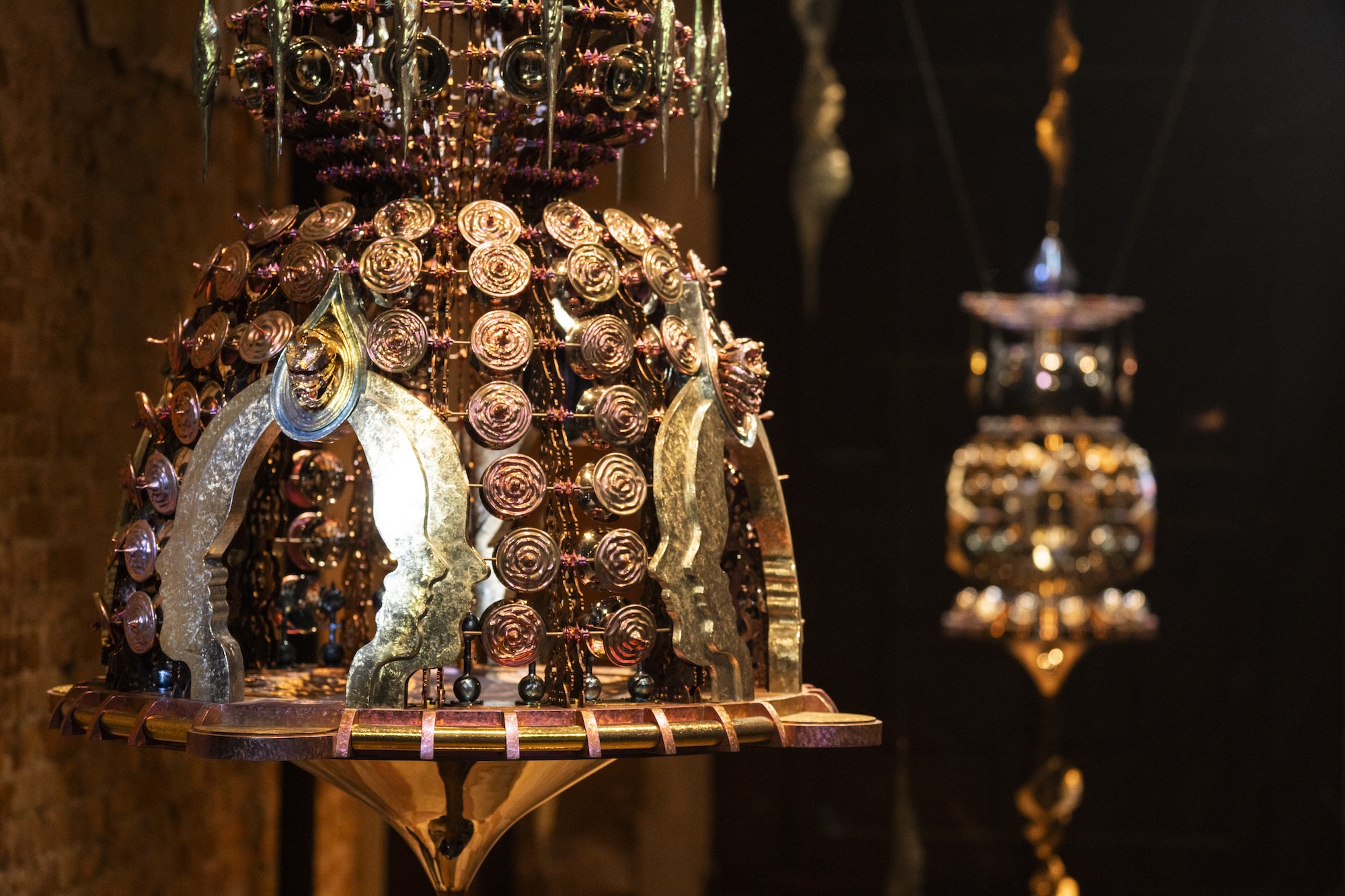
The works are primarily made of titanium, with some parts at the base and top made of stainless steel. Each sculpture is made from over 5,000 titanium parts and held together with over 22,000 screws.
When these works are shown at the Long Museum, they will be even bigger. Visitors will be able to walk inside and stand on a rotating platform, and so it will feel like the work is calling to you from all directions.
I’m trying to challenge myself with scale to see what’s possible. Every morning, we wake up thinking about costs, expenses, and how much we should eat. I want to let go of all of that and see what I can achieve. 20 years ago, I wouldn’t have been able to make something the size of my fist out of titanium, and now I can make a sculpture that’s 12 metres tall”.
I closed by asking him what made him choose to show works in two spaces, both the chapel and the Scala Contarini del Bovolo:
“I’m still connected to the chapel space and feel like I have an emotional tie to it. The second space was a new discovery for me. As I ascended the stairs, the architecture felt as if it were pulling me in all directions, allowing me to see Venice from a different vantage point.
I was inspired by the space and wanted some of my large-scale sculptures to be in dialogue with it and the building’s Tintoretto painting of Paradise. I was also inspired by the building’s astronomical heritage [the building was used in the 19th century to make important astronomical observations].
The exhibition is called ‘Mythos’ in a nod to another Tintoretto painting, Mercury and the Graces”.
Venice clearly has a hold on Wallace Chan, with this being his fourth exhibition in the city, so I finish by asking him whether he’ll ever get to a point where he feels like he’s done with Venice and ready to move on:
“I’ve been visiting for 30 years and have exhibited here since 2021. I feel like I have to come back as the city keeps calling to me”.
With that commitment to returning to Venice, we part ways, and I look forward to seeing what his Shanghai exhibition looks like and what he will create for his next exhibition in Venice. He feels like an artist who still has the ideas and ambition for many more exhibitions to come, both in Venice and beyond.
Wallace Chan: Vessels of Other Worlds is on at the Chapel of Santa Maria della Pietà, Venice (8th May-18th October), and later in parallel at the Long Museum, Shanghai (18th July-25th October).
Wallace Chan: Mythos is on at Scala Contarini del Bovolo, Venice (4th April – 18th October).