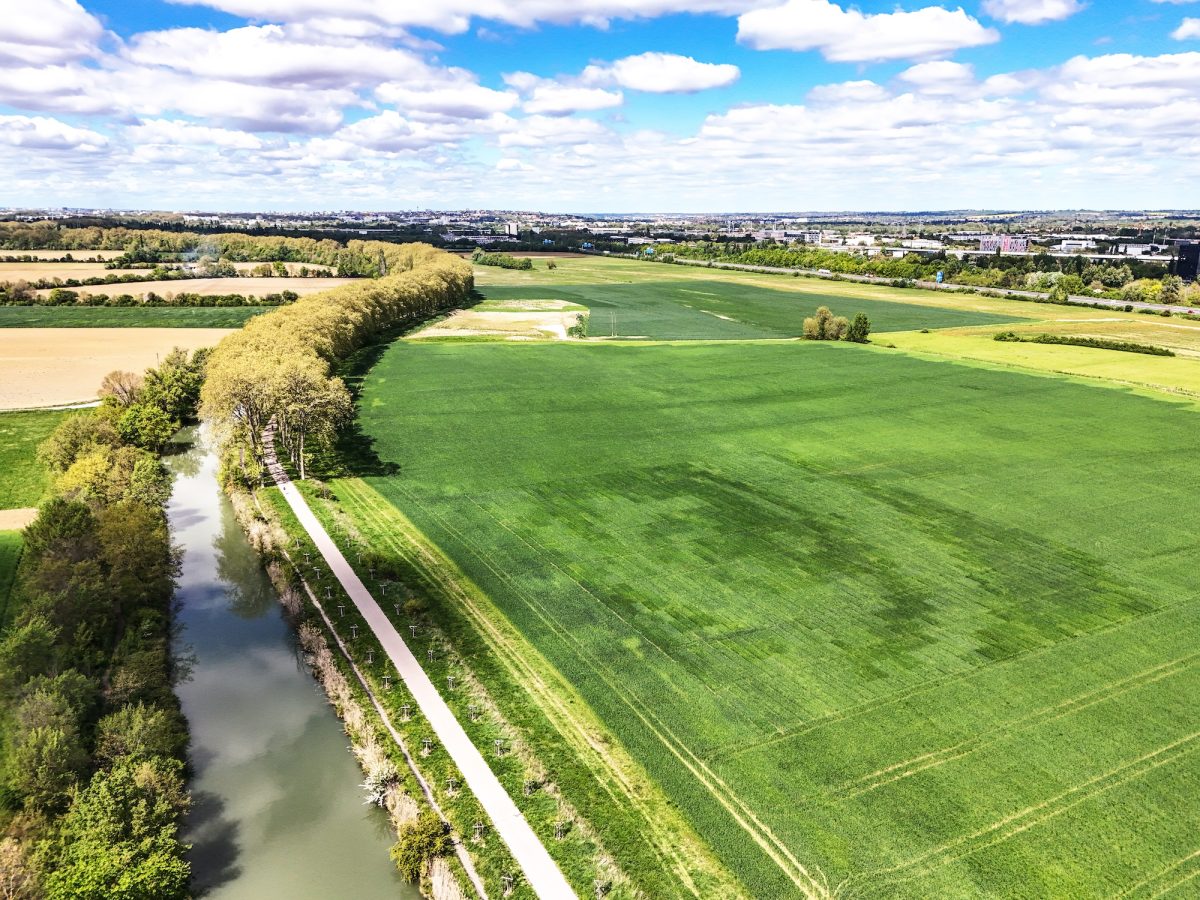
A cultivated field near Toulouse has become the site of what is believed to be the largest photographic artwork ever created. Developed by artist Almudena Romero in collaboration with the French National Research Institute for Agriculture, Food and Environment (INRAE), Farming Photographs transforms more than 11,000 square metres of agricultural land into a living photographic image produced through plant growth, photosynthesis and time.
Three years in development, the project has overcome a failed first attempt and one of the wettest winters on record before finally beginning to emerge in the landscape. Sown in October 2025, the work replaces conventional photographic processes with living crops, turning the field itself into an image-making surface. From ground level, viewers encounter shifting grasses of varying colours, textures and densities. Only from above does the full composition reveal itself: a monumental human eye cultivated directly into the land.
The project marks a significant development in Romero’s ongoing exploration of photography’s material possibilities. Rather than printing or chemically fixing an image, Farming Photographs allows the photograph to emerge through biological processes, extending the medium beyond human control and into the realm of ecology and plant agency.
Its appearance was far from guaranteed. Following an exceptionally wet winter, including the wettest February recorded in the area since records began in 1947, the field flooded and the project was placed in jeopardy. The uncertainty became part of the work itself, exposing the same environmental pressures increasingly affecting agricultural production worldwide.
At the heart of the project is a rethinking of photography’s relationship to light and nature. Building on the nineteenth-century anthotype process, Romero uses photosynthesis itself as an imaging mechanism. The crops absorb light, grow and gradually generate the image, turning cultivation into a form of photographic production and positioning the work between photography, land art, performance and ecological research.
The eye at the centre of the composition draws inspiration from eyespot mimicry, the natural phenomenon in which animals develop eye-like markings to deter predators. Composed from features associated with different races and genders, the image functions as a collective portrait of humanity while highlighting our interdependence with the ecosystems that sustain us.
Like the living systems from which it emerges, the work is inherently temporary. The image will continue to evolve throughout the growing season before being harvested in August 2026. The wheat will then be milled into flour, extending the artwork’s life beyond the field and returning it to the communities and ecologies that made it possible.
About the artist
Almudena Romero, born in Madrid in 1986, is a visual artist whose practice explores the material, historical and social dimensions of photography. Working with organic and sustainable materials, she expands the medium beyond the mechanical and chemical, approaching photography as a biological, performative and ecological process. Her work has been exhibited internationally at the Victoria and Albert Museum, Maison Européenne de la Photographie, Saatchi Gallery, Musée Départemental Albert-Kahn and Les Rencontres d’Arles, among other venues. She was nominated for the Prix Pictet in 2021 and has received major grants and commissions from Arts Council England, Creative Europe and Wellcome Trust, as well as international residencies at the Sichuan Fine Arts Institute, the Mitsubishi Ichigokan Museum and the Whitechapel Gallery.