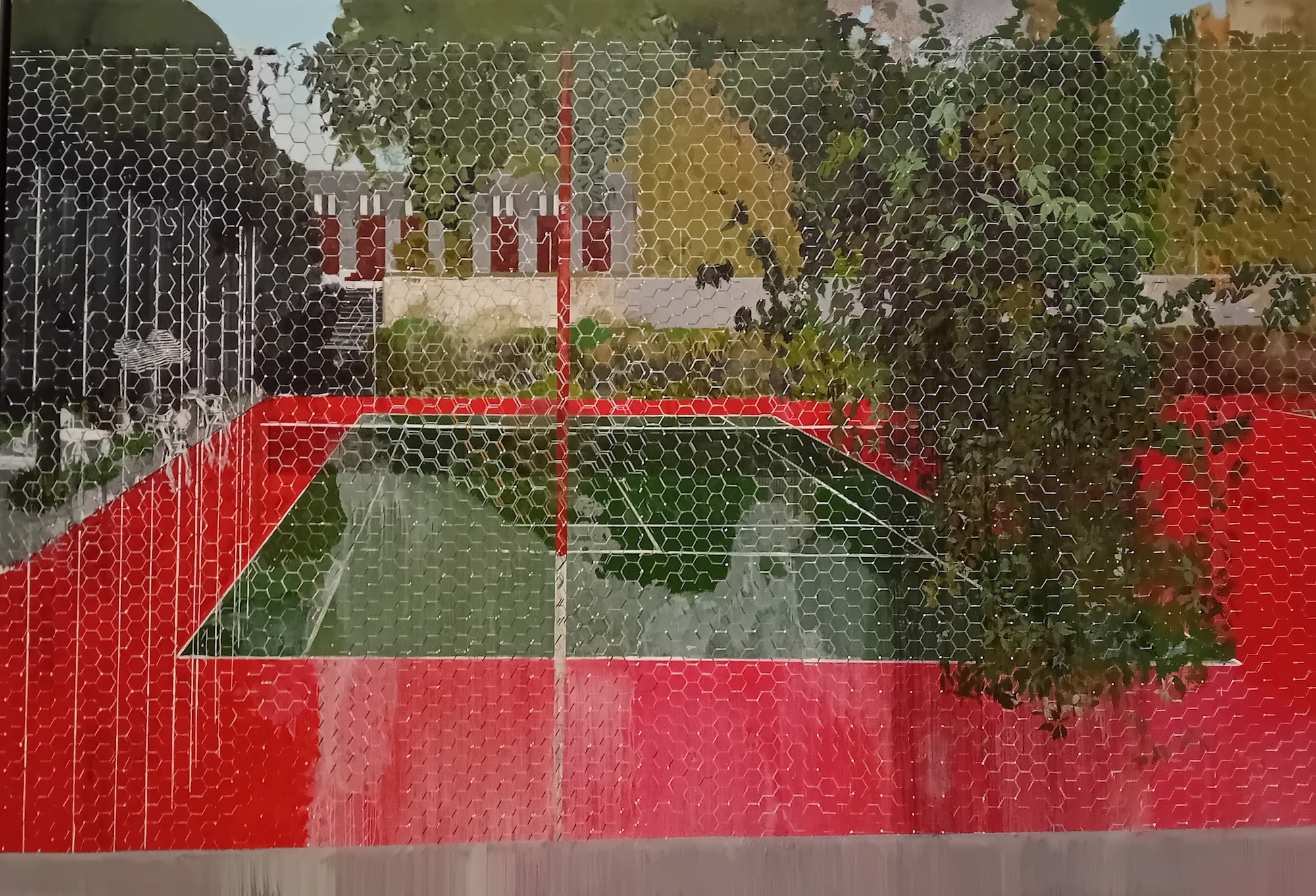
Hurvin Anderson: Country Club: Chicken Wire, 2008 – oil on canvas, 240 x 347 cm
Hurvin Anderson’s superb 80-work retrospective at Tate Britain (to 23rd August) reveals a wider range of subjects than one might expect, given that his long-running depiction of barber shops has been centre stage in recent UK shows – only three of them are included here. He often works in such series, but ‘Country Club: Chicken Wire’ is more a one-off. It depicts an empty tennis court in Port of Spain, Trinidad, viewed through a chain-link fence. The highly detailed geometric pattern of the wire suggests constraint and exclusion, as well as acting as a visual barrier. As such, it explores both Anderson’s typical themes of colonial history and social segregation and the tension between representation and abstraction.
As Roshini Kempadoo observes in the show catalogue, the intensity of light is such that we ‘can almost imagine heat bouncing off the asphalt of the courts’ – courts which are ‘persistent symbols of the pleasurable leisure activities of the colonial elite – the crisp white dress code, the omnipotent status of the umpire meting out the rules of the game, the clear painted lines that denote when you are in or out’. And tennis, likely to have been played here by the colonial population, remains a middle-class sport. The scene also fits with how land was parcelled up to be owned, fenced off and occupied on the back of the slave trade – we as viewers are positioned as witnesses to that history. And in 2023, as it turned out, the Trinidad Country Club was acquired by the US government as the site of its new embassy, so the power issues behind the use of this land remain firmly in play.
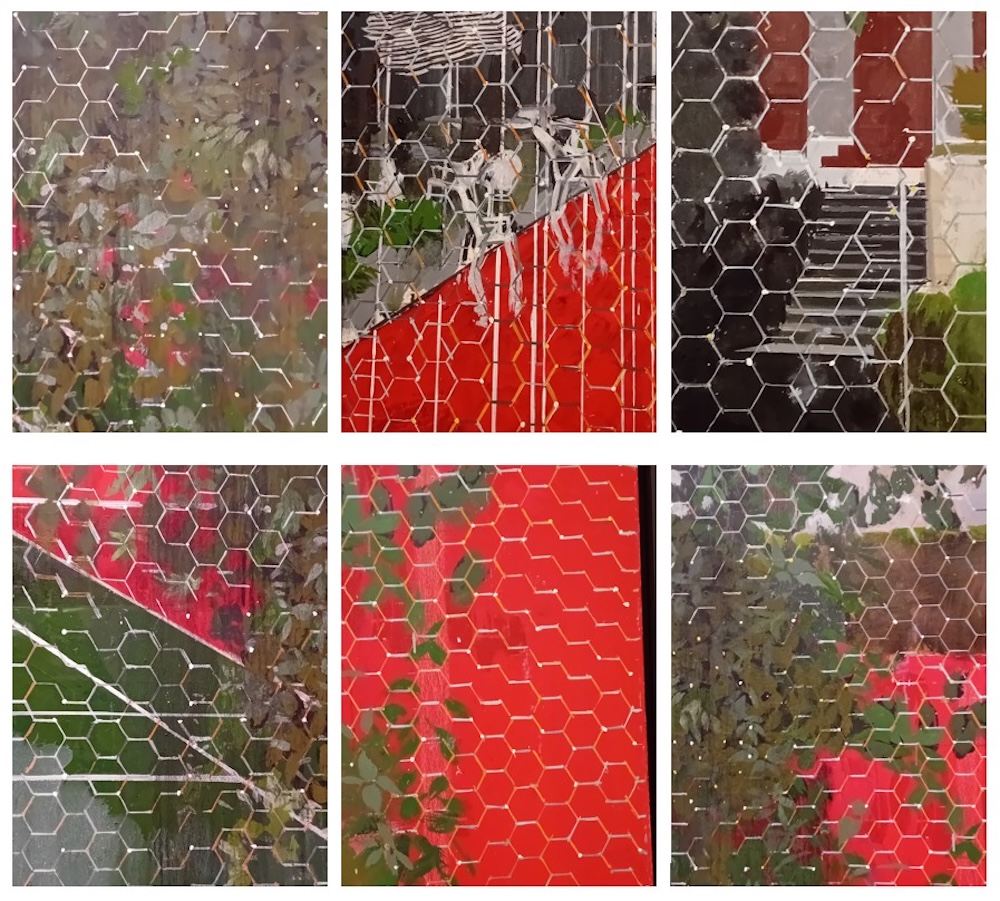
The court is empty – though the somewhat unusual presence of two chairs at the net (centre top in my detailed shots) initially appeared to me as ghostly presences, and that feels appropriate. The absence of obvious figures serves to concentrate the eye on the obstructions of the mostly-grey-to-white overlay of fencing, spiky fence posts and foreground wall, contrasting with the vibrant red and green of the court surface. Tennis court surrounds are normally referred to as netting, and are more substantial than the titular chicken wire: that term, I assume, is introduced as a link to the confinement of fowl in the typical Caribbean backyard, using that cheap and utilitarian material. And the overlay operates – with surprising local variety – to set up abstract effects, drawing us in to the detail across the whole surface. That’s the key to why this painting operates so successfully in formal, as well as thematic, terms.
Paul Carey-Kent selects a ‘Gallery of the Month’, a ‘Show of the Month’, a ‘Work of the Month’ and a ‘Book of the Month’ for his weekly column in FAD. A collection of previous gallery columns ‘Paul’s Galleries To Go’, is available from FAD.