The 61st International Art Exhibition of La Biennale di Venezia (aka the Venice Biennale) is sprawling. So much art happens during its opening week (May 6th–10th); FOMO is rife. In drafting this preview, I had a long list of pavilions, collateral and other exhibitions, performances, events, as well as individual artists whom I wanted to see. The task, as with the opening week, felt imposing. Echoing something of the theme for this year’s Biennale, In Minor Keys, I decided to refocus: to disregard the mounting PR noise in my email inbox and to look specifically at the national pavilions whose lower frequencies most resonated with me.
Bulgaria: The Federation of Minor Practices, curated by Martina Yordanova
Do not kill me for featuring a ‘film-based’ pavilion in my preview list … Featuring newly commissioned films by Veneta Androva, Gery Georgieva, Maria Nalbantova, and Rayna Teneva, The Federation of Minor Practices will challenge the transitory nature of the Venice Biennale opening week. No quick in-and-out; this pavilion demands sustained attention. Conceived as an interactive environment, computer game-like, this demand surfaces a politics of complicity. Here, attention invites us to imagine conditions of a future otherwise to the one we are heading for.
Venue: Sala Tiziano, Centro Culturale Don Orione Artigianelli, Fondamenta Zattere Ai Gesuati, 919, 30123 Venezia VE
Canada: Abbas Akhavan, curated by Kim Nguyen
Trying to find or ascertain any information about Akhavan’s project for Venice, Entre chien et loup has proved impossible. Faced with PR blankness, most press outlets reporting on Venice have discussed Akhavan’s project in relation to his previous work, often accentuating his corporeal background and his general themes – Man’s corruption of material history to speak broad. Not satisfied with this approach, I Google the meaning of the pavilions’ French title:
“Entre chien et loup is a French expression that translates to “between dog and wolf” in English. This phrase refers to the time of day just before nightfall when it’s difficult to distinguish between a dog and a wolf … [a time of day when] things become uncertain and ambiguous.” (See Nicola Fioravanti’s blog post on the phrase for further information.)
I have always been drawn to Akhavan’s use of light: how he materially captures light through ‘straight’ or cameraless photography, through installation, as well as sculpture. This is a subtle side of Akhavan’s work. It is a focus which asks us to look beyond the face of what lies in front of us and to think about the innate ambiguity – politics and changeability – of a history’s formation. Moreso, it is a focus which demands we think about the taming of history, how this is done, why and by whom.
By withholding any information which might illuminate his Venice project, it seems Akhavan is corrupting the pre-writings of history, asking journalists like me to look beyond the PDFed face of Venice previews.
Venue: Canada Pavilion, Giardini della Biennale, Calle Giazzo, Venezia VE
Catalonia: Claudia Pagès Rabal, curated by Elise Lammer
I love life’s quiet details. A la Perec, the mute parts of life make me think critically, like, what can a flock of pigeons taking flight from a fountain ‘say’ about social precarity? I want to suggest that Pagès Rabal shares something of this thinking. Based upon her research and engagement with the 15th-century paper watermarks archives at the Museu Molí Paperer de Capellades (Catalonia), this pavilion, Paper Tears, wields the often overlooked politically. Installed as an audiovisual installation, with sculptural LED screen and enveloping soundtrack, the cast of characters core to Pagès Rabal’s pavilion will not only relay a history of specific watermarks but invite intuitive recollections. In this way, Paper Tears, will surface the en filigrane (the watermark or underlying sensibility) of our present, demonstrating how our world has and increasingly continues to be marked by institutional forces.
Venue: Docks Cantieri Cucchini, San Pietro di Castello 40A, 30122 Venezia VE
Lithuania: Egl? Budvytyt?, curated by Louise O’Kelly
Anything relayed on 16mm film gets my heart going. Budvytyt?’s film animism sings anarchy embraces this media, pairing it with a multi-channel means of display to create a cinematographic choreography – a sense of liveness which connects with Budvytyt?’s wider artistic practice. Drawing upon the work of anthropological archaeologist Marija Gimbutas, specifically her research around Neolithic matrilineal and animist societies, Budvytyt?’s out-of-body performance attempts to translate historical instances of female leadership into ecstatic media – song, movement, altered feelings – thereby reenlivening our patriarchal present. That is, at a time when masculine egos are imperilling the planet (full stop) animism sings anarchy will operate as “a much-needed medicine for our times” – to quote the pavilion’s curator Louise O’Kelly.
Venue: Fucina del Futuro, Castello 5063/B, 30122 Venezia VE
Spain: Oriol Vilanova, curated by Carles Guerra
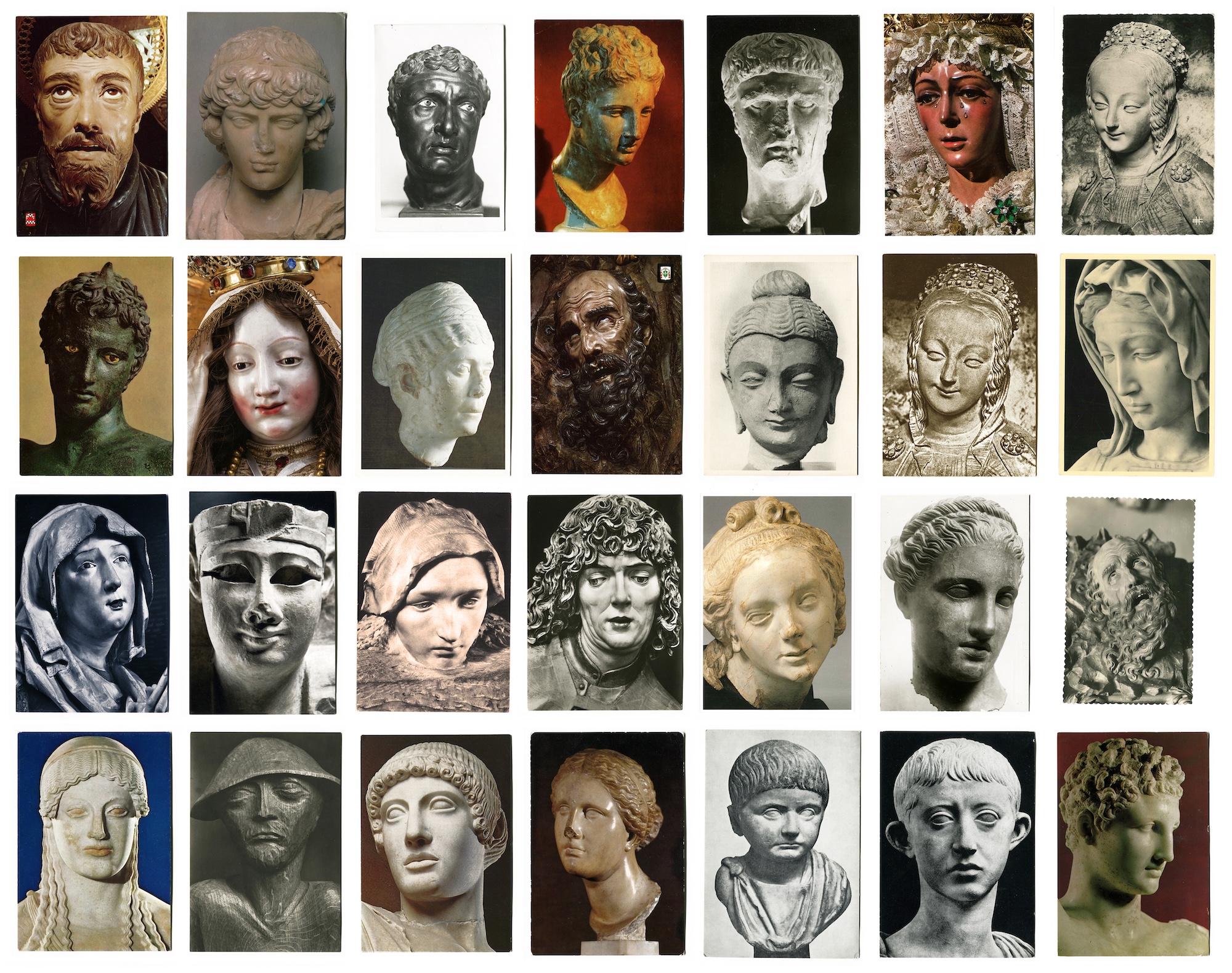
Sometimes the simplest ideas attract the most of my attention. Materially, Vilanova’s project Los restos is a pseudo-museum constructed from the touristy detritus of such sites: the postcard. Working with his personal archive of postcards, collected over the last twenty years from flea markets and second-hand shops, Vilanova’s pavilion seeks to question the economies that mediate memory. Specifically, with his postcards arranged as an endless mural, Los restos acts as a gesture probing the materialities of memory circulation, uprooting museal conventions of value, to foreground the commonplace reciprocity at the heart of everyday human life. At a time of increasing image mediation, in the place of Venice where daily life has become tethered to tourism and trade, Vilanova’s project acts as a subtle warning, alluding to how the common image-memories we share are vulnerable to communicative regimes.
Over the course of the Biennale, Vilanova will push the concepts at the heart of his pavilion into public space via the performative intervention The Phantom of Liberty. Extending between the Giardini and the Arsenale, the chance encounters at the heart of this intervention will demonstrate how valuable memories are often made, incidentally with others on the street, critically privileging a peripheral system of communicative circulation.
Venue: Spanish Pavilion, Giardini della Biennale, Calle Giazzo, Venezia VE