The collages of Belgrade-based Russian Natalia Titova caught my eye recently, and she’s one of 40-odd artists featured in the ambitious show ‘Collective Voices’, organised over 20th-26th March in Edinburgh by the JustArt Collective. It’s tempting to think collage is pretty easy. No need to create any content, you just grab stuff from wherever. No great technique required, just scissors and glue. These days, you don’t even need that; it can all be done digitally. There again, it’s easy to throw a dart into a board, not so simple to hit the bullseye – and collage is a little like that: easy to make attractive and pleasing, hard to make distinctive and original. So it is that, while many artists have used collage impactfully to expand the range of an established practice from other media – Picasso, Ernst, Man Ray, Matisse, Rauschenberg, Baldessari and Rosler might spring to mind – not many have made their reputation primarily through collage. One might cite Kurt Schwitters, John Heartfield, Hannah Höch, Peter Kennard, John Stezaker, Kara Walker, Frida Orupabo and Linder. Either way, successful collage has tended towards three principal areas of focus: politics, broadly defined, where the collision of disparate elements underscores the conflicts in governmental, racial or sexual relations; the inner self, using disjuncture to summon the subconscious; or an interest in modes of representation, exploiting how collage slips between categories: we might take Heartfield, Ernst and Picasso respectively as initiating examples of those approaches.
Natalia Titova does something rather different by combining collage with another medium that has important presence in visual art, yet stands slightly apart from mainstream: text. The combination operates largely through literary subject matter, meaning that she has two ways of introducing the text: directly, by quotation; and, predominantly, indirectly, as implied by reference to famous writings. Let’s look at an example of how that operates.
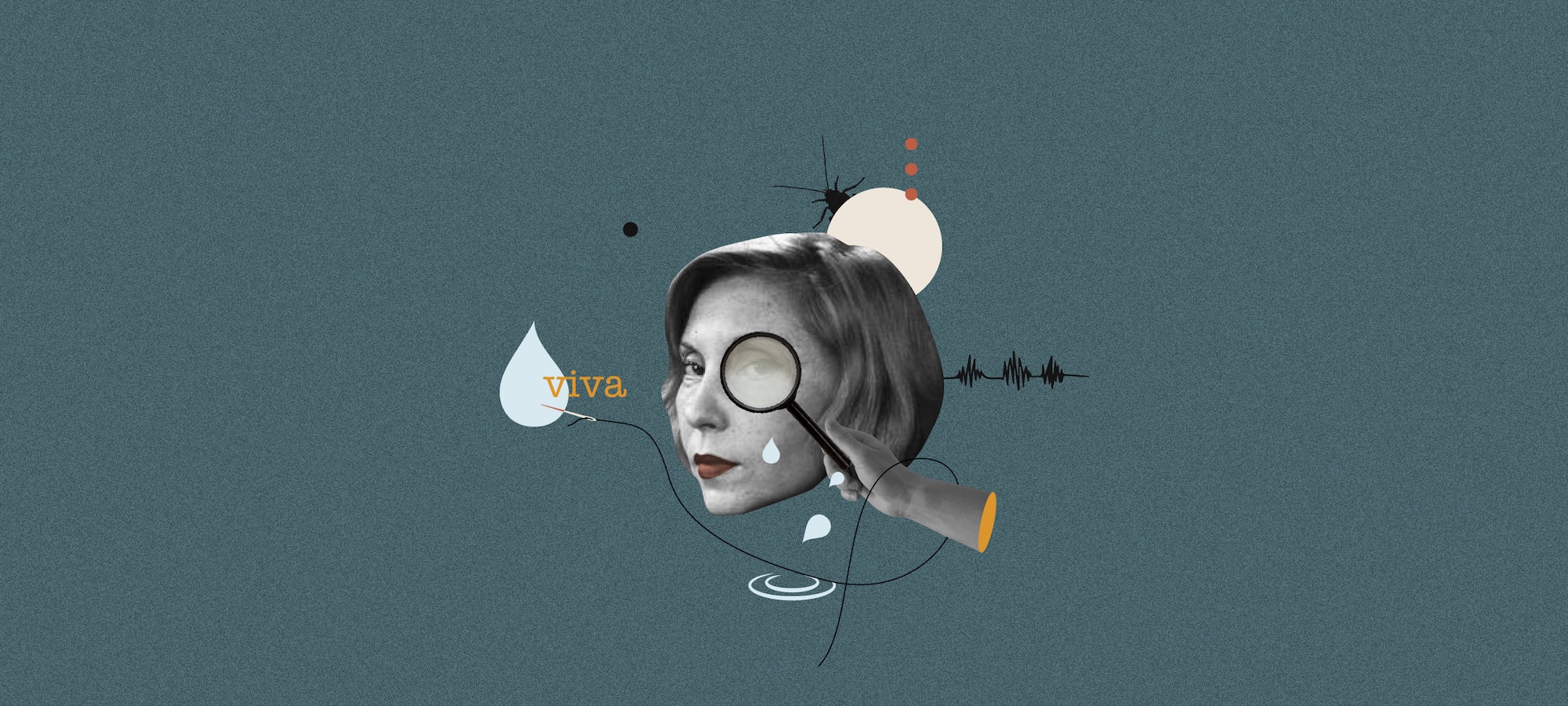
Ukraine-born, Brazil-raised Clarice Lispector (1920-77) found early fame with her stream-of-consciousness novel Near to the Wild Heart, 1943, perhaps the first to introduce the mode to Portuguese literature. Titova alludes to that through electron waves as a visual metaphor for continuous inner thought. Lispector continued to maintain an intense focus on interior emotional states, including in what is possibly her best-regarded work, the directionless monologue of the highly experimental Água Viva – translatable as ‘Living Water’ or ‘Stream of Life’. The collage picks that up in the oceanic surround and drops of water, evoking both Lispector’s fluid style and her typical concentration on the power of individual perception to alter reality – to refract it, perhaps. Titova also includes a cockroach, seeing that as a symbol of vulnerability. Lispector certainly had her vulnerabilities and dealt with physically and emotionally challenged characters in her fiction, but those insects are also famously able to endure difficult circumstances. That fits, too, as Lispector wrote through many health problems, and almost died in a fire in 1967 – it left her so badly scarred, she avoided being seen in public thereafter. We can link that in turn to the needle as a symbol of pain. The cockroach is also central to Lispector’s most notorious story, The Passion According to G.H., 1964, in which the crushing and partial consumption of a cockroach triggers some sort of mystical union with the substance of the universe. No wonder Lispector looks through a magnifying glass, indicating in Titova’s words, ‘how an artist or writer can see and feel emotions, enlarging their significance and depth’. In a memorable phrase from Água Viva, the unnamed narrator declares ‘I want to seize my is’, and creativity was very much Lispector’s own ‘is’: as she put it in a late interview before succumbing to cancer, ‘when I am not writing I am dead.’
As that account illustrates, one can draw copious material from an apparently straightforward collage, given that three elements are in play: the life of the depicted subject; the content of their writings; and the nature of the creativity that emerges, suggesting parallels between one art form and another – to quote from Água Viva again, ‘I feel a voluptuousness in going along creating something to tell you’. Of course, different viewers will have access to differing degrees of relevant knowledge, but those unfamiliar with a writer might find Titova stimulates further reading and investigation. Or else, having said all that, the collages can stand aside from the rational explanations for what they include: as uncanny concatenations in the surreal tradition; as poolings of evocative images with a unifying aesthetic; as conversations between abstract and representational content.
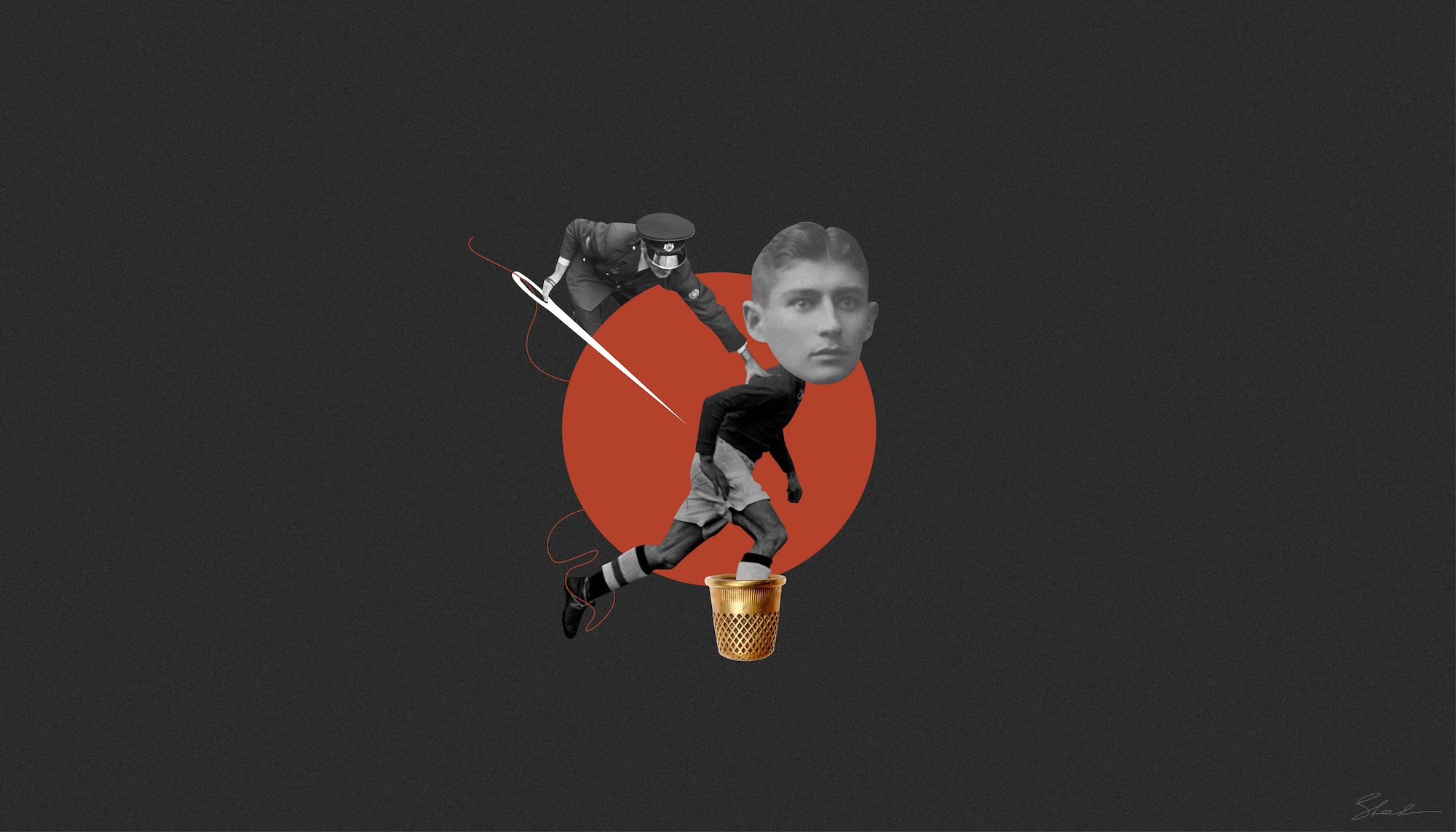
We might touch on some further examples. They, too, combine life, literature, creation – and, affording a telling edge, some darkness. Franz Kafka’s head looms out of Sewing Machine, 2026, in which the military officers and central red circle symbolise authority and restrictions, the boundaries within which the artist is expected to remain. The needle reappears, but this time with a thimble, offering some protection against the pain – yet the setting is black, the thimble seems to have trapped the footballer’s foot, and the needle may remind us of ‘In the Penal Colony’, 1919, in which a torture machine uses hundreds of needles to execute a prisoner by slowly inscribing the law he violated into his skin.
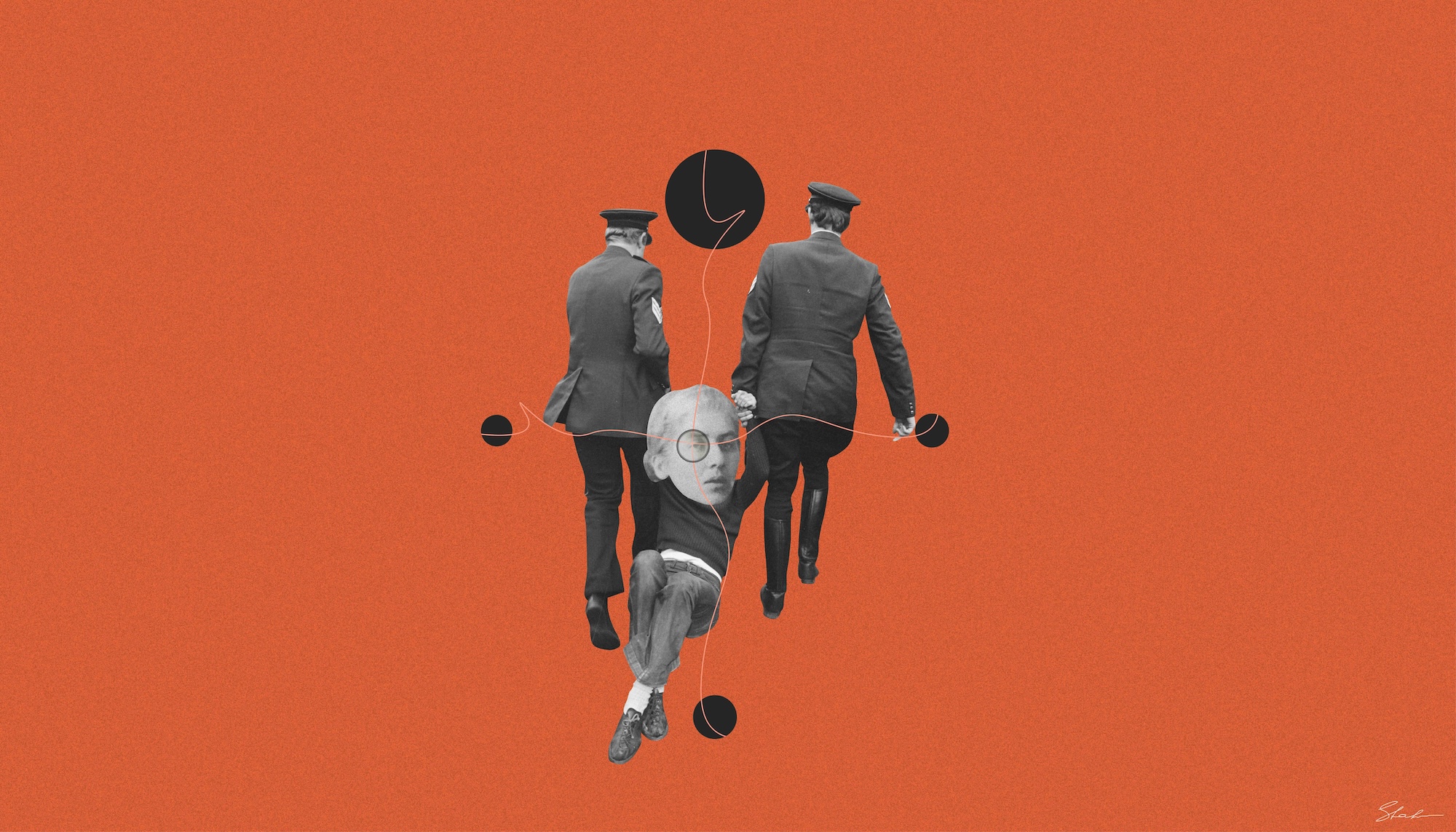
Soviet writer, 2026, is more directly political. The face of the figure being dragged away is that of the dissident Russian poet Lydia Chukovskaya (1907-96). Her life was nomadic and precarious, and her husband was executed in one of Stalin’s purges. As such, she stands for struggling to work under censorship and repression – so much so, it seems, that the ensemble forms a martyr’s cross on a blood red ground.
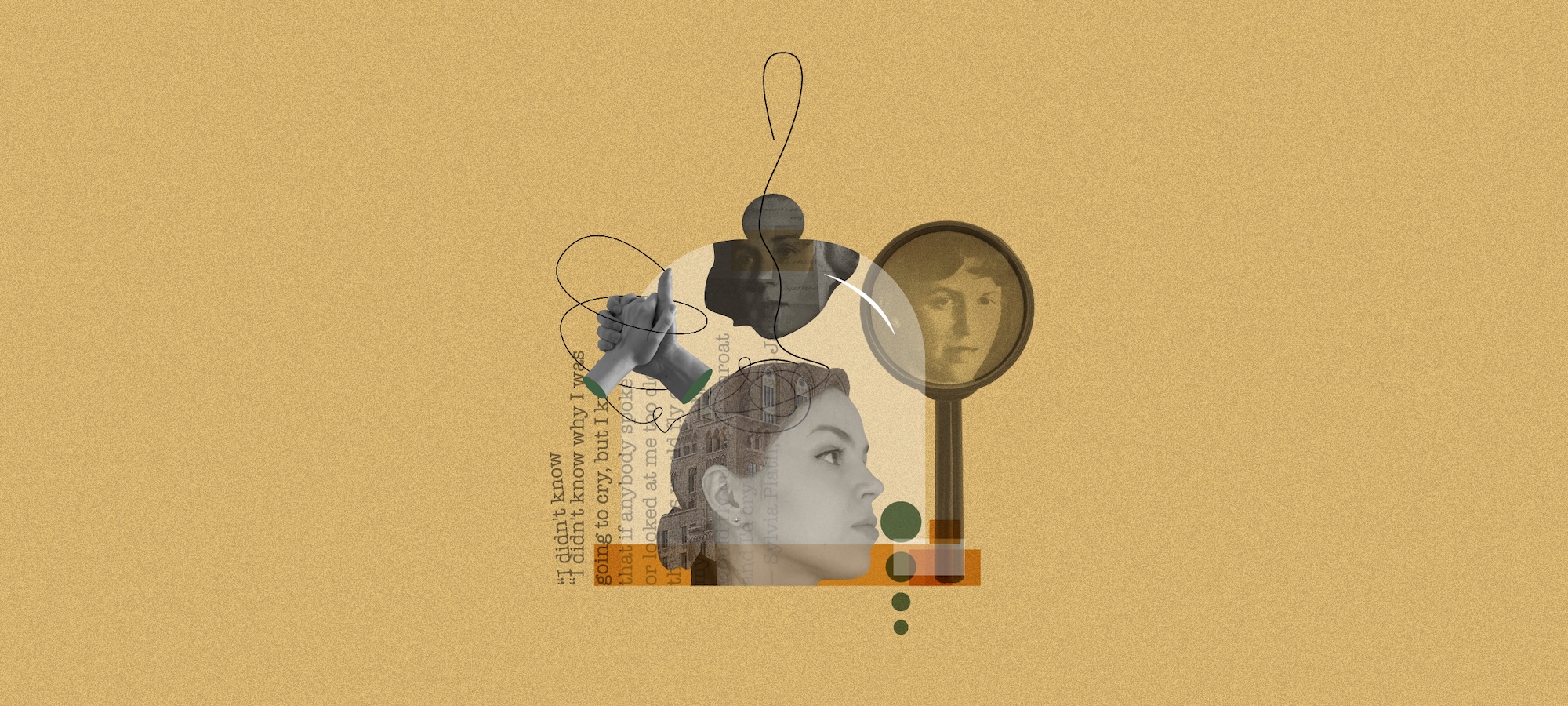
There are three faces in Favourite writers, 2022: Sylvia Plath, Tove Ditlevsen, and the reader or observer, seemingly situated in The Bell Jar of Plath’s semi-autobiographical account of mental illness. The quotation, the longest in these examples, comes from there: ‘I didn’t know why I was going to cry, but I knew that if anybody spoke to me or looked at me too closely the tears would fly out of my eyes and the sobs would fly out of the throat and I’d cry for a week.’ Hands suggest connections between the figures, cuing us in to how the Dane, like Plath, wrote directly from her life (notably in The Copenhagen Trilogy, 1967-71) and was admitted to a psychiatric hospital several times.
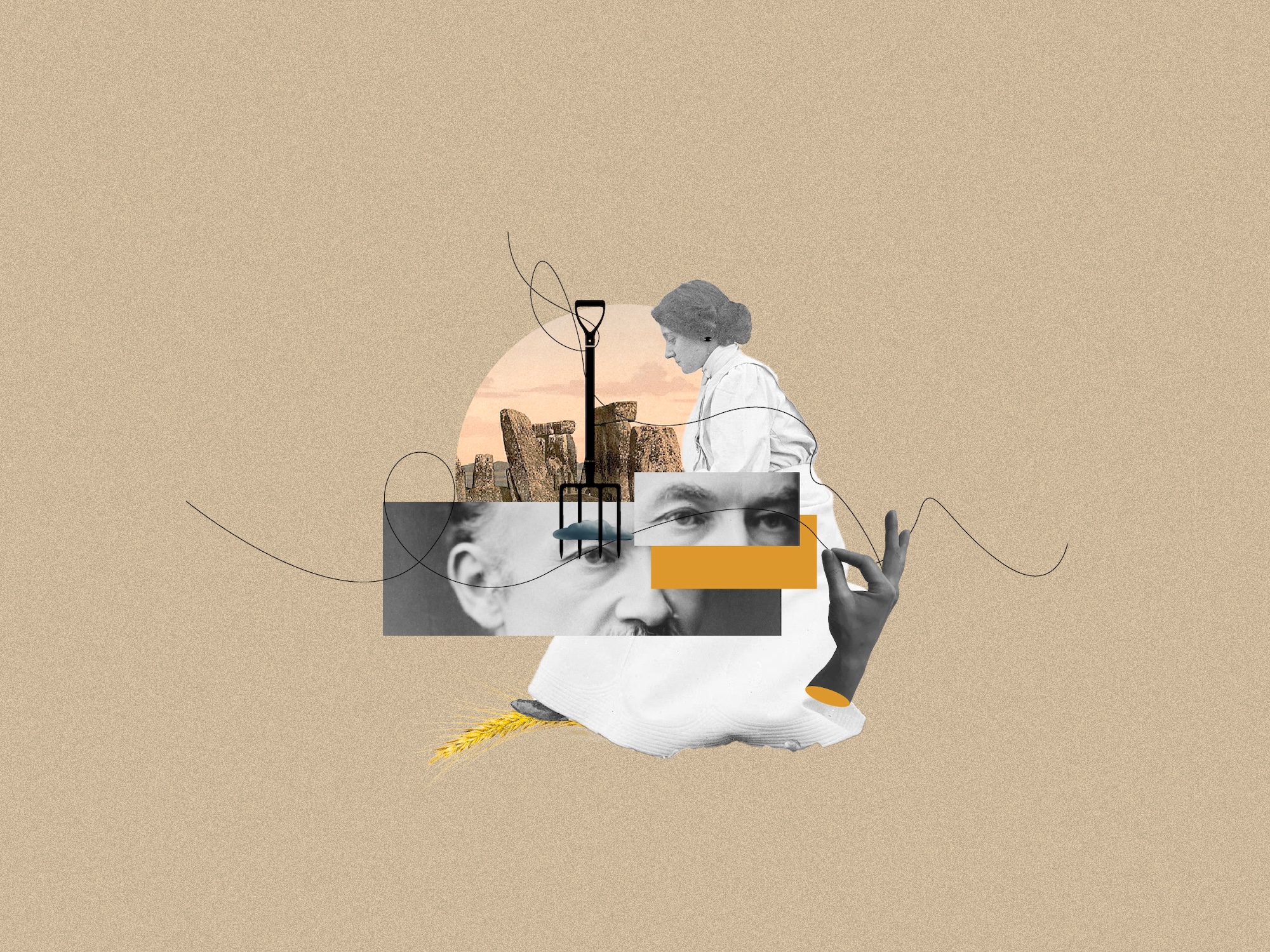
Mrs Hardy, 2023, shows the author’s second wife, Florence, observed by her semi-hidden husband across a 39-year age gap. Titova sees her as ‘a personification of nature itself’ as ‘woman and nature share one essence and one inner life’. She builds on that with the pitchfork of rural labour, the wheat ear of its yield, and Stonehenge – local to Hardy’s vision of Wessex – as a symbol of mystery and deep time. Together, they evoke the setting of Hardy’s life – and how the couple collaborated on his posthumously published biography. Here too, though, there’s a cloud: ‘a sign of the hidden, darker side of the inner self’, says Titova, ‘something shifting, elusive…’ We might ascribe that to how Hardy poured out regretful love poems inspired by his first wife, Emma, whom he’d neglected in her life during his marriage to Florence.
It’s no wonder, then, that connecting threads appear visually across all of my examples. As Titova explains, literature is ‘my greatest guide. Through timeless texts and words, I try to understand the meanings and emotions that endure, connecting us with generations before us — their feelings, their essence.’ Looking more broadly, her range includes series – such as ‘Childhood’ and ‘Women’s Day’ – with a more personal or social focus, but the approach is comparable. Overall, she takes collage in a richly interesting new direction. And that isn’t such an easy target to hit.
Just Art Collective present Collective Voices, 20th – 26th, Whitespace, Edinburgh
Art Opening March 20th 6PM – 8:30PM