Fresh from a visit to Monet’s garden in Giverny, Takashi Murakami turns his attention to the deep, reciprocal relationship between Japanese ukiyo-e and European Impressionism. In Hark Back to Ukiyo-e: Tracing Superflat to Japonisme’s Genesis, Perrotin Los Angeles presents 24 new paintings that extend Murakami’s long-running inquiry into how Edo-period visual culture reshaped the trajectory of modern art.
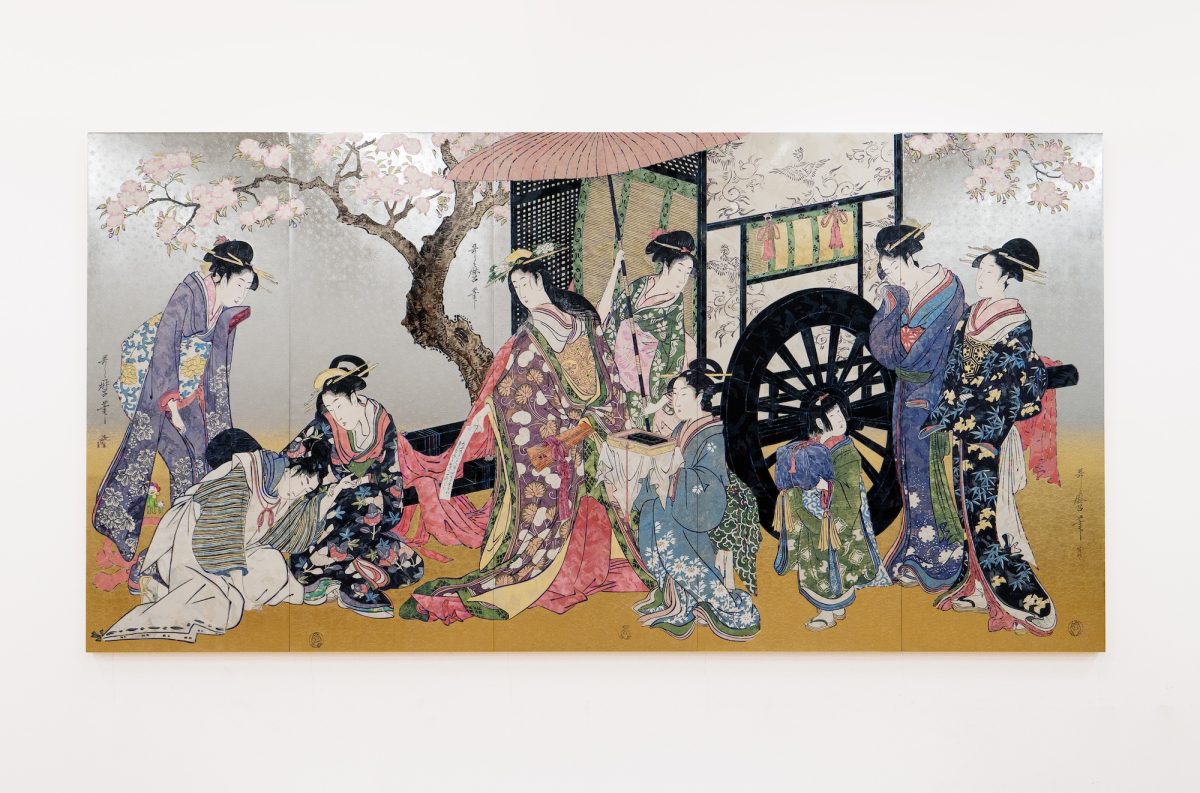
At the heart of the exhibition is Murakami’s evolving theory of Superflat — not simply as a contemporary aesthetic, but as a lineage that begins with ukiyo-e’s radical handling of surface, colour and space. In recent years, Murakami has returned repeatedly to the moment when Japanese woodblock prints entered Europe in the late 19th century, influencing artists like Monet to abandon strict perspectival depth in favour of subjective composition and flattened pictorial planes. Here, that investigation narrows its focus to bijinga — “pictures of beautiful women” — a genre that captivated Western artists and collectors alike.
In ukiyo-e, bijinga portrayed courtesans, geisha and teahouse attendants as cultural icons of Edo society, rendered with sensuous precision and compositional daring. Their tilted ground planes, shallow spatial depth, bold outlines and attention to gesture offered a new visual language — one that Impressionist painters absorbed into their depictions of modern life. Murakami revisits this exchange head-on, opening the exhibition with four monumental works based on bijinga by Kitagawa Utamaro and Torii Kiyonaga.
Reimagined at an imposing two-by-four-metre scale, Murakami’s SUPERFLAT versions of Utamaro’s celebrated scenes — including Flowers of Yoshiwara and Snow in Fukagawa — echo the grandeur of the originals, which once circulated in Paris collections during the height of Japonisme. Hanging alongside large-scale reproductions of woodblock triptychs, these works highlight the subtle devices used to convey sensuality: the exposed nape of a neck, bare feet, languid posture, even the delicate shaping of a hairline.
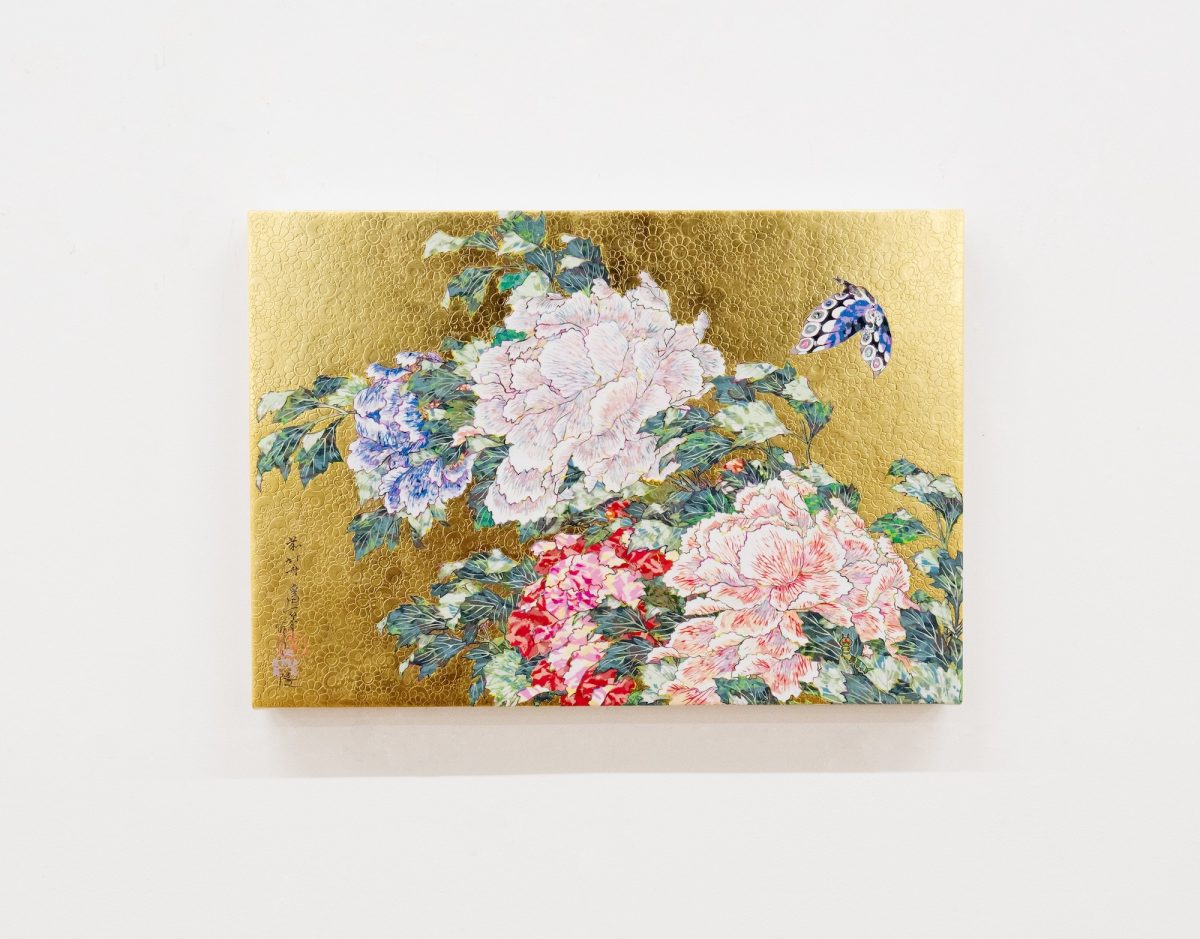
Murakami’s meticulous process — layering silkscreened acrylic paint with custom squeegee techniques and a high-gloss finish — becomes a method of close reading. By copying these works, he encounters their formal intelligence firsthand, translating Edo-period visual strategies into his own hyper-saturated, contemporary language.
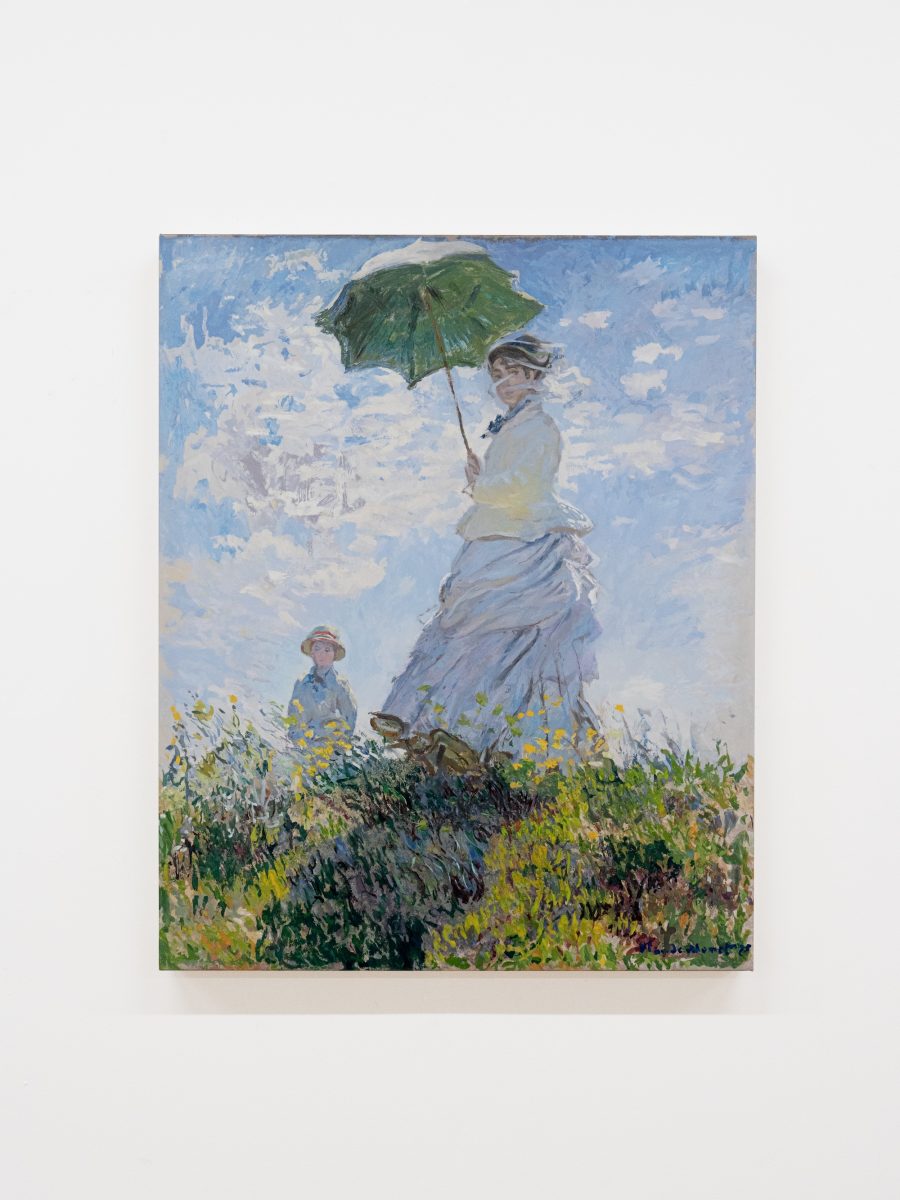
A second sequence traces a direct line from bijinga to Monet’s Woman with a Parasol – Madame Monet and Her Son (1875). Murakami pairs his own version of Monet’s portrait with enlarged ukiyo-e prints by Kikukawa Eizan and Utamaro, proposing a visual genealogy: the three-quarter figure, parasols seen from below, flowing fabrics, and cloud-like blossoms reappear across cultures and centuries. Murakami’s rendering of Monet’s scene replaces painterly brushwork with rhythmic squeegee patterns, flattening light into surface.
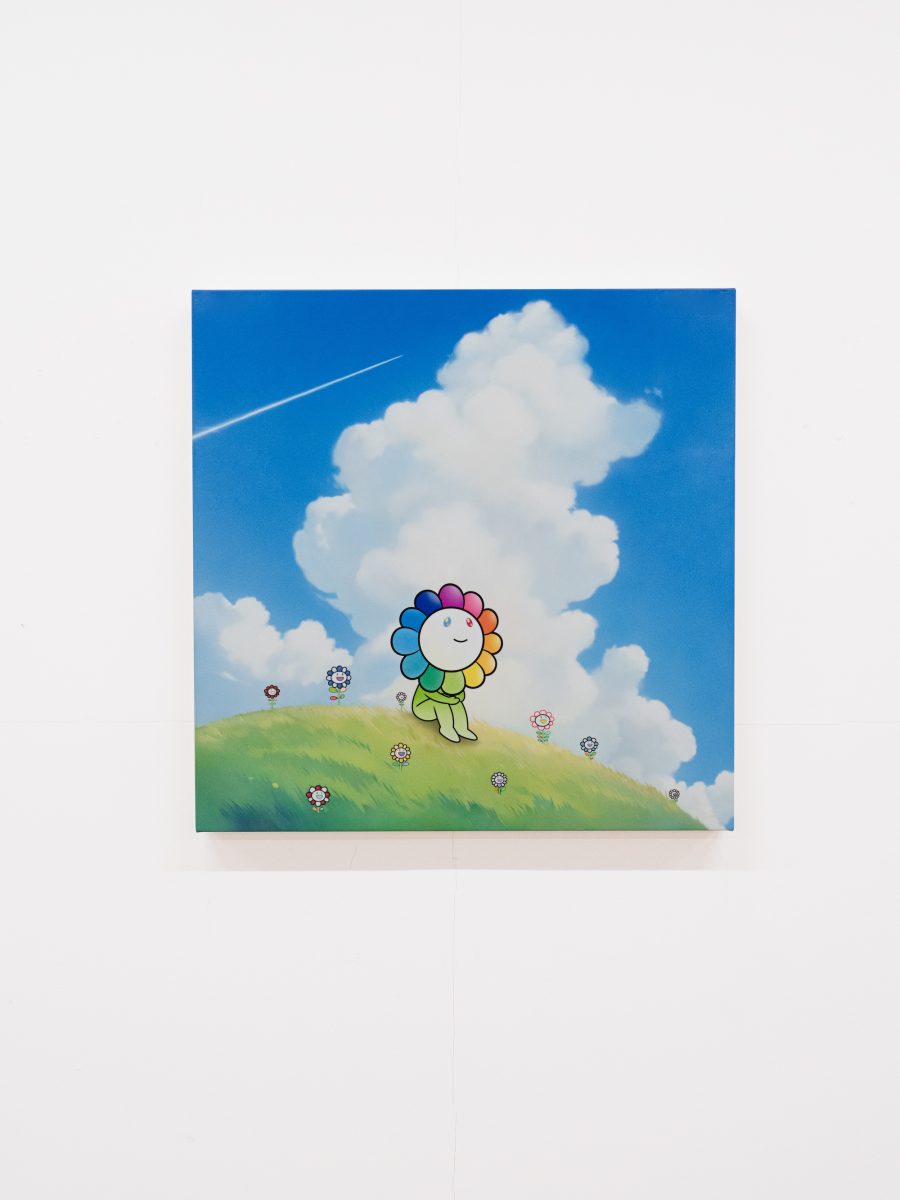
The exhibition’s final movement extends this lineage into contemporary Japanese visual culture. Works such as Camille Doncieux Painting Outdoors and Flower-Chang on the Hill originated as designs for Murakami’s 108 Flowers Revised trading card series, released in 2024. Drawing on Hayao Miyazaki’s The Wind Rises — itself influenced by Monet — Murakami folds manga, anime and kawaii aesthetics into the same historical loop. Monet’s pastoral figures give way to Murakami’s smiling flowers and animated characters, while contrails and blossoms quietly reference youth, memory and impermanence.
A concluding group of works looks even further back, presenting precedents for Murakami’s iconic floral motifs through copies of ukiyo-e flower prints by Hokusai and Hiroshige, alongside hollyhock compositions inspired by Rinpa masters Ogata K?rin and Kenzan. Together, they underline a key premise of the exhibition: that copying, far from being derivative, is a generative act deeply embedded in Japanese artistic tradition.
For Murakami, revisiting the past is not nostalgia but method. By reworking historical images, he clarifies the chain of influence linking ukiyo-e to Impressionism, abstraction and contemporary visual culture — a project that has come to define his later practice and recent museum exhibitions worldwide.
Takashi Murakami, Hark Back to Ukiyo-e: Tracing Superflat to Japonisme’s Genesis, February 14th – March 14th, 2026, Perrotin Los Angeles
Alongside the exhibition, a Perrotin Store will operate from 6th–28th February at 5040 West Pico Boulevard, offering limited-edition prints and merchandise by Murakami and other gallery artists. Murakami will also appear in conversation with MOCA Chief Curator Clara Kim on 12th February at The Geffen Contemporary at MOCA, reflecting on his theories of Japanese art and the enduring legacy of Superflat.