

Esther Schipper open Ensemble, bringing together works by Jac Leirner & Rafa Silvares.
The exhibition marks Silvares’s first and Leirner’s third with the gallery. The year Silvares was born some hundred kilometers inland, Leirner completed her artistic education; decades later, Silvares would study at the same institute in São Paulo. Continuing their rich correspondence, the exhibition is a result of the artists’s exchange within each other’s universes. Taking the habit to pick up, sketch, and keep quotidian items as a point of departure, the artists’s dialogue echoes a Benjaminian ode to collecting.
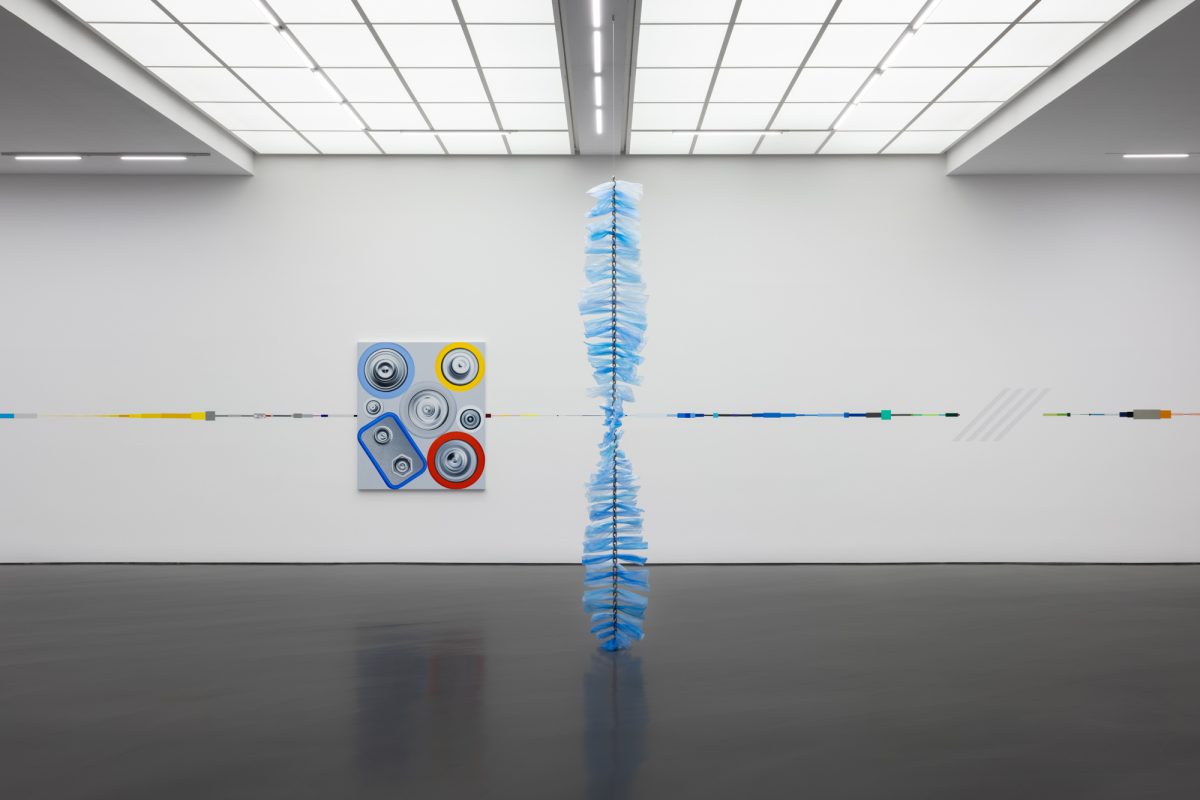
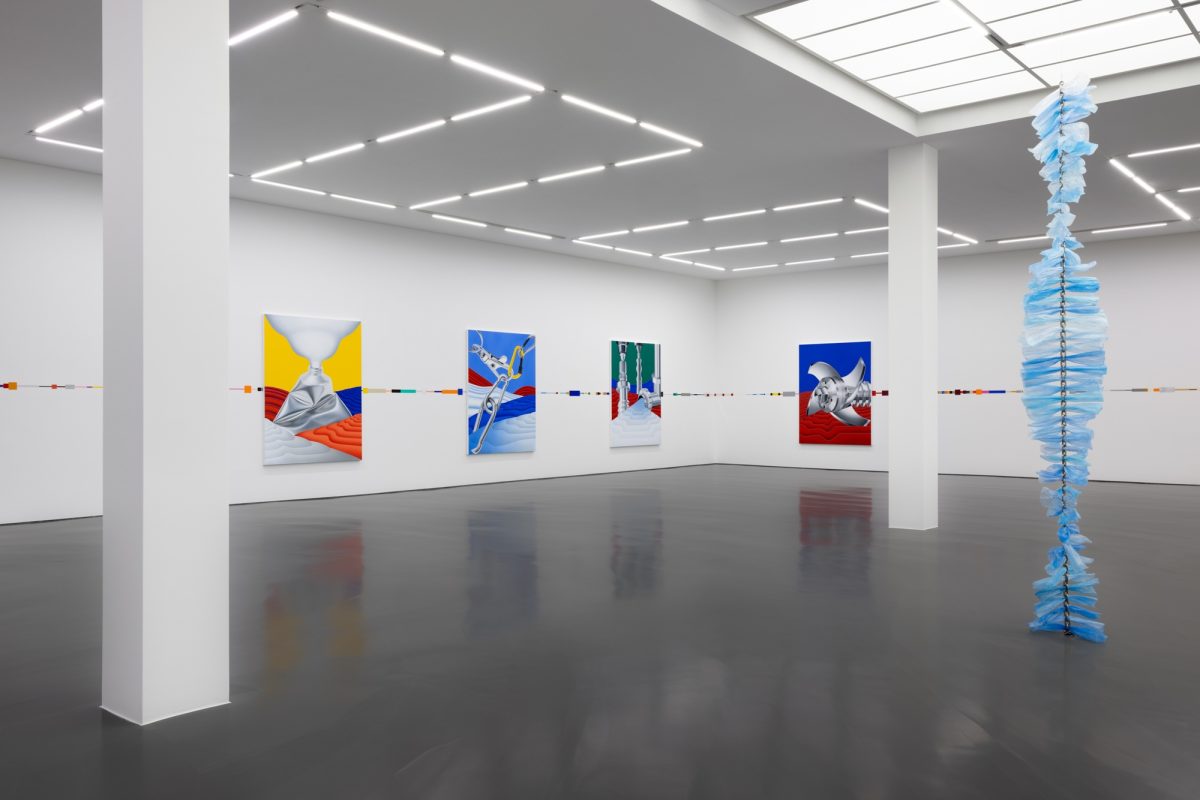
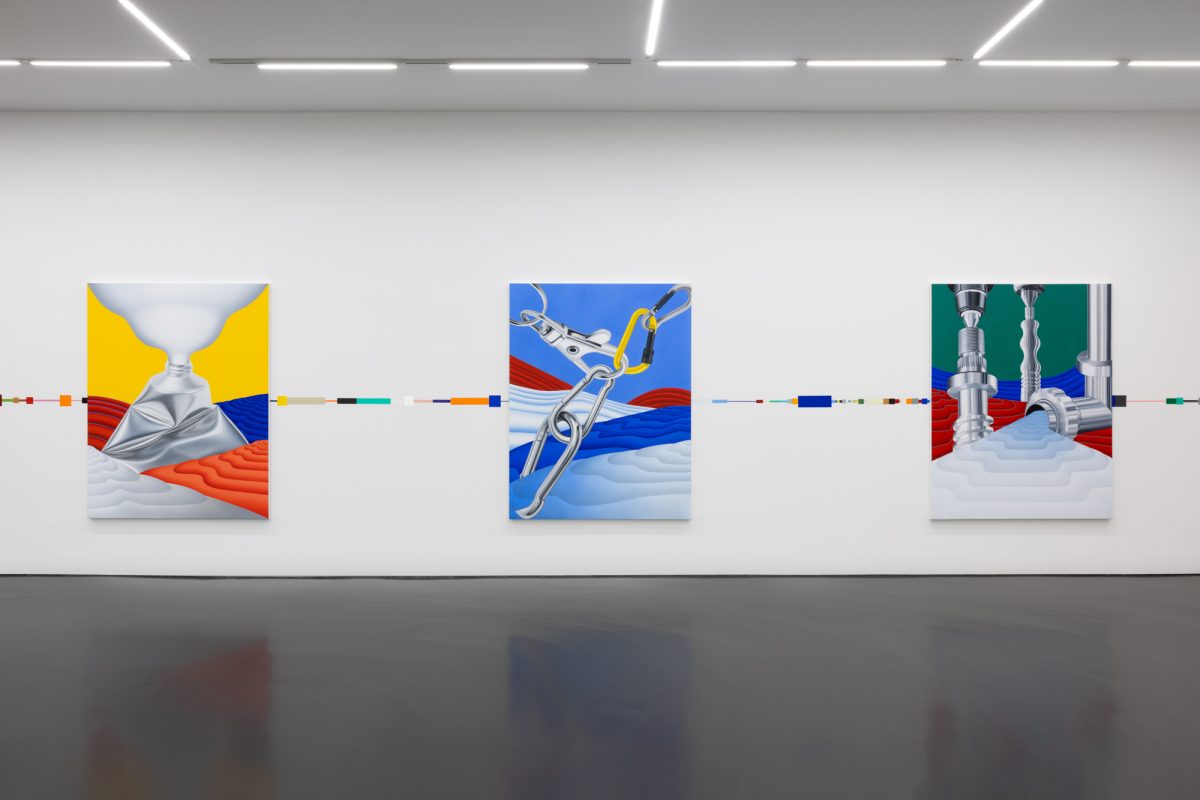
A new iteration of Leirner’s groundbreaking work, Hip Hop (1998/2025), extends along the exhibition space’s walls. Held in the Solomon R. Guggenheim collection, Hip Hop has been presented in eight institutions across continents. For this presentation, Leirner has produced a new version of the historic piece, adding a motif, “scratch,” a sequence of four parallel, diagonal bars. The installation, while paying homage to Piet Mondrian’s penultimate painting Broadway Boogie Woogie (1942–43), takes its name from the unruly beats that jumped from New York’s Bronx onto the world stage. In its materiality, the work, comprised of a horizontal line made from hundreds of pieces of adhesive tape in different widths, colors and thickness, testifies to the music genre’s sticky sociality: once emerging from Black and Brown block parties, today, hip hop continues to laud the intersection of drums, voice, and dance. By combining chromatic confrontation and square elongation, Leirner translates the phonetic of the name “hip hop” into space. Bouncy and saturated, the work resonates with the music genre’s pulsating loops and highlights the importance of Leirner’s musical background as a formative experience. Borne by the transgressive potential of music, Hip Hop recalls an adaptation of roaring frequencies into the optics of rhythm. Spun around its own axis, Anthropomorphic (2024), consisting of a metal chain through which blue plastic bags have been threaded, reiterates the motive force of rhythm within a sculptural grammar.
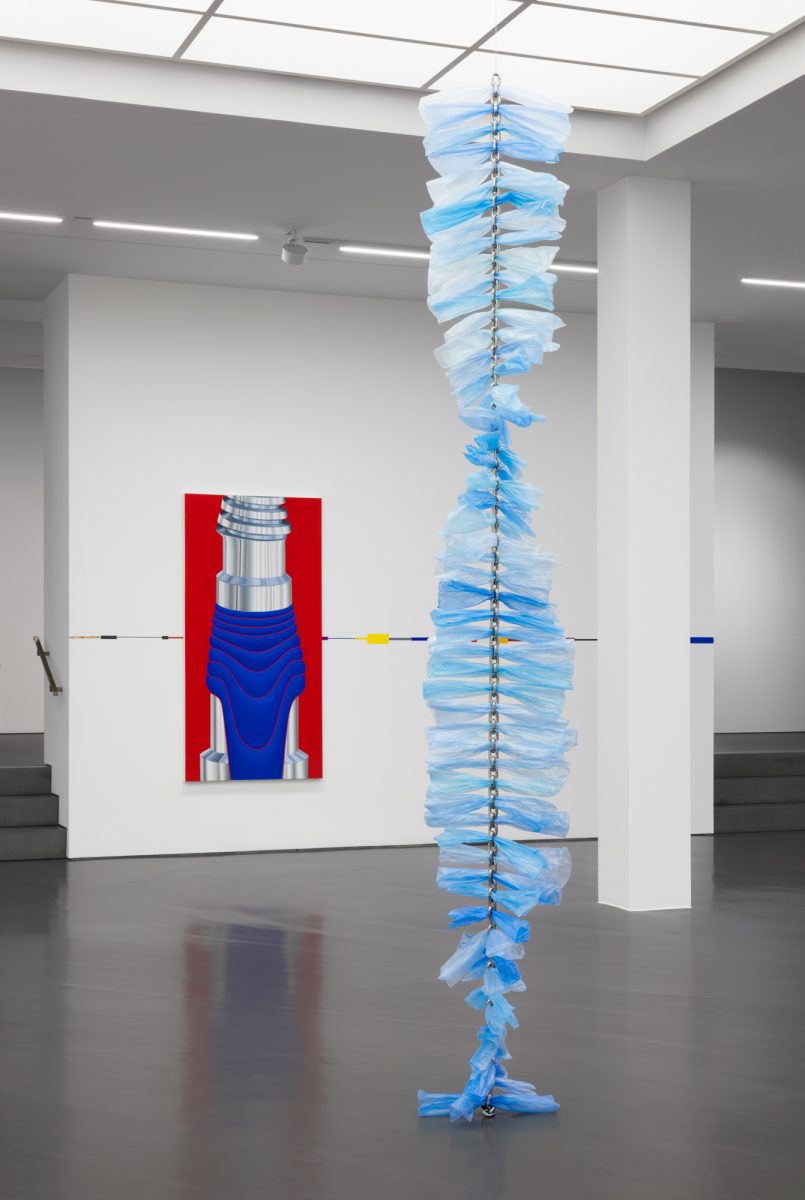
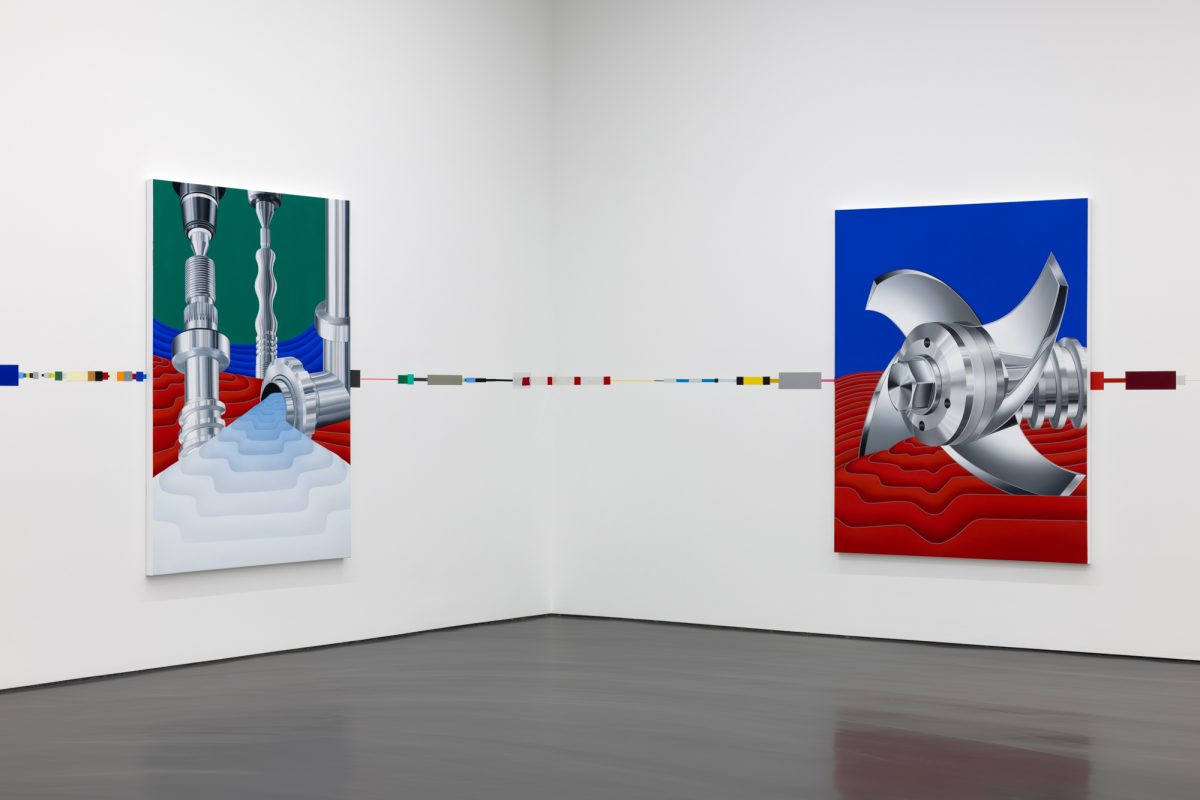
Six new paintings by Silvares are installed across Hip Hop, which runs through their core and resumes a connective horizontal line between them. Four large-scale paintings are hung sequentially; each depicts an abstract landscape comprised of viscous mounds that appear to unfurl slowly, interrupted only by the crisp contour of metallic objects. Metal is a recurring motif that exerts symbolic power; its hard, lustrous, reflective shell evokes the promise of modernity with its scientistic notions of cleanliness and the antiseptic. In Pillars (2025), a finely polished pipe empties a bulge of viscid silver into the painting’s foreground while Mill (2025) exhibits a helical screw blade. Titanium (2025) depicts a clenched tube facing it’s squeezed-out white paint; the silhouette is reminiscent of an hourglass and idiosyncratic for the artist’s seamless brush strokes. Hiperlink (2025) depicts interlocked snap hooks and pays tribute to Leirner’s trademark gesture of tying, clipping, or otherwise attaching products bought at hardware stores into extensive installations. As a can in vivid red is crushed inside a hydraulic press, time appears to stand still in Pole (2025). Suggestive of a crumbling pillar, the work’s vertical composition briefly halts Hip Hop, while tapping into Anthropomorphic’s tall, tranquil dynamic. Executed in oil, Silvares’s 808 (2025), depicts shiny and perfectly round knobs in aluminum grey, embraced by intense shades of red, yellow, and blue that read as another nod to Mondrian. Another reference, indicated by the work’s title, is the iconic drum machine Roland TR-808 Rhythm Composer, a bedrock of early hip hop samples.
As though sampled beats looped on Silvares’s 808, taking the shape of Leirner’s Hip Hop, were bouncing back from the gallery walls, the exhibition stages the transposition of sound into color by uncovering their substantial form: frequency. Side by side, and one above the other, Leirner and Silvares extend their exploration of chromatic vibration into an ensemble of rhythmic interventions. Both artists draw on an untamed color palette, not shying away from vibrant hues, loud accentuation, or pointed contrasts. Yet, the deliberate placement of color in their respective work exhibits an aesthetic of sensorial fine-tuning. What drives the artists’s parsing of color through spatio-temporal unfolding, then, is not the chilled metrics of containment, but rather an enduring attraction to intensity, rhythm, and frequency
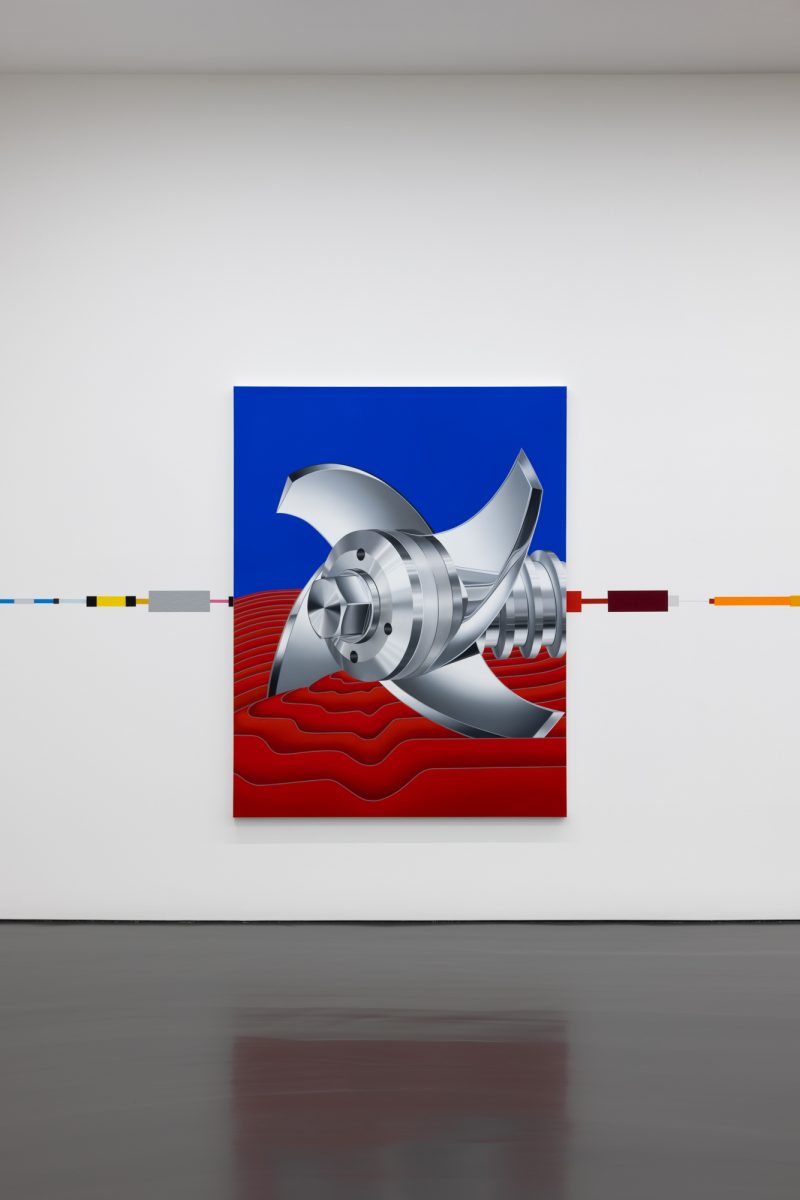
Jac Leirner, Rafa Silvares, Ensemble, November 14th – December 18th, 2025 Esther Schipper, Berlin
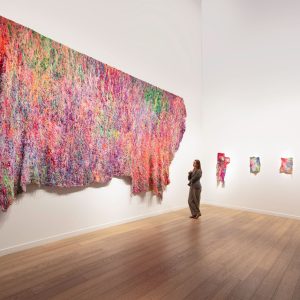
All images Exhibition view: Jac Leirner and Rafa Silvares, Ensemble, Esther Schipper, Berlin, 2025 Courtesy the artist and Esther Schipper, Berlin/ Paris/Seoul Photo © Andrea Rossetti
About the artists
Jac Leirner was born in 1961 in São Paulo, where she lives and works. In 1984, she received her BFA in Fine Arts from the Fundação Armando Álvares Penteado, in São Paulo.
The artist was awarded numerous grants and residencies, among them: 2019 Wolfgang Hahn Prize; 2012 APCA Award: Best Exhibition of the Year – Estação Pinacoteca, Sao Paulo; 2012 artist in residence at the Yale University School of Art; 2001 John Simon Guggenheim Fellowship; 1998 visiting artist at the Rijksakademie van Beeldende Kunsten, Amsterdam; 1991 visiting artist at the University College, Oxford; 1991 visiting artist at the Ruskin School of Drawing and Fine Arts, University of Oxford; 1991 artist in residency at the Museum of Modern Art in Oxford, and the 1991 artist in residency at the Walker Art Center, Minneapolis.
Selected solo exhibitions include: Jac Leirner, Swiss Institute, New York (2023); Us Horizon, Esther Schipper, Berlin (2022); Jac Leirner. Wolfgang Hahn Prize 2019, Museum Ludwig, Cologne (2019); Institutional Ghost, IMMA Dublin (2017); Borders are Drawn by Hand, MoCa Pavilion, Shanghai (2016); Jac Leirner. Functions of a variable, Museo Tamayo, Mexico City (2014); Jac Leirner, Pinacoteca do Estado de São Paulo, Sao Paulo (2011); Adhesive 44, Miami Art Museum, Miami (2004); Projeto Parede, Museu de Arte Moderna de São Paulo, Sao Paulo (1999); Directions, Hirshhorn Museum and Sculpture Garden, Washington D.C. (1992); Currents, ICA, Boston, (1991), and Viewpoints, Walker Art Center, Minneapolis (1991).
Rafa Silvares was born in 1984 in Santos, Brazil. He studied fine arts at FAAP (Fundação Armando Alvares Penteado), São Paulo and received a BA in Language and Literature from the Faculty of Philosophy, Languages, and Human Sciences (FFLCH) at the University of São Paulo.
The artist was a Pipa Award Nominee in 2020. Among his residencies were in 2021 The Fores Project, London (2021); La Centrale residence, Paris (2018); and Pivô research, Pivô São Paulo (2016). In 2008 the artist participated in the 28th São Paulo Biennial, in collaboration with AVAF.
Recent exhibitions include: Ganz konkret 2, Kunstpalais, Erlangen (2025); L’Almanach 23, Le Consortium, Dijon (2023); Real Fake Door, Arsenal Contemporary Art, New York (2023); The Artists Contemporary Atelier, London (2021); Monster High, Olhão, São Paulo (2020); 48th Luiz Sacilotto Art Salon, Casa do olhar, Santo André (2020); Bife, Olhão, Sao Paulo (2019); Traço, Platô Studio, São Paulo (2016); Pivô Art Research, Pivô, São Paulo (2016); I Scream, critical follow up of Galciani Neves and Regina Parra, Galpão Glicério, São Paulo (2015); 21th Praia Grande Art Salon, Praia Grande (2014); Dizzy World, Paper Box, New York, NY (2013); and Parahaus, São Paulo (2011).