
When my phone pinged on a chilly Sunday morning in Berlin, I wasn’t expecting what appeared on screen.
“Someone just messaged me and said the Kabinett is gone.”
Gone? Like, how gone?
A thousand-pound Brutalist kiosk embedded into the concrete sidewalk doesn’t just walk away.
My first thought was that the council had taken it. Which council you might ask? We never really knew. Our public art gallery, Crystal Kabinett, staged in an abandoned and disused Transport for London (TfL) shelter, stood on Crystal Palace Parade at the intersection of five boroughs: Southwark, Lambeth, Bromley, Lewisham, and Croydon. After poring over maps, emailing councillors, and tracing boundary lines with out feet, my team and I had never quite determined under whose purview our little space fell, but we suspected that this very ambiguity had helped it fly somewhat below the proverbial and bureaucratic radar.
It wouldn’t have been the first time the council took a Kabinett away. Last summer, the flagship Kabinett in Camberwell had been excavated and removed by Southwark one day in July without warning. Disappointing as that was, within a matter of weeks we identified a new space in Crystal Palace and simply migrated the project south. Like the progressive exile of many London-based creative projects and independent artists being pushed out from the centre, the name of the game is sink or swim.
After all, as a guerilla-style public art platform, exhibitions ebb and flow with the tide of the megalopolitan. The structures we restore and maintain never really belong to us. This makes them slightly easier to part with. They are abandoned — forgotten by the city like municipal has-beens, accumulating rubbish and taking up space. They sit within the friction of public life on borrowed ground, open to the public’s moods.
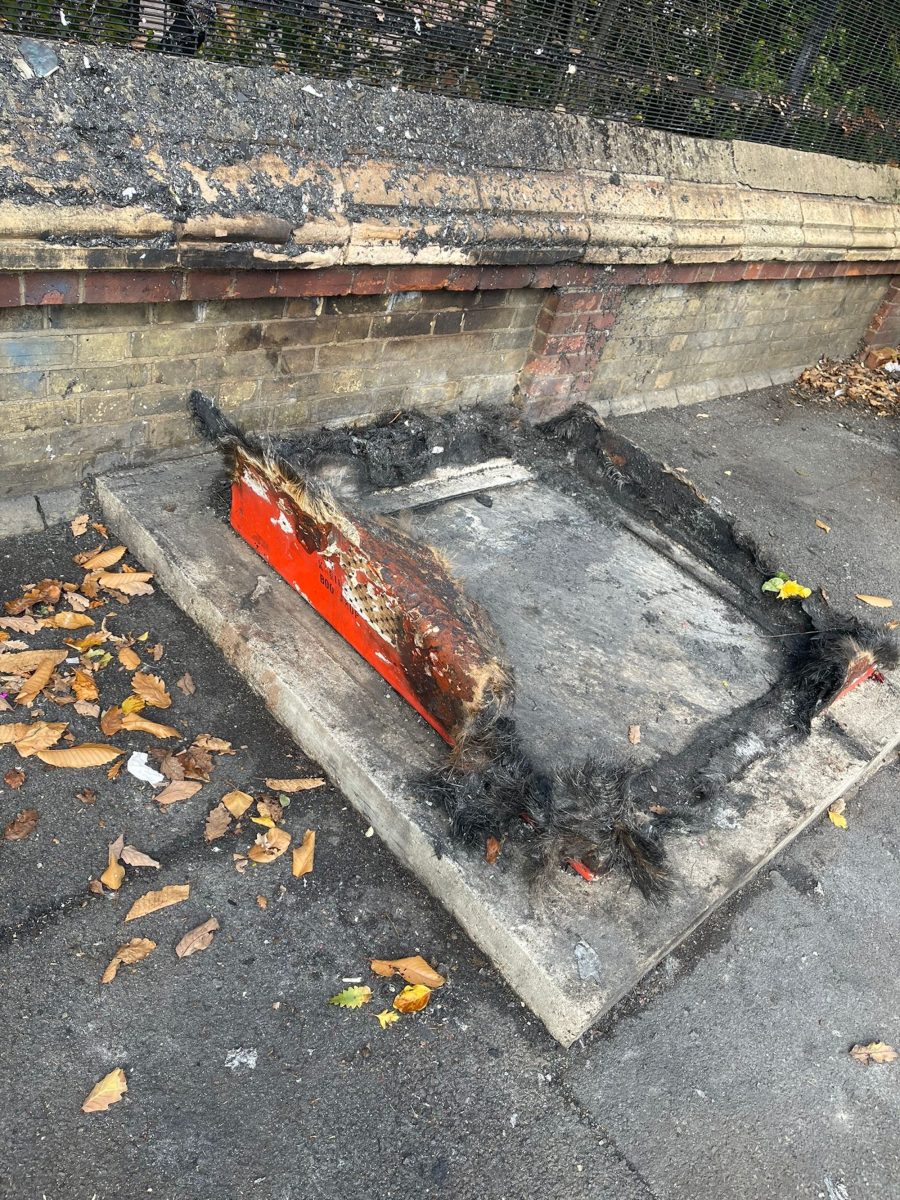
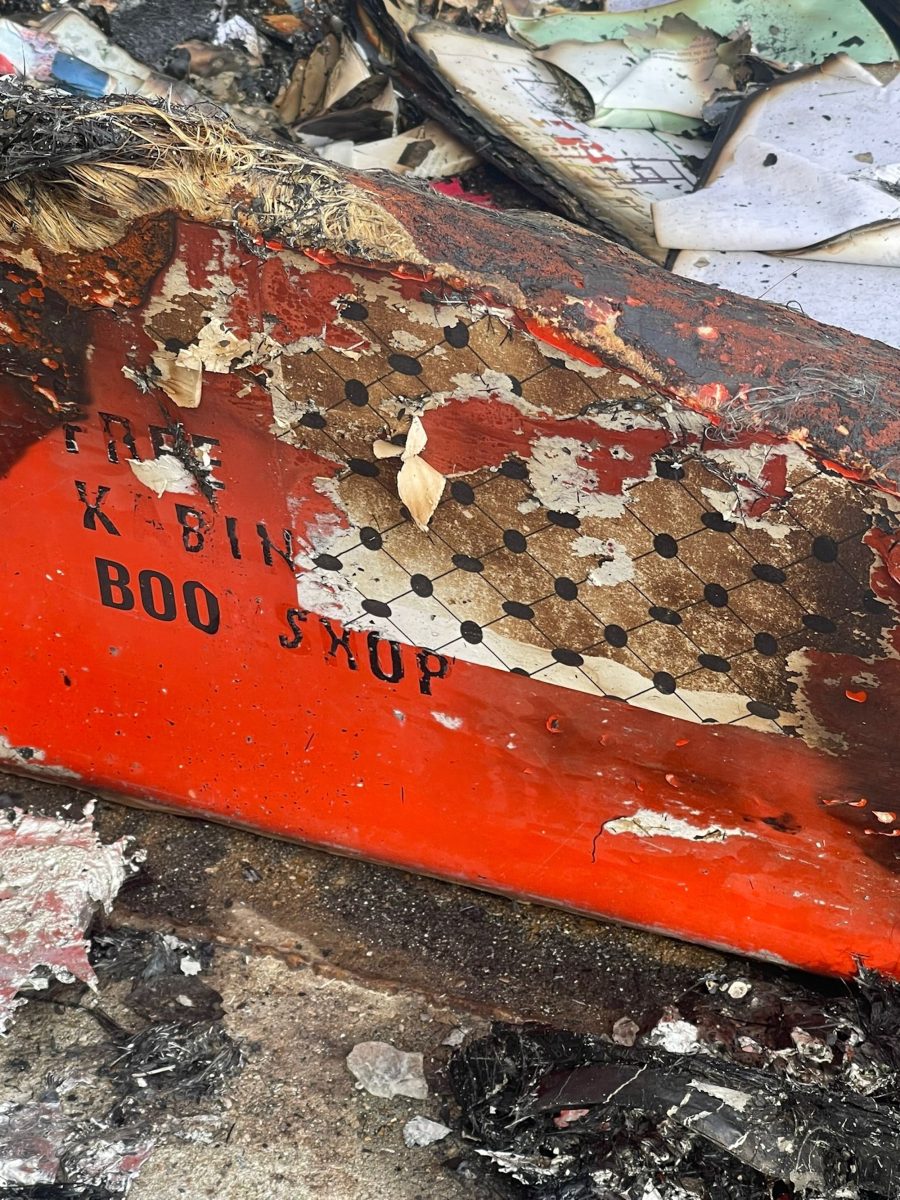
But this time, it wasn’t the council. As I swiped to open the message, I saw the image my colleague had sent: the scorched and melted fuselage of what had once been a fibreglass structure, its fibrous innards protruding like exposed nerves from a blackened hull. Near the bottom of what used to be a red porcelain enamel façade, I could still make out the letters spelling free books inside. In addition to hosting art exhibitions and performances, the Kabinett had become a community book exchange, home to nearly a hundred titles on its single shelf. Another photo showed a singed book.
“Why does it look like it’s burned?” I asked.
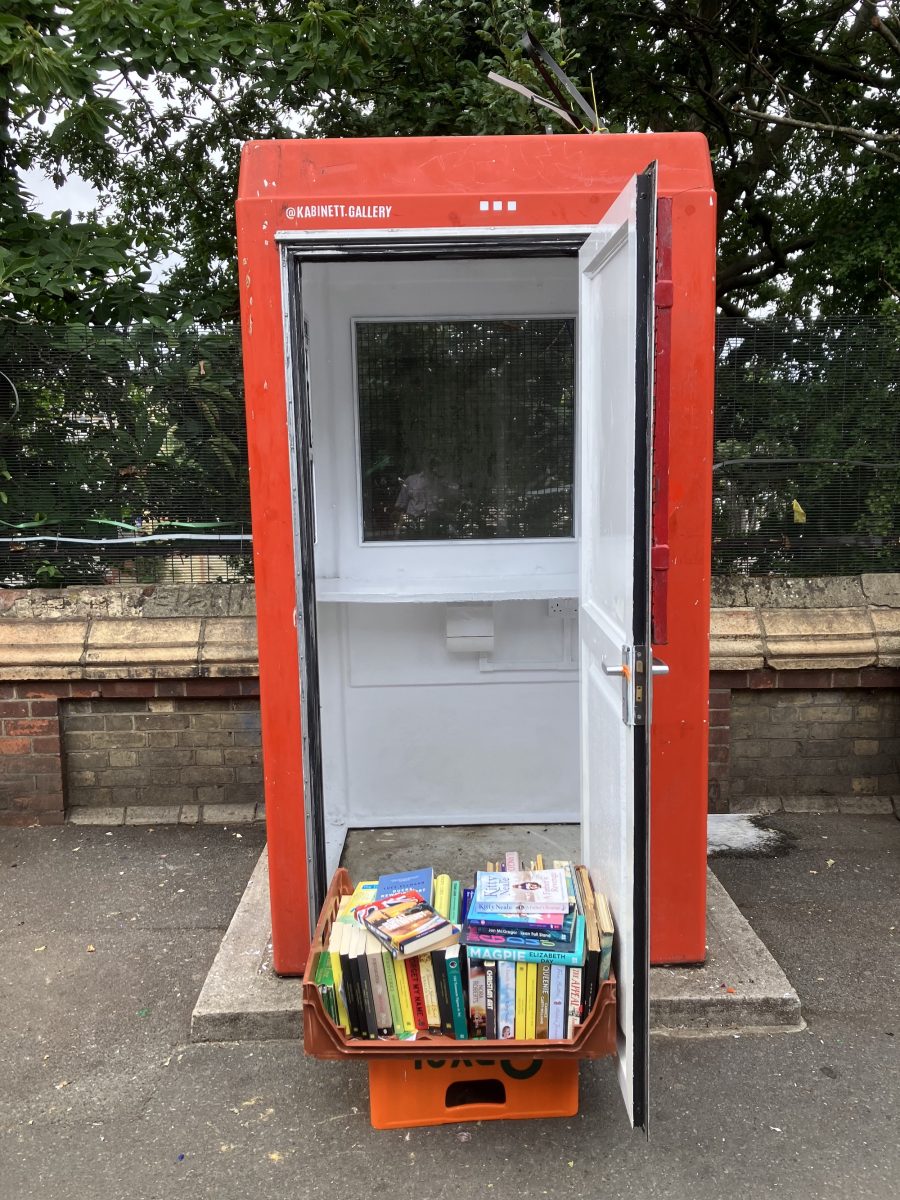
Opened in 2024, Crystal Kabinett was located inside a TfL outpost near the historic site of the former Crystal Palace — which, ironically, also met a fiery fate. Like its Camberwellian predecessor, Camberwell Kabinett, Crystal Kabinett was an identical modest cabin from the 1950s made of fibreglass, concrete, and glass, once used by the bus inspectors for logging bus routes and schedules.
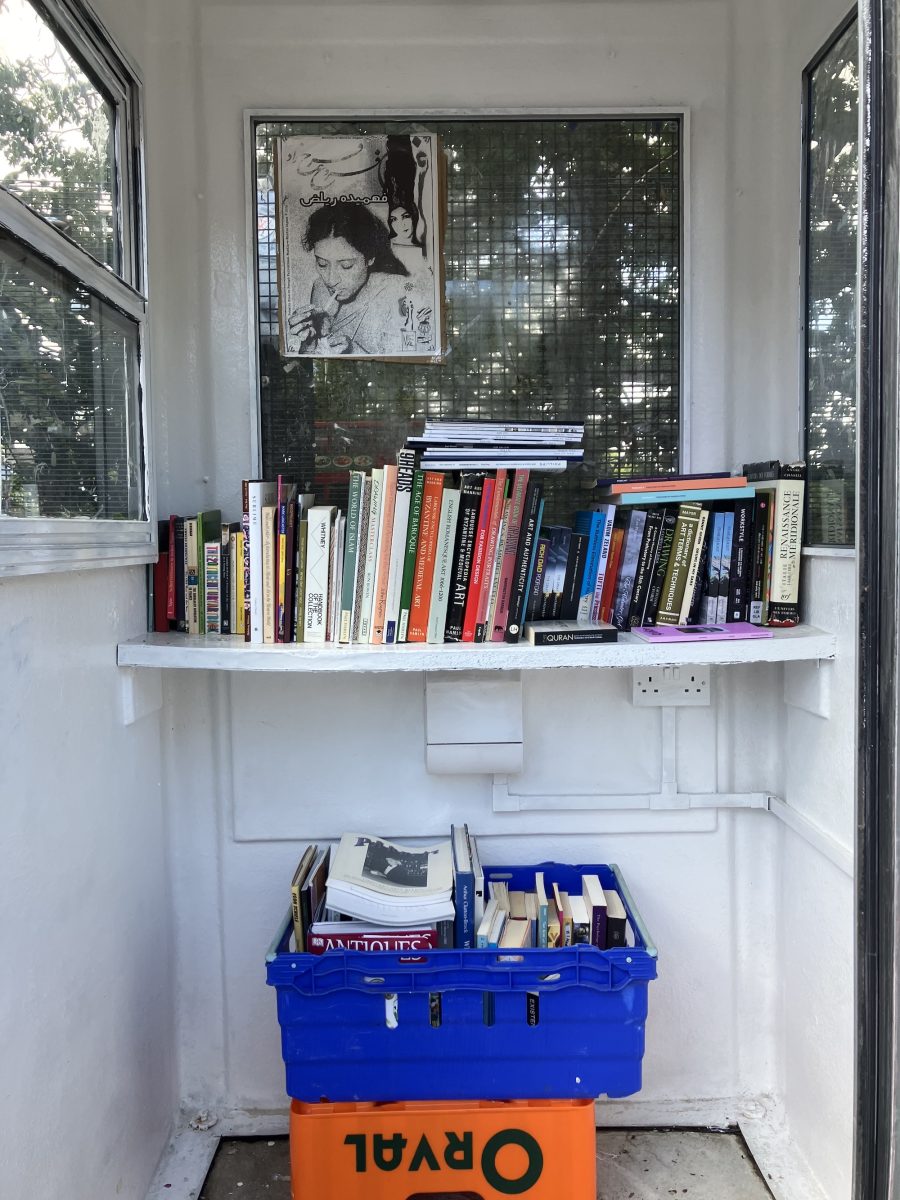
Bus inspectors would use the space to lock up belongings, shelter from rain, or just take five. Slightly larger than a phone booth, 2-3 people could fit comfortably inside it. After being disused for over ten years, we found it in a state of decay. Having become a dumping ground for newspapers, the inside smelled like rain and urine. After about three solid days of work, countless bags of waste, and a complete and total excavation of a rotting floor, my team and I reclaimed it as a site for contemporary art — part of a growing network of Kabinett spaces across London and Berlin, each one a fragment of public architecture reimagined as open exhibition space.
On the Sunday of the fire, I was nearly a thousand kilometres away. Images and messages flooded the social media inbox. By Monday, police had confirmed what we already knew: Crystal Kabinett had burned sometime between three and four in the morning. The fire brigade had not been called. No CCTV cameras had captured it; the nearest ones, angled toward the opposite side of the road, had seen nothing.
By Tuesday, police closed the case.
When my team visited the site later that week, the evidence was strange. The fibreglass shell — a material normally resistant to burning — had melted inward from heat, but the trees nearby remained untouched. It had been a small, contained fire, deliberate in its precision but undoubtedly intentional, since without accelerant, fibreglass simply will not burn. The council had already cleared most of the debris. All that remained was the base of the Kabinett: a ravaged rectangle about twenty centimetres high, an accidental monument to absence.
We don’t know who started it. We may never know.
But in the weeks before the fire, we had noticed a shift. Passersby had started to make comments about the Keffiyeh-pattern wallpaper enrobing the structure — part of a recent installation called Kabinett Keffiyeh, an educational collaboration with Crystal Palace Friends of Palestine that aimed to destigmatise the Palestinian scarf as a radical or incendiary symbol. Some mentioned the Palestinian flag that had flown there during an earlier event, where poet Hafiza Ibrahim had recited a poem mourning the July killing of journalist Ismail al-Ghoul.
“You should hang an English flag,” one man had shouted whilst passing by. “Union Jack for England.”
The flag comments lingered. When Crystal Kabinett went up in flames, some speculated a targeted act, motivated by xenophobia or political resentment, though no one could prove it. Because, in a way, this was nothing new. People said things and moved on. That was always how it was. Public space invites that kind of performative behaviour — it’s part of what it means to be visible.
Working in public space means accepting exposure — to the weather, to bureaucracy, to ideology. It also means confronting how quickly gestures of openness can become vulnerable. The Kabinett project was always precarious: a series of architectural resurrections that blur the line between gallery and street furniture, art and infrastructure. Each site is an act of reclamation — of space, of attention, and of care.
Earlier this year I found myself back in Camberwell for a collaboration between Kabinett and Outhouse Gallery, which entailed a tandem exhibition spanning Brunswick Park and Crystal Palace. Part of the project involved a straw bale, which I then had to dispose of on the show’s final day. There I was, decked out in Kabinett attire (ie. my rattiest, tattiest work clothes), manoeuvring a large bale of straw into a shopping trolley so that I could wheel it away for recycling. It may sound eccentric, but it’s the kind of situation one finds themself in when curating art.
A woman approached me and said, “excuse me, are you homeless?” Slightly stunned and minorly offended on behalf of unhoused people, I stared at her blankly, finally managing to ask her what in the world the point of her question was. She asked again. And again. When I still didn’t tell her, she eventually noted that I didn’t “sound from around here” because of my accent, and concluded that I must have come to England to take advantage of the welfare system.
Having spent a small fortune on student visas, then left the country because of the cost of living, only to return periodically to foster and maintain a public art project, her comments felt especially caustic, like fire catching on the dry detritus of human hate.
The Kabinett sought to repurpose that detritus — not to erase it, but to listen to it. In a city where creative space has become a commodity, we wanted to propose something radical in its simplicity: that space already exists. That it belongs to the public.
When we restored these disused shelters, their Brutalist geometry felt like a metaphor for the postwar optimism they once embodied. The Crystal Kabinett became a meeting point for poets, locals, and artists — a curiosity at the edge of the park where bus drivers and teenagers and pensioners might pause to look at a small sculpture or take book. It was never cordoned off and its door was never locked. Its fragility was its strength.
After the fire, messages of sympathy poured in and flowers accumulated at the smouldered stump. Kabinauts from Berlin and London wrote to say how deeply they felt the loss. “This is what it means to practice without a space,” one colleague said, who happens to be the director of a museum that is currently under renovation. I keep thinking about that advice. What does it mean to continue when the material structure — the literal shelter for the work—is gone?
In a sense, the Kabinett always existed on that threshold. It was both architecture and attitude. Its destruction feels like an ending, but also like proof of what it revealed: that public space is still contested territory, that the right to exist within it remains political. Art in the street reflects the society that passes by. The Kabinett mirrored its environment — its tolerance, its indifference, and its hostility. That is the truest form of public art: one that remains inseparable from the forces that shape it.
When I look at the photos now, I’m struck by how contained the fire was. The base still visible, the trees untouched, the asphalt clean. It was as if someone wanted to erase only the idea, not the place itself. The violence is symbolic of a world where destruction is easier than dialogue, and where fire replaces interaction. What happened mirrors the wider logic of war: the impulse to erase rather than engage.
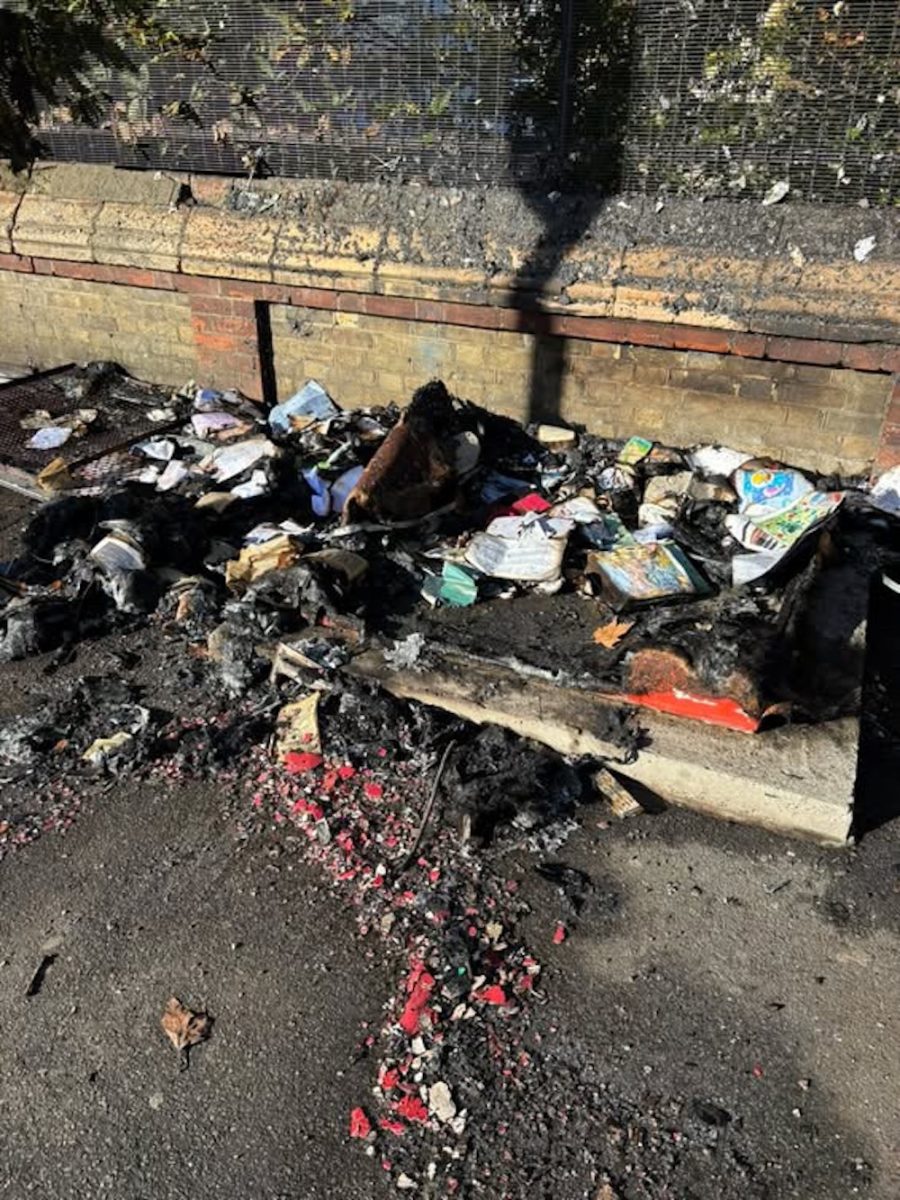
“The Kabinett is gone,” the message said. But maybe it isn’t.
The structure was always secondary to what it proposed: a reimagining of ownership and a call to inhabit the city differently. If public space is a reflection of who we are, then the ashes of Crystal Kabinett belong to that reflection too — both what we build and what we burn. You can burn the walls, but not the work. You can destroy the form, but not the practice. Kabinett Gallery endures — not only in Berlin, but everywhere and anywhere.
In light of the incident, we ask anyone who wishes to show support by donating to our GoFundMe, which will be dedicated to exploring new opportunities for Kabinett spaces and continued community engagement.