Gagosian has opened an exhibition by Christopher Wool at its Grosvenor Hill location in London. Featuring 50+ works on paper, sculptures, and prints from the most recent period of his career.
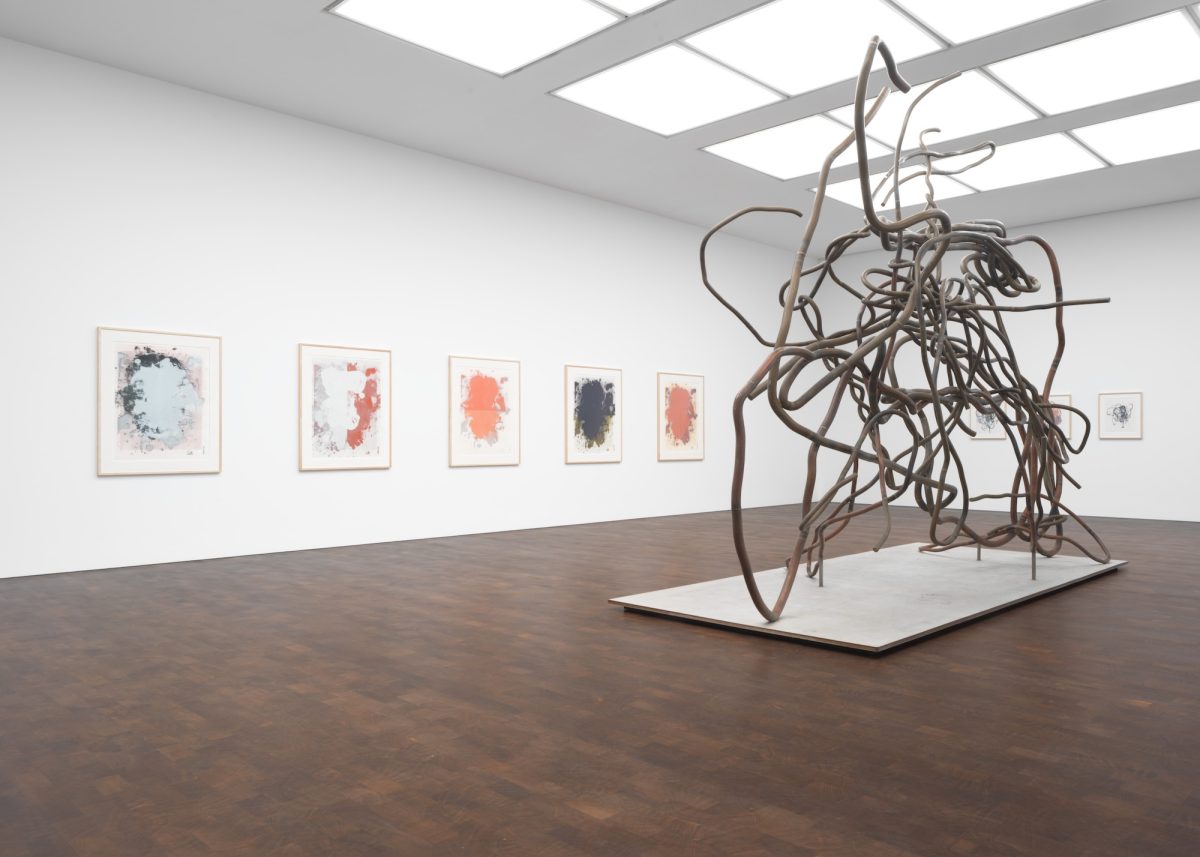
This is the most expansive presentation of Wool’s work in London for many years and his third with the gallery. As in his latest self-staged exhibitions—last year in New York and this year in Marfa, Texas—the London exhibition highlights the essential interconnectivity of the artist’s practices, in which he continues to engage with the limits of abstraction. For Wool, process and subject go hand in hand.

The range of processes employed in each of Wool’s multilayered works on paper reveals the extraordinary breadth of his artistic strategies. He began to silkscreen his own works in the 1990s, flattening an image and applying it to canvas before adding gestures of paint. This approach has become more complex over time, as the artist explores the effects of repetition, scale, rhythm, and different means of overpainting, such as the looping line of an industrial spray gun. Further to these expressive marks of paint, Wool drags turpentine-soaked rags over the painted surface to efface his images in a haze of gray mist. In contrast to the monochrome palette he is often associated with, at Gagosian Wool imbues various works with pastel hues. By erasing, collaging, overpainting, and digitally modifying imagery from previous works, he creates something vitally new through a process of self-replication.
The cursive line of Wool’s sculptures—shown initially in his landmark survey at the Solomon R. Guggenheim Museum, New York, in 2013–14—echoes the gestural marks of his paintings. Four intimate and two large-scale sculptures in copper-plated steel and bronze are on view here. Their genesis lies in the arid landscape of Texas, where Wool divides his time between Marfa and New York. Wool collected pieces of old fencing and hay-baling wire for years before realizing their sculptural potential. At times these remain as found, and at others they are transformed into new forms and reimagined on a dramatic scale. Wool purposefully leaves details of the processes visible, such as welded joints, to stress the handmade quality of his works.
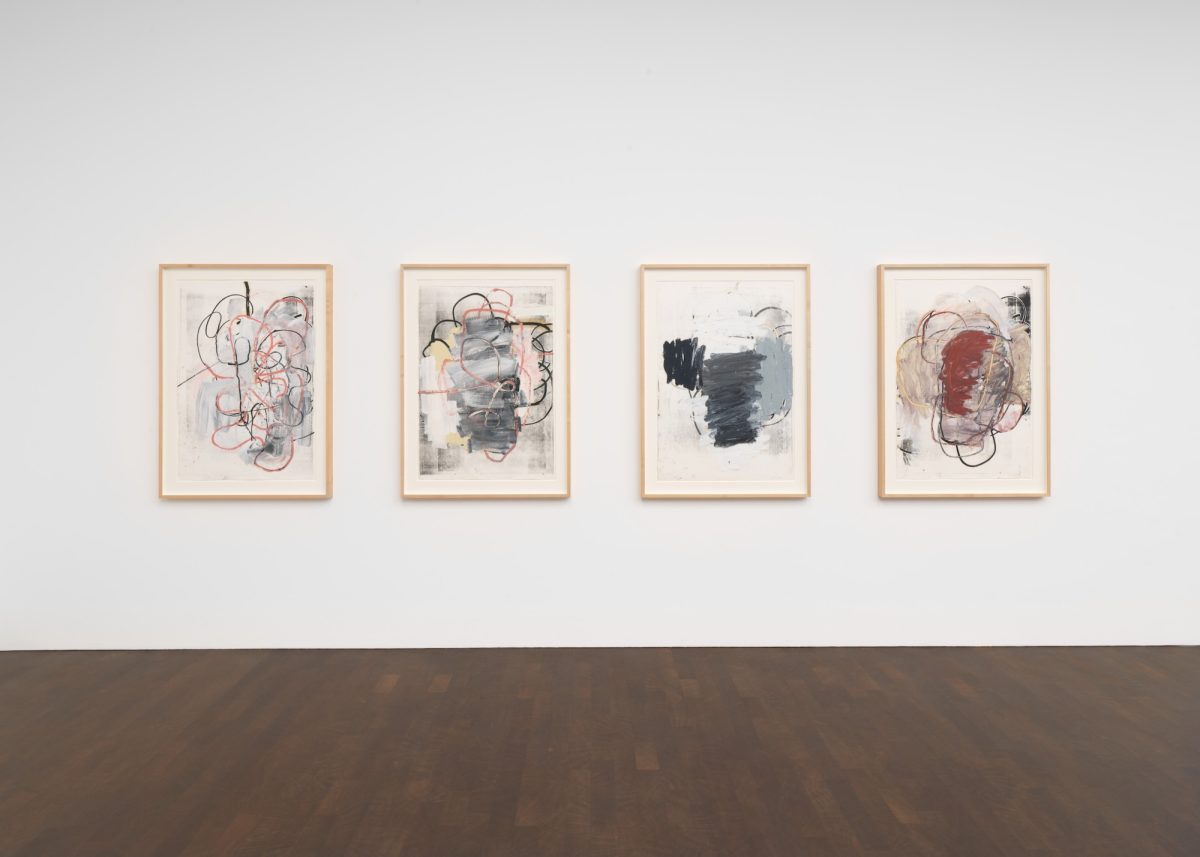
Courtesy the artist
Two series of etchings from 2021 and 2023 also form part of the exhibition. The latter, Defenestration Suite, was made to illustrate What Just Happened (2023), a book of poetry by Richard Hell—a writer, musician, and longtime collaborator of Wool’s. Reminiscent of Wool’s iconic word paintings, letters and words are entangled with lines in these prints to test the meaning and visual resonance of language.
Currently on view, See Stop Run West Texas is a survey of Wool’s works from the past decade at the Brite Building in Marfa, organized by the artist with curator Anne Pontégnie. It is complemented by three large outdoor sculptures as well as a new 400-page book, to be published this fall. Featuring more than two hundred images, the book documents the first iteration of See Stop Run, which took place in 2024 on the nineteenth floor of an unoccupied space in New York’s Financial District. The city permeated the exhibition through windows that wrapped around the 18,000-square-foot installation.
Both of these installations emphasize Wool’s complex image-making process and the interconnectivity between mediums: painting, sculpture, photography, and mosaic.
CHRISTOPHER WOOL October 13th–December 19th, 2025, Gasgosian Grosvenor Hill
About
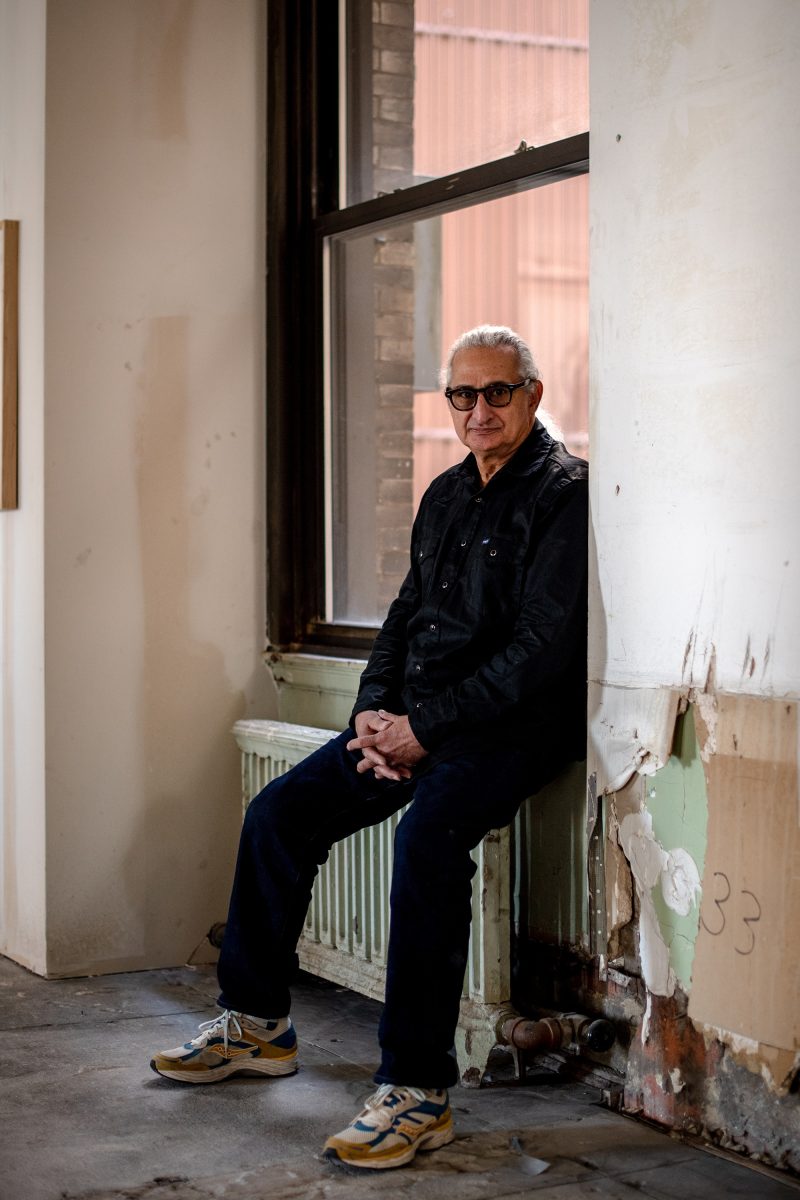
Christopher Wool (b. 1955, Chicago) lives and works in New York and Marfa, Texas. After studying at Sarah Lawrence College and the New York Studio School, he developed a practice that probes the tension between image, language, and process.
In the mid-1980s, Wool began rolling black enamel patterns onto white panels, deliberately leaving smudges and breaks that gave his work a charged fragility. Around the same time, a piece of graffiti on a white truck sparked his first text paintings—gridded compositions where words are fractured, vowels dropped, and spacing distorted to slow the act of reading.
Since the early 1990s, Wool has used silkscreen printing to rework his own imagery, layering transfers of earlier paintings with sprayed enamel, paint, or drawn line. His more recent “gray paintings” push this further: sprayed marks are wiped away to reveal ghostly compositions where precision meets blur, clarity meets haze.
Photography offers another view into his restless eye. Absent Without Leave (1993) and East Broadway Breakdown (1994–95/2002) capture New York’s nocturnal streets in stark black and white—fragments of a city that mirrors his paintings’ raw immediacy.
His recent survey See Stop Run (2024), organized with curator Anne Pontégnie, filled an entire floor of a Financial District space, its wraparound windows merging the city’s architecture with Wool’s layered abstractions. A second chapter opened in 2025 at the Brite Building in Marfa, accompanied by three large outdoor sculptures, extending Wool’s dialogue between urban intensity and desert stillness.