Gagosian to present Says I, to Myself, Says I, Ed Ruscha’s first exhibition dedicated to his paintings on unprimed linen. On view at the Davies Street gallery in London the exhibition coincides with Talking Doorways, an exhibition at Gagosian’s rue de Castiglione gallery in Paris.
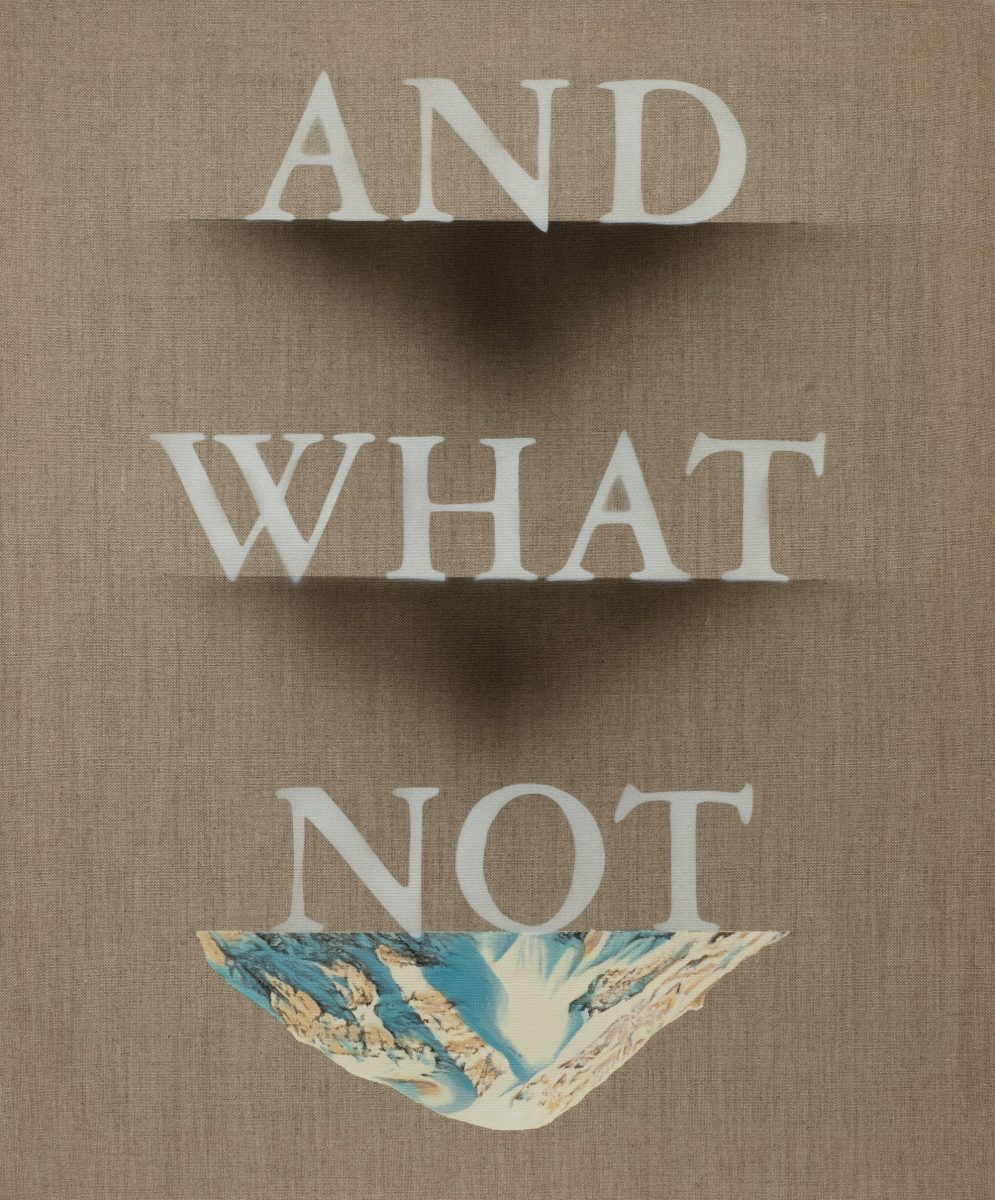
Ruscha began making paintings on raw linen in the early 1990s, although this body of work has never before been the focus of an exhibition. The ten new works in this format presented in London establish visual and textural contrasts between the painted words and images and their supports, emphasizing their definition and potential. Rendered in a serif typeface and mostly in white, many of the words are underlined with tapering black shapes that accentuate them and suggest horizons and cast shadows within otherwise flat compositions, while some canvases include additional painted passages and symbols.
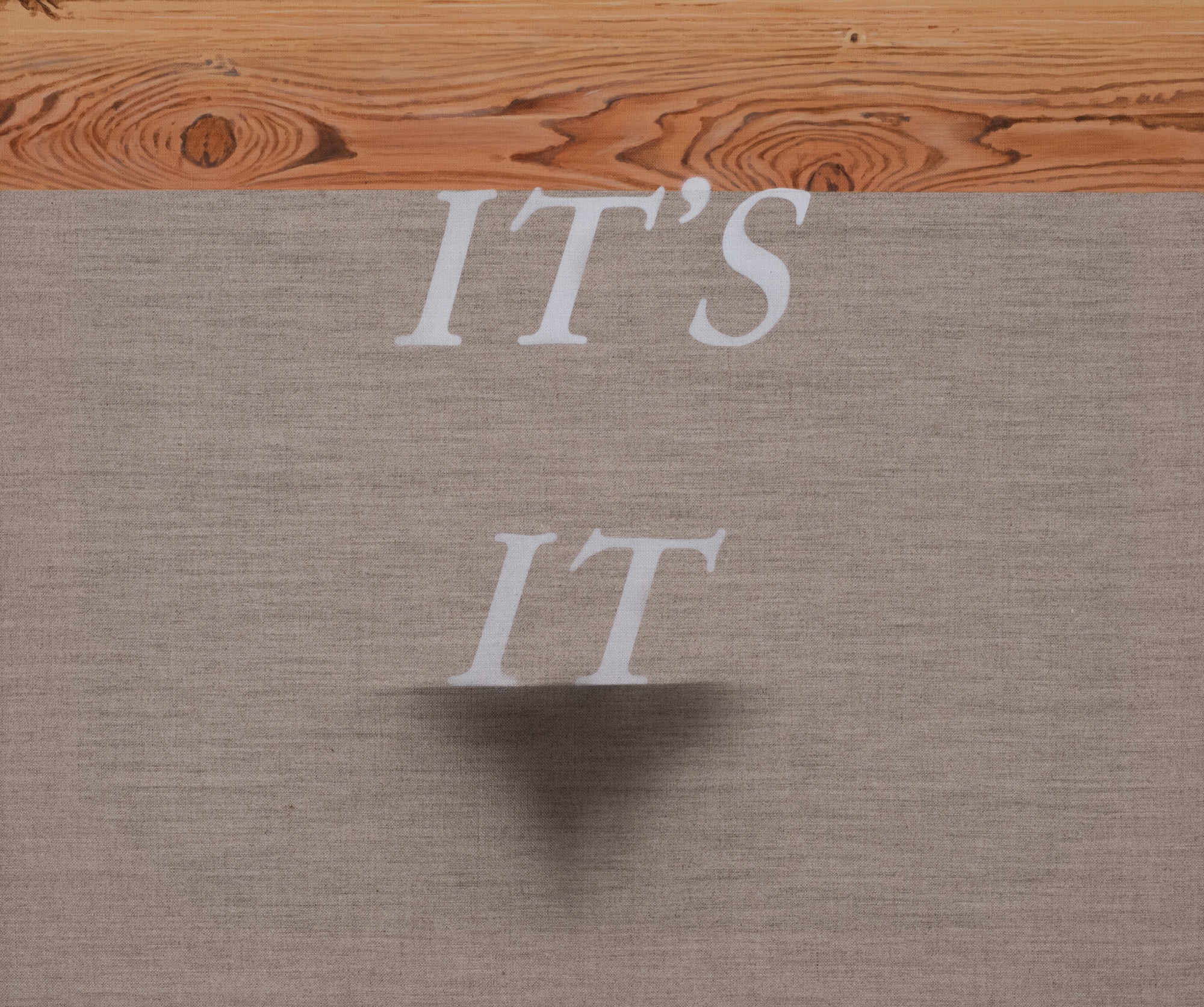
Since the 1960s, Ruscha has consistently foregrounded the strangeness of everyday language, exploring how the relationships between words and images transform the meanings of each. It’s It (2024) suggests an attempt to clarify the identity of something, though the lack of antecedents renders the doubled pronoun somewhat cryptic. It’s It also incorporates the naturalistic image of a wooden plank stretched across the top of the composition—the defining element of the artist’s Tom Sawyer paintings from 2022.
Other works picture a mountain peak—among Ruscha’s most iconic motifs—in a juxtaposition of archetypal landscape imagery with signifying language. Instead of using the snowy range as a backdrop to text as he did in his Mountain series (1997–), Ruscha here positions it as a graphic and painterly element, replacing abstract shapes in these paintings.
Says I, to Myself Says I (2024) places its text at a diagonal, the words’ dynamism emphasized by the geometric shapes that extend from the lines to the right. An intriguing example of vernacular language, the phrase can be found in Irish and American folk songs and colloquial sayings, while the repetition of “Says I” suggests an introspective declaration.
ED RUSCHA Says I, to Myself, Says I October 14th–December 19th, 2025 Gagosian Davies Street
Opening reception: Tuesday, October 14th, 6–8pm
About the artist
Ed Ruscha began by calling himself “an abstract artist who deals with subject matter.” Rather than inherit the weight of Abstract Expressionism, he turned to the language of advertising, making words his raw material — as image, as sign, as substance. With wit and precision, he placed the everyday into painting, locating the sublime in both natural and fabricated landscapes.
Born in Oklahoma City and based in Los Angeles since 1956, Ruscha studied at Chouinard Art Institute, where the impact of Jasper Johns’s targets shifted his path. From early miscalculated canvases like E. Ruscha (1959) to his first artist’s book Twentysix Gasoline Stations (1963), he embraced error, graphics, and the road itself as artistic ground.
His practice has since unfolded across painting, drawing, photography, and over a dozen books, including the accordion-folded Every Building on the Sunset Strip (1966). Works like OOF (1962–63) condense language into image, demanding both to be seen and spoken. Over six decades, Ruscha has continued to experiment — rendering phrases in pastel and carrot juice, painting trompe-l’oeil volumes, and reimagining the American vernacular as technology reshapes communication.
Major retrospectives — from the Whitney (2004) to ED RUSCHA / NOW THEN at MoMA and LACMA (2023–24) — confirm his place as one of the most influential artists of his generation. Ruscha’s voice remains singular: a cool, incisive gaze on how words, images, and landscapes shape the way we see and speak