Alex Conyngham advances his father’s foundational cultural vision with CAIM at Slane, curated by Jenn Ellis of Apsara Studio and Matilda Liu of Meeting Point Projects. The exhibition marks a turning point in Slane Castle’s artistic legacy and a new chapter for Ireland’s contemporary art scene.
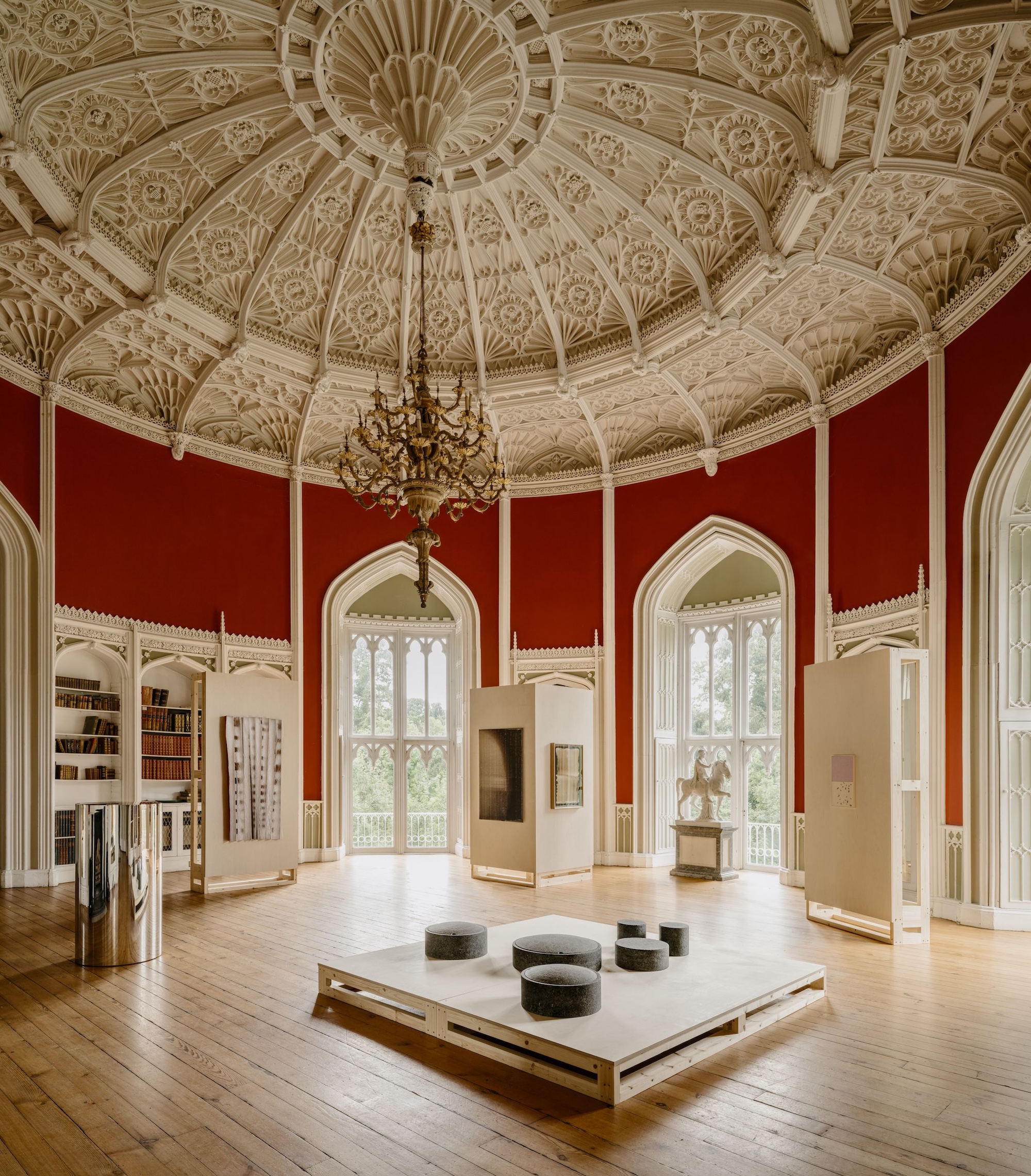
CAIM at Slane intervenes into Ireland’s arts model, the majority of it made up of publicly funded arts organizations. CAIM means ‘sanctuary” and creates an artistic sanctuary dialoguing with Ireland’s rich history and landscape. Bringing the international art market to Slane is a first step in putting a spotlight on Ireland’s rich artistic talent. Alex Conyngham, 9th Marquess Conyngham of Slane Castle, speaks of the way he sees CAIM, saying: “It (Slane Castle) is a blank canvas for a wonderful kind of juxtaposition between 18th century heritage and contemporary art. I like that relationship, because these houses always evolve. So Slane is not stuck in time.”
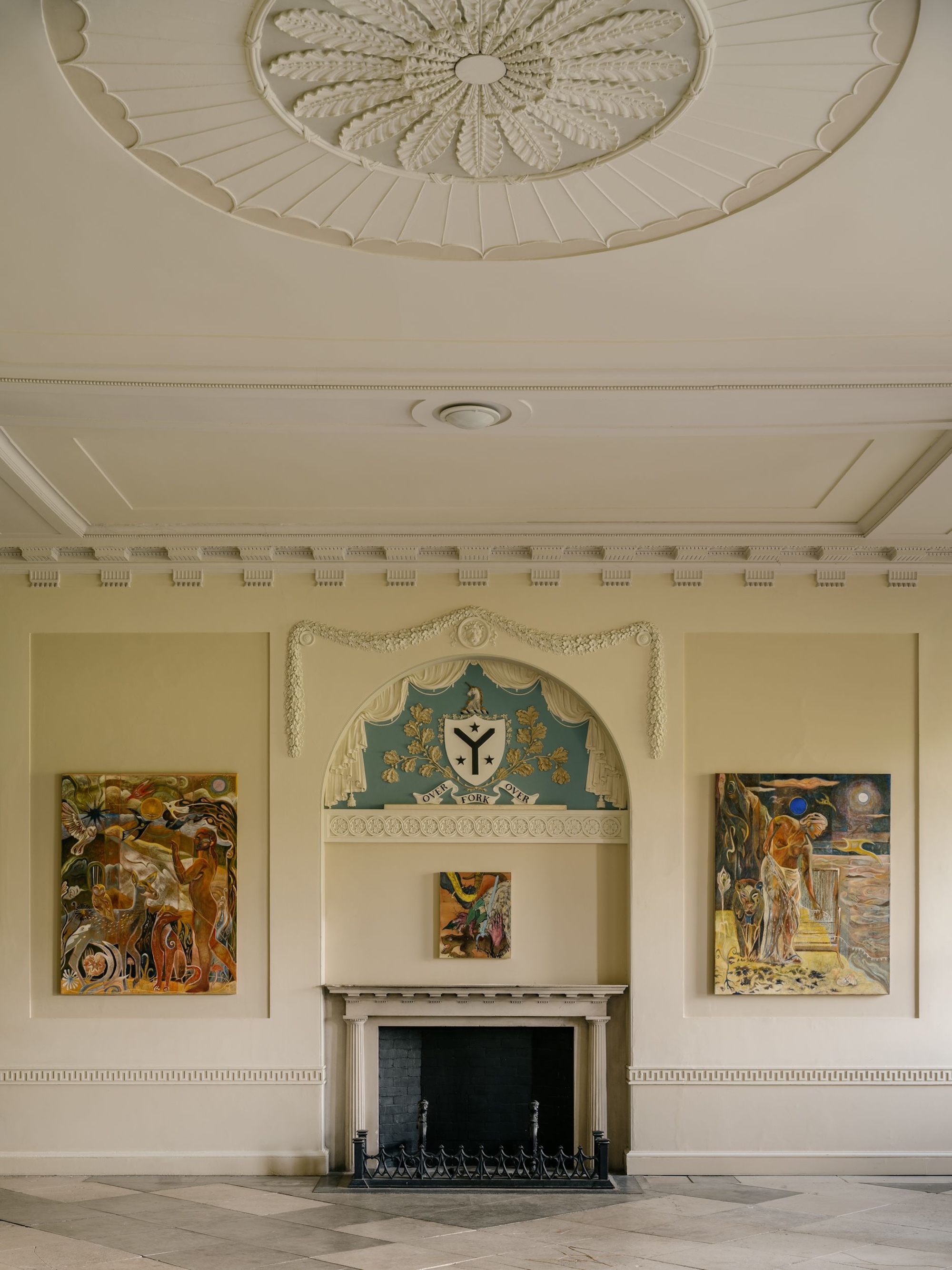
Standout artists include Margaret R. Thompson, whose work is hung in the Great Hall, in conversation with the symbols embedded in the neo-classical plaster works by Wyatt and Johnston. Her process starts by drawing a circle in the ground, creating a haven for her creativity in relation to the natural environment. A stag on the crest on the opposing wall, seems to wink at a doe in Thompson’s vibrant painting. The crest has the family motto “Over Fork Over,” which can be traced to the family’s origins in 1100’s Scotland.
It was then that a Conyngham farmer risked his life to shelter an on-the-run rebel prince Malcolm in the family’s hayloft, while he was fleeing Macbeth’s troops. That act of bravery was rewarded when Malcolm eventually became King Malcolm II of Scotland and gave the family lands and an armorial. Today, you can spot the pitchfork in the family’s crest. To Alex, CAIM is a unique opportunity to live in the spirit of family’s motto “Over Fork Over,” sharing that, for him, these words speak to “the constant need to evolve with a spirit of standing up for what you believe in and a streak of rebellion.”
He goes on to explain:
“Over Fork Over is about continuously breaking new ground and evolving, so each generation is putting its own stamp within this context. My intention is to use this amazing 18th century context for contemporary art in a non gallery setting.”
A non-gallery setting is particularly important, because, as he puts it, these works are designed to be lived with: “If someone wants to start a relationship with a piece and acquire it, it’s going to be moving on, from our home to theirs. I think that’s a very different relationship from taking it from a gallery to a domestic setting. I like the conversation.”
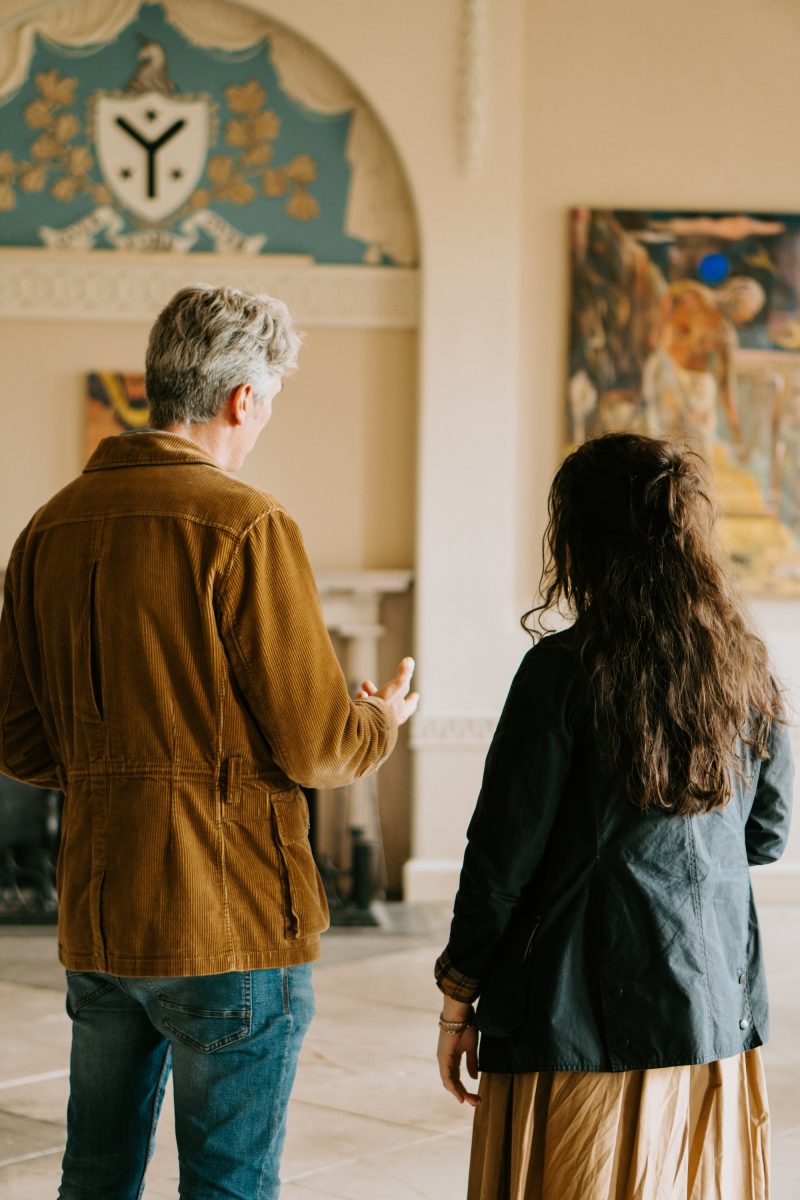
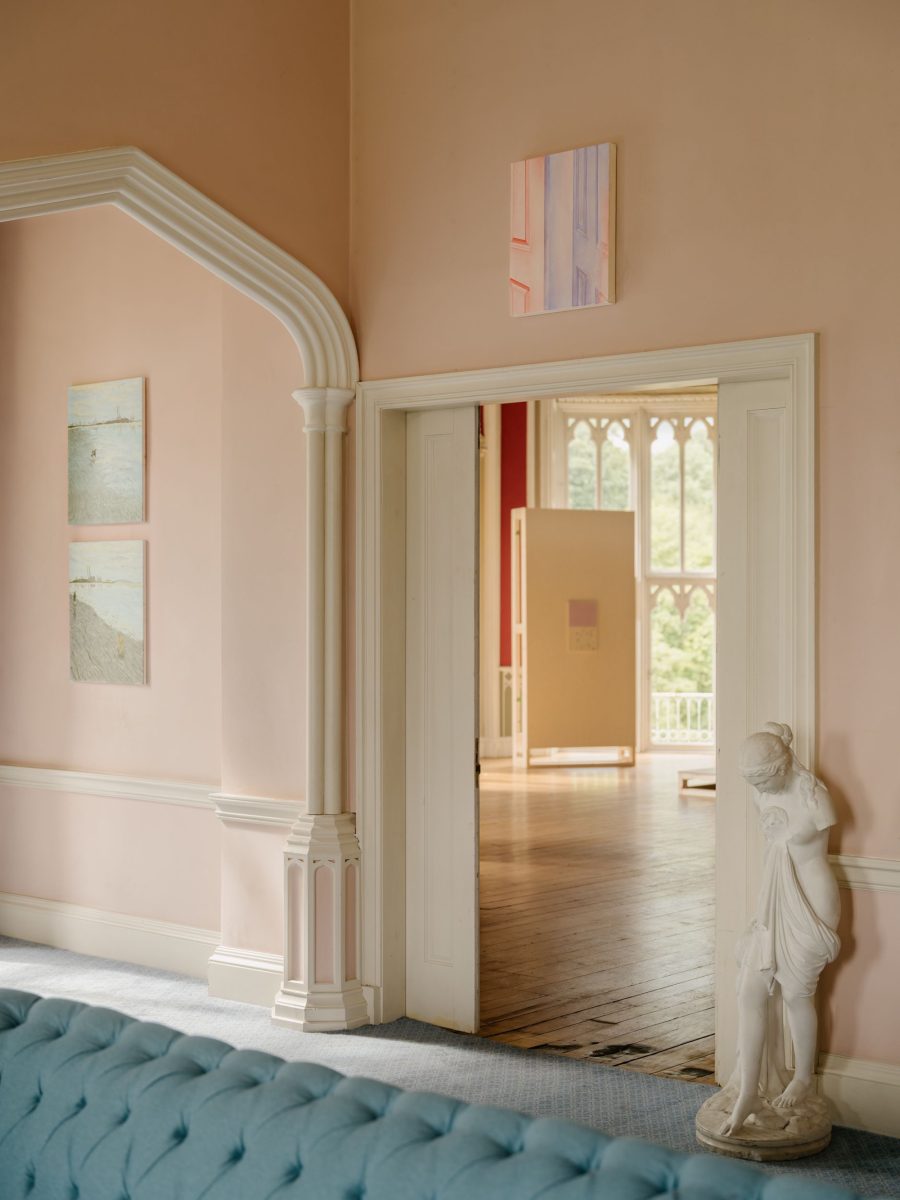
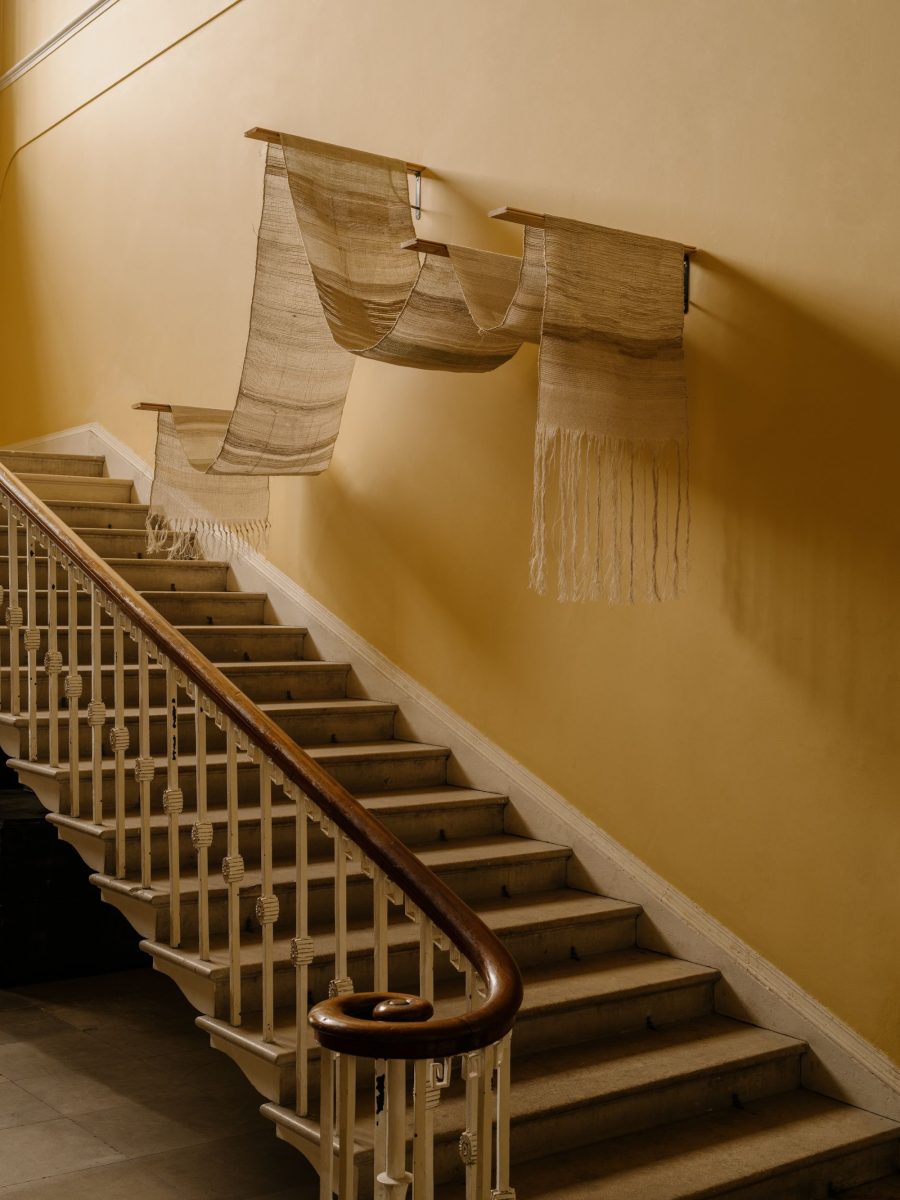
Five rooms of the Conyngham family home, Slane Castle, including the plaster-pink Drawing Room and the Ballroom have been staged for the exhibition. In the ballroom, first designed for the visit of George IV in 1815, established Irish artists like Fergus Martin and Niamh O’Malley are paired with breakout international voices. A dialogue between past and present is initiated by these contemporary pieces below the ballroom’s intricate ceiling, widely regarded as one of the finest examples of Neo-Gothic plasterwork in the country of Ireland. Attention to detail is a hallmark of the exhibition. Points of transition are not overlooked, but instead thoughtfully curated by Ellis and Liu—take Phoebe Evans’ inquiry into how we view transitional spaces hung above the doorways or Laura Wilson’s intimate embroidery pieces in the hall between the parlor and dining room. Also by Wilson are two stunning embroidery installations in the stairwell, adding a touch of drama with a compelling story. The artist completed the works alongside her mother and, in a beautiful serendipitous moment, a personal project to track her family tree led to the realization that she descends from a long line of Irish women weavers.
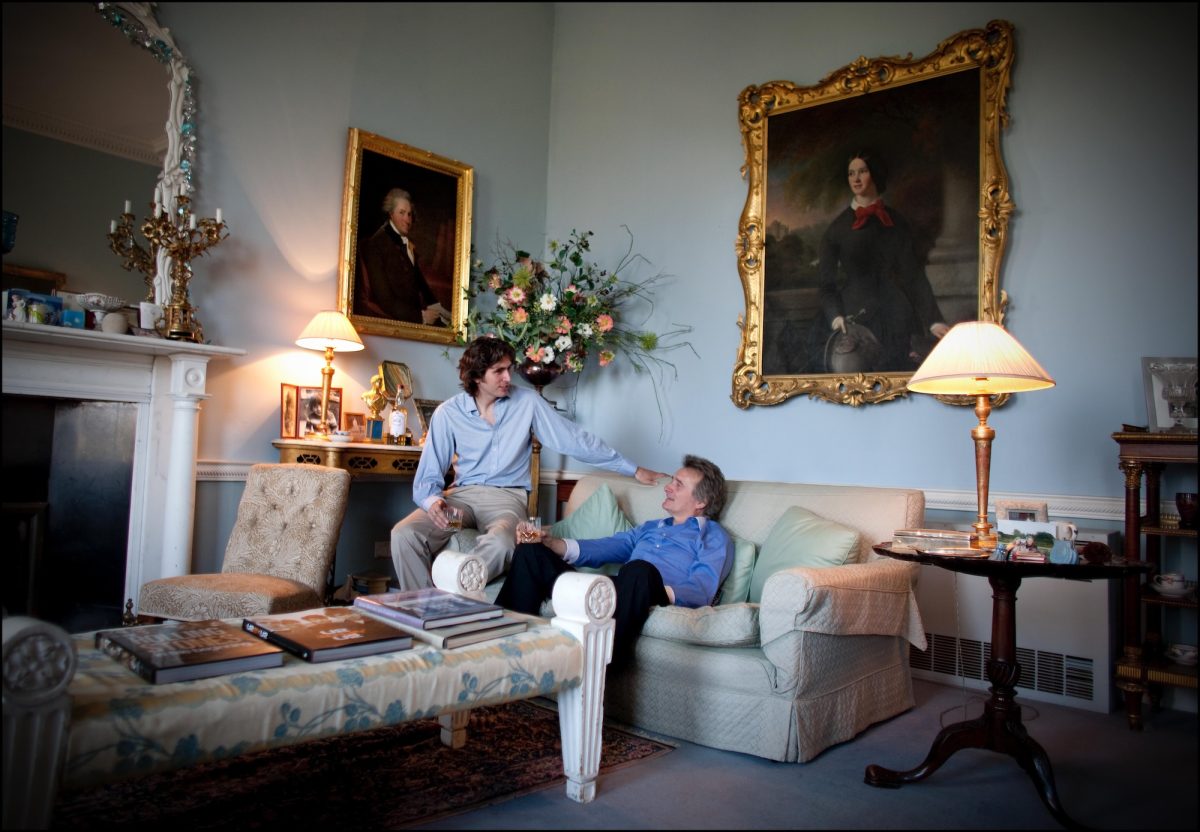
Like a well-aged whiskey, a strong exhibition requires a delicate blend of patience, effort, time and care, allowing the vision to mature into a curation that is resonant. As Alex tells it, his father and he had bounced an idea around for a visual arts program at Slane Castle for years before CAIM was realized. In the 1991 fire, many artworks were lost. This created somewhat of a “void” in the collection and first opened up conversations about how the walls of Slane Castle might be used in the future. Alex shared a love for collecting with his father, who had eclectic taste and enjoyed collecting the work of Irish artists such as Patrick Hennessy. When asked about a favorite moment in the exhibition, he immediately mentioned Omar el Lahib’s “After Rain,” a striking nocturnal landscape that he thinks his father would appreciate:
“Dad always enjoyed raising eyebrows, that was part of his character. I think he would have got a real kick out of seeing two generations of Conyngham family portraits flanking the large-scale work “After Rain” by Omar el Lahib and pondering what their own reaction to this striking work would have been.”
Alex’s father, Henry, 8th Marquess Conyngham’s legacy is Slane Castle’s concert program, which is slated to re-commence in 2026, 45 years after Slane’s first concert in 1981. CAIM marks the beginning of Alex’s continuation of a cultural vision for Slane Castle:
“Dad seeded the idea of the Slane Castle Estate being a blank canvas for both nurturing and hosting cultural events. His legacy was the Slane Concerts, without which we would have not been able to hold on as custodians to the estate.”
Together, with his wife Carina, Alex intends to extend Slane Castle’s cultural legacy beyond music and into other art forms.
Exhibiting Artists: caimatslane.com/artists-2025