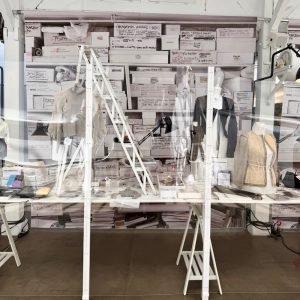
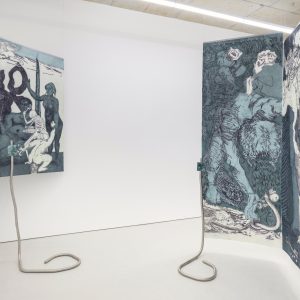
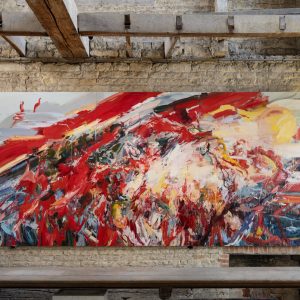
At first glance, Sarah Sze and Elizabeth Peyton appear to be polar opposites. One creates lush installations that intertwine everyday objects in controlled and yet random celebrations of time, space and general chaos. The other creates refined, intimate, and romantic portraits, renewing the language of figuration. Yet one commonality illuminates their trajectories: both, born in the 1960s, are now among the most successful female artists on the auction market, bucking the trend of a slowing premium segment.
Two artistic languages – at opposite ends of the spectrum
Elizabeth Peyton (born 1965 in Connecticut) established herself in the 1990s as a key figure in the figurative renaissance. Her intimate, delicately brushed portraits transformed celebrities – from Kurt Cobain to David Bowie, from Angela Merkel to historical figures – into icons imbued with romantic melancholy. Minimalist and refined in her approach, Peyton draws on collective memory to extract an intimate and timeless aura.
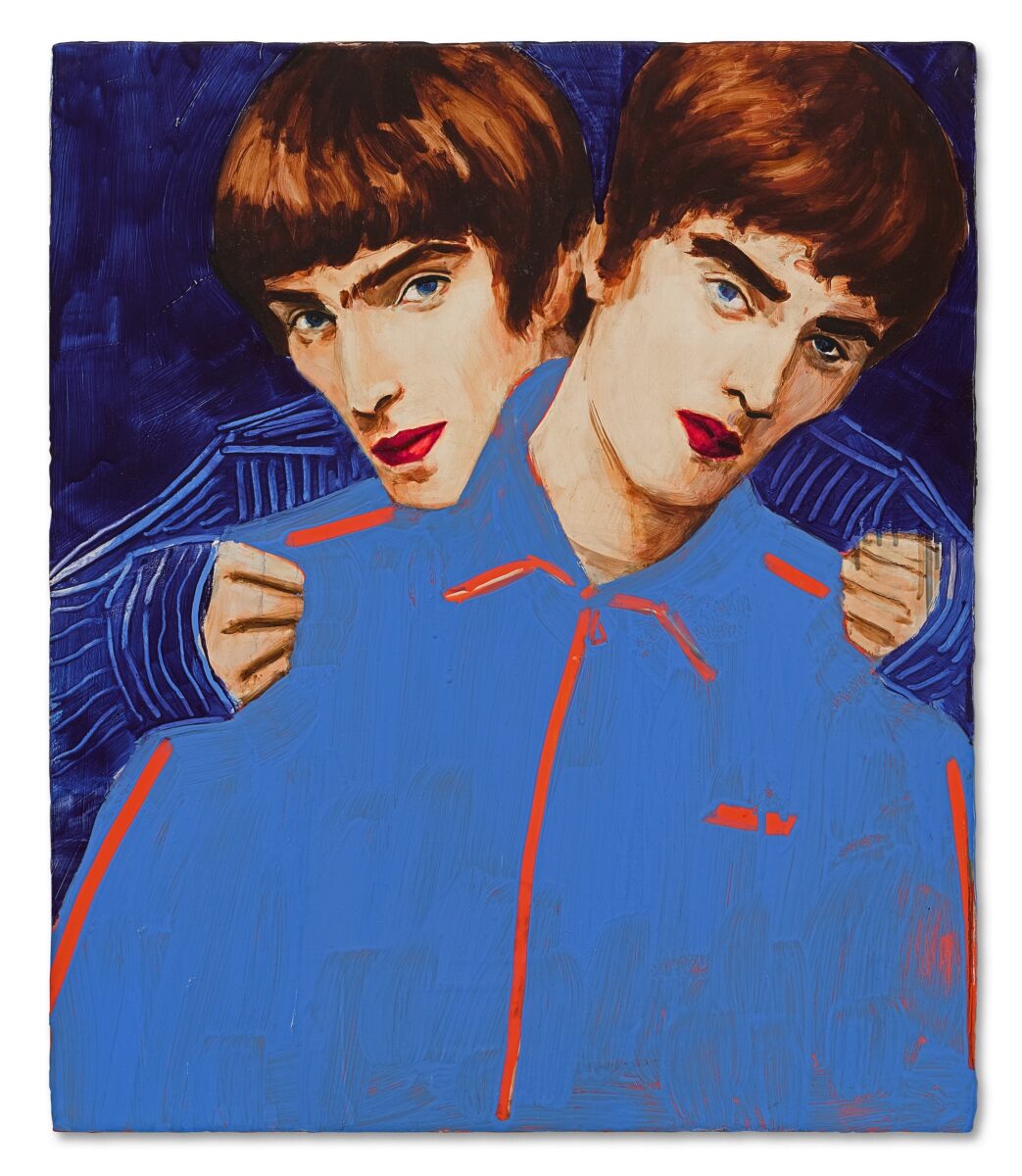
Estimate: £1.5-2 million
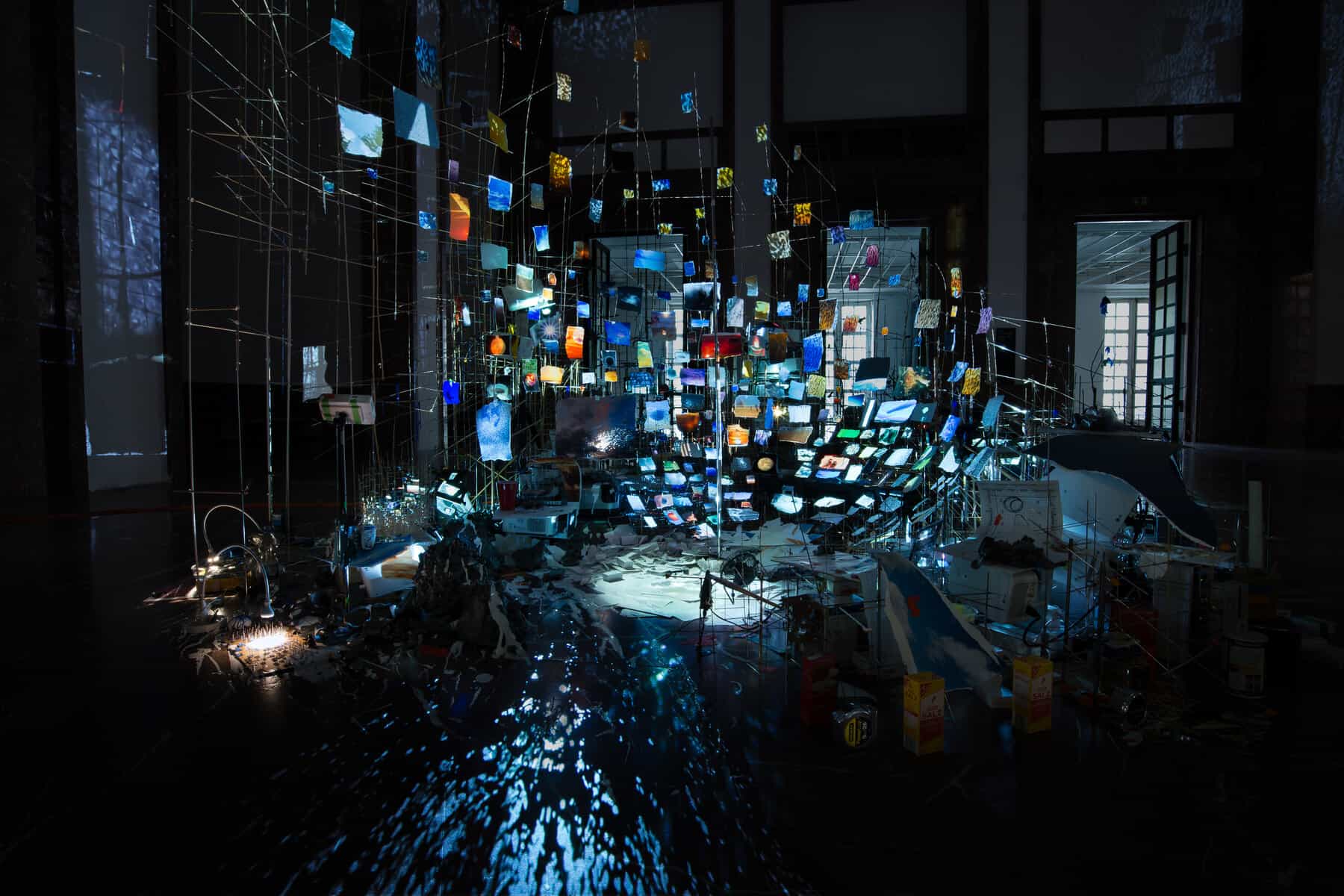
In contrast, Sarah Sze (born in 1969 in Boston) has built an installation universe where constellations of objects and images float or reside in seemingly chaotic yet controlled spatial environments. Her abundant installations, constructed from and extraordinary mix of everyday objects and images – are veritable poetic cartographies of our world saturated with images and data. They remain precariously balanced, as if suspended by a thread, oscillating between chaos and precise order. Where Peyton summons the depth of interiority, Sze captures the energy of the present and its incessant flux.
Sarah Sze: From poetic chaos to a buoyant market
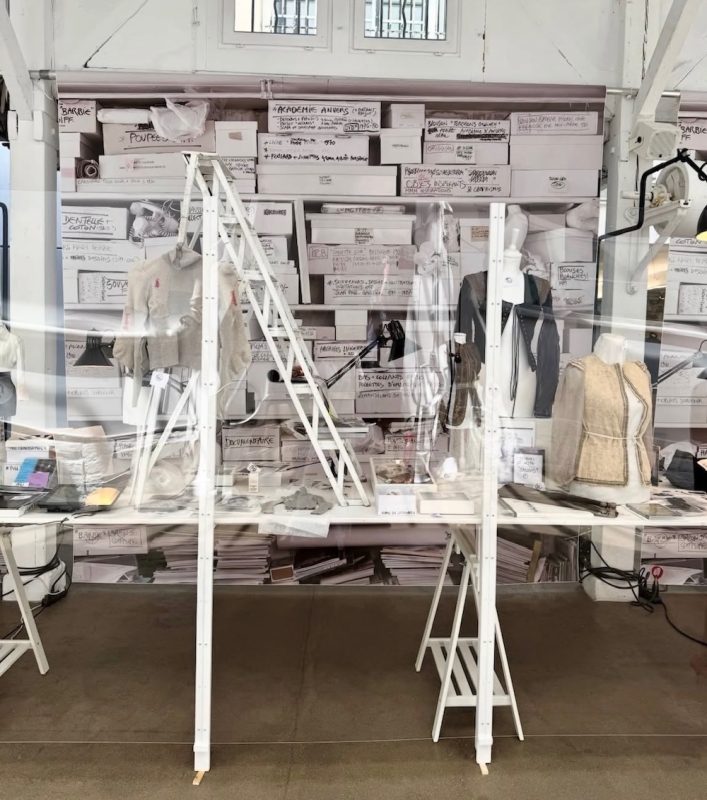
Since the 1990s, Sarah Sze has been building a unique universe where images and objects with and without aesthetic value (coffee filters, string, miniature fans, projectors, adhesive tape, aspirins etc.) are the poetic building blocks of monumental installations. Each work seems on the point of collapse, but reveals a precise balance where the ephemeral transforms into a fragile and fascinating cosmos.
United States Representative at the Venice Biennale in 2013 with Triple Point, Sze has since had a number of major exhibitions, including at the Guggenheim, the Fondation Cartier, the Storm King Art Center, the Moscone Center, and, more recently, her first solo exhibition in Asia, at the Gagosian in Hong Kong (2025).
While her installations clearly have no precedence in art history, it’s her painted work that is currently captivating the market today. In 2020, her triptych Surprise Ending (2020), estimated at $300,000, reached $737,500 at Christie’s. Four years later in 2024: her Spell (2023) reached nearly a million dollars in London, and a month later in New York, Long Ending (2019) crossed that symbolic threshold by reaching 1.07 million dollars, more than five times its low estimate.
In 2025, collectors have reconfirmed confirm their confidence, since her Flicker (2020) found a buyer at $819,000 in New York, five years after its acquisition from the Victoria Miro gallery in London. With $3.2 million in auction turnover between January 2024 and summer 2025, Sze now stands out as one of the 15 top-selling female artists born after 1965. She is supported by three major galleries: Victoria Miro, Tanya Bonakdar and Gagosian.
Elizabeth Peyton: sublimated Figuration, a patient ascent
In contrast to Sze’s profusion, Elizabeth Peyton embodies the economy of means and the power of intimacy. Born in 1965 in Connecticut and a graduate of the School of Visual Arts in New York, she established herself in the 1990s as an emblematic figure of the return to figuration. Her delicate portraits transform celebrities, political and historical figures into icons imbued with romanticism and melancholy: from Kurt Cobain to David Bowie, from Angela Merkel to Napoleon.
Her works, which bridge the gap between collective memory and interiority, are now exhibited in major institutions: MoMA, Centre Pompidou, SFMOMA, the Tate. Her career has been built with the support of some of the most influential galleries: Gavin Brown’s Enterprise, Gladstone, then Sadie Coles (London), David Zwirner (New York, Paris, Hong Kong) and Thaddaeus Ropac (Paris, London, Seoul).
Institutional recognition has fueled an exemplary market trajectory. In 2003, Jarvis and Liam Smoking (1997) fetched $108,000 at auction. In May 2025, the same painting reached $1.6 million, a dizzying increase of +1,402% in twenty years, and just a month later her portrait of Liam + Noel (Gallagher) (1996) set a new auction record $2.7 million in London, beating her previous record of $2.47 million set in 2024 for Matthew (1997), whose value already multiplied by 18 since 2002.
With nearly $7 million in auction turnover since January 2025, Peyton is currently the fourth most successful female artist born after 1965 on the auction market, just behind Jenny Saville, Lisa Brice and Cecily Brown.
Two trajectories serving a broader dynamic
The parallel between Sarah Sze and Elizabeth Peyton illustrates a powerful dynamic: that of a sustainable and growing appreciation for women artists, driven as much by influential galleries as by strong private demand. In a sometimes hesitant global market, their auction results reflect long-term confidence and already well-established institutional recognition.
One unfolds the poetic chaos of the contemporary world, the other sublimates the intimacy of public figures. Both demonstrate that beyond the diversity of visual languages, the power of their singularity finds an exceptional resonance in the art world and on today’s market.
Words: Céline Moine, Artmarket by Artprice