“Drawing can create a portal into other realms of consciousness.”
— Catherine Goodman
At Boughton House, a historic English estate, an exhibition features tapestry works and paintings by Catherine Goodman. Goodman has returned to Boughton House many times, continually exploring its rich collections and expansive gardens. Through painting and tapestry, she responds to the estate’s particular atmosphere and “spirit,” entering its many layers of history through art.
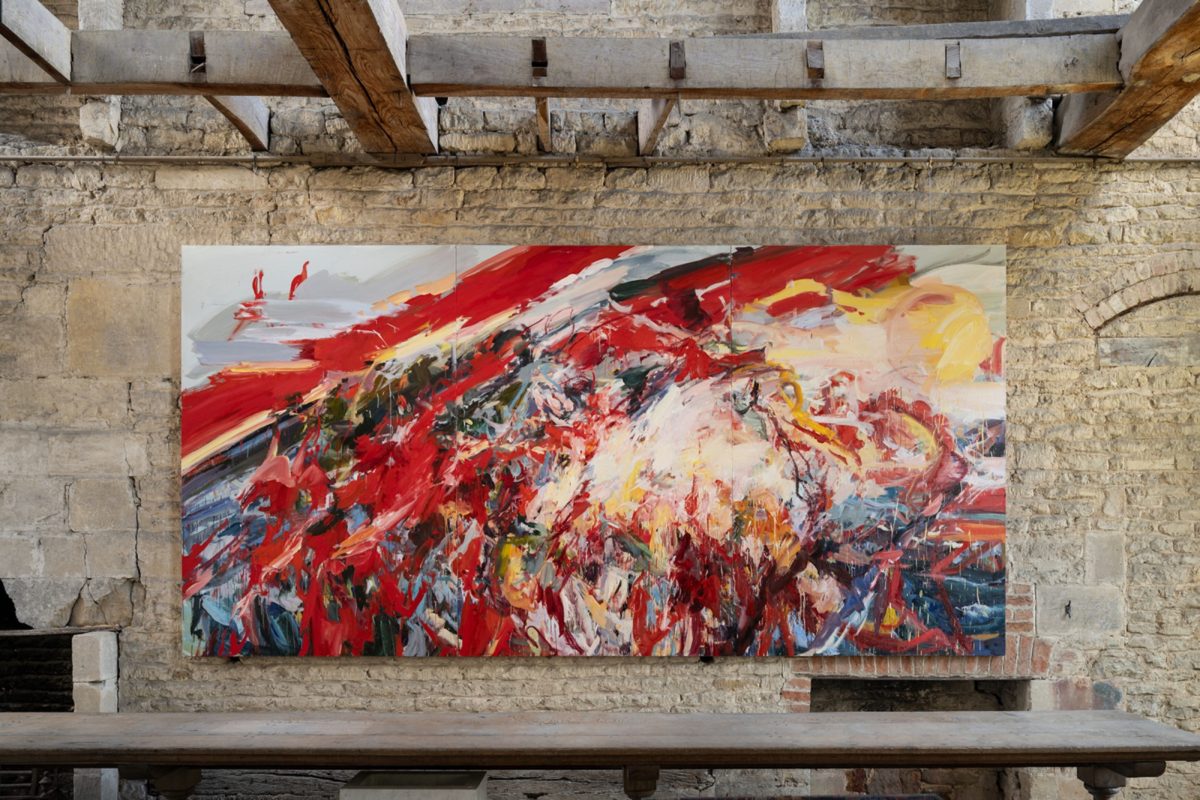
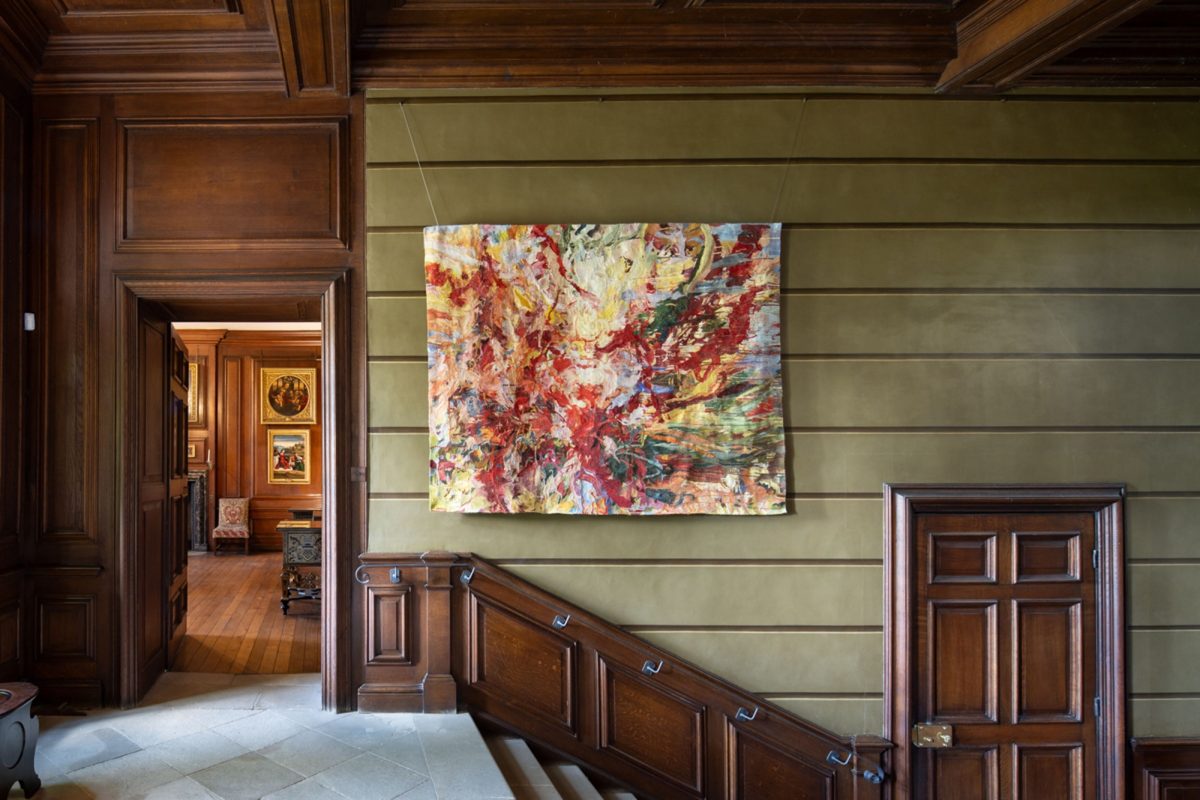
Goodman introduced the two large tapestries featured in this exhibition. The late Duchess had deep ties to South Africa and had long supported a local charity helping women find work in textiles. Through this connection, Goodman came to know the Stevens Tapestry Studio near Johannesburg and invited the South African workshop to weave two large tapestries for the exhibition. She said she travelled to South Africa herself last November to work with the weavers on the colour scheme. The tapestries were woven from her own oil paintings. The weavers at the studio are mostly women, many of them daughters and granddaughters of the studio’s first generation of weavers. The process is extraordinarily meticulous – every drop of paint in the original painting is faithfully rendered in thread. She was thrilled with the results and said she hopes to keep working with the studio in the future.
The first piece, From Volterra to Boughton, began as sketches made while painting outdoors in Volterra, in Tuscany. It started as a landscape, but gradually evolved into something resembling a phoenix or a flame. She said the whole exhibition carries a theme of Phoenix, Fire, and Renewal.
Goodman had been friends with the late Duchess since she was young. The Duchess was a BBC producer, writer, and journalist who tragically passed away shortly before the coronation. She had long hoped Goodman would one day hold an exhibition at the estate, and so Goodman began making extensive sketches and studies around the grounds.
Goodman feels this estate is special. Unlike Chatsworth or Blenheim – grand estates that have long been open to the public – Boughton has always remained a private residence, rarely opened to visitors. It has been remarkably well preserved, with almost no major alterations even during the Victorian era. As a result, the whole house feels untouched, as if sealed in time, holding many treasures still unknown to the wider world.
Afterwards, we moved into the Great Hall. Charles explained that the hall was built in the 1520s and later rebuilt by Ralph Montagu. Its features include four large tapestries depicting the four elements – fire, water, air, and earth – of French design, a ceiling painted by Louis Chéron, and the Montagu family crest. He also told us that Ralph Montagu had travelled to France and married a wealthy wife, whose fortune helped him build the estate as it stands today.
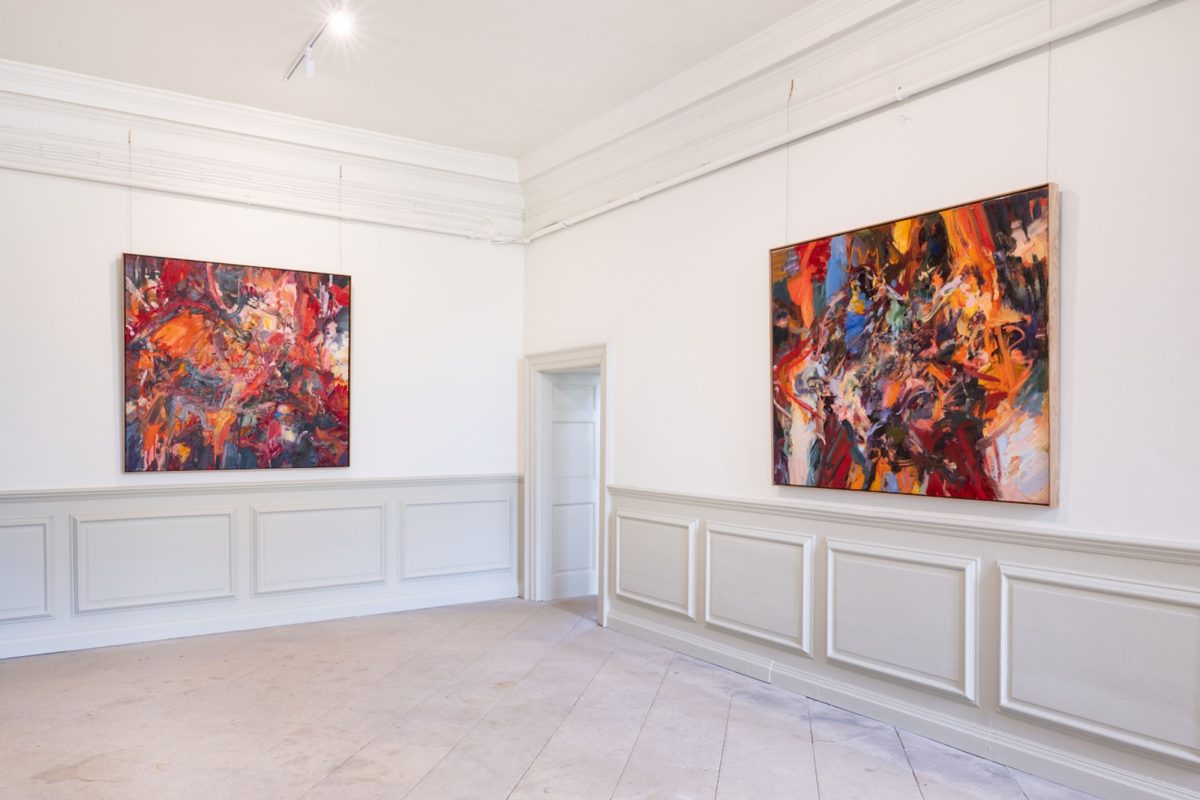
Goodman said she has always loved large, immersive spaces – Giotto’s chapel in Italy, for instance, or her experiences travelling in India. She likes it when viewers don’t simply stand outside a painting, but instead “step inside the work.” That’s why so many pieces in this exhibition are on such a massive scale.
She stressed that, although this exhibition was commissioned by the estate, she didn’t want to simply paint the estate itself. She wanted the work to also reflect her own life, contemporary society, and what’s happening in the world – because, after all, this is a contemporary art exhibition.
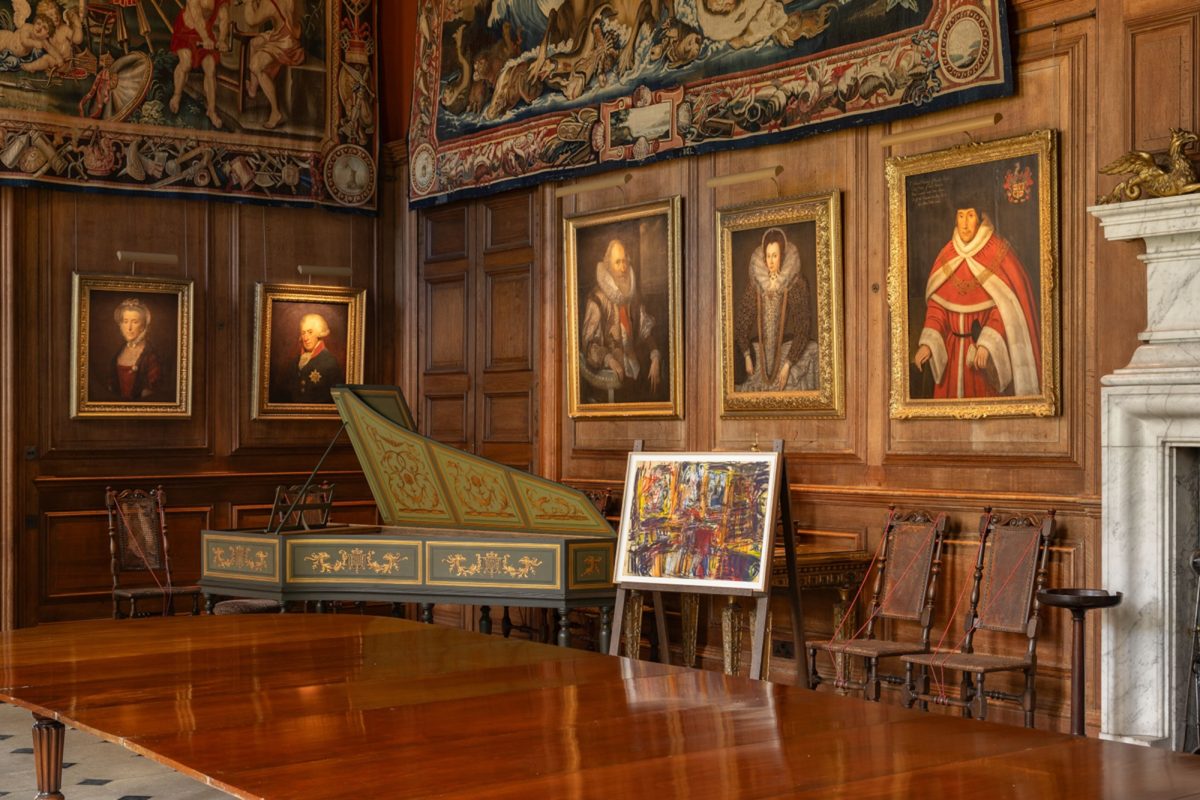
Charles explained that the so-called “Egyptian Hall” has nothing Egyptian about it at all. Inside are Roman sculptures from the 2nd century AD, El Greco’s famous painting Adoration of the Shepherds, family portraits, and contemporary artworks – reflecting a long-standing tradition among the estate’s successive owners of collecting contemporary art.
We then came to one of the most unusual spaces: the Unfinished Wing, a section that was originally planned but never completed. Goodman said she was struck the first time she saw it – doors opening onto thin air, exposed roof structures, unplastered stone walls – giving her a surreal feeling, like something out of Alice in Wonderland.
She then showed us a huge oil painting, Red Dress. Goodman talked about what was happening while she made it: in the wider world, these past few years have brought war, violence, suffering. On a personal level, her parents passed away one after the other, and she herself was diagnosed with cancer and underwent six months of chemotherapy – yet she kept painting throughout treatment. She said the painting expresses how grief and hope can exist at the same time. For her, making art means pouring the whole of one’s life experience into the work.
She has always loved tapestries. Tapestries are everywhere in this estate – in the drawing rooms, the bedrooms, and rolled up in great numbers in the attics. To her, a tapestry is like clothing a room – which matters all the more in an old stone building that gets so cold in winter. Tapestries don’t just provide warmth; they bring softness into a space. She sees this as a kind of feminine response: turning cold stone warm.
Finally, we came to the Chinese pavilion in the garden. Charles explained that this reflects the Chinoiserie style fashionable in 18th-century England – though it isn’t authentic Chinese architecture. It’s an 18th-century English imagining of “Chinese style.” In summer the pavilion is assembled in the garden; in winter it’s taken apart and stored away, like a giant set of building blocks. Inside is also a genuine piece of 17th-century furniture imported from China. He noted that 18th-century England imported tens of thousands of Chinese decorative objects, a sign of just how captivated English society was with Chinese art at the time.
Afterwards, I had the chance to ask Goodman a few questions. Do you think painting is a form of meditation, one that brings us back to our inner world? She said yes.
I also asked her how she decides when a piece is finished.
She said:
“It’s a process. I sometimes think that they’re finished when they’re not. Usually, when I finish working on something, I turn it around and kind of ask it a question, to say, ‘Do you need more?’ And if it answers yes, then I carry on. Rather than saying I’ve finished it, I kind of keep asking it a question.”
I then asked her what she thought young artists most need to learn. ‘What’s your best advice?’
“Work discipline. But I think it’s more complex than that. I think it’s about finding your ceremonial time…There’s that quote from Pasteur that inspiration happens while you’re working. It means finding out when you work best. Are you a morning person? An evening person? There’s no morality attached to that. Whatever works best for you, you show up.”
“What you need for painting is a much deeper response. It’s not a dopamine response. It’s like thinking from your inner silence, from your feelings, your unconscious. For that, you really need to get away from clickbait.”
All the images: Catherine Goodman. In the House of Tapestries, Boughton House, Kettering, United Kingdom, 2026. Artworks © Catherine Goodman. Photo: Damian Griffiths. Courtesy the artist, Hauser & Wirth and Boughton House