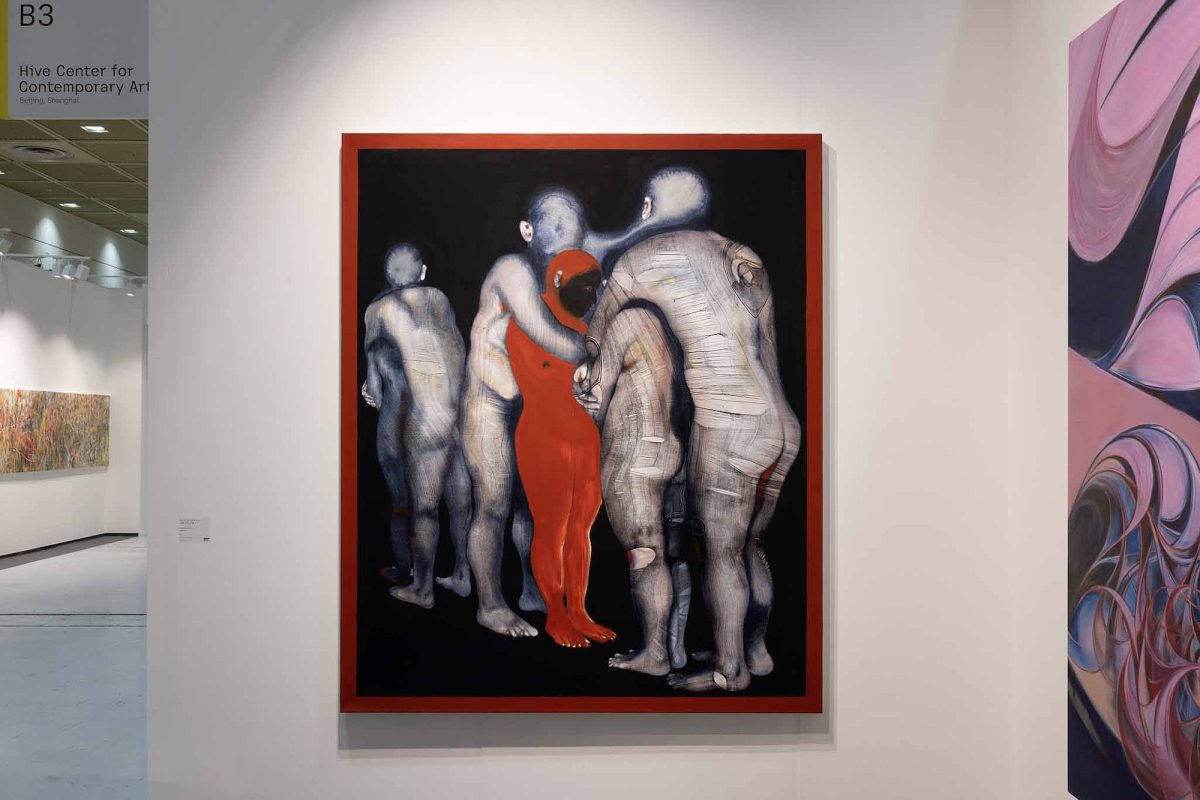
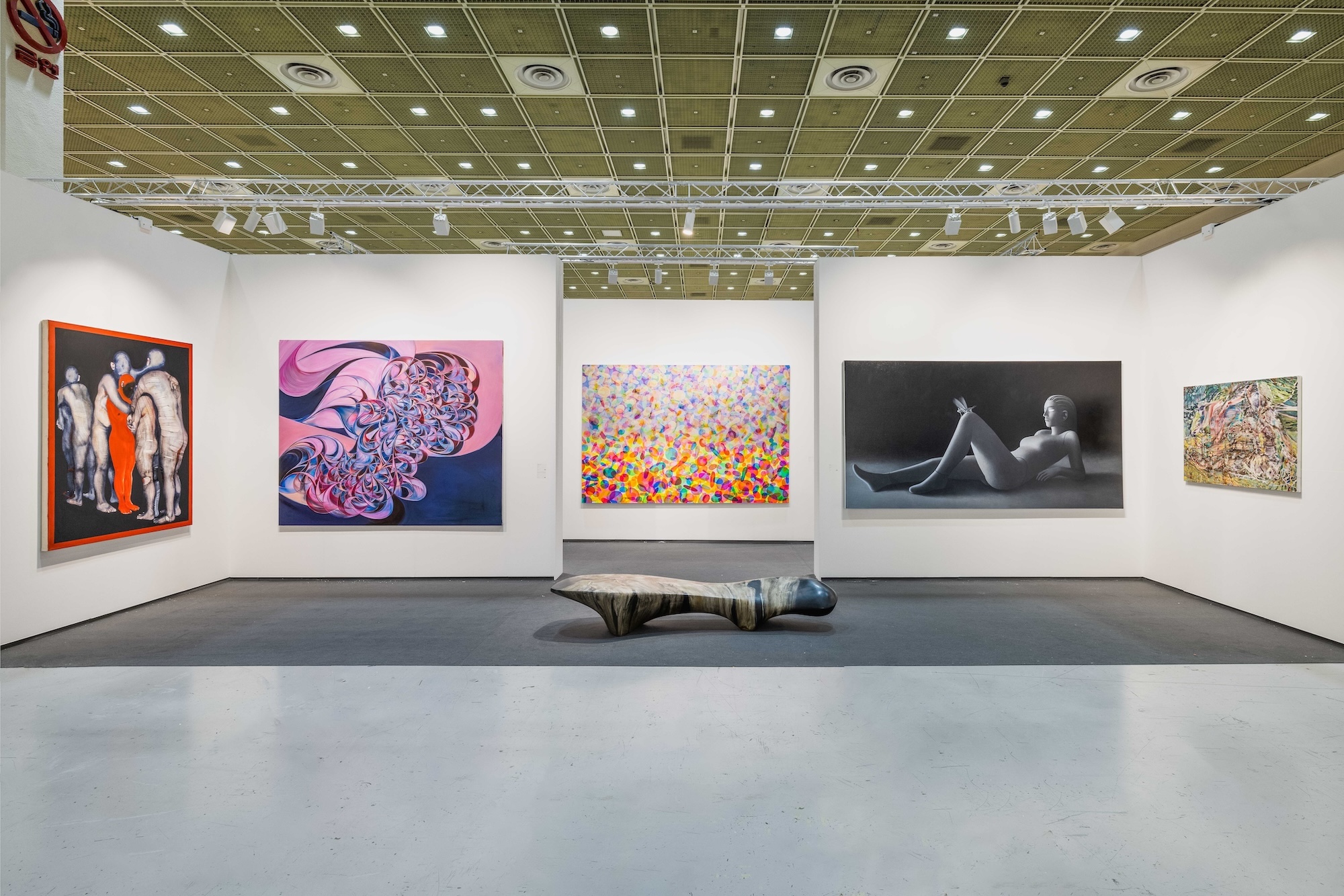
At this year’s Frieze Seoul, Hive Center for Contemporary Art introduced Zhang Mingxuan to Korean audiences with a debut that felt both visceral and philosophical. Across her new works, a striking red flesh anchors the eye—at once grotesque and playful—pulling the viewer into a charged dialogue with the body.

Zhang’s artistic practice circles around the fluidity and de-symbolization of the body. Distortion and omission unsettle the image, as she reconfigures the fragile ties between body, space, and gaze. Everyday fabrics slip into her paintings, covering, wrapping, and pressing against the painted figure. In this interplay between the “virtual” and the “real,” the canvas itself becomes a container—tight, constricting, insistent—forcing the body to negotiate its limits. Her work reopens the question of what the body is allowed to mean, and how images of flesh continue to carry weight, vulnerability, and resistance.
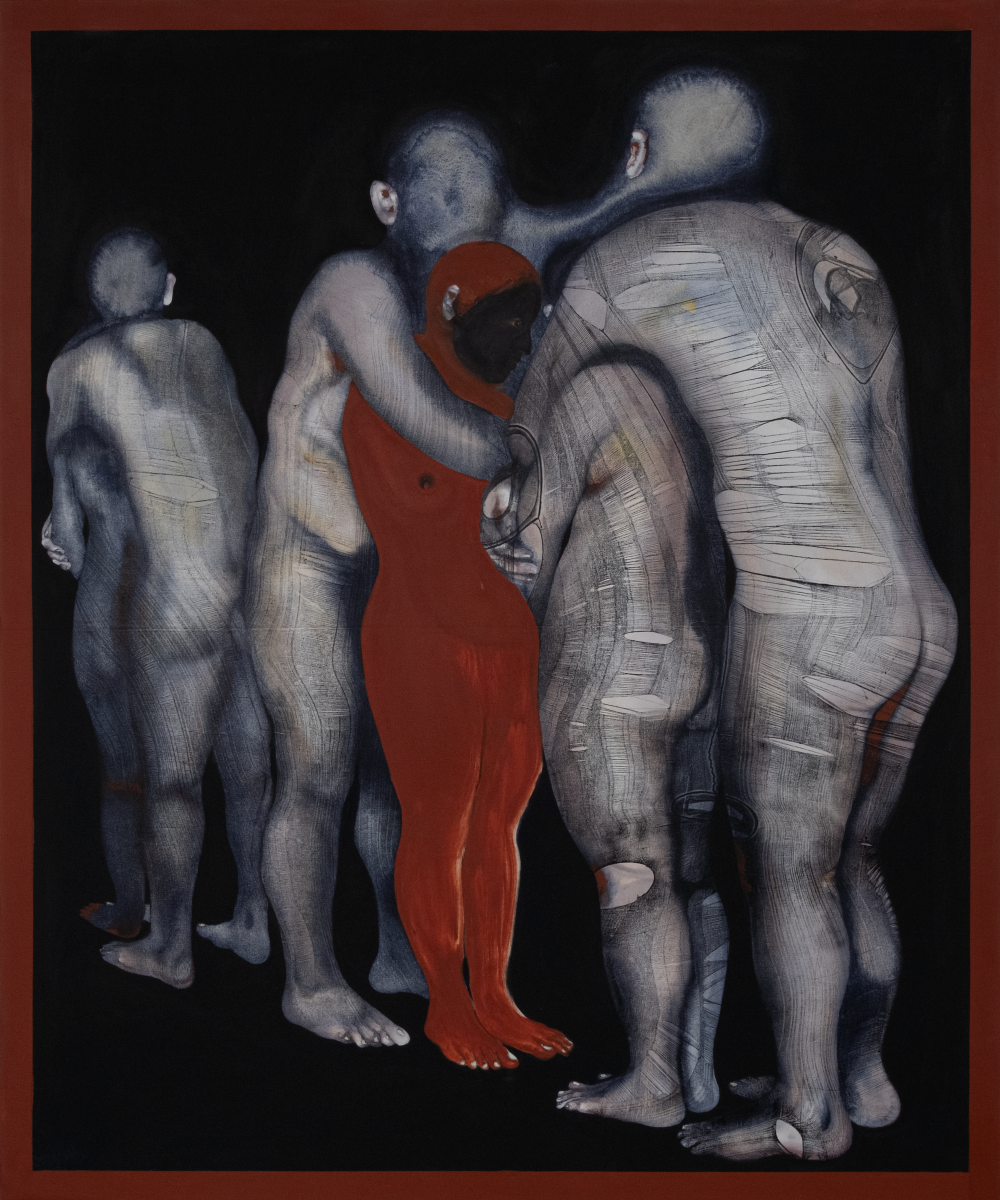
In Mirror within Mirror, the bodies repeat in symmetrical alignment. Their intimacy quickly turns estranged through sameness, an uncanny rhythm of reflection. A single crimson figure breaks the pattern—Zhang’s own likeness, a self-portrait. The work recalls Milan Kundera’s The Unbearable Lightness of Being, where the heroine Teresa confronts her soul in the mirror, only to discover that the mirror offers only flesh, only matter. Teresa’s struggle against the spectral presence of her mother becomes a refusal of the “soulless world,” a resistance against a life reduced to bare materiality. In Zhang’s painting, the mirror is no longer a neutral surface but a battlefield—between self and other, flesh and soul, presence and erasure.
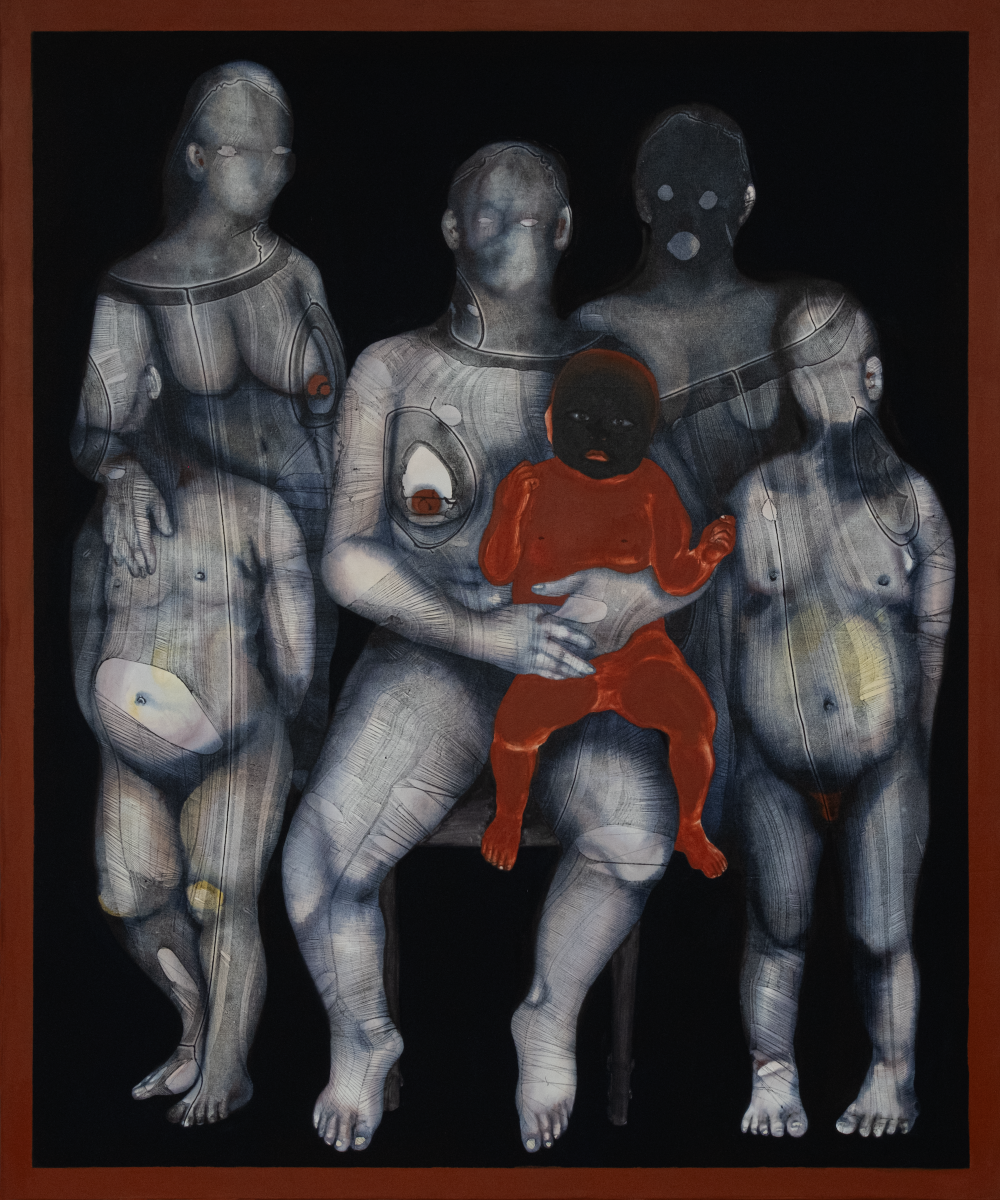
Another work, Site of the Other, turns toward the familial. Drawing on the language of traditional portraiture, Zhang stages a meditation on self-construction within the primal sphere of the family. The infant figure stands apart from the blurred collective, a luminous face in sharp relief. Here, Zhang nods to Emmanuel Levinas’s notion of the “face of the Other”: exposed and vulnerable, yet ethically binding, forbidding violence even as it invites it. The infant becomes the “visible face,” the anchor of subjectivity; the surrounding bodies dissolve into the “invisible face,” a blur that gestures toward communal bonds.
At Frieze Seoul, Zhang Mingxuan’s debut unfolded as more than an exhibition—it was a meditation staged in color, fabric, and flesh. Her canvases are not static images but ethical fields of gaze, asking how the self persists within the collective, and how the Other shapes our recognition of identity. With her blend of European literary and philosophical currents and the tactile warmth of a new Asian sensibility, Zhang emerges as a distinct voice in contemporary painting—one that renews and complicates the narrative of the body.
MORE: @mikugiao