
When Lucho Argain misplaced a necklace gifted to him by his girlfriend Carmen, he didn’t tell her right away. Rather than confessing the loss outright, he and his bandmates from La Sonora Dinamita turned the mishap into a musical apology. First performed privately for Carmen, the song was later released to the public and ended up becoming a 1978 smash hit. To this day, Se me perdió la cadenita remains a staple on Latin music playlists around the world.
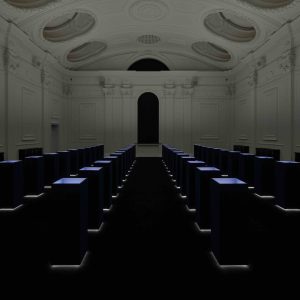
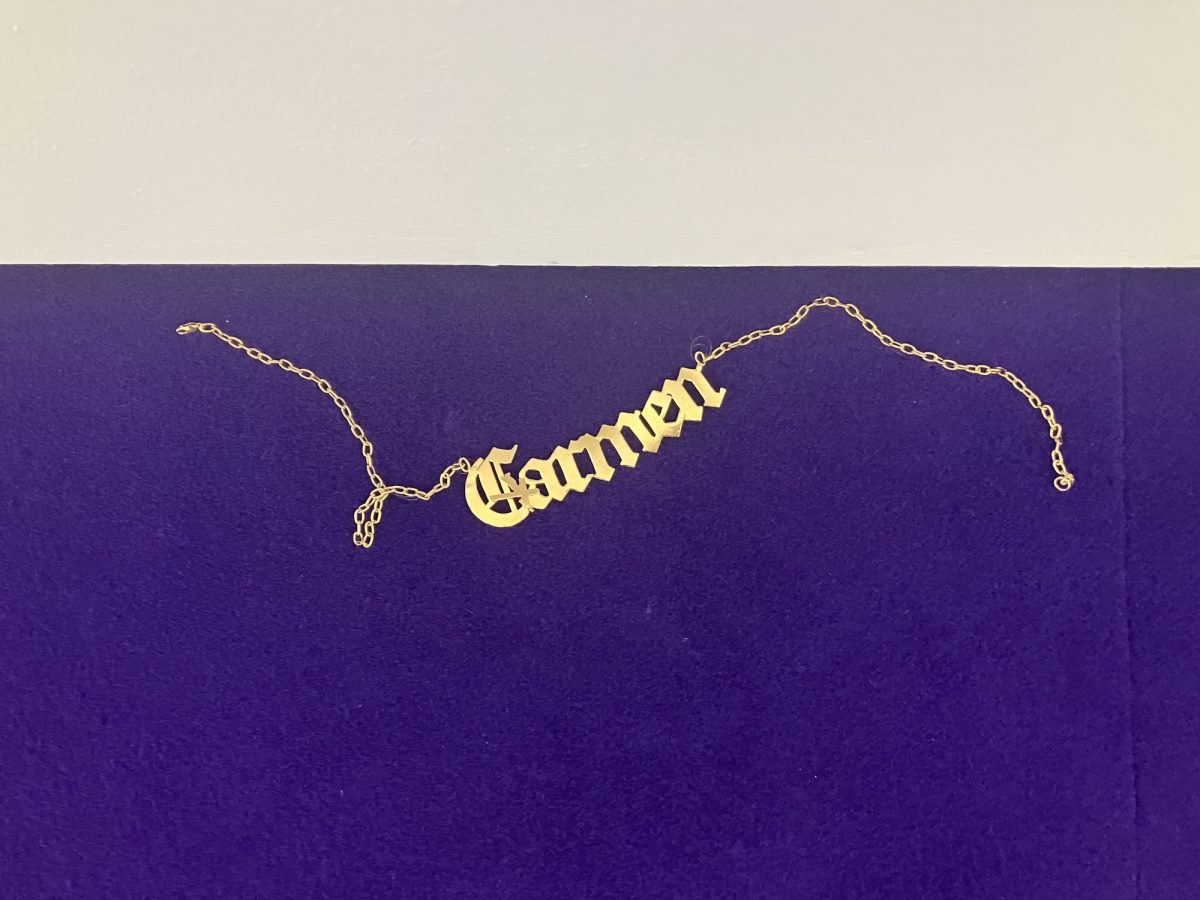
Almost as though it had been manifested, the ornate keepsake (or at least its doppelgänger), missing for decades in Mexico, unearths itself in the corner of one of Germany’s oldest art museums. Mario García Torres stages its quiet return – or something like it – featuring a reimagined version of the song. The playful mixed media artwork Me encontre la cadenita (I Found the Chain) centres on a necklace positioned at the edge of a purple carpeted room accompanied by an immersive soundscape built around the iconic song and reinterpreted by singer-songwriter Marion Raw. Overhead, the room’s low ceiling softens into infinity.
Whether it is the sense that something went awry or the feeling that it has finally been resolved, the haunting musical tune seems to celebrate and grieve this silently significant event. The work speaks to both disappearance and rediscovery, but more importantly, it raises a question: do we need to know the story behind something to feel its impact? Or – what happens when we encounter something without knowing exactly when it comes from? Can it still speak to us?
Many of Torres’s works suggest that the answer is both yes and no. Whether or not everything happens for a reason, and whether we ever will, can, or need to know that reason, A History of Influence at the Fridericianum is a show that challenges the viewer’s relationship with history, its underlying assumptions, and leaves you believing that life has meaning – if you didn’t already.
For Torres, everything is connected — and if there is no meaning already, there is meaning in the connection. Artist second and storyteller first, his main medium is events. Tracing ripples, overlaps, and synchronicity, Torres’ process is rooted in enquiry, anthropology, and a determined weaving of connections: a hidden chain of events linking one thing to another. And while this intellectual treasure hunt can be exhilarating for the hyper-curious or the relentless puzzle-solver, for the average viewer it’s a bit like being handed a map with no “You Are Here” marker.
Many works are marked “n.d.” (no date), not because Torres forgot but perhaps to deconstruct chronological narratives, freeing objects from historical fixity. Can this be enough to free ourselves from the tyranny of context, or are we just floating in a sea of trivia, waiting for meaning to materialise? After all, timelessness also has its implications.
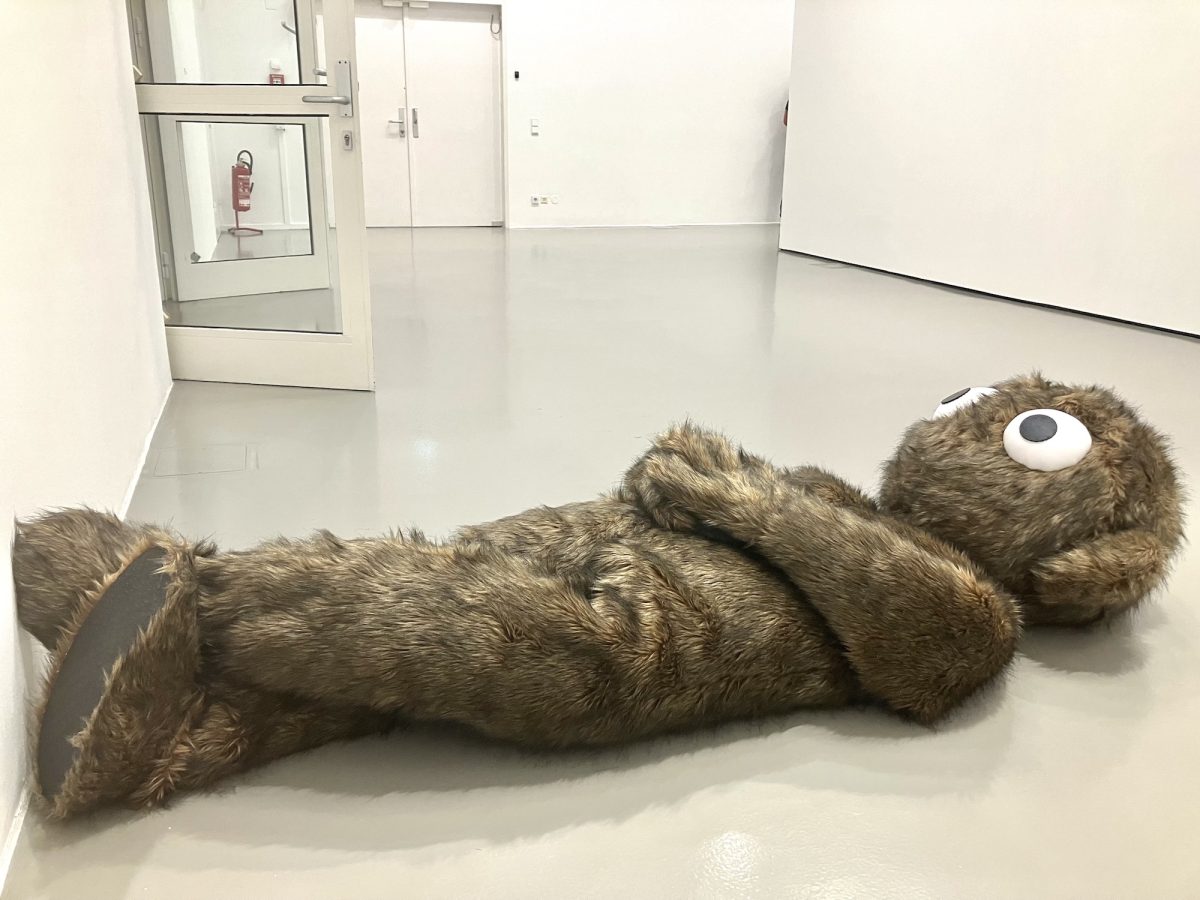
This is art for the patient, the curious, the conspiracy theorist within. And for the deeply bored. Which, to be clear, is not a criticism but possibly the point. After all, Xoco – Torres’ shaggy, cartoon-eyed creature who slouches, leans, and lies motionless throughout the show – seems to take boredom as a lifestyle choice, an existential coping mechanism, and a survival strategy. Throughout the run of the exhibition, the figure of Xoco, with his vacant Furbee-like gaze, appears in videos, performances, and in the [fur] flesh.
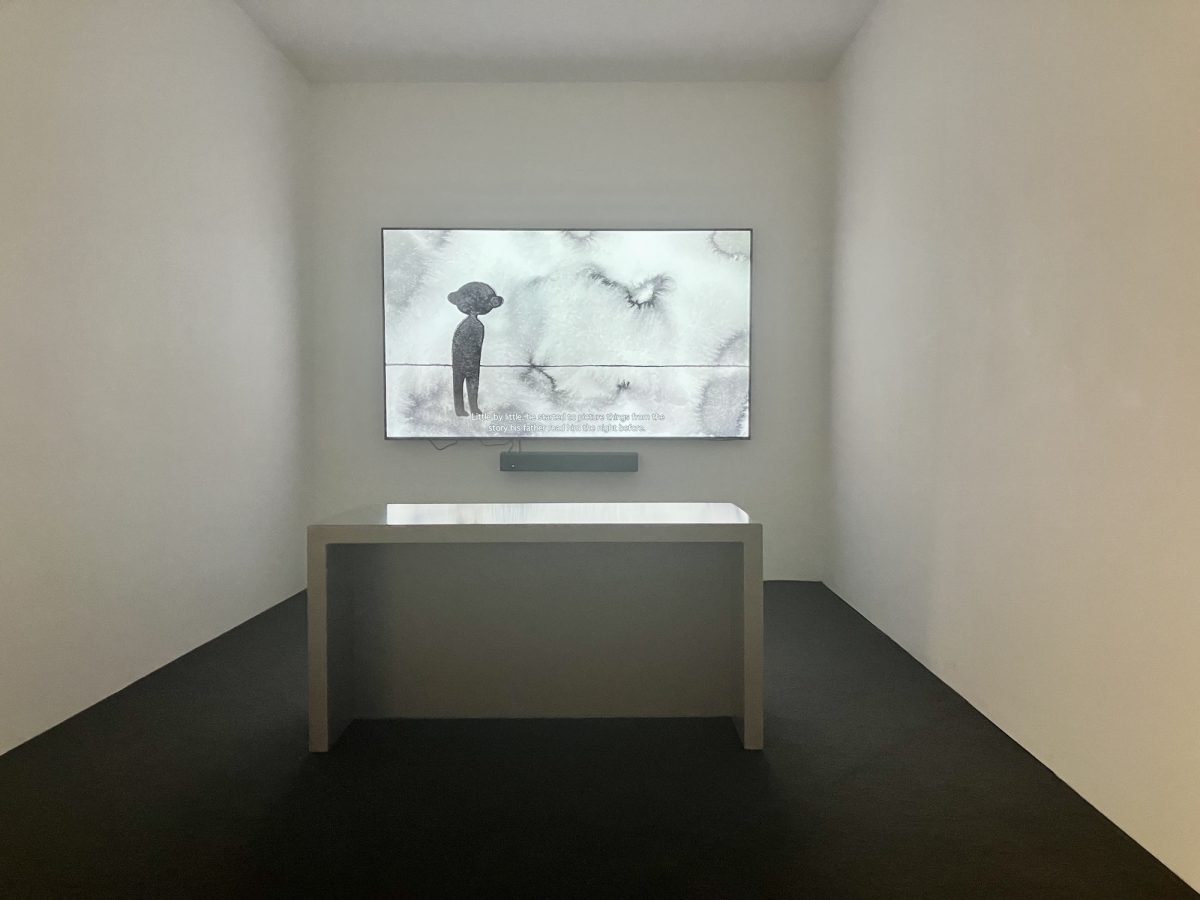
On performance days, Xoco moves slowly, rests often, and appears to be caught in a perpetual state of aimless observation. His presence may be interpreted as a kind of gentle provocation: what if doing nothing is a form of resistance? What if boredom is not a void but a space for unexpected connections to emerge? You can see him lounging in crawlspaces or puttering about looking as if someone tried to animate a sigh. He’s endearing and enigmatic: part mascot, part metaphor for the kind of creative fugue state Torres is asking us to enter.
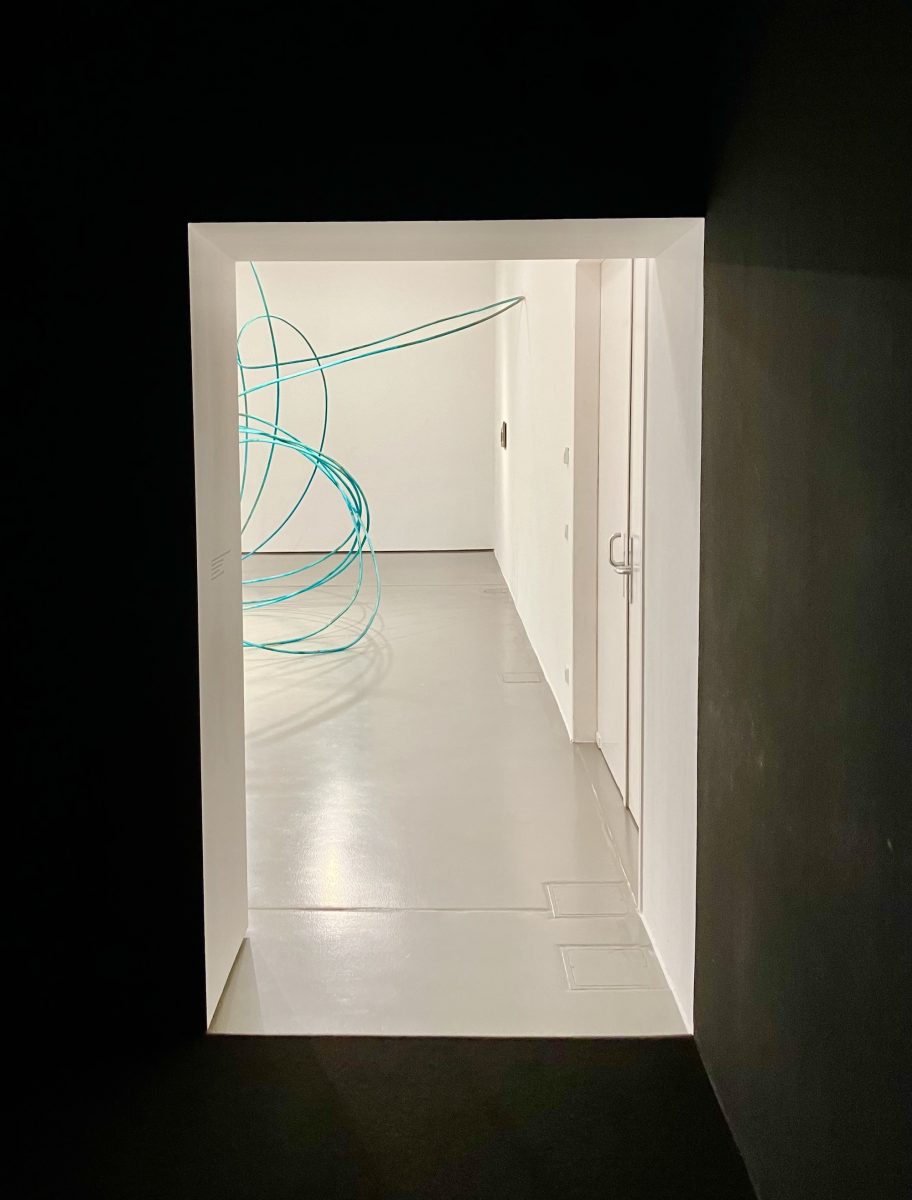
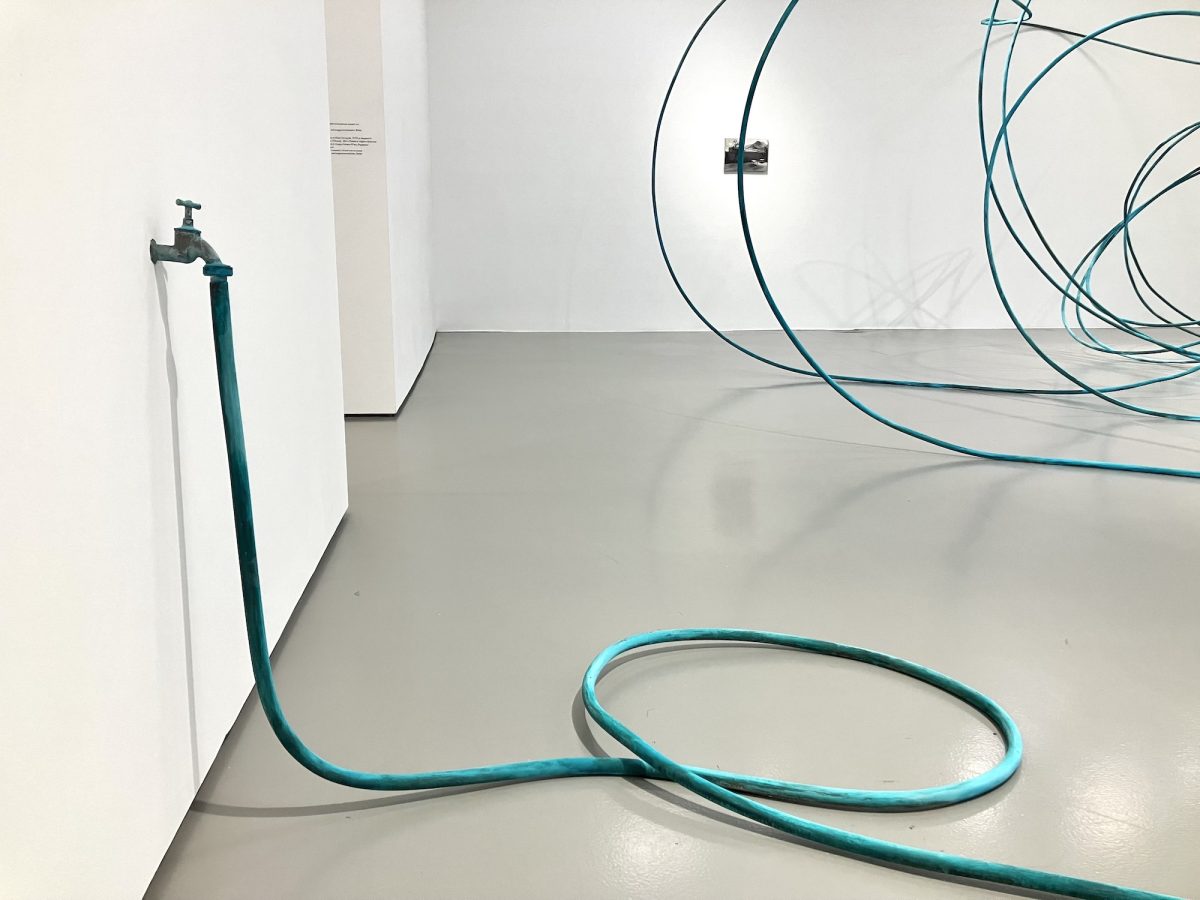
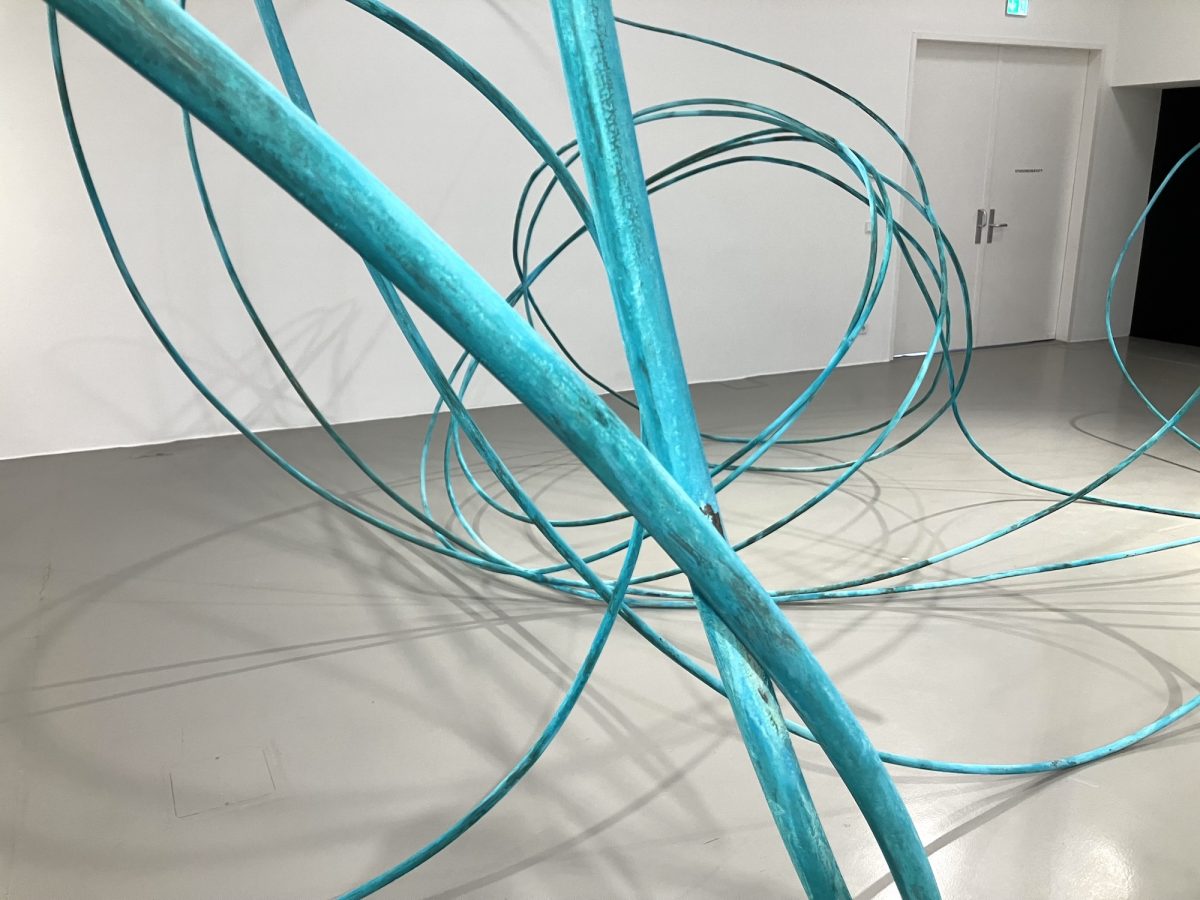
Xoco unfolds onto the undated sculpture Manifestazione tangibile di una fantasia mentale, introducing another key theme in Torres’ work: Alighiero Boetti. Crafted from patinated copper and formed into an endlessly coiled garden hose, the piece nods to the Italian artist, to whom Torres has dedicated a series of works. This impressive undulation recalls Boetti’s Autoritratto (Mi Fuma Il Cervello), a self-portrait in bronze in which the figure is holding a garden hose and spraying water over his head. Torres takes it one step further, giving the hose a life of its own: untamed, tangled, and almost frantic in its pursuit of inspiration, as if it has lost control in the search for meaning.
There’s a light touch to many of the gestures here, even when the subject matter is heavy. Torres avoids didacticism despite engaging with overtly political material. He returns to his long-standing interest in the U.S. invasion of Afghanistan, first explored during his time at CalArts in the early 2000s. At the time, he struggled with how and whether to respond to the conflict as a foreign student. Discovering the work of Boetti, particularly his One Hotel project in Kabul (1972–76), provided a way to work through his own ambivalence.
That thread continues in the exhibition, notably through the reappearance of a film first shown at documenta 13 in 2012 in the exact same room. In it, archival photographs of Kabul are treated like forensic evidence: objects to be read not just for what they depict but for what they conceal and for what they imply about photography as a deliberate, and now largely lost, act.
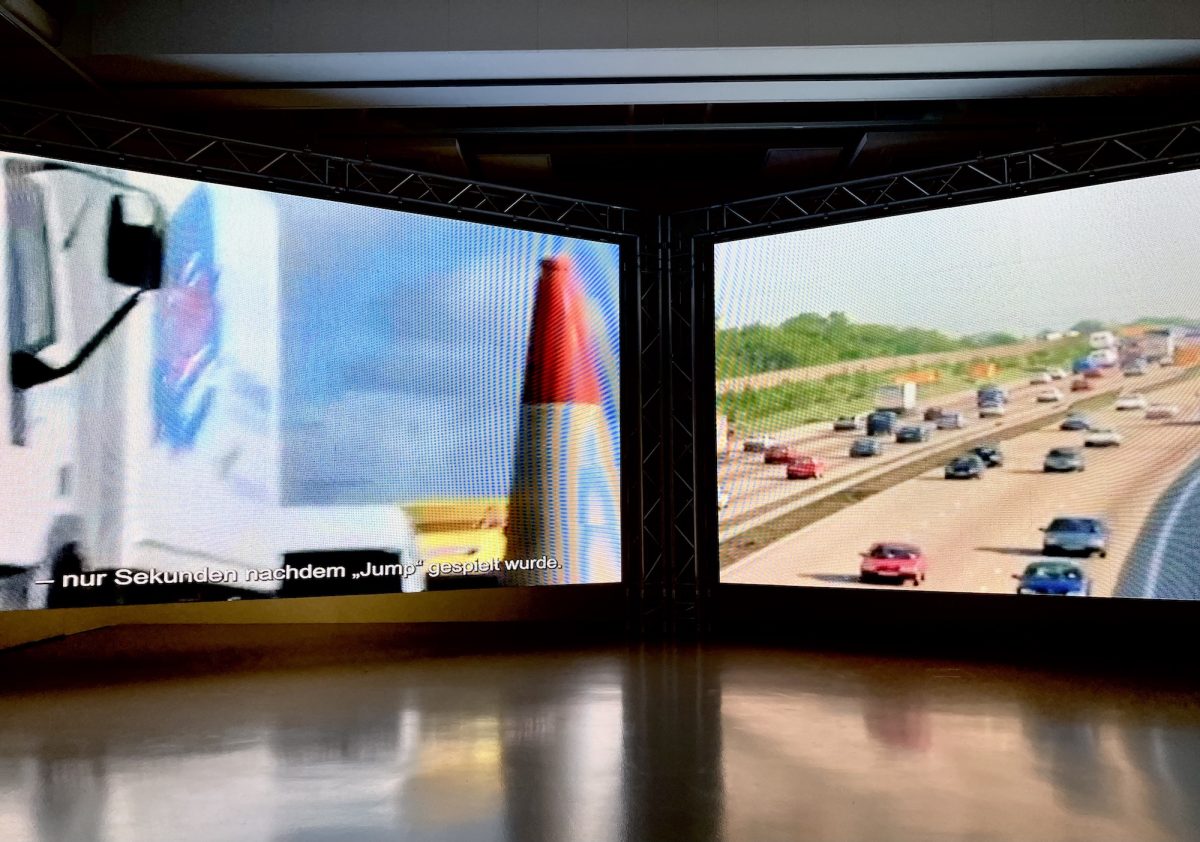
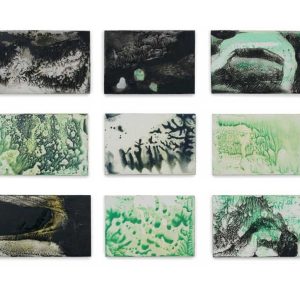
At the opposite end of the space, a series of canvases visualise degrees of separation between various public figures. In the adjacent space, the video essay Cayendo juntos en el Tiempo (Falling Together in Time) begins with Van Halen’s Jump and ends with… well, who knows? Along the way, we’re offered a sprawling web of tenuous, delightful, possibly meaningless coincidences connecting rock stars, truck drivers, and Muhammad Ali. It’s a work that pokes at the boundaries of what constitutes relevance, where the footnote becomes the story and causality is just another kind of fiction.
Torres delights in these kinds of improbable linkages, like a scholar who took a wrong turn on Wikipedia and decided to lean into it. He’s less concerned with what things are than with what they remind us of, what patterns they trace, and how they echo through time. This can be thrilling in moments, and exhausting in others. At times, it can lead to a frustrating experience, especially for those not immediately attuned to the artist’s methods or narrative style. The more you dig, the more you might wonder: is this the birth of a profound insight or just a stunt to prove how many random things Torres can link together? But the thing is, pieces don’t insist on explanation. Rather, they offer the possibility that meaning can unfold in many ways: sometimes through knowledge and sometimes through feeling.
Take the necklace: it’s a lovely, layered anecdote, but if you don’t know the story, you might just see a gold chain in a corner and think someone dropped it. Yet, there’s something about it that just feels momentous. Torres courts this kind of ambiguity, this feeling of missing the inside joke. It’s the tension at the heart of the show: does knowing the story behind something make it more meaningful, or is the not-knowing the point?
Ultimately, Torres is concerned with artwork as a tool for rethinking how stories are told, remembered, and shared. Instead of drawing conclusions, he offers frameworks. The title, A History of Influence, is telling in this regard. It does not claim to present the history, nor even a complete one, but rather a fragmented, provisional version: one that understands influence as something nonlinear and sometimes invisible – yet deeply pervasive. It’s like the uncanny. Hard to define, but when it’s there you know it.
And while whatever it is remains somewhat up for discussion, it still lands on something resonant: the idea that meaning isn’t always found in the centre, but in the margins, or in the weird coincidences that stitch a story together – but most importantly, like the necklace, it’s there (and has been all along).
As for Carmen? She forgave Lucho.
Mario García Torres, A History of Influence, March 15th – July 27th, 2025 Fridericianum
All photos: Camille Moreno