In an art world increasingly grappling with sustainability, personal narratives, and the re-evaluation of traditional crafts, Hui Zhang emerges as a compelling voice. Her recent exhibitions, featuring series such as “Echoes Between Threads” and “When the Spores Fall”, signal an artist deeply committed to exploring complex themes through the ostensibly gentle medium of textiles. While her work undeniably possesses a unique aesthetic and conceptual depth, a closer examination reveals both its strengths and areas for further growth.
Born in 1996 in Zhengzhou, China, Hui Zhang now lives and works in London, UK. Her artistic journey has seen her pursue a BA in Clothing and Accessories Design in China , followed by extensive postgraduate studies in Textile Design at Chelsea College of Arts in London, where she completed both a Graduate Diploma (2020-2021) and an MA (2021-2023). This dual foundation in fashion and fine art textiles clearly underpins her unique approach to material and form. Zhang’s dedication to her practice has culminated in a busy exhibition schedule in 2025, with notable participations including “Premio Maestri a Pechino” at Three Shadows Photography Art Centre in Beijing, China , “Moments of Grammatical Collapse” at DFFF Studio in London , and “La beauté du petit” at Sol de Paris in Paris, France. These recent showcases underscore her growing presence on both the international and UK art scenes.
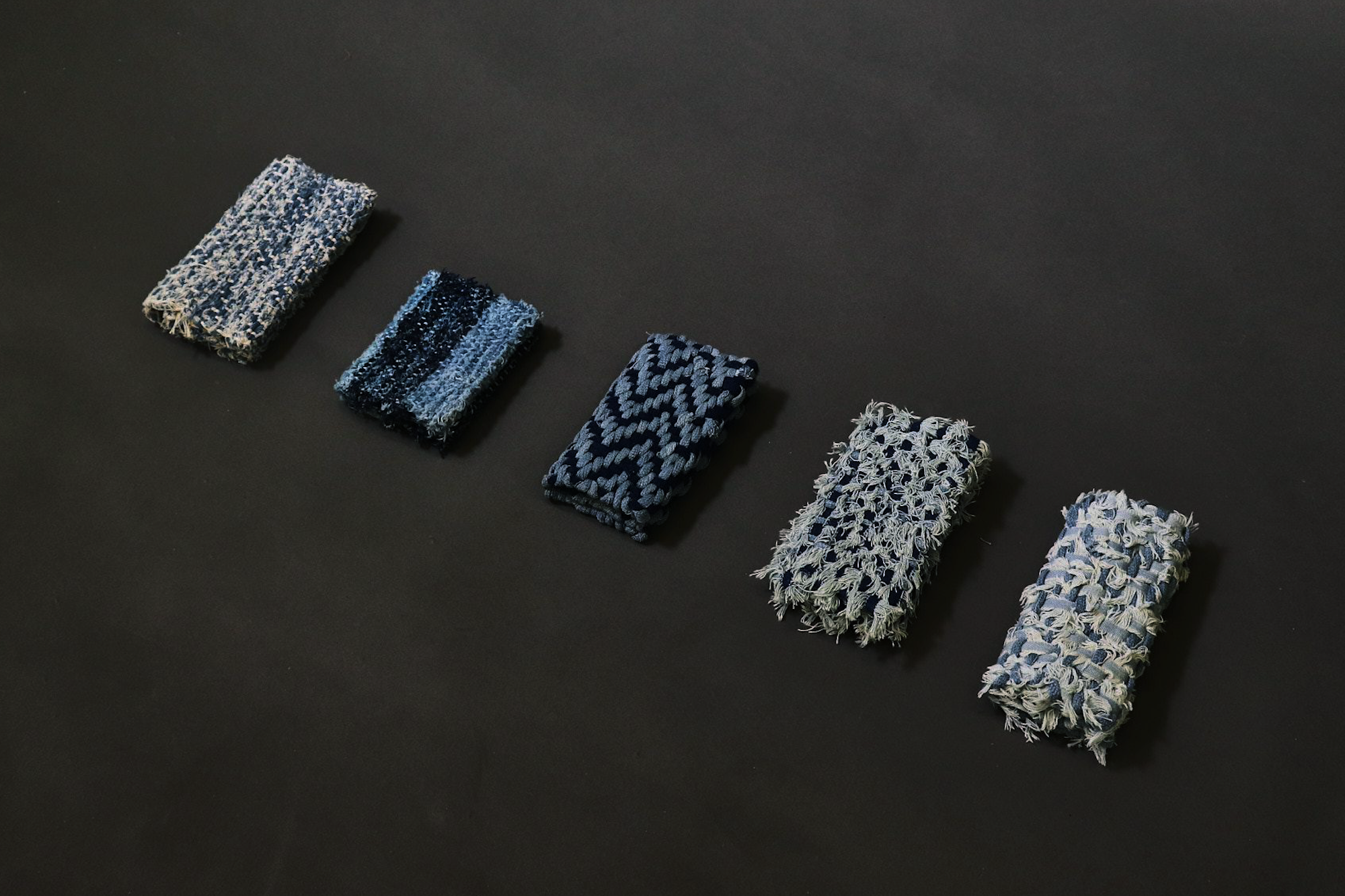
Zhang’s core strength lies in her ability to imbue reclaimed materials with profound meaning. Her primary medium is reclaimed denim, which she combines with natural fibers and found materials, transforming what could be mere upcycling into a poignant act of “regrowth”. This is particularly evident in “Echoes Between Threads”, where the transformation of a cleaning tool (loofah sponge) into a sculptural “vessel” for emotion is a potent metaphor for re-evaluating domestic labour. The conceptual framework is robust, challenging viewers to consider the invisible work, often associated with women, that underpins daily life.
As a Chinese female artist, Zhang’s practice is deeply informed by her heritage. She uniquely draws upon familial traditions, specifically influenced by the women in her family who crafted household objects from natural materials – whether her grandmother weaving grass mats or her mother using loofah for cleaning. These domestic handcrafts are not merely survival strategies but forms of embodied knowledge. Zhang’s work thus functions as a profound form of personal ethnography, meticulously documenting and re-presenting the overlooked value of female domestic labor and the quiet resilience embedded in traditional Chinese familial values and handicraft transmission. Her artistic process, particularly the repetitive acts of wrapping and weaving, can be seen as a direct continuation and transformation of these intergenerational practices, echoing the shared experiences and wisdom across her grandmother’s, mother’s, and her own generations. While revealing profound similarities and an unbroken thread of knowledge, her contemporary artistic lens simultaneously transforms these traditional acts, pushing them into new conceptual territories and giving them a visible, audible presence in the art world.
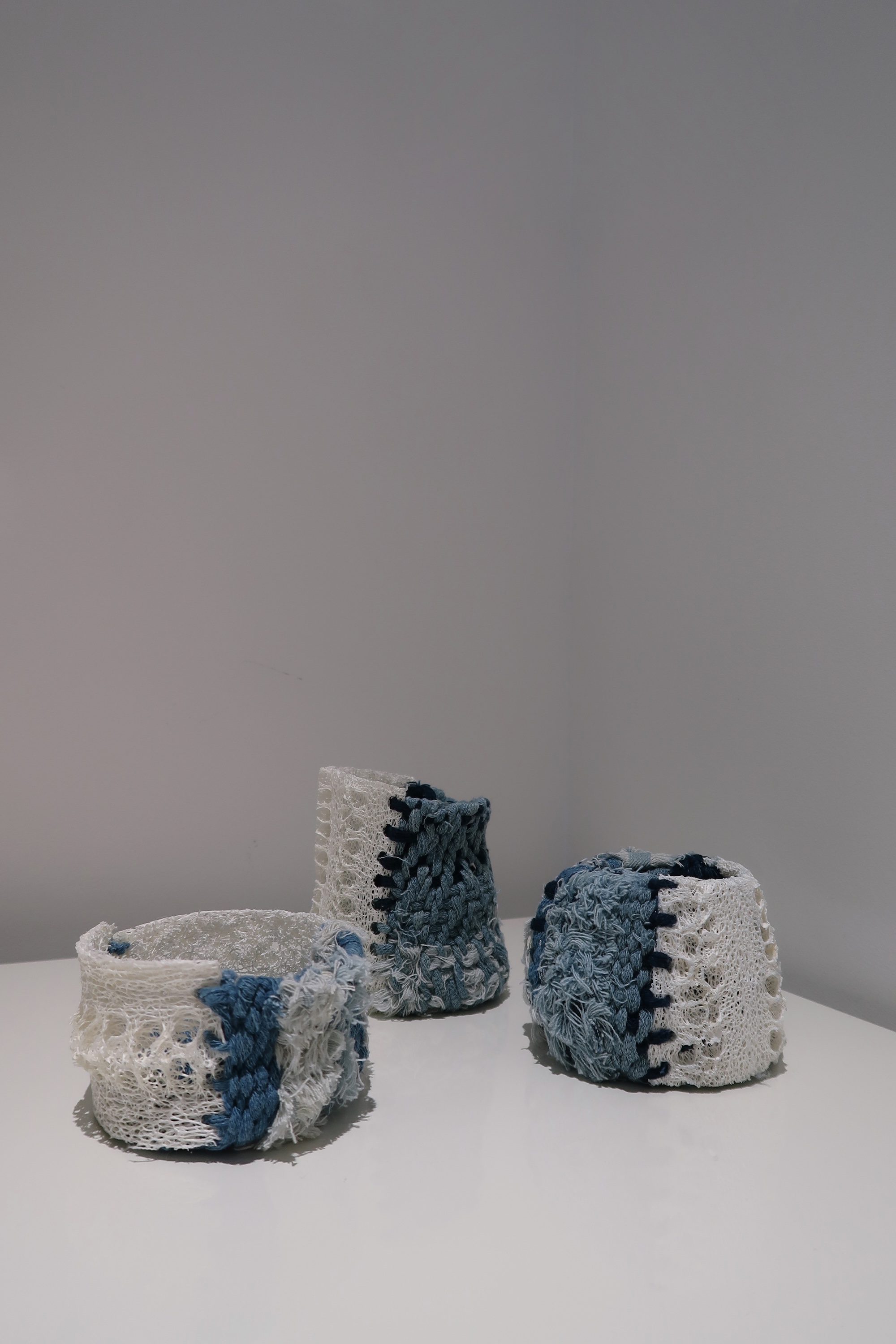
Beyond the visual, Zhang’s foray into sound integration within her sculptural forms is particularly ambitious and, at times, captivating. The layering of her mother’s housework sounds, childhood environmental recordings (insects and her mother cutting paper), and contemporary domestic audio in “Echoes Between Threads” creates a multi-sensory experience that attempts to render the unseen “tactile, audible, and meaningful”. This push into interdisciplinary practice speaks to a contemporary sensibility, demonstrating a willingness to experiment beyond the confines of purely visual art. Sound becomes a structural dimension, forming a symbiotic system with fiber and memory. The overall impression of her work is one of immense warmth and profound emotion; one can almost palpably feel her love and respect for her family, especially the women, and the quiet power of their shared history. In an often-detached contemporary art landscape, this heartfelt connection is a refreshing and vital component.
However, it is precisely in this ambition that some of the work’s limitations occasionally surface. While the conceptual intent behind the sound elements is clear and impactful on paper, their experiential integration can sometimes feel more illustrative than intrinsically woven into the sculptural form itself. At certain points, the auditory overlay, while narratively rich, risks becoming a commentary on the sculpture rather than an inseparable part of its being. For a work so deeply rooted in the physicality of textile and material, the challenge moving forward will be to ensure the sound component achieves a seamless, almost visceral, unity with the visual, avoiding any sense of being an “added extra.”
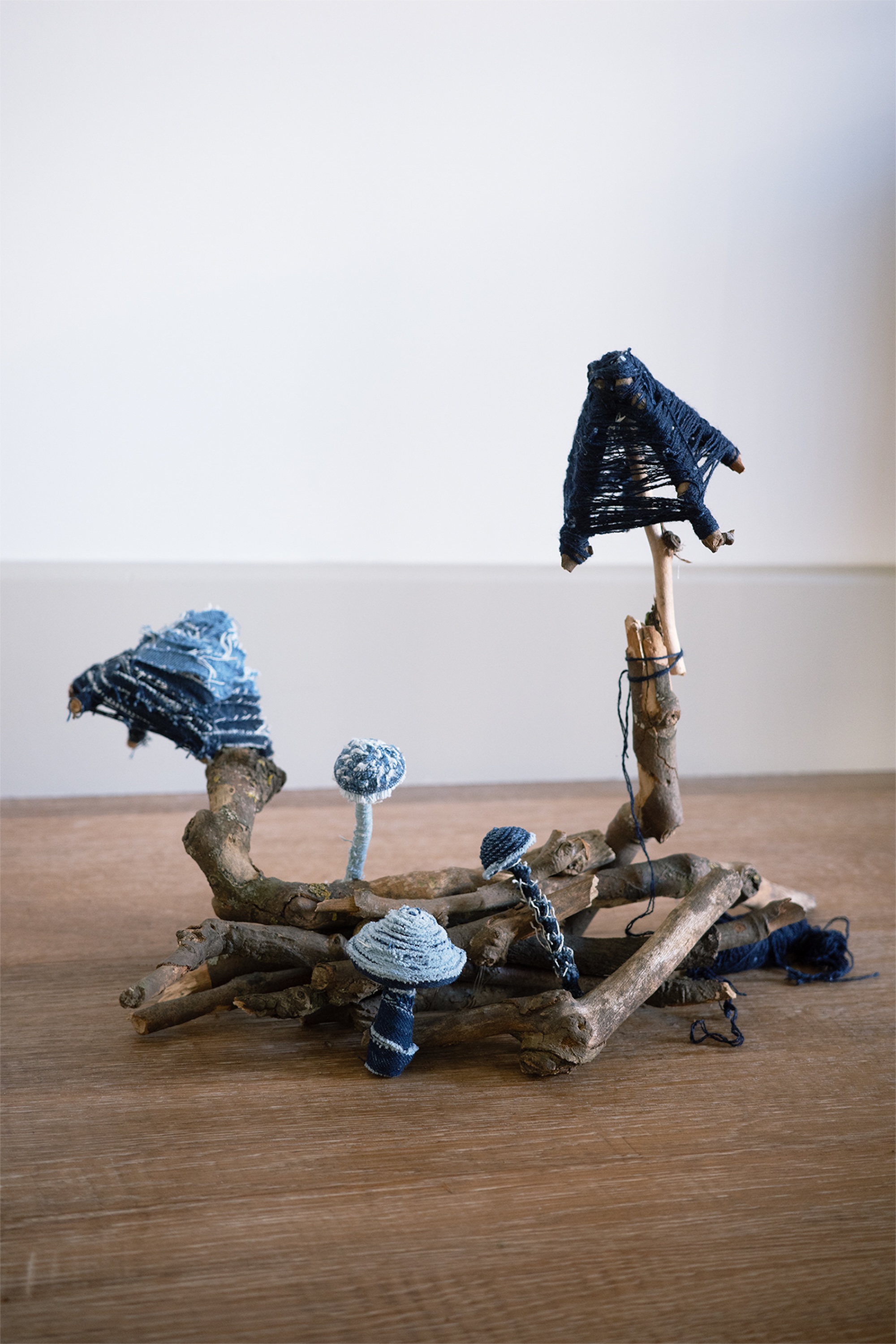
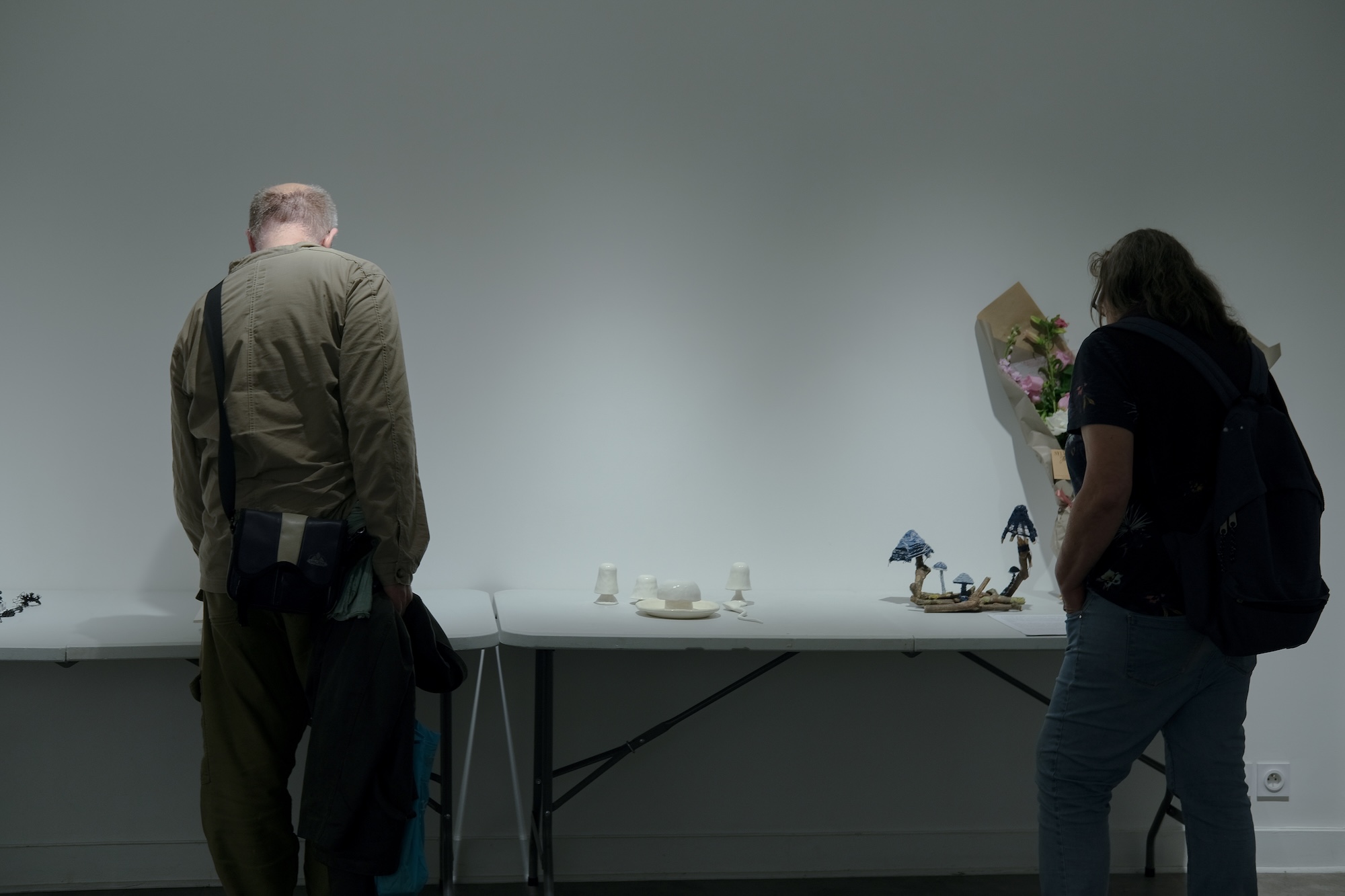
Similarly, in “When the Spores Fall”, the organic forms woven from recycled denim yarn and foraged branches are conceptually intriguing, evoking the cycles of nature and intergenerational knowledge. The metaphor of the mushroom and its spores as a symbol of quiet transmission and regeneration is elegantly conceived. Yet, the visual impact of some individual pieces, while competent, occasionally leans towards the illustrative rather than the transformative. To truly push the boundaries of “soft ecological sculpture”, the work could benefit from further exploration into how the materials themselves might defy conventional sculptural expectations, perhaps through scale, more radical deconstruction, or even a greater embrace of the inherent “imperfections” of recycled materials to create more viscerally arresting forms. The “handmade bonsai” analogy, while charming, might inadvertently suggest a contained, delicate aesthetic when the themes she addresses—ecological crisis, persistent labour—demand a more forceful, even unsettling, visual language.
Despite these critical observations, Hui Zhang is undoubtedly an artist with exceptional promise. Her dedication to themes that resonate deeply with current global dialogues, combined with her innovative use of textiles and her distinctive cultural perspective, positions her for significant future impact. The conceptual rigour underlying her practice, coupled with a willingness to experiment with form and medium, suggests a trajectory towards becoming a significant voice in contemporary art. Her work acts as a vital reminder that art can indeed become a vessel for family memory and ecological wisdom, a warmth and human connection that is much needed in our contemporary era, even as she continues to refine its formal expression. FAD Magazine will be keenly watching her future development, particularly how she navigates the intricate balance between profound concept and truly groundbreaking execution.