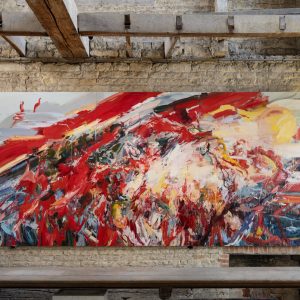
Three artists, three completely different approaches, but the same observation: on the international art market, the young Japanese art scene is currently brighter than it has been for a long while: Miwa Komatsu, Justin Caguiat and Yukimasa Ida are now among the world’s top-rated ultra-contemporary artists, attracting acquisitive attention from collectors in Asia… and beyond.
Japan’s next generation of artists is no longer waiting in the aisles… it has just burst onto the scene. At the head of this new trend, three names are constantly returning to auction rooms and international art fairs: Miwa Komatsu, Justin Caguiat and Yukimasa Ida.
All born after 1980, they embody three powerful visions of contemporary creation, driven by unique stories, assertive museum & institutional footprints and sales results that place them at the top of their generation. While the global market traverses a period of moderation, these Japanese artists are captivating their audiences with their audacity, their mystique and their hybridity. We take a closer look at their work, which, despite the ambient market sobriety, is still causing sensations at major art sales.
Miwa KOMATSU (1984), dialogues with the invisible
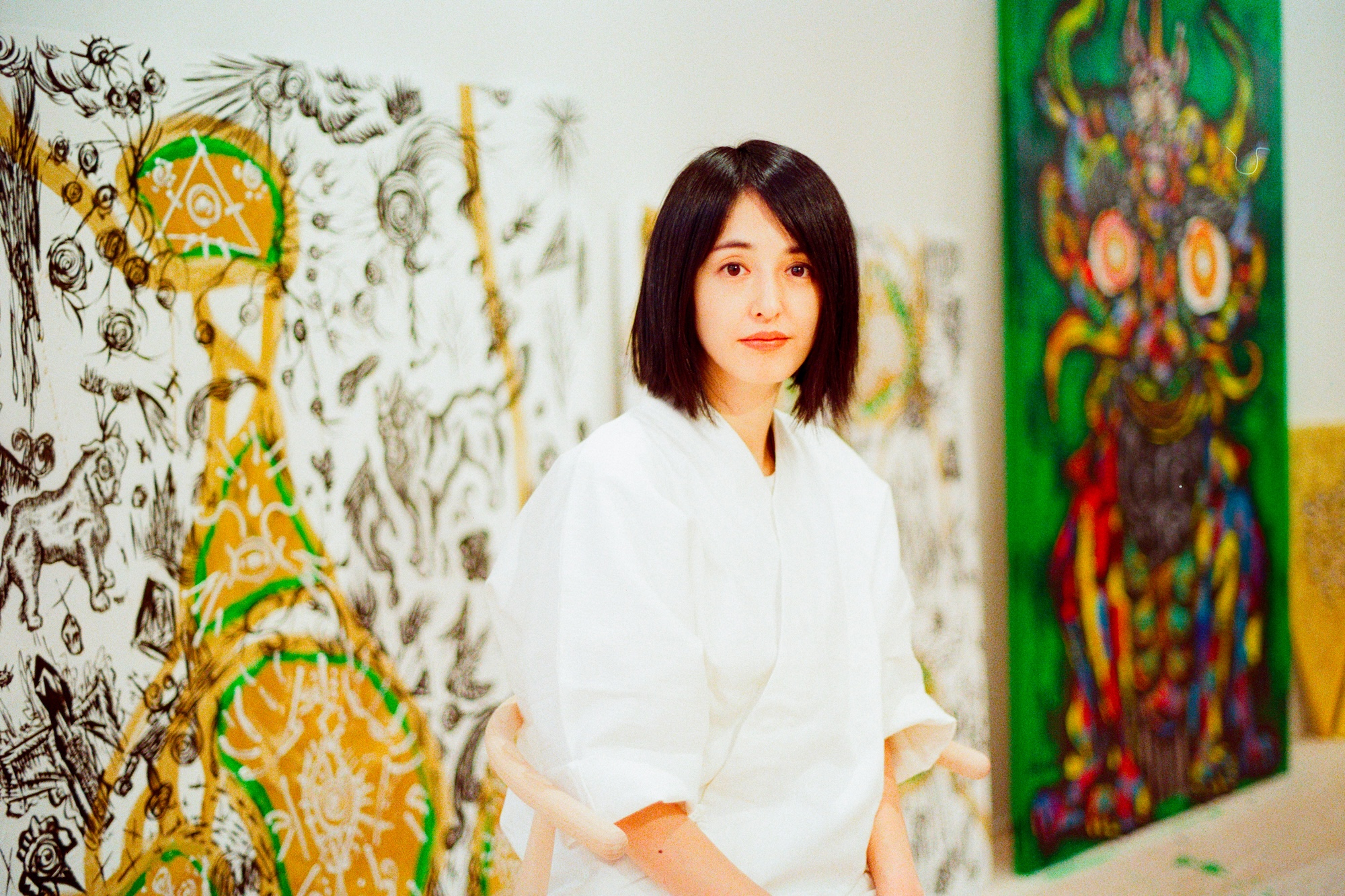
For a decade, Miwa Komatsu has established herself as one of the most unique and promising figures in Contemporary Japanese art. Her trajectory, driven by a spiritual vision of art and a powerful aesthetic, has been accompanied by an increasingly assertive institutional and commercial recognition over the past decade.
In 2015, when she was just 30, Komatsu was invited to London’s prestigious Chelsea Flower Show organized by the Royal Horticultural Society under the patronage of Queen Elizabeth II. At the show, she presented Arita Komainu (Guardian Beast of Heaven and Earth), a porcelain work that was immediately acquired by the British Museum… a dazzling recognition for a still emerging artist.
That same year, her work appeared on the art auction market, and not just anywhere; at a Christie’s Hong Kong sale dedicated to contemporary Asian art. Her freshly completed canvas, Guardian Lion of Historic Ruins, fetched $25,800 including fees – double its high estimate. That strong result was the first in a series of rising bids for works by this artist who is convinced that art can heal the heart and the soul.
Over the following years the momentum was confirmed. In 2016, her first solo exhibition at the Ginza Mitsukoshi gallery in Tokyo was a tremendous success and all the works sold. In 2017, her exhibition Shin-jyu (Holy Beasts) Area 21 at Tokyo Garden Terrace Kioicho attracted nearly 30,000 visitors, many of whom witnessed her live painting performances… with bare hands. The critics loved the event and it substantially contributed to her public notoriety.
In 2019, Miwa Komatsu’s career passed another decisive milestone: her virtual reality work, Prayer = INORI was selected at the 76th Venice Film Festival in the VR category. This international recognition confirmed her status as a singular artist whose work lies at the crossroads of the visible and the invisible. The same year, her work began to excite bidders at Japanese auction houses and demand began to take off: for two consecutive years, every work offered found a buyer. To respond to this enthusiasm, she increased her output with nearly 60 works sold in 2022 generating a total of $2 million over the year with a sold-through rate of 96.6%. That put Komatsu among the 1,000 top-selling artists in the world (at 603rd place), while becoming the first ‘ultra-contemporary’ Japanese artist to ever figure in the ranking.
Since then, Miwa Komatsu has had a steady stream of solo shows in Singapore, Seoul, Beijing, Taipei and Hong Kong where the Whitestone gallery has just closed its doors on Sacred Nexus. The enthusiasm is real, both among the public and collectors. In Asia her prices are continuing to rise, driven by strong and sustained demand; but the increase has not been disproportionate: a one-meter canvas still sells for between $40,000 and $50,000 at auction – a much more affordable ticket than the $100,000 to $400,000 necessary to access the works by new British ‘market-darlings’ like Rachel Jones and Jadé Fadojutimi. This rare combination of strong demand and yet still accessible prices could well open the doors for Komatsu in a Western market in search of new work and new perspectives.
Justin CAGUIAT (1989), a fast-rising ultra-contemporary
Born 36 years ago, the most American of Japanese artists, Justin Caguiat, established himself in the upper echelons of contemporary art sales with a 7-digit result in New York last year. Without returning to this peak, his work caused a considerable buzz in March at London’s prestige sales.
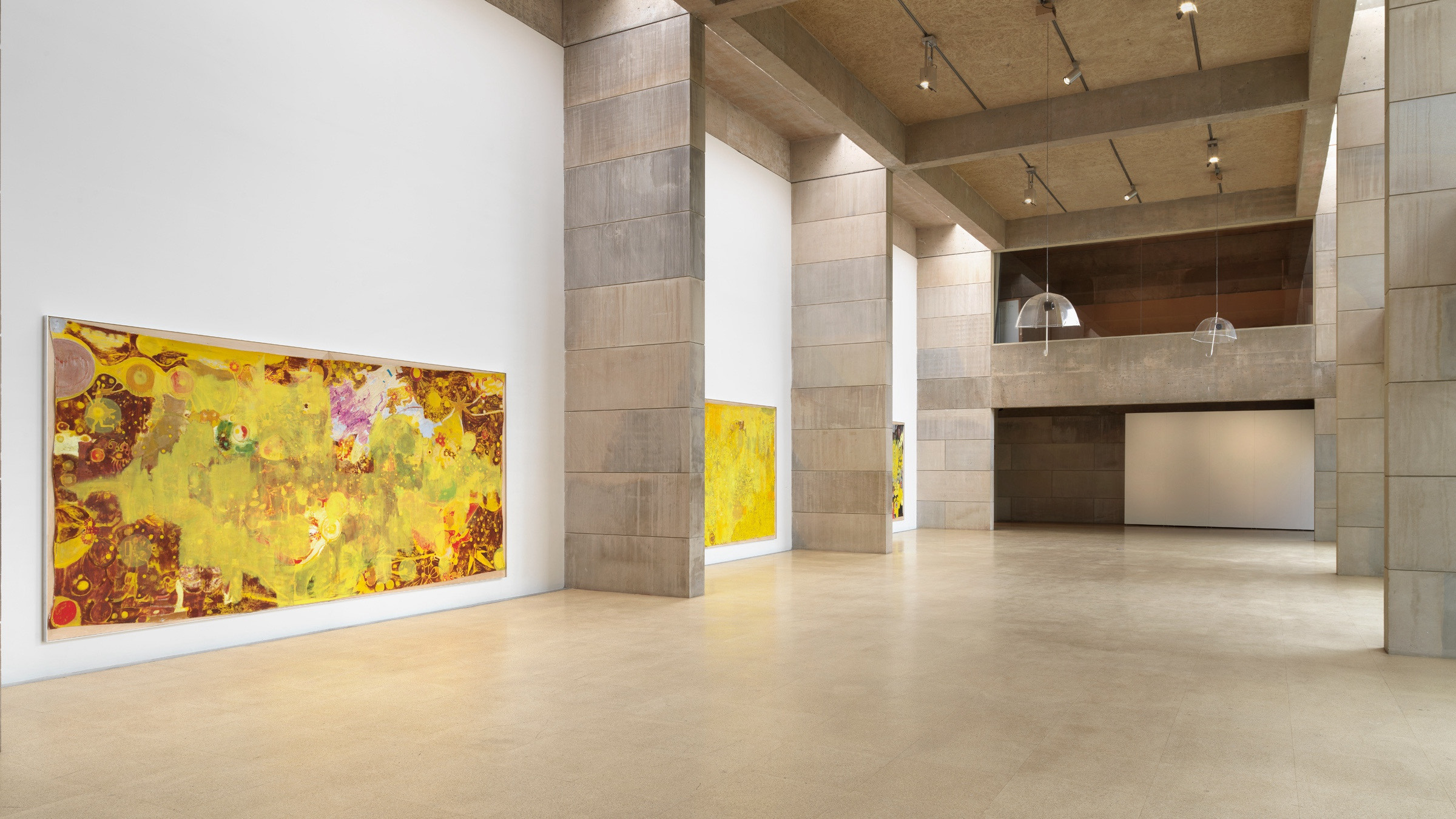
At just 36 years old, the most cosmopolitan of Japanese artists is currently adding considerable effervescence to art auction activity. Born in Tokyo, raised between Yokohama, Hong Kong, Jakarta and Manila, settled between California and New York, Justin Caguiat embodies a fluid and mobile “third culture”. His work, equally hybrid, mixes figures, abstract shapes and ideas on vast canvases of unstretched linen or cotton, which seem torn from larger worlds.
On the auction market, the last three years have seen his prices inflate rapidly. Priced between $30,000 and $50,000 in galleries in 2020, his works started to circulate on the secondary market in 2022 during the art market’s post-pandemic enthusiasm. Right from his debut appearance, the tension was palpable: Doll 3 Eros (2020) – estimated $380,000 to $450,000 – fetched $504,000 at Phillips in New York.
Since then, the momentum has continued. In March 2025, Christie’s London sold a predominantly orange painting – seen two years earlier at the Modern Art gallery – for $682,000, at double its low estimate, a remarkable result in the current context of market sobriety. It was also the world’s highest ‘ultra-contemporary’ result in Q1 2025.
Of course, this kind of success is no accident. At the end of 2024, Caguiat completed his first museum exhibition in the United States (Triple Solitaire, Wesleyan Art Center) and was prominently exhibited at Art Basel Miami. His works have also joined prestigious collections such as the Hammer Museum in Los Angeles and the MoMA in San Francisco. In May 2024, a monumental painting titled The Saint is Never Busy (2019) fetched $1.09 million at Sotheby’s New York after a six-minute battle between eight bidders. Its high estimate was just $300,000. With his singular vision, his immersive painting and an increasingly assertive museum presence, Justin Caguiat has established himself among the most coveted artists of his generation. Well-controlled rarity further reinforces his appeal: auction houses only offer one painting per year, each time arousing feverish enthusiasm among the wealthiest collectors. As a result, the estimates are dwarfed, driven by demand that is both sustained and highly selective.
Yukimasa IDA (1990), a favorite among top galleries
Backed by Takashi Murakami, promoted by Perrotin, Mariane Ibrahim and Villepin galleries, Yukimasa Ida is causing a sensation. In 2023, at the age of 33, he joined the world’s 1000 top-selling artists on the art market, driven by the fervor of collectors and a series of auction successes. Two years later, his rating remains solid, proof of his roots among the most prominent artists of his generation.
His universe, nourished by Japanese philosophy Ichi-go Ichi-e — the beauty of the unique moment — explores the passage of time with striking formal freedom. Painting, sculpture, portrait or abstraction: Yukimasa Ida refuses labels, preferring an abundant practice, between tradition and contemporary intensity. In 2020, this singular approach seduced Murakami, who invited him to join a group exhibition at Perrotin in Paris, which was subsequently presented by the Mariane Ibrahim gallery and promoted the show on the international scene.
From then on, his works were shown at all major market events: the Armory Show, Art Basel (Miami, Basel), Paris+, Frieze Seoul, and even in Hong Kong at the Villepin gallery. This exposure was followed by strong secondary market demand: in 2023, his works generated a total of $1.26 million, with a personal record of $356,300 hammered at SBI Art Auction in Tokyo.
His ascension also includes an important museum milestone: his first major solo exhibition in Japan, Panta Rhei – For as long as the world turns, under the curatorship of Jérôme Sans, inaugurated in his hometown of Yonago, and subsequently hosted in Kyoto. After four years of sharp price inflation, Yukimasa Ida’s market is experiencing a slight slowdown, with buyers becoming more demanding: two works remained unsold during the spring sales in Hong Kong. But the artist has not given up. With only seven lots sold between
January and March, he remains firmly anchored among the 15 top performing under-40 artists of the quarter, ahead of Emma Webster and Louis Fratino. Proof that his prices are holding up, driven by the undiminished enthusiasm of Tokyo collectors.
Japan has long been a breeding ground for contemporary art superstars like Yayoi Kusama, Yoshitomo Nara and Takashi Murakami, whose works hang in the most prestigious collections and dominate international auctions. Today, the next generation, embodied by artists like Yukimasa Ida, Miwa Komatsu and Justin Caguiat, are making their mark on the auction scene.
While Yukimasa Ida and Miwa Komatsu are still mainly appealing to Japanese collectors, their conquest of the British and American markets is clearly underway, even if the foundations remain to be consolidated. Conversely, Justin Caguiat, already supported by the major New York auction houses, is establishing himself among an elite of insiders on the international scene, and his impressive results suggest a brilliant future lies ahead.
Words: Céline Moine, Artmarket by Artprice