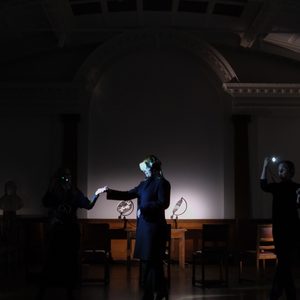
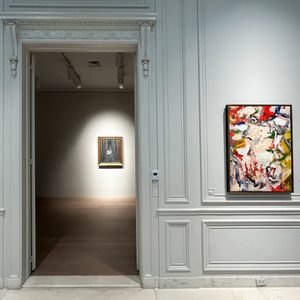
In a cultural landscape increasingly driven by spectacle, Jichi Zhang turns quietly toward the ephemeral, the marginal, and the barely perceptible. Working with post-industrial materials—plastic sheathing, translucent packaging, and industrial film—he crafts installations that do not insist on attention, but whisper their presence. His artistic inquiry centers around the aesthetics of partiality: presence without assertion, gesture without resolution, and material without monument.

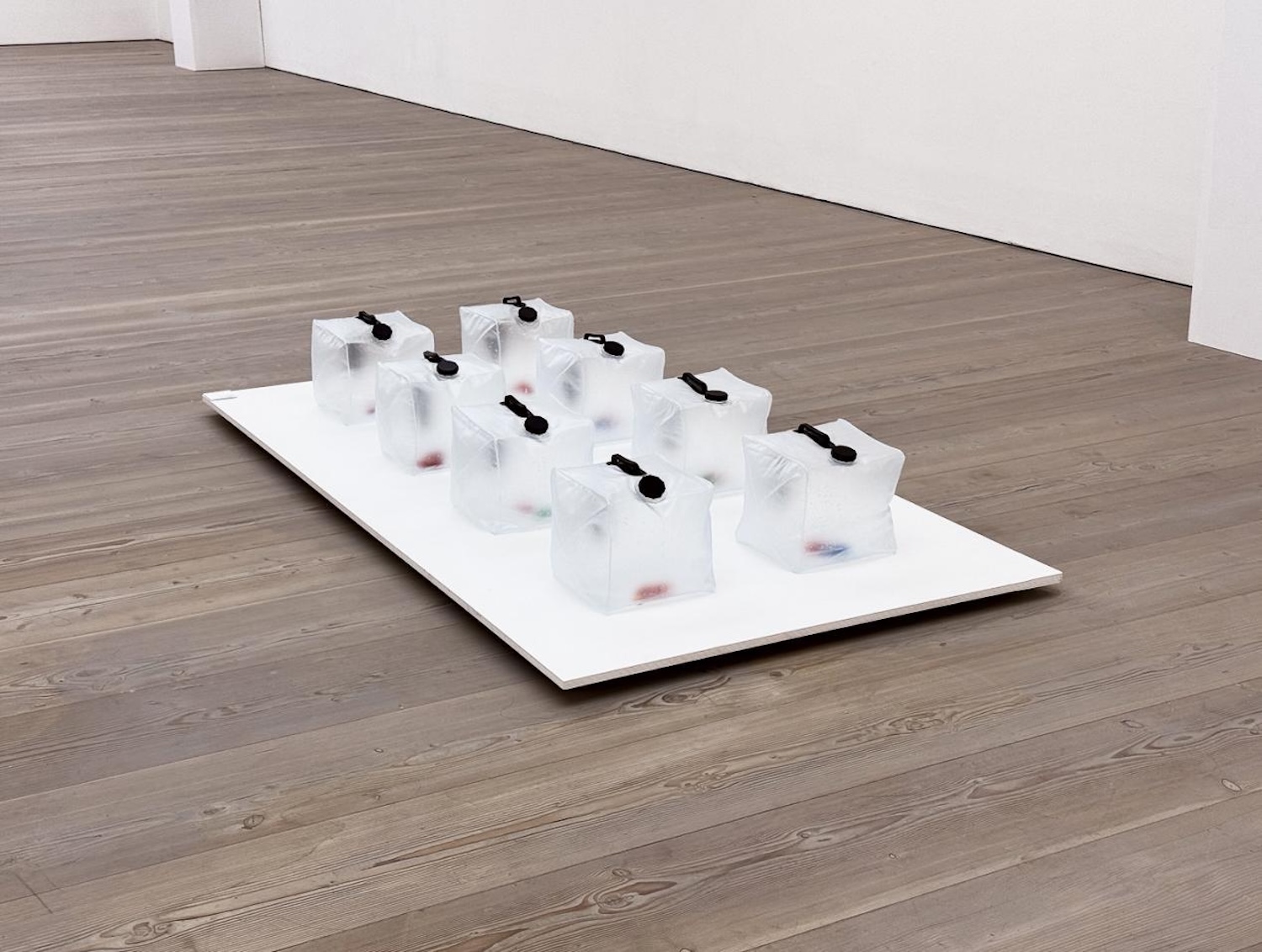
These materials inherently resist permanence. Folded, curled, or gently arranged, they respond to air, light, humidity, or bodily proximity. A thin plastic sheet may tremble; a folded edge may sag—not as a failure, but as part of the work’s logic. Jichi’s practice does not conform to the traditional sense of sculpture but becomes a choreography of fragility. Disappearance is not absence, but a form of action-an active suspension that asks the viewer to witness duration rather than outcome.

Jichi does not impose form; he collaborates with matter. His gestures are quiet, reverent, and open-ended. Frosted and translucent surfaces mediate between concealment and revelation, interior and exterior. These are not symbolic objects—they invite slow encounter, not fast interpretation. The work asks to be noticed, not explained. It invites presence and attentiveness. They are, in many ways, about care: the care of looking, of waiting, of acknowledging what might otherwise remain unseen.
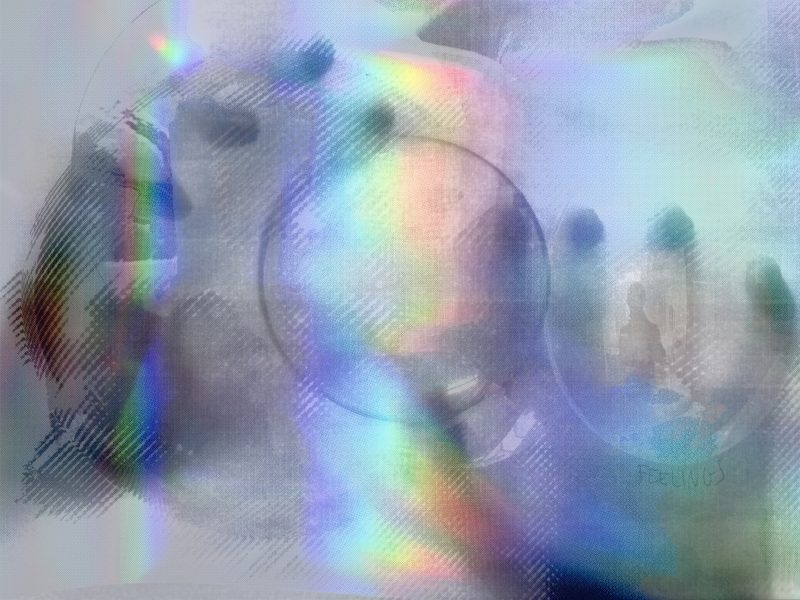
In his recent solo project am, Jichi detaches the verb from any object or action. “Am” becomes a suspended state of being—neither fully present nor entirely absent. The works, like the word, exist in ambiguity. Thin sheets curl inward as if in retreat, translucent materials hover without revealing what lies beneath. Nothing is fixed, and that instability becomes both conceptual and material. Jichi embraces impermanence not as loss, but as method—a conceptual tool to resist closure and dominance.

His practice draws on principles that resonate with East Asian philosophies—especially those that value emptiness, balance, and the in-between. Rather than filling space, Jichi negotiates with it. Emptiness becomes not a lack but a structure. What is most important is often what is not there, or what is only barely there. His installations dissolve into the environment rather than dominate it. Activated by light, time, or movement, they behave more like atmosphere than object. In this way, his work redefines the idea of site-specificity—not as adaptation, but as dissolution.
This refusal of visibility aligns him with artists like Felix Gonzalez-Torres and Eva Hesse, who redefined the languages of trace, presence, and memory. Yet unlike many of his Western predecessors, Jichi’s use of fragility is not melancholic, but meditative. It speaks not of decay, but of flux. His subtlety is not retreat, but resistance—a form of conceptual rigor that uses lightness and delay as counterweights to spectacle and immediacy.
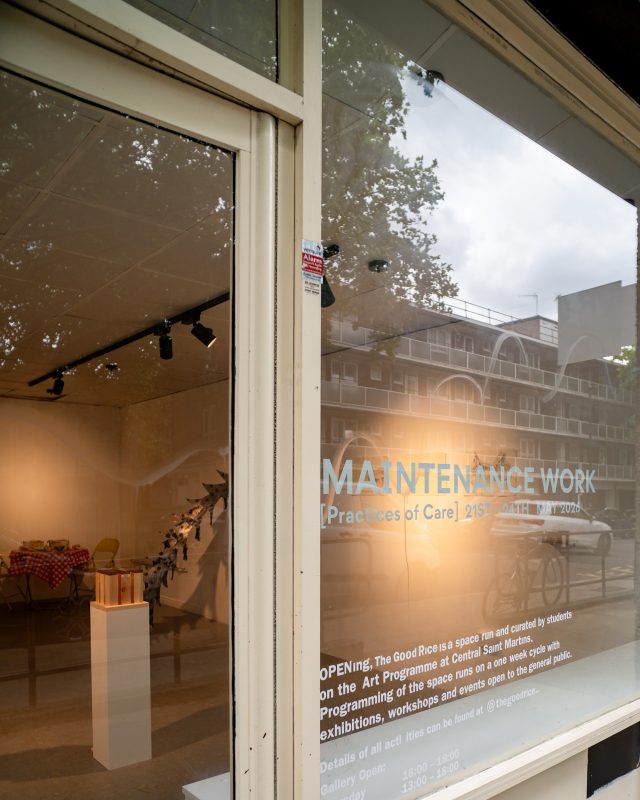
Jichi’s materials often exist on the edge of discardability. They are remnants, fragments, semi-transparent layers that hold light but not volume. Their impermanence lends them urgency. There is always the sense that the work might shift—or vanish—between viewings. In exhibitions such as To & from (The Good Rice Gallery, London) or Knock knock (Universität der Künste Garten, Berlin), this quality of mutability was not just tolerated but emphasized. The works did not compete for attention; they responded to their context like breath to weather.
Jichi contributes a critical voice to the global discourse of post-minimalism and material poetics. His exhibitions in London, Berlin, Paris, and across East Asia offer a radical quietness—a soft urgency—within cultural spaces that often privilege clarity and control. He reminds us that what barely exists may be what most needs our attention. Through this insistence on slowness and fragility, his work opens a space for a different kind of viewing: one that values uncertainty, patience, and transformation over certainty or resolution.
About the artist
Jichi Zhang (b. 2001, Hohhot, China) lives and works in London. He graduated from Central Saint Martins (Fine Art XD Pathway), and completed an Erasmus exchange at Universität der Künste Berlin. His work has been exhibited at the Saatchi Gallery, the National Gallery (London), the Louvre (Paris), and various independent spaces across the UK, Germany, and China. Jichi’s practice spans installation, sculpture, and conceptual research, with a particular emphasis on non-monumental forms, material sensitivity, and the poetics of impermanence.