In Bobby Zhaocheng Xiong’s uncanny liturgies, divinity no longer soars above but nestles within arrays of phosphorescent screens, algorithmically permuted scripture, and derelict domestic tableaux. His interactive installations such as New Deity, Apocryphal Prophecy, Mutual Metaphor, and Flower operate in a register that is both sacral and speculative, weaving a kind of post-spiritual poetics that probes how the digital superego rearticulates belief, nature, and intimacy. Rejecting techno-fetishism, Bobby constructs soft dystopias, ambiguous sanctuaries where cybernetic theology and artificial ecologies intertwine.
Rather than prescribing narratives or didactic messages, Bobby creates spaces for ambient contemplation where the audience becomes an essential participant in the production of meaning. His works do not seek to restore pre-digital modes of connection but rather draw attention to the ontological shifts in our understanding of what is sacred, what is organic, and what is human. These installations operate as affective systems, interfaces through which we practise how to breathe, kneel, hope, and mourn in the age of neural networks.
His projects exhibit a notable consistency, both visually and conceptually. Recurring elements such as CRT monitors, raw screens, analogue interfaces, ritual gestures, and constructed ecologies form a coherent material lexicon that defines his signature. His practice adheres to a clear methodology that employs ritualised interactivity to interrogate philosophical questions regarding artificial divinity, digital nature, and posthuman intimacy. In doing so, Bobby does not simply produce a body of work but establishes a distinct artistic persona, one who resembles a liturgist navigating speculative futures.
I. New Deity: Algorithmic Worship and the Modular Divine
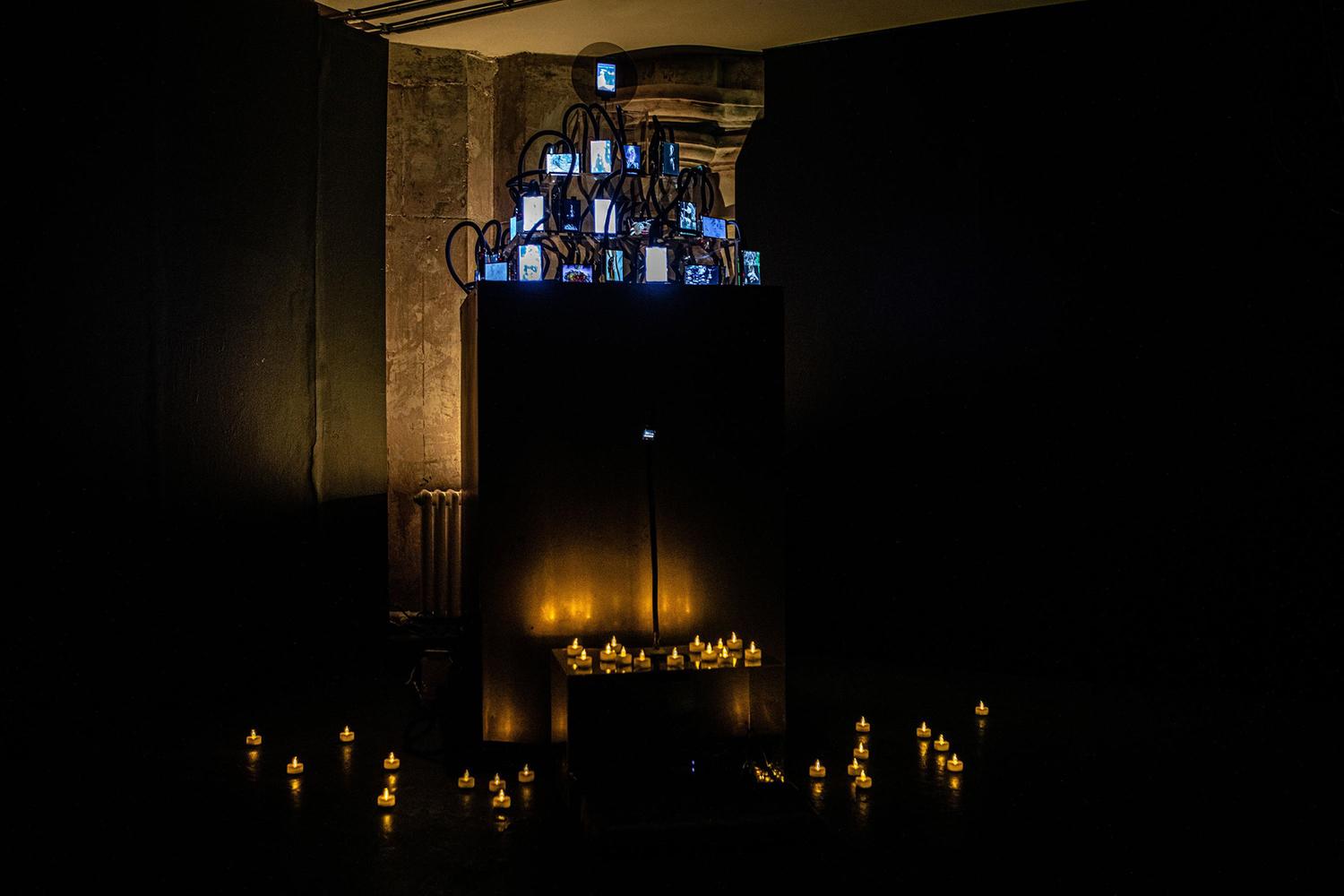
New Deity presents a liturgical interface, a mechanical altar peopled with generative saints and algorithmically composed blessings. Visitors must kneel and shine their torchlight upon the altar to receive a personalised invocation, a GPT-generated fragment that hovers between revelation and recursion. The deity here is not omniscient or transcendent, but a recombinant, polytheistic aggregate that continually renews itself.
Bobby does not parody religious experience but constructs a parallel theology. In his work, the sacred is translated into protocol, and devotion is enacted through interface ritual. New Deity captures the postmodern condition in which traditional gods may have vanished, yet the gestures of belief persist within feedback systems and algorithmic hallucinations.
Utilising tools such as StyleGAN and GPT, Bobby simulates the language and imagery of liturgy, illustrating how algorithmic systems increasingly mediate our metaphysical desires. These generated prayers and mutable avatars challenge fixed religious iconographies, offering a semantic arena where spiritual authority is no longer revealed but computed.
The viewer’s engagement, using a mobile flashlight, evokes the flicker of votive candles or the stained-glass shimmer of cathedral light. This act of participation places the viewer within a new cycle of ritual observation and machine exchange. To receive, one must illuminate.
II. Apocryphal Prophecy: Techno-Esoterica in a Domestic Ruin
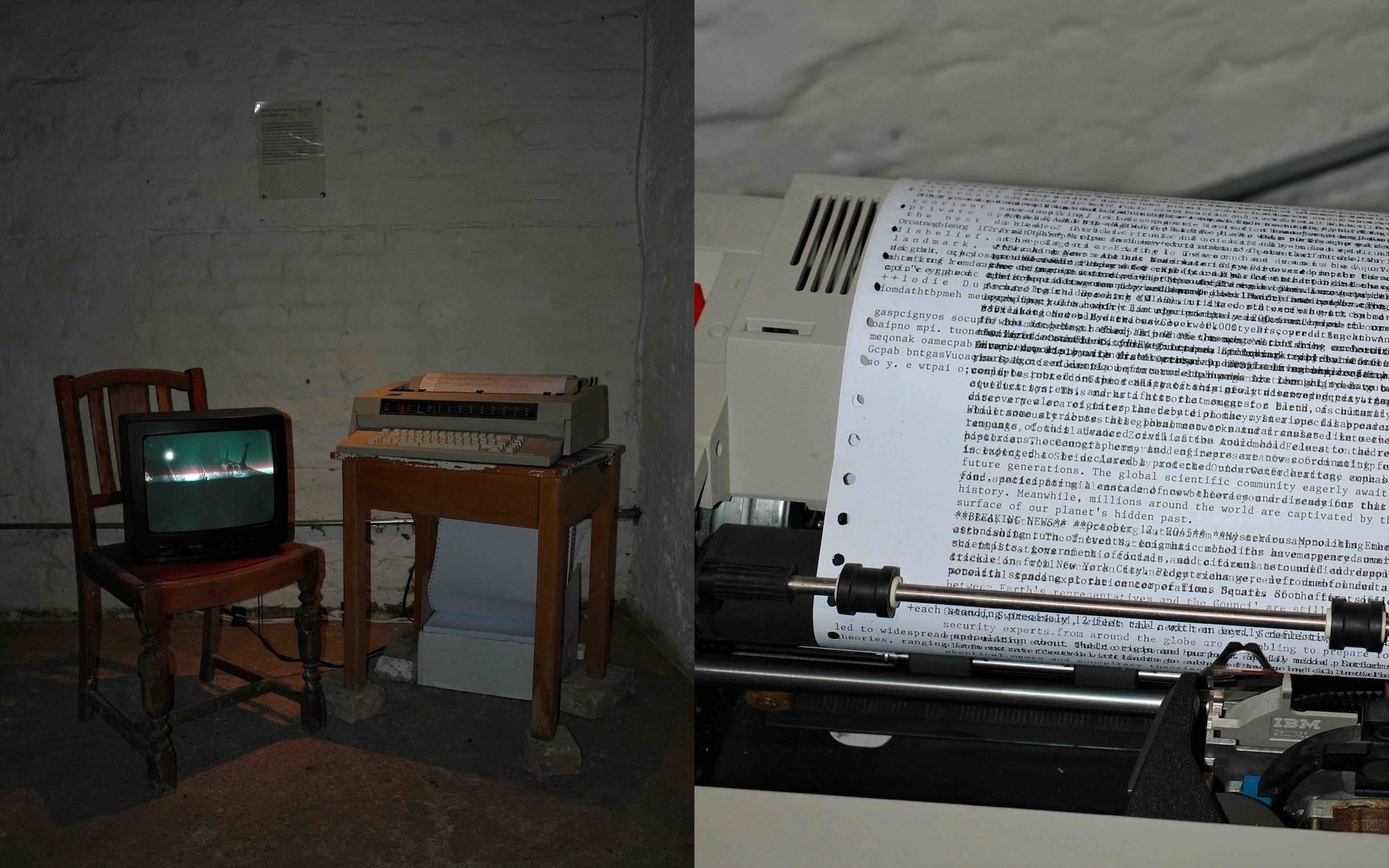
Apocryphal Prophecy transforms prophecy into ambience. A worn domestic setting is cluttered with dormant devices. An old typewriter repeatedly types ghostly pronouncements, while a cathode-ray screen cycles through simulated timelines. The entire composition conjures a parallel world of exhausted futures, where the oracle is mechanised, and prophecy is reduced to ambient noise.
This domestic space, stripped of homeliness, functions as a shrine to technological obsolescence. Its decaying furnishings recall the tactile past of analogue media, overlaid with digital futures. Here, the ghost in the machine is made tangible, with AI reanimating forgotten news through nostalgic machinery.
In this context, divination does not reach toward the divine but loops back on itself as error and repetition. Apocryphal Prophecy brings to mind Walter Benjamin’s reflection on historical melancholy, where revelation is archived before it is understood.
Bobby’s inclusion of obsolete media also questions our uncritical embrace of innovation. His installation becomes a counter-monument to progress, collapsing historical and technological time into a recursive cycle of failed prophecy and disenchanted wonder.
III. Mutual Metaphor: Augury, Algorithm, and the Allegorical Interface
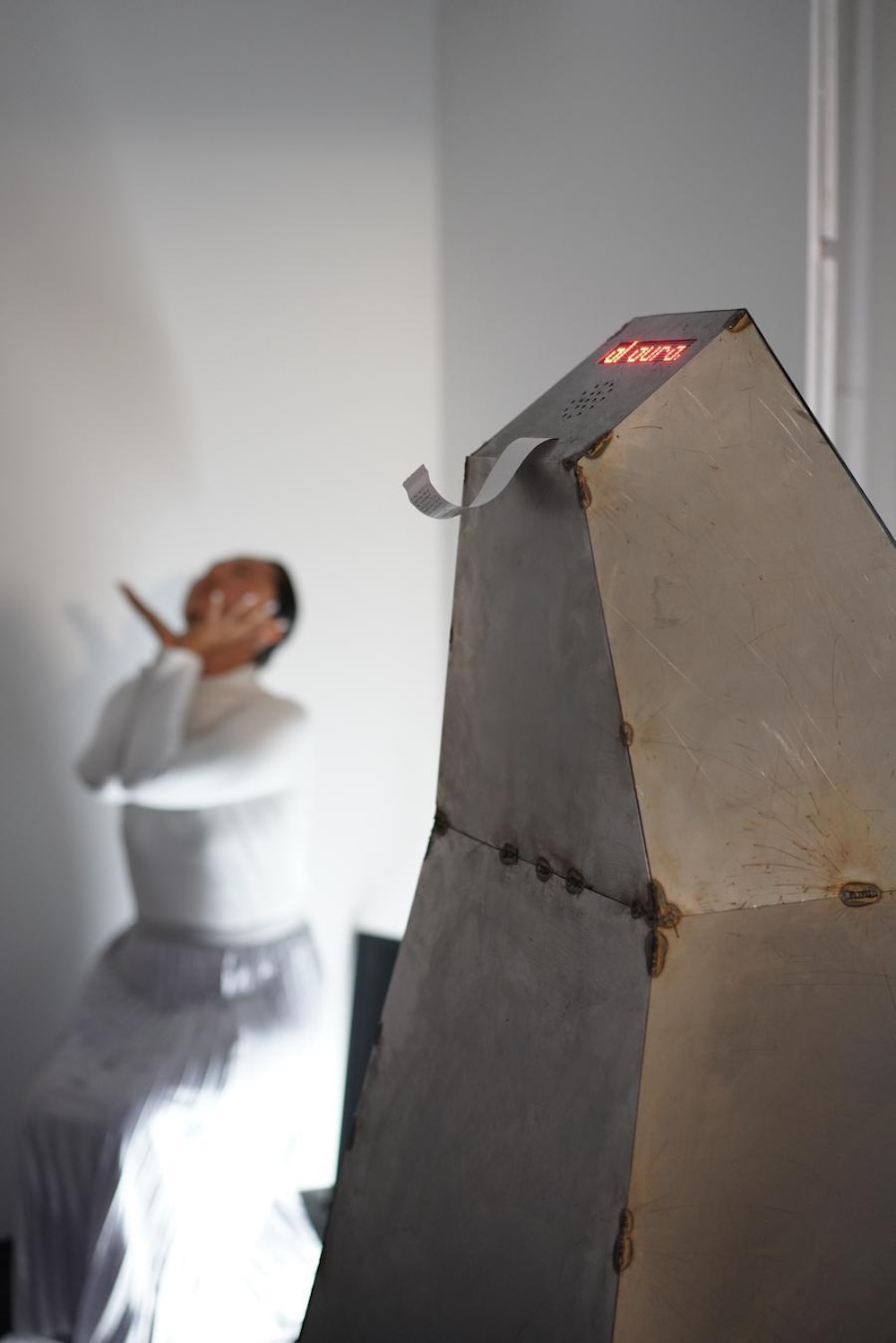
In Bobby’s artistic and theoretical practice, the structural resonance between esoteric divination and algorithmic forecasting is encapsulated in his notion of Mutual Metaphor. This conceptual work visualises the one-to-one symbolic alignment between superstition-based fortune-telling and machine learning’s predictive logic.
Mutual metaphor does not merely suggest comparison but performs an embodied analogy. It shows both systems as ritual technologies devised to interpret chaos through coded signals. Crystals, water, and intuition mirror datasets, neural architectures, and probabilistic computation. This juxtaposition demonstrates that the impulse to foresee remains constant, whether channelled through incantation or inference.
As both diagram and experience, Mutual Metaphor offers a visual and intellectual structure for thinking across spiritual and technical epistemologies. It challenges the binary between reason and magic, situating contemporary AI within a lineage of occult tools and sacred systems.
IV. Flower: Simulated Flora and the Intimacy of Artificial Ecology
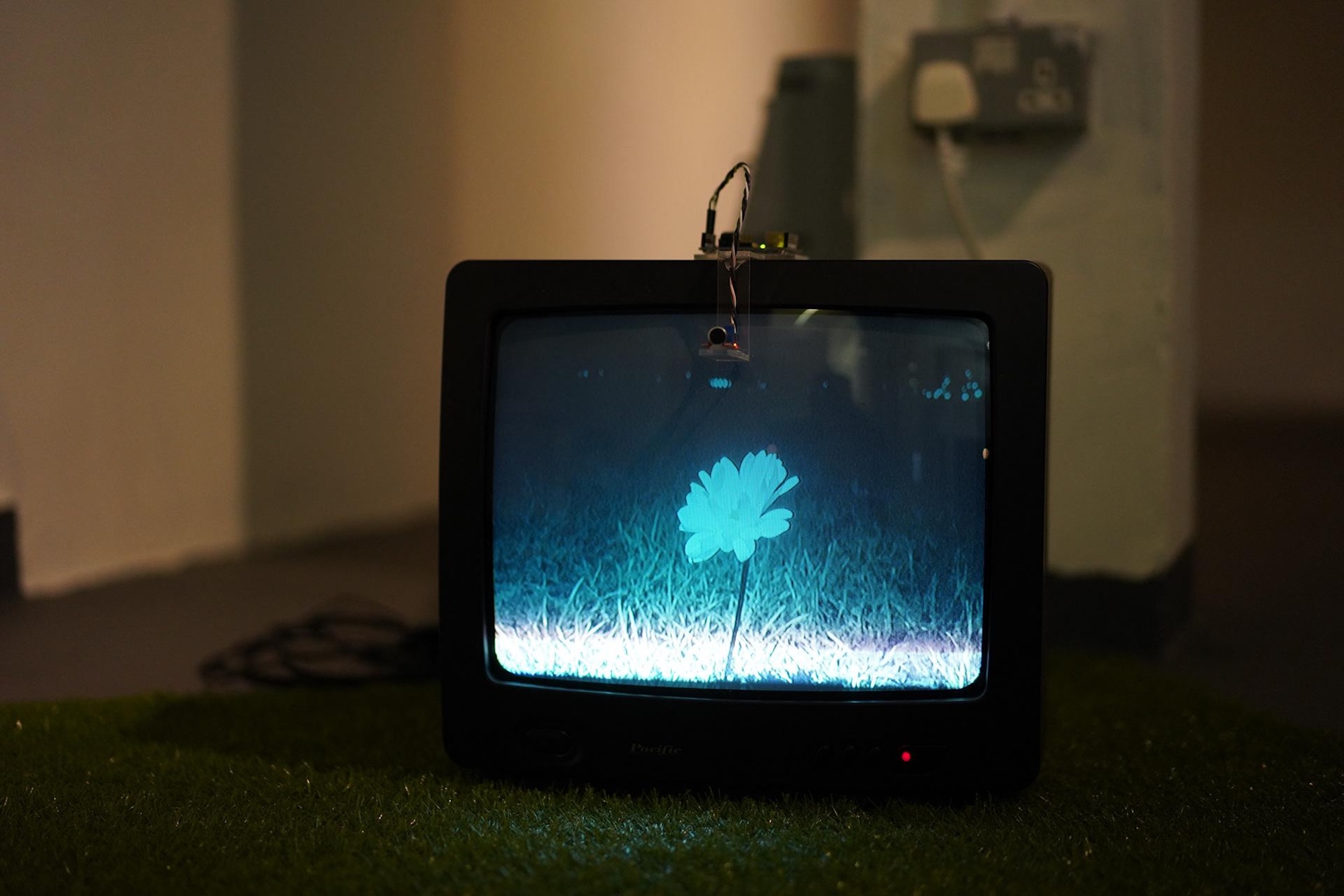
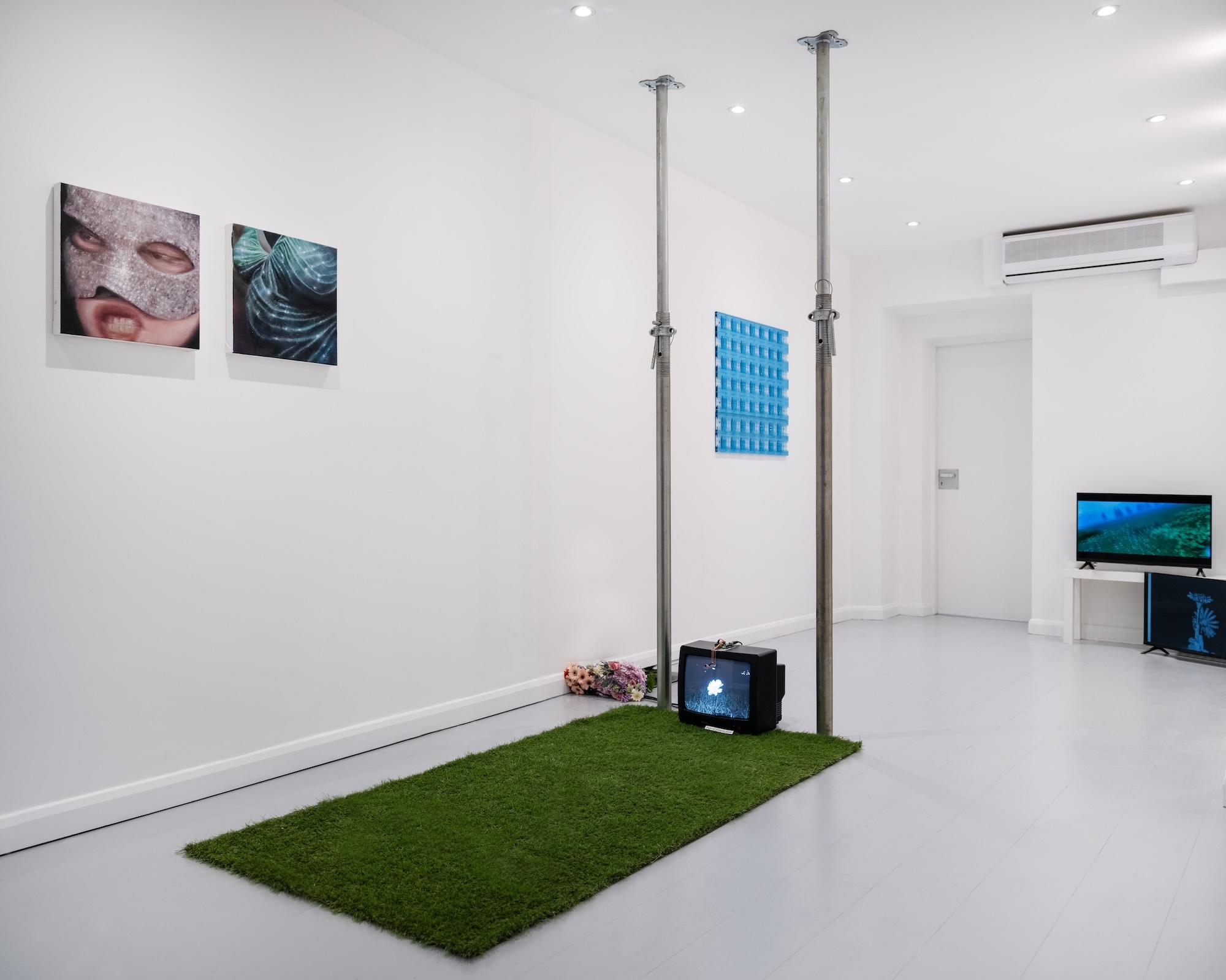
Flower belongs to a growing sequence of installations that imagine fragments of an imagined world. This work further articulates Bobby’s speculative cosmology by envisioning a technologised natural environment, where digital ecosystems have replaced organic presence. A CRT screen embedded in synthetic turf displays a blossoming virtual flower that responds to human breath. As the reclining viewer exhales, the bloom gently moves.
Though superficially innocent, the gesture is orchestrated by sensors and code. This is not a flower, but a simulation of vegetal grace. Bobby’s artificial garden becomes a mnemonic space, evoking a vanished nature that comforts through approximation. The work expresses an ecological melancholy, a yearning for a biome we have already lost.
What makes Flower poignant is not its verisimilitude but its simulation of care. The act of blowing, echoing a child’s interaction with dandelions, is here repurposed by algorithmic response. Input becomes gesture, gesture becomes ritual. The work invites viewers to rehearse their place within a digitally sustained, post-natural order.
In doing so, Flower joins a lineage of ecological artworks not concerned with restoration, but with mourning. It imagines a future in which our grief for lost ecosystems is processed through affective technologies, designed to remember on our behalf.
V. Temporal Dislocation and Synthetic Worlds
Bobby’s installations are distinguished not only by their interactivity and atmosphere but by their temporal ambiguity. These works do not project linear narratives of future or past. Rather, they open portals into fractured timelines that feel both speculative and eerily familiar. Familiar technologies are reassembled into compositions that do not belong entirely to the past or future, but to a collapsed present that feels strangely estranged.
Each work functions as a portal into a coherent, if uncanny, microcosm. These are not literal forecasts, but emotional hypotheses. By inviting viewers to kneel, to breathe, to bear witness, Bobby asks them to inhabit these realities, not merely to observe them. The viewer steps not into an artwork but into a delayed moment from a world already forming.
Through this temporal rift, Bobby presents not dystopia or utopia, but a charged elsewhere. Here, technology no longer serves utility but constructs atmospheres. These works ask the viewer: can you feel at home here? And if not, why does it feel familiar?
Yet within this consistency lies a productive tension. One may ask whether the refined systems of ritual interactivity occasionally become overly determined, limiting the possibility of interpretive slippage or emotional volatility. The repetition of visual markers such as dim CRT screens, algorithmic flora, or scripted prophecy risks becoming symbolic shorthand rather than evolving material inquiry. There is also room to question whether the AI systems invoked in these works are sufficiently treated as autonomous interlocutors rather than narrative instruments. These observations do not detract from the coherence or ambition of the work but instead suggest a compelling direction forward. Bobby has constructed a world. The next challenge may lie in letting it momentarily misfire or disintegrate, allowing disorder to rupture elegance and permit unfamiliar meanings to emerge.
Conclusion
Bobby’s work is not a lament for vanished belief, but a blueprint for post-sacred practice. It does not seek resolution or revelation. Instead, they offer quiet spaces where faith, memory, and ecology are reimagined through machine logic. In these artificial landscapes, ritual becomes interface, and intimacy is rehearsed through acts as small as a breath or a flicker of light. What emerges is a new kind of devotion—not to gods, but to systems. Bobby’s work reminds us that even in a world mediated by algorithms, the impulse to believe, to care, and to remember endures.