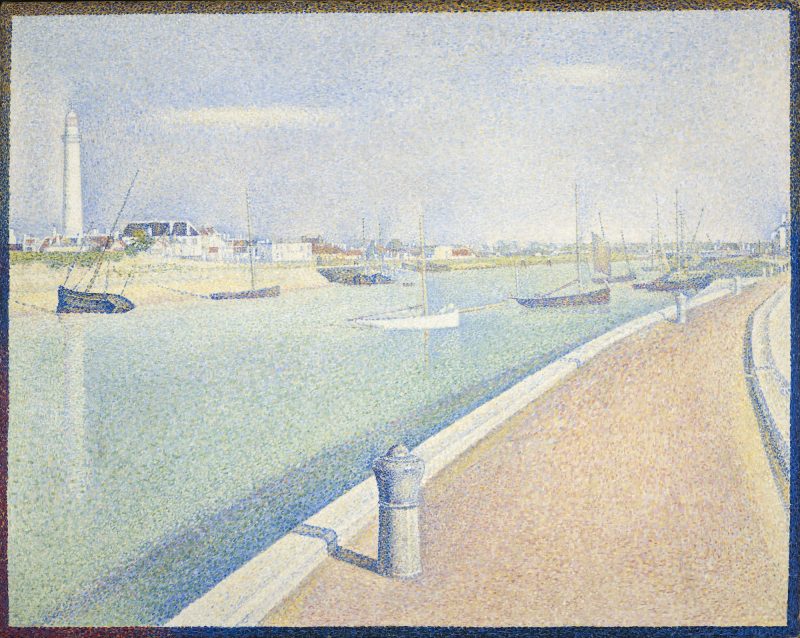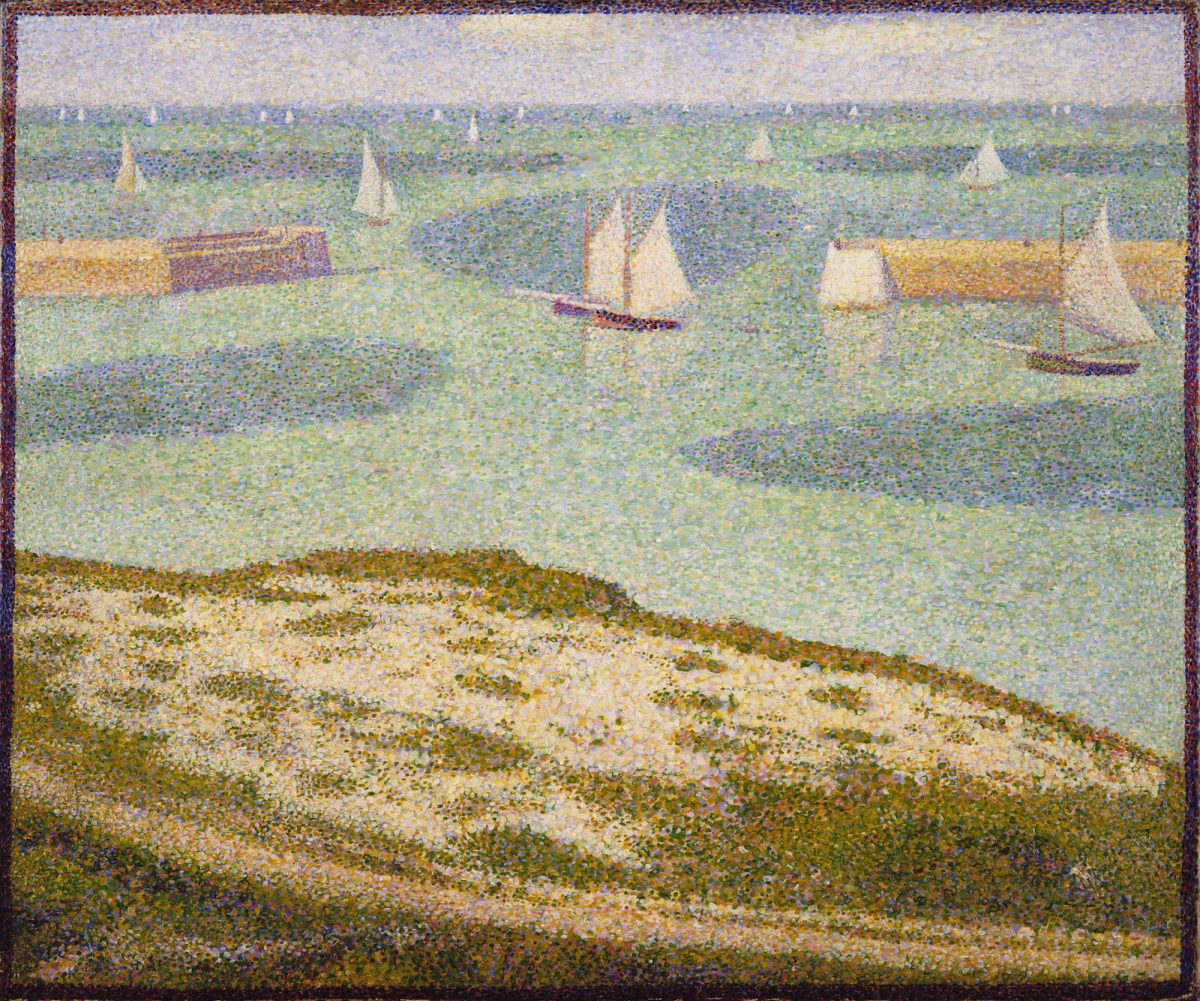
In this view of a fleet of fishing boats heading for the open sea, Seurat gives us – as he always does – a straight factual title as if to say: here you are, this is simply what I saw. But he’s being ironic, given how artfully he re-presents reality:
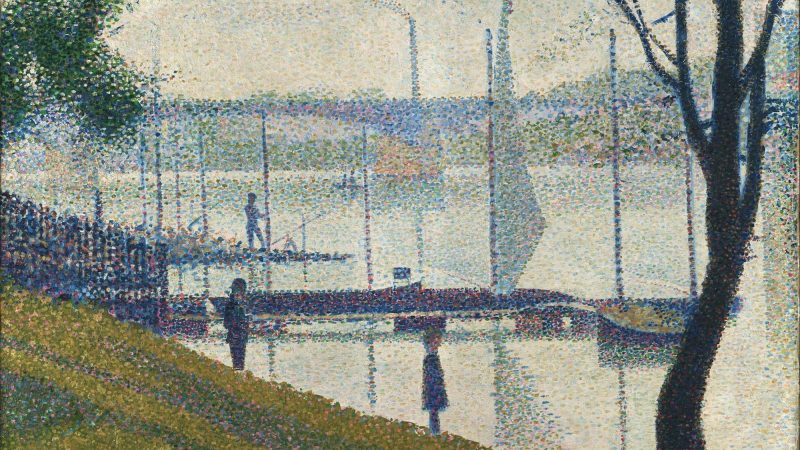
* That’s most obvious, widely-discussed and innovative reason for that is his ‘neo-impressionist’ technique of seeking ‘optical fusion’ by placing colours in proximity on the canvas rather than mixing them on the palette, and using complementary combinations. That’s also known as pointillism, but Seurat wasn’t a formulaic painter of dots: his mark-making varies greatly to suit what he depicts. Seurat’s aim was to create light through colour, and his delicate evocation of the soft and iridescent light of northern French coast has been much-praised. He also controls tone through colour, typically having established that in black conté crayon studies.
* Seurat adjusts the view to optimise the composition, as demonstrated at the Courtauld by comparisons with contemporaneous postcards
* He introduces patterns. Most notably here in how the shadows of clouds echo both each other and the foreground land. Those shadows, in turn, complement the gentle reflections of the boats
* He adopts orthographic projection, viewing objects in profile as if they were viewed head-on with no perspective, as they tend to appear from a great distance. The illusion of depth is not provided by perspective, but by the contrasts in scale and the overlapping of what operate as silhouettes – mainly, here, the boats.
* He adds a painted internal frame to increase the luminosity
Put all those factors together, and commentators have seen an atmospheric undertow of melancholy. I think it’s more that his method asserts and yet denies the presence of what is depicted, which then operates more as symbols than messy realities. There is both presence and absence, just as in memory, and it’s the connection to memory and loss that can seem melancholy. He also tends to show human activity and human construction, but without us seeing people: a stilled presentation of implied motion: presence and absence again. It turns out that nothing is real, and yet reality is persuasively evoked through its transformation.
Seurat made only 45 full-size paintings. More than half are seascapes, and 17 of them feature in ‘Seurat and the Sea’, supplemented by nine preparatory works. That makes it a remarkably comprehensive examination. It’s hard to believe there will be a better show this year. Seurat now sits at the top of Paul’s Index of Art Tragedy, newly available as a limited edition t-shirt HERE.
London’s gallery scene is varied, from small artist-run spaces to major institutions and everything in between. Each month, art writer and curator Paul Carey-Kent gives a personal view of a space worth visiting.