A monumental painting of a rearing horse will take centre stage at the National Gallery this spring in a focused exhibition devoted to George Stubbs.
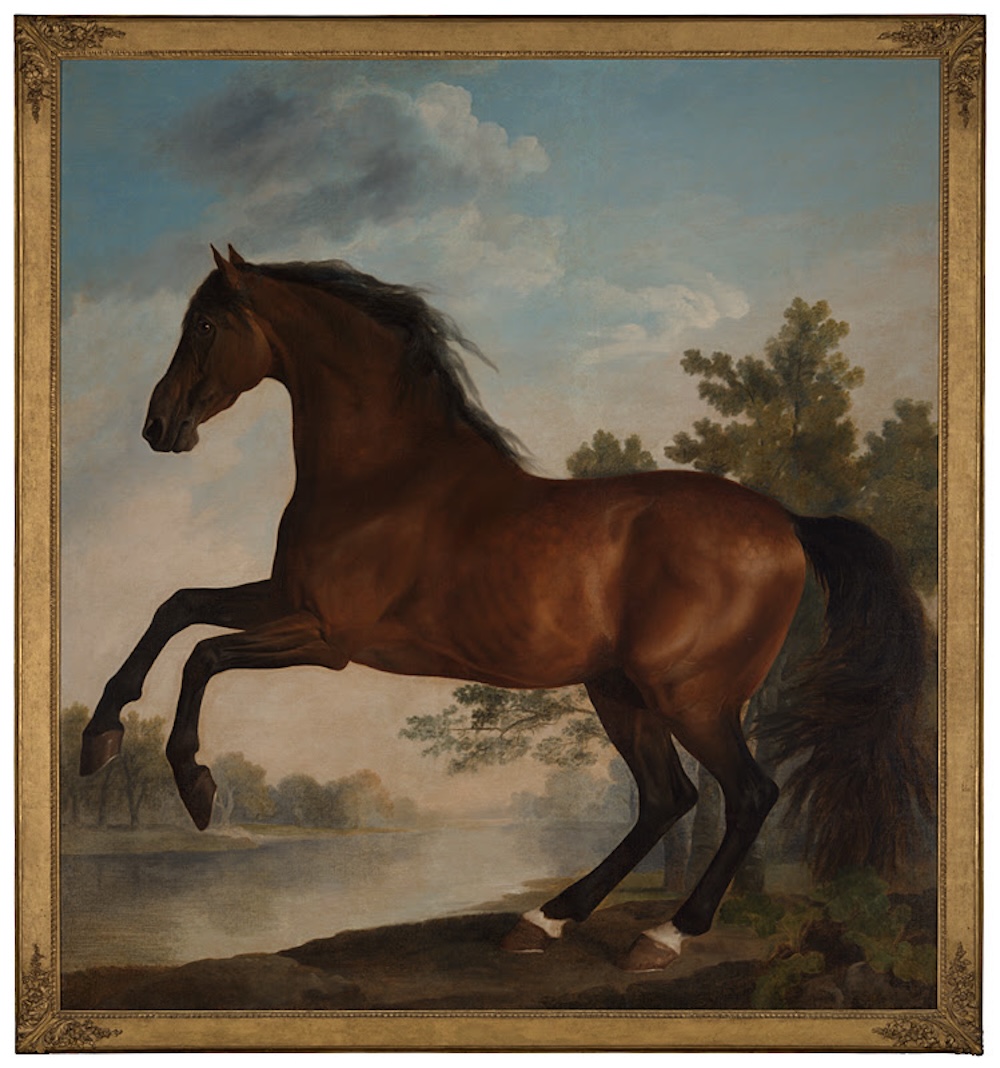
The show brings together, for the first time, two of the artist’s most important equine portraits: Whistlejacket (c.1762) from the National Gallery’s collection and Scrub, a Bay Horse Belonging to the Marquess of Rockingham (seen above) (c.1762), the only life-size horse painting by Stubbs still in private hands — and only once before seen in public.
Painted in the same year for Charles Watson-Wentworth, 2nd Marquess of Rockingham, the two works represent a radical moment in British art. They are the first large-scale portraits of horses shown without riders, transforming animals normally tied to power and pageantry into autonomous subjects. Together, they reveal how Stubbs reshaped equine painting through close observation, anatomical knowledge and a new attention to individual character.
The story behind Scrub is as striking as the painting itself. Originally intended as part of a grand royal commission, the picture was begun after Whistlejacket proved so visually powerful that Rockingham chose to keep it riderless. Stubbs then turned to the bay colt Scrub as the basis for a portrait of George III — a plan later abandoned when Rockingham resigned from court. The artist retained the painting, which suffered damage during a failed attempt to sell it in India before being returned to Stubbs and eventually sold after his death.
The exhibition places Scrub within two defining projects that shaped Stubbs’s career. The first is his extraordinary anatomical research, undertaken between 1756 and 1758 in a barn in Lincolnshire, where he spent 18 months dissecting horses to record every muscle, tendon and bone. These studies led to his landmark publication The Anatomy of the Horse (1766), still one of the most detailed visual records of equine anatomy ever produced. The exhibition includes the treatise alongside six original working drawings and finished studies, all on loan from the Royal Academy.
The second is The Turf Project, begun around 1790, in which Stubbs was commissioned to paint a series of Britain’s most celebrated racehorses, including Eclipse and Gimcrack, to chart 50 years of racing history. Although the project was abandoned, 16 paintings were completed and exhibited in 1794. Two works from this series — Dungannon, with a Lamb and Mambrino — will be shown here, underscoring how deeply Stubbs became associated with the imagery of the turf.
Stubbs’s horses are among the most anatomically accurate ever painted, yet his achievement lies in something more elusive: the way he imbued each animal with a distinct presence. As Associate Curator Mary McMahon notes, “Stubbs fundamentally changed the approach to depicting the horse in late 18th-century British art, combining his hard-earned knowledge and understanding of their anatomy with a desire to capture a distinct individual character.”
In bringing Scrub and Whistlejacket face to face, the exhibition reveals the moment Stubbs turned the racehorse into a modern subject — one that is observed, studied and, ultimately, allowed to stand on its own.
12th March – 31st May 2026, The H J Hyams Room (Room 1) Admission free
About the artist
George Stubbs (1724–1806) is best remembered for his paintings of horses and his conversation pieces. Having studied anatomy, Stubbs’s pictures of horses are among the most accurate ever painted, but his work is lyrical and transcends naturalism.
Stubbs was born in Liverpool, the son of a currier (leather worker), and he spent his early career in the north of England, painting portraits and developing his interest in anatomy. In the later 1740s he lived in York and supplied the illustrations for a treatise on midwifery. Following a brief visit to Rome in 1754 he had returned to England by the following year. From 1756 to1758 he settled in Lincolnshire, where he dissected horses and made drawings that would later be published in his major treatise, The Anatomy of the Horse (1766). By 1759 he had moved to London, which remained his base for the rest of his life.
Early clients for his sporting and racing paintings included many of the noblemen who founded the Jockey Club. Like Gainsborough, he later painted scenes of peasant life, as well as studies of wild and exotic animals. He also became known as a printmaker and for his paintings in enamel on Wedgwood earthenware plaques.