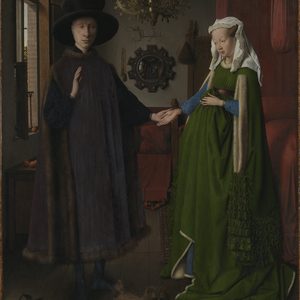
Ask people to think of a Renaissance painting, and the chances are the top five answers will be Italian- think da Vinci’s Mona Lisa or Botticelli’s Birth of Venus. But almost certainly, there’ll be one exception — a Flemish painting that predates all likely others. The National Gallery has had Jan van Eyck’s Portrait of Giovanni Arnolfini and His Wife (1436), a.k.a. Marriage of the Arnolfini), on display since 1842, but now they bring it together with all his known individual portraits, and two relevant works by others. Anyone interested in how we represent real persona in images, and how we project ourselves through them, has something to learn from van Eyck.
Van Eyck’s date of birth is unknown, but he was in his thirties when he became court painter to the Duke of Burgundy in 1425. He moved permanently to Bruges, now in Belgium, in 1428 and died there in 1451. The city was a bustling, thriving trading hub where you could buy virtually anything brought as far as Portugal, Siberia and Byzantium. Van Eyck was considered the finest Northern Renaissance painter of his time, known for completing the huge, outstanding multi-panelled altarpiece in Ghent’s St Bavo Cathedral in 1432 that his brother Hubert had started, and his whole approach to painting. A technical innovation lies behind his art. Back then, when egg tempera was the normal medium painters used to apply pigment, an Italian scholar credited van Eyck with inventing oil painting. Actually, oil-based paint goes back to ancient times, but van Eyck, along with the other master of early ‘Netherlandish’ painting Robert Campin, started layering his oils to achieve naturalistic tones, blending them and giving them depth and texture. Even when photography came centuries later, it would take a long time to find the subtlety of colour and shade that makes images match reality like van Eyck did.
After passing a brief timeline of van Eyck’s life and piles of books about him, the portraits are found in just three modest rooms, dimly lit but not quite as dark as the black, dimensionless background to most of the portraits. There are only twelve works on show, but as curator Emma Capron says, ‘it’s all killer, not filler’. Other than the 82 x 60 cm Arnolfini marriage painting, no work is bigger than 34 cm high. Four are displayed to show the extraordinary work van Eyck made on their backs, painting them black and spattering them with watercolour before varnishing them. This was five centuries before Jackson Pollock. As we shall see, frames, too, were painted to carry messages as if carved in stone.
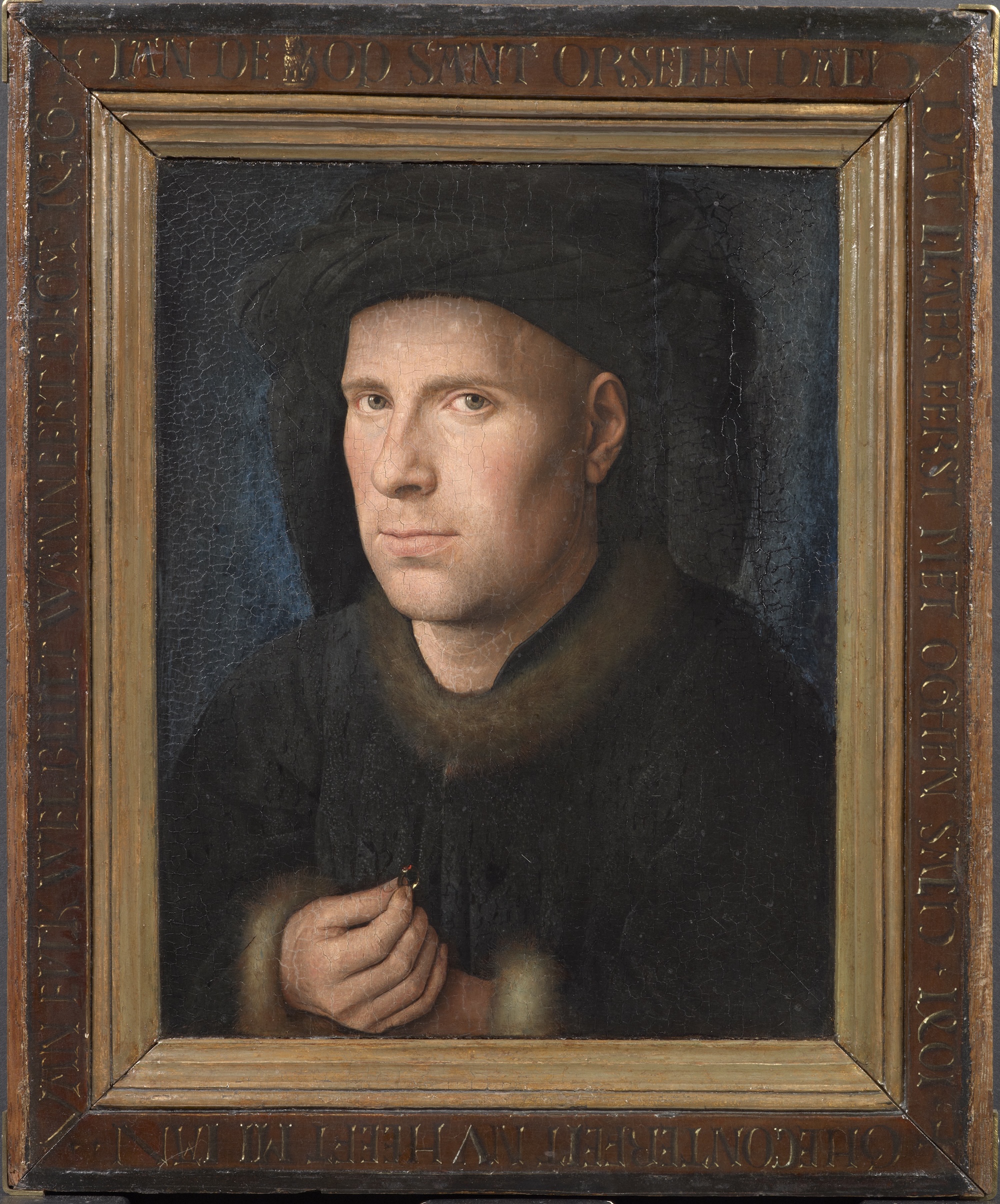
We find a variety of characters and sometimes on-the-spot information reports. The portrait of Jan de Leeuw stares back at us as he holds a ring to signal his profession as goldsmith, and in the inscription around the frame he is given a voice, telling us that ‘now Jan van Eyck has counterfeited me. It can be seen when he began 1439’. The word ‘counterfeit’ is a surprise, but takes on refreshed significance with today’s news and social media, especially by the likes of influencers and politicians — is their instant images merely a mask of the real character? Yet van Eyck’s were painstakingly constructed and meant to last. And he always made his subjects look very real.
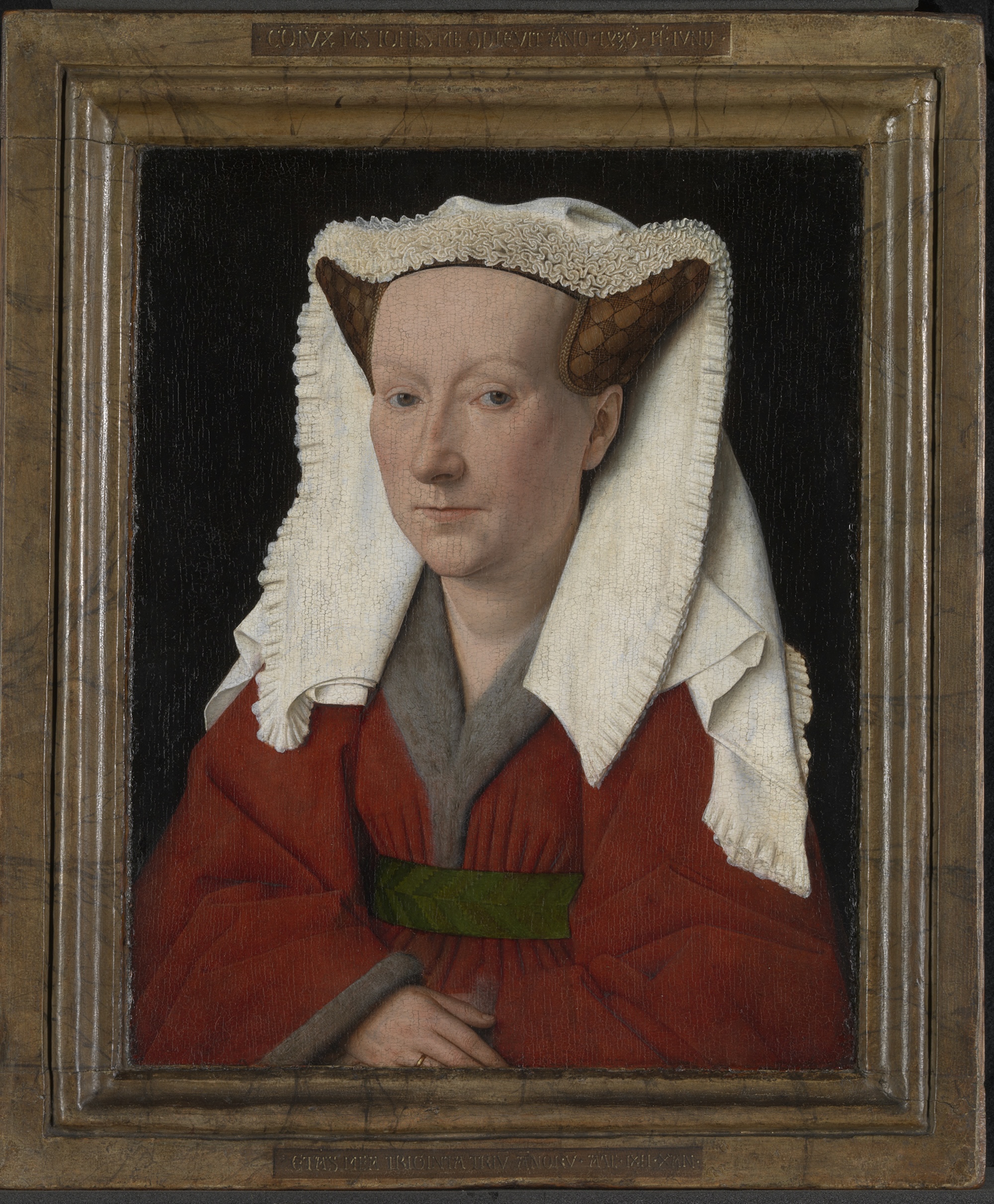
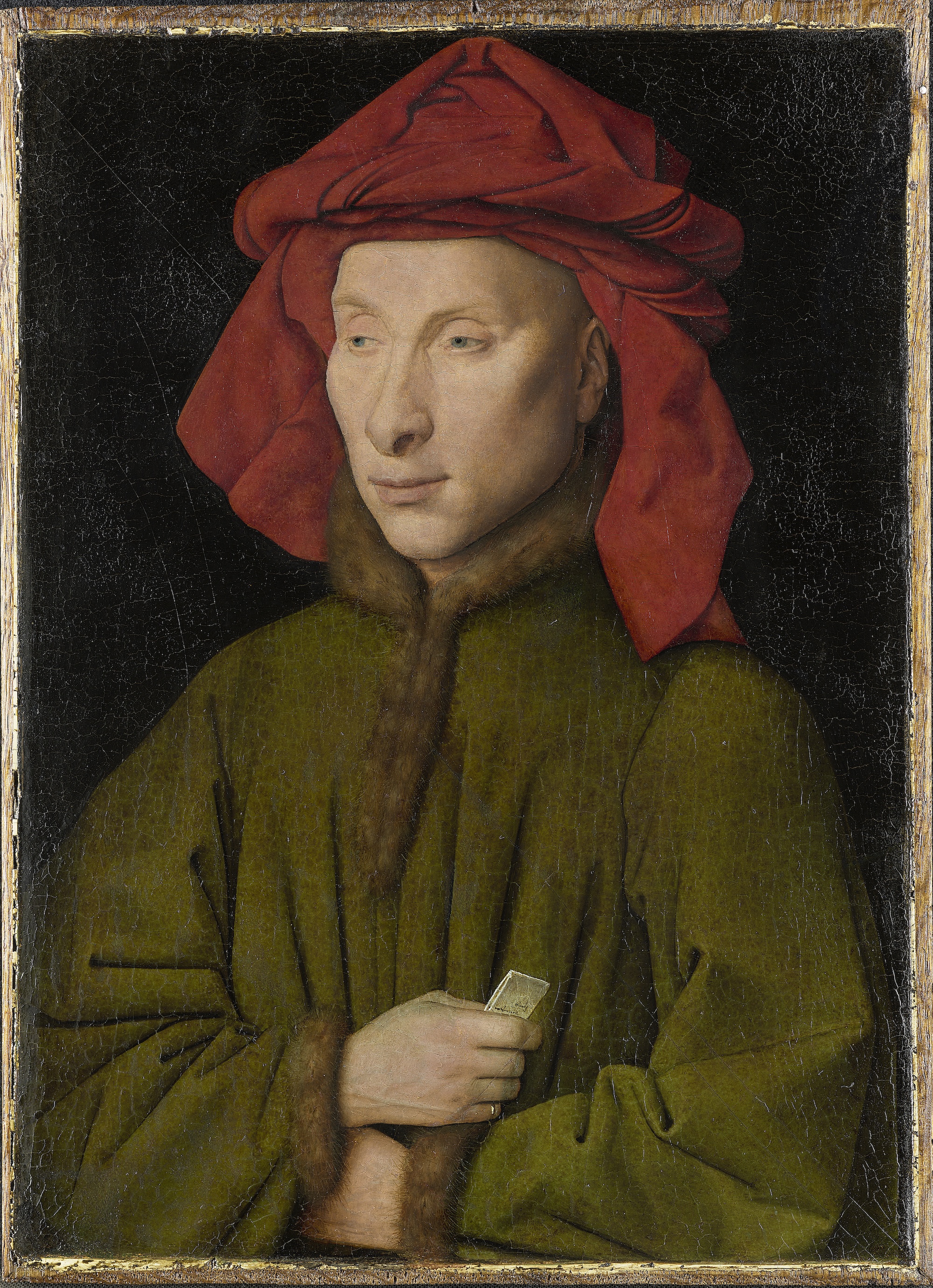
His wife, Margaret van Eyck, and Arnolfini’s wife are the only women portrayed in the show, both with hair wrapped up into the devil-like horn-shaped cornettes of the time. Margaret looks at us directly, perhaps with an air of resigned patience. Van Eyck’s extreme attention finds a scar gap of one eyebrow and details the mind-bogglingly complex folds of lace on her head, not unlike a maze. The inscription says: ‘My husband Johannes completed me in the year 1439’. For all we know, that may have a double meaning. Van Eyck seems to have painted himself, looking straight at us. Individual hairs in has stubble and blood vessels in one are visible and bloodshot in the portrait that National Gallery coyly calls ‘Portrait of a Man (Self Portrait?)’, although there’s little doubt it’s him. That penetrating stare is what he would have seen looking at his mirror reflection as he painted, and the frame’s inscription ‘als ich can’ (‘as I can’) plays on the similarity of ‘ich’ and ‘Eyck’. It’s popularly known as the Man in a Red Turban’ because of the dramatic, extrovert folds of red cloth on his head, but they almost certainly conceal a hat called a chaperon, which had a cloth tail that could be wound around it. Such is the case with the solo portrait of Giovanni Arnolfini, who appears in far less ostentatious clothing than as he was portrayed with his wife. Again, the National Gallery can’t be 100% sure it’s him, so they put a ‘(?)’ in the title.
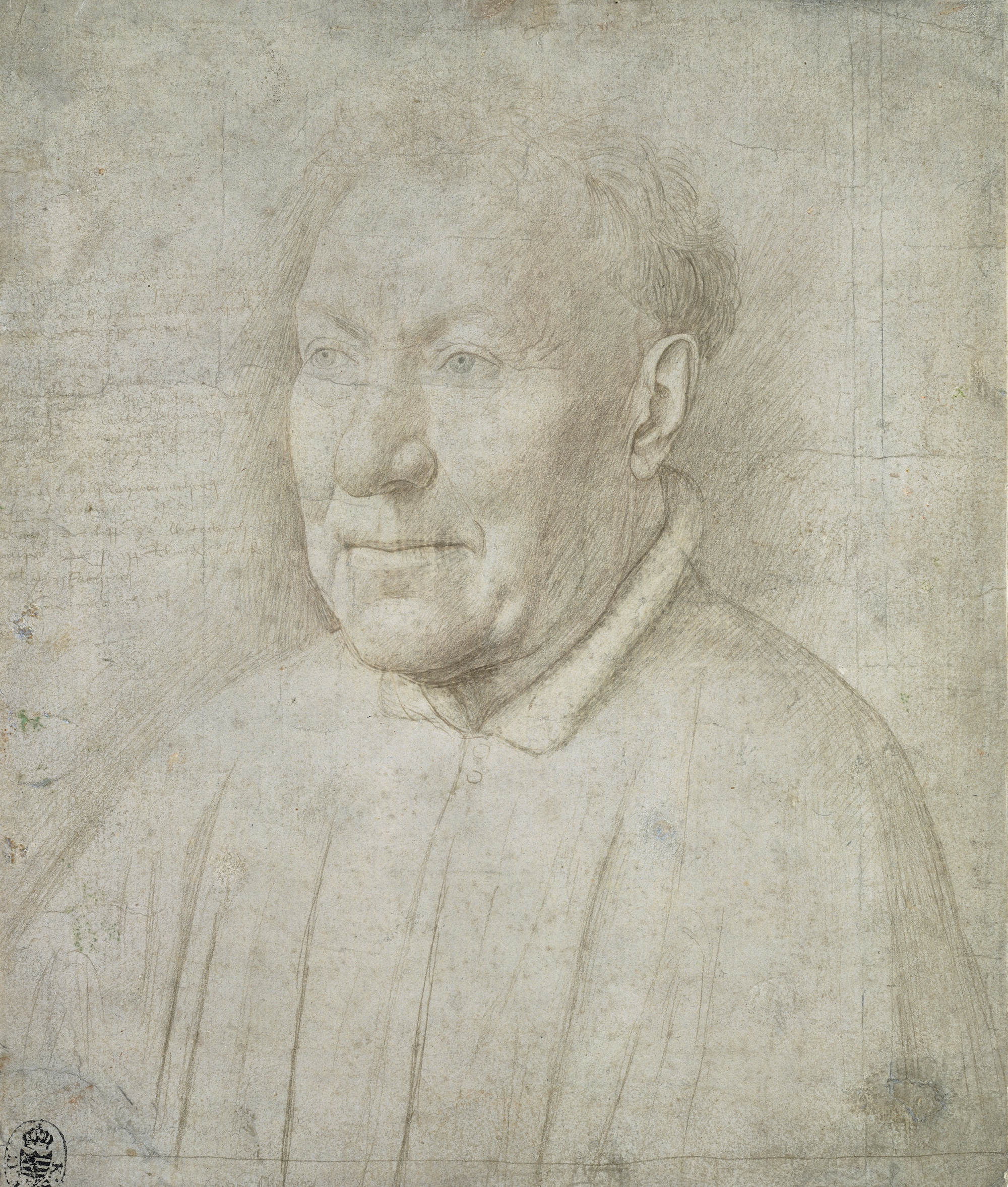
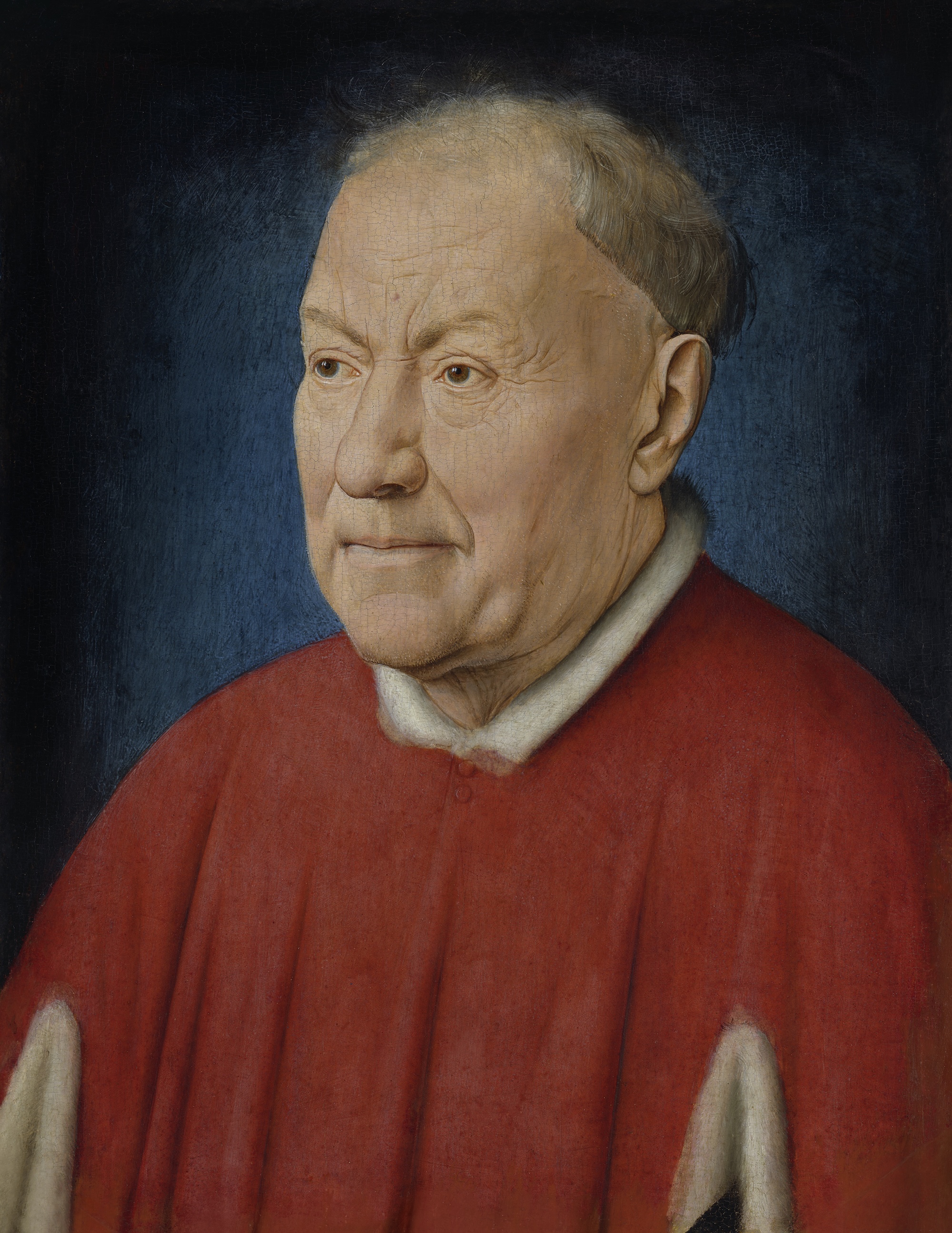
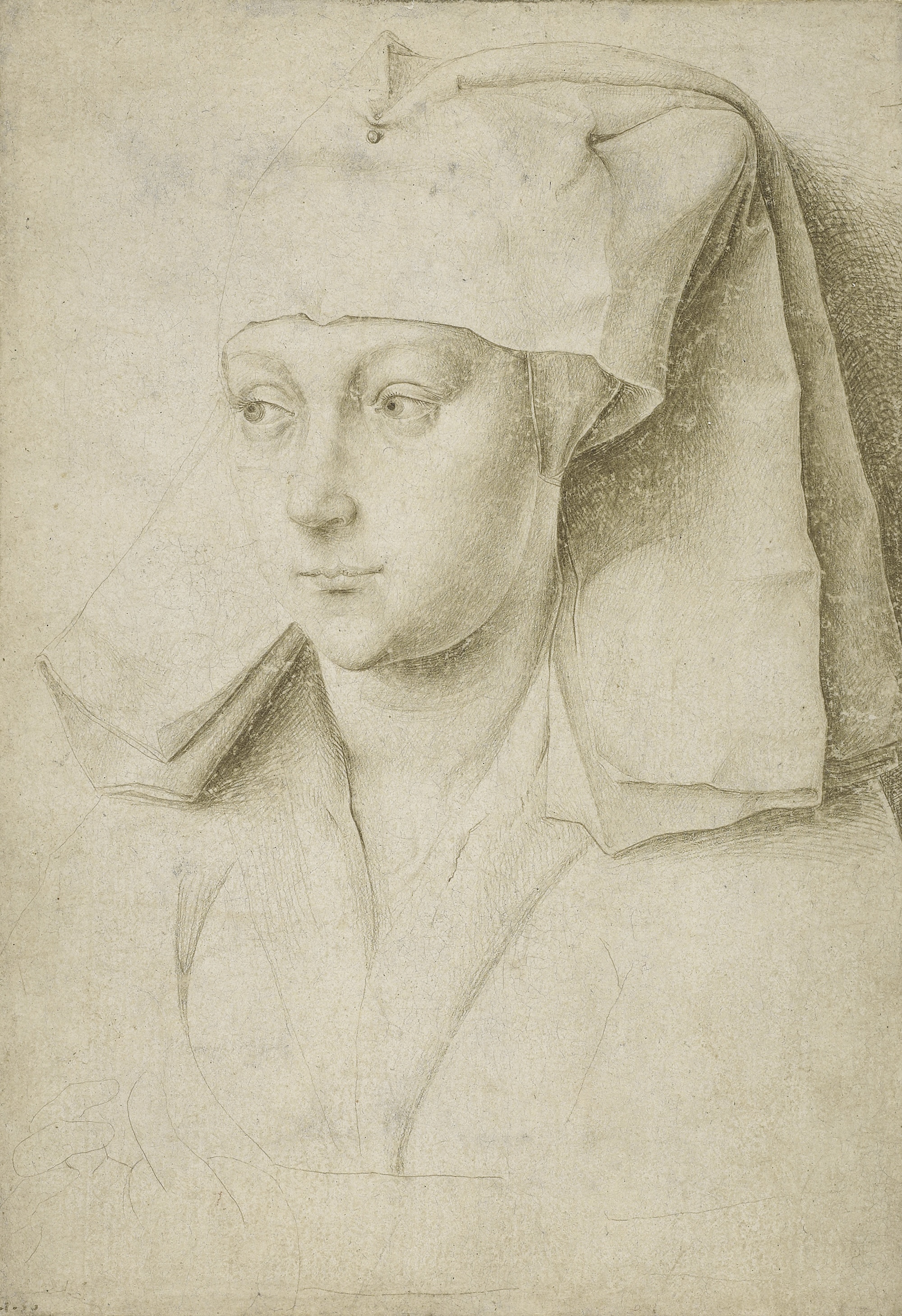
Several subjects are identified with less certainty. In the case of the Portrait of an Elderly Man (A Scholar?), the description suggests it could be a cardinal, although to me he looks exactly like the canon van Eyck painted in Virgin and Child with Canon Joris van der Peale (not in the show), just a little younger. Whoever he is, the show includes the only known drawing by van Eyck, a study for the painting in which, remarkably, he shapes the three-dimensional form of the head from cross-hatching. By contrast, Rogier van der Weyden uses line and shadow in his drawing Portrait of a Young Woman, included in the show. It’s as if the two contemporaneous Flemish masters were debating their approaches to drawing.
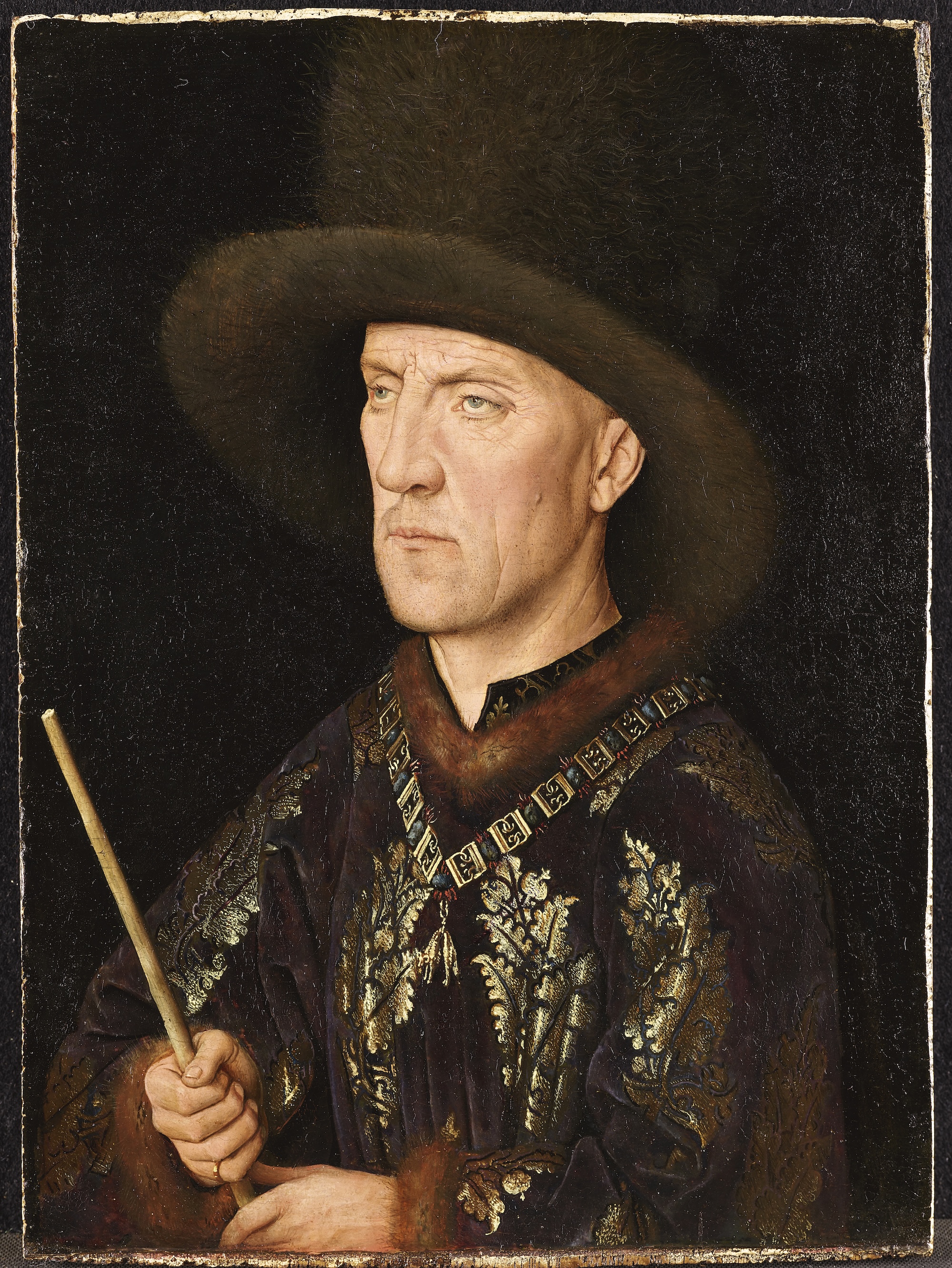
A different sort of mystery lies in the portrait of Baudouin de Lannoy, who looks quite sour under his big black hat, or at least cold and calculating. His likeness is uncannily like Edward Grimston, an Englishman portrayed more colourfully by another Flemish painter, Petrus Christus, at about the same time, which can be seen elsewhere in the National Gallery. These are different men, yet both worked in diplomacy, and Lannoy’s missions included one to England. There may be more to this than meets the eye.
Naturalistic painted portraits of individuals (rather than imagined religious figures or statues of the powerful) date back to the Fayum mummy portraits from Roman Egypt and Pompeian frescoes, both often striking in revealing their subjects. Real, identifiable individuals re-appeared in Italian painting as early as 1305 when Giotto inserted a banker into a big religious image in Padua, but it was van Eyck who brought his subjects to life with living texture, uncompromising in detail and accuracy (although some portraits make heads big compared to the bodies).
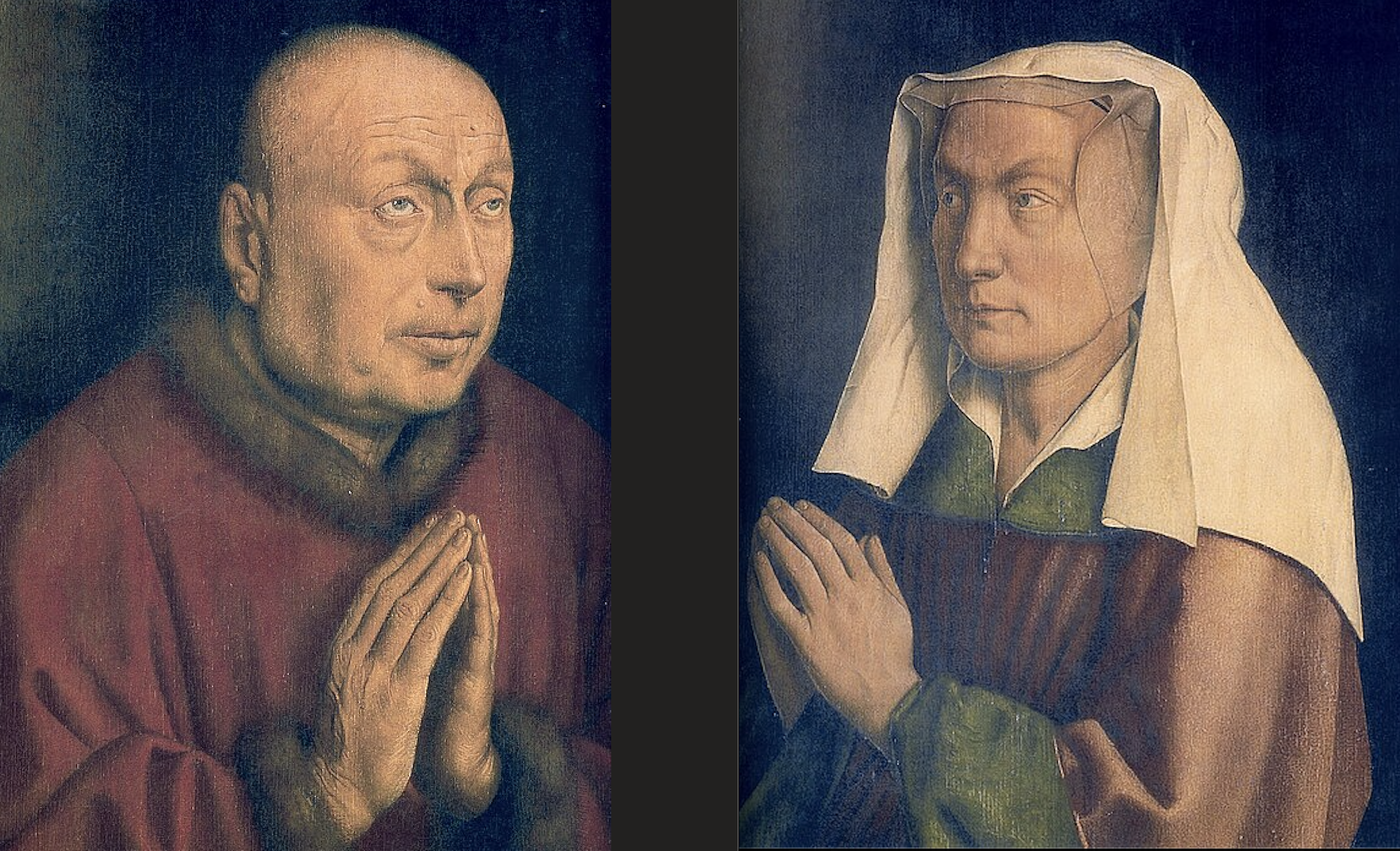
This show rounds up all van Eyck individual portraits, but other subjects are found within big works, such as Canon van der Paerle. The epic Ghent Altarpiece (1432) distributes real people in different panels, including three recent Popes. Van Eyck would not have met them, but he knew the husband and wife who financed the altarpiece and depicted them in rear panels, against backgrounds where a dim glow and shadow suggest physical space. The outlier in the show is the Arnolfini Marriage painting, because it too depicts the environment around their subjects, unlike the dark backgrounds that detach them from the physical world. It anticipated the intimate domestic scenes painted by Vermeer, Pieter de Hooch and in others from the Golden Age of Dutch painting after the Netherlands won independence in the 17th century.
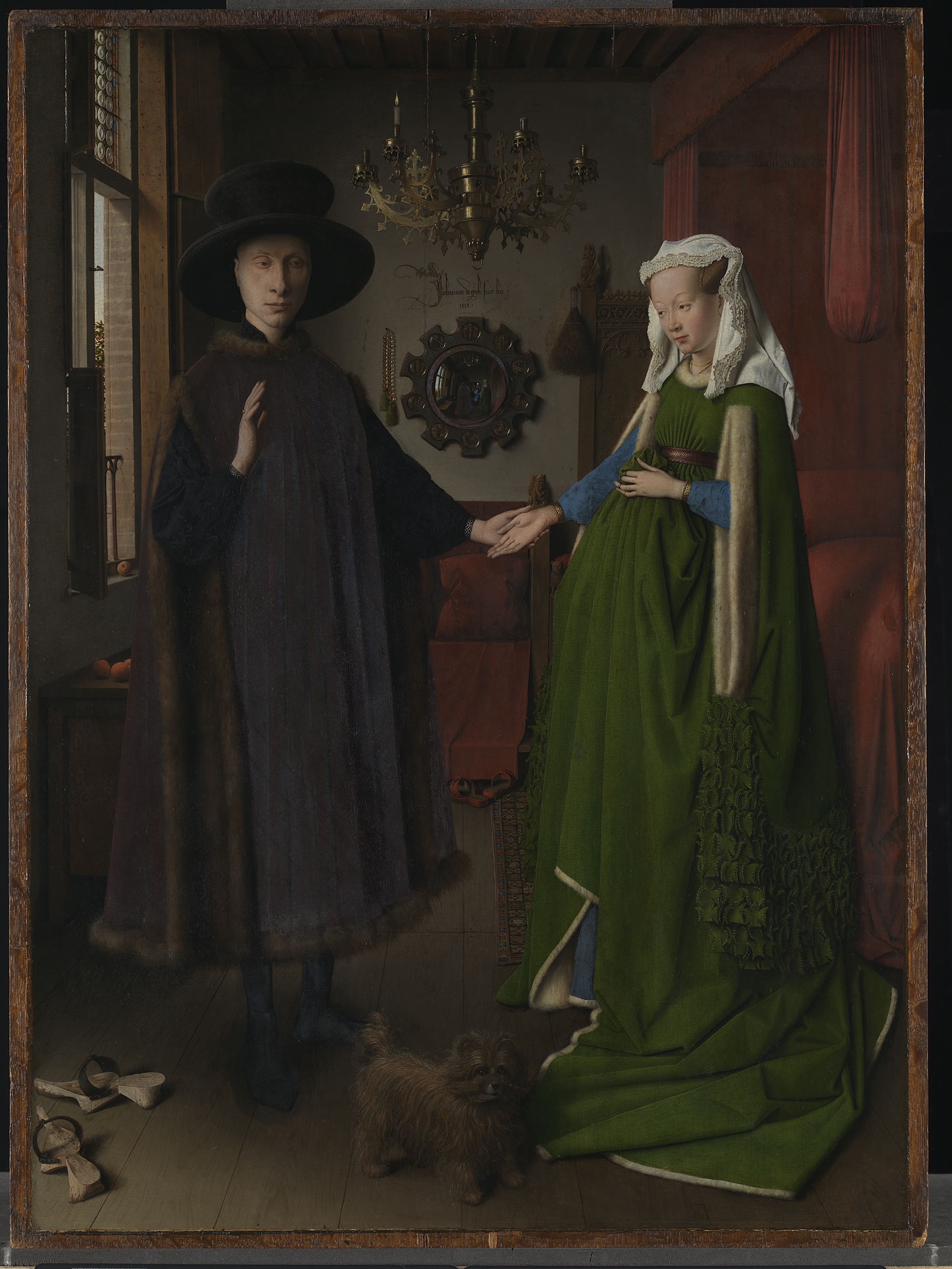
Van Eyck’s astounding ability to detail explored everything in the room the Arnolfinis stood in, from the intricate brass chandelier in which just one of many candles mysteriously burns above them to the casually discarded clogs on the floor, and even the bricks and distant leaves outside the window. He shows mastery of light, which falls from the window, down to catching its reflections in the eager eyes of their dog, whose every hair seems to be rendered. Famously, the mirror gives a curved reflection of the scene from behind, and includes two figures standing in the door, one of them likely van Eyck himself. Such minute brushwork makes you wonder if he used a magnifying glass or eyeglasses (a 13th century invention), and indeed Venetian glass available in Bruges likely included such items. But the characters themselves, holding hands and wearing fine fashion, remain elusive. He is solemn, she is demure. His free hand may be giving a blessing; hers is holding up the cloth of her green dress into a shape that some mistake for pregnancy. What is going on between them?
Not all van Eyck’s subjects are enigmatic, for example, de Leeuw or the scholar. But perhaps the elusive characters reveal that the closer you see into a person, the more mysterious they become. It’s like a Heisenberg Uncertainty Principle for people instead of subatomic particles. That would be yet another aspect in how van Eyck’s revolutionised what a portrait could do. In many ways, they represent the Big Bang in portraying who we are. Nowadays, artifice, pretension, superficiality to gain likes on social media, and soon deep fakes, erode how images can do that. Going back to the visual truth van Eyck revealed in his subjects makes this show a must-see with contemporary relevance.
Van Eyck: The Portraits, 21st November – 11th April 2027, National Gallery