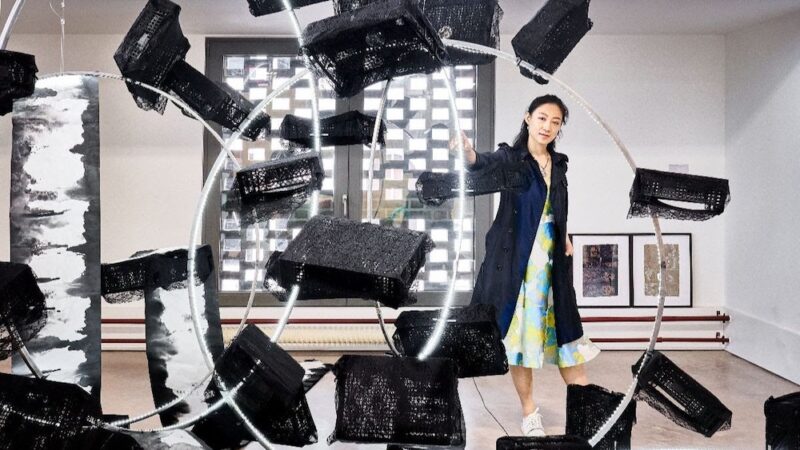
The mud remembers, the paper breathes, and writing slowly collapses into matter. This is the atmosphere that Xinyue Liang seeks to evoke through her work. In her recent pieces, Liang constructs a space where language is no longer stable—it seeps, cracks, and peels away like mud after rain. What remains is a network of traces that cannot settle, a series of utterances that refuse to be archived. Liang’s art is not about preservation, but about the gradual dissolution of what “preservation” itself means. Born in Henan, Liang began with the study of calligraphy before continuing at the University of the Arts London, where she focused on contemporary art. Her practice moves fluidly between mediums while maintaining a cool precision. In her hands, Chinese calligraphy ceases to be a linguistic or classical form; it becomes are-materialization of the act itself—a thing, rather than a sign.
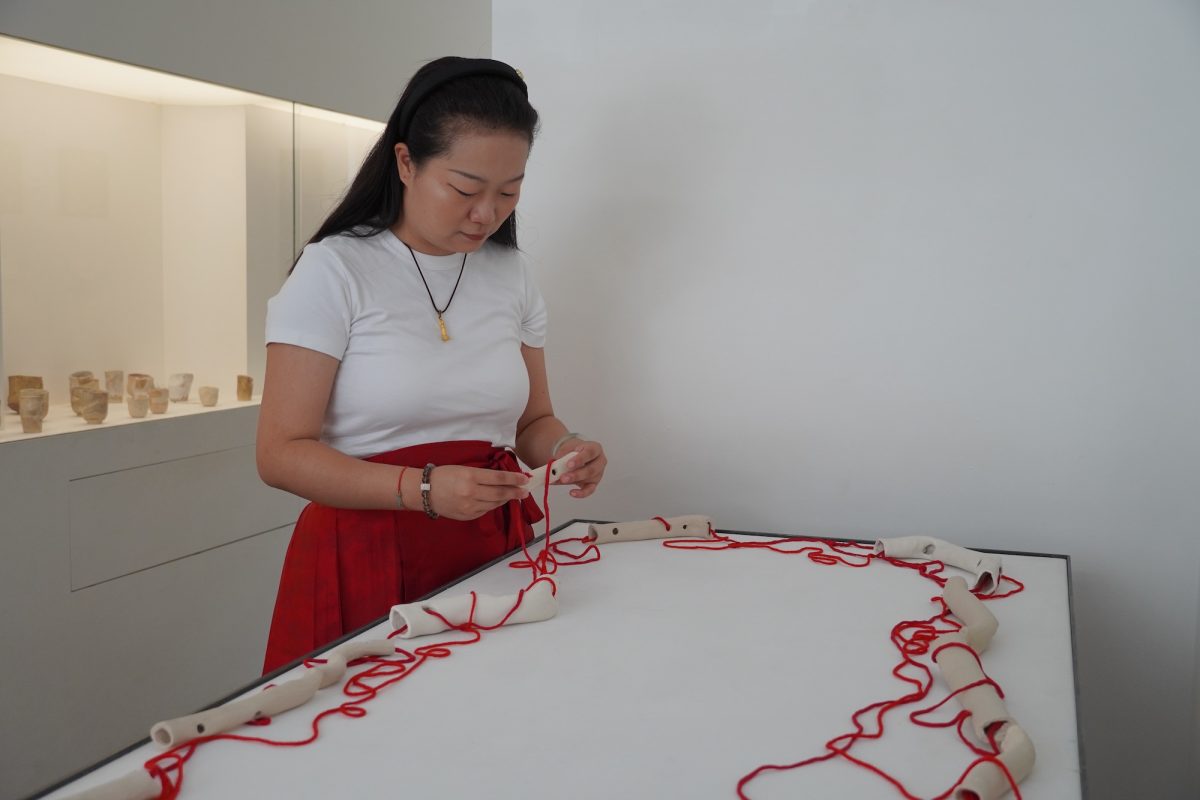
In her work Fragility of Mud by Porcelain and Paper Versions, Liang merges mudwith Dai paper. What makes this process both fascinating and unique is her use of aneight-hundred-year-old paper-making craft from Yunnan, recognized as one of China’s most fully preserved forms of primitive papermaking. Dai paper, made fromtree bark, possesses a distinct fibrous texture that carries the touch of its origin. In Liang’s process, the Dai paper is torn apart, mixed, and stirred with different types of mud, creating a fibrous mud pulp. While still half-dry, she uses a bamboo knife tocarve irregular shapes from the surface; once fully dried, she writes upon it withblue-and-white pigments. The inscriptions are composed of fragments of ancient Chinese scripts—including oracle bone inscriptions, pictographs, and cuneiform symbols. Through this act, the work transforms writing into material memory, allowing history to breathe through the delicate fusion of porcelain, paper, and mud.
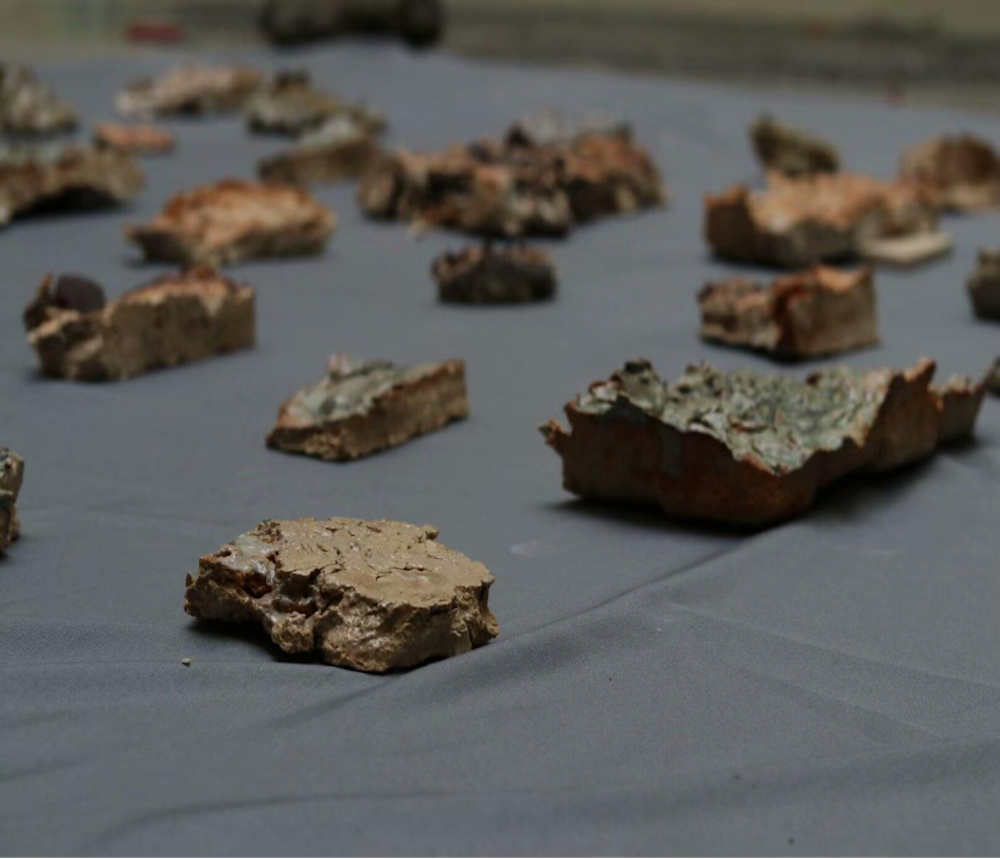
Through the act of writing, Liang achieves a fusion of material and memory withinthe combination of mud and Dai paper. The two substances—resistant yet inseparable—conflict and merge, drying into curved and torn surfaces. Writing, as atrace of history, is inscribed into the surface, only for the artist to let it disappear beneath layers of glaze. The work wavers between sculpture and manuscript, as though language itself were struggling to survive the slow erosion of time. Eachlinepressed into the mud, each fragment embedded within the Dai paper, is simultaneously an act of inscription and of erasure. Liang views her practice as thecollapse of a linguistic system—where structures that fail or dissolve leave behindthefaintest, yet truest, residues of memory. In her work, one perceives a distinct sense of fragility. This fragility, within Liang’s artistic language, is not a metaphor but amethod of expression. The cracks on the surface are deliberate; the appearance of imperfection is carefully choreographed. She allows the material to performits own“failure,” transforming it into a form of knowledge. For Liang, cultural continuitydepends not on solidity but on fragility—for only by allowing things to collapse can history continue to breathe.
By contrast, the Utensils Series reveals a softer sensibility. These vessels, composedof mud and Dai paper, retain wide areas of blankness on their surfaces—spaces that seem to await future inscriptions and traces. No longer burdened with utilitarianpurpose or fixed meaning, the vessels instead carry relations: air, absence, andpossibility coexist within them as equals.
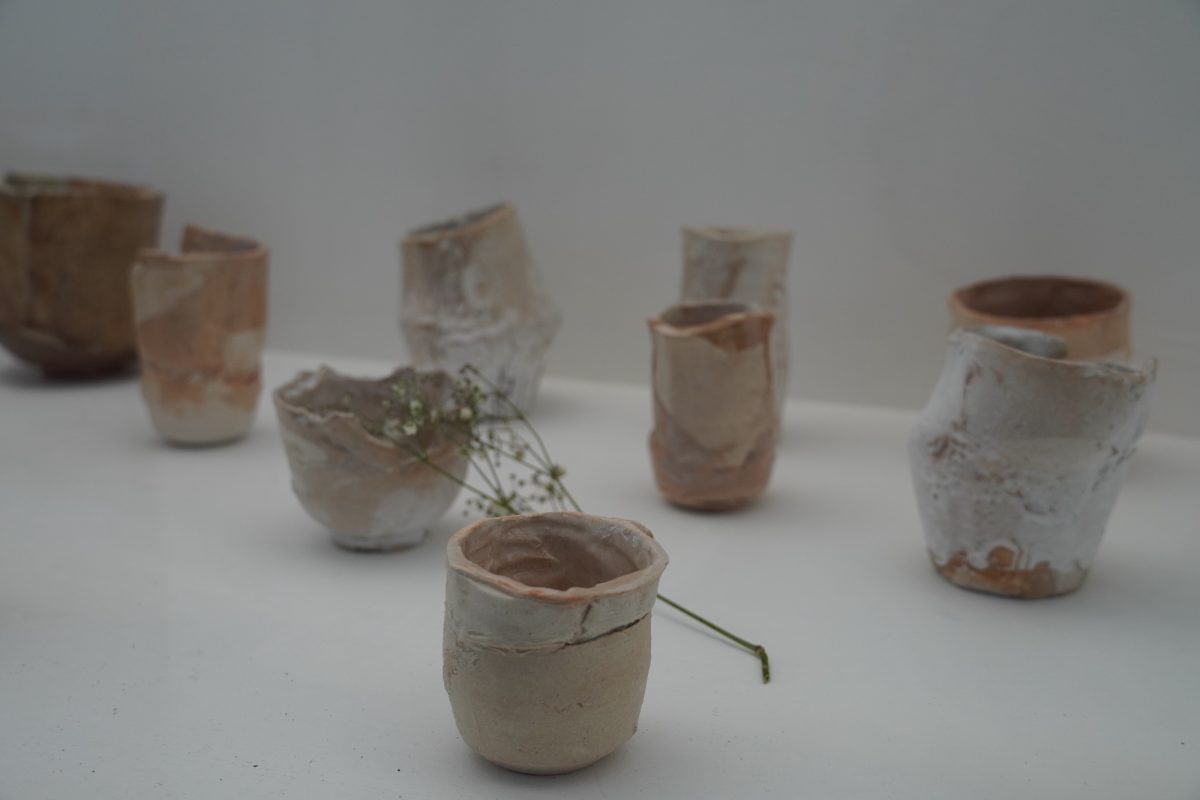
What makes Liang’s work so striking is its deliberate refusal to be complete. Rather than illustrating “fusion” or “inheritance,” her pieces enact those states materially. Each work lingers between formation and dissolution; this uncertain mode of expression is itself a stance. For Liang, to respect tradition is not to reproduce it, but to allow it to crack open under new conditions of meaning. Ultimately, her work speaks in a language of residues. Dusts of mud, paper fibers and faded ink remind us that cultural continuity does not rely on clear narratives, but on the persistence of ruins. To look at her art is to acknowledge that both writing and identity can survive only in fragments—and perhaps, that is enough.