A painting rarely fails on the wall. It fails in the months after it comes off the wall, when it is crated, shifted between rooms and parked in a space that was never designed for it. Anyone who has watched a collection move through a renovation, an estate settlement or a gallery changeover knows how often storage is where the damage starts.
Four things do most of the harm, and none of them looks dramatic when it begins.
Humidity swings. Canvas, wood panels, gilded frames and paper all take on and release moisture at different rates. When relative humidity rises and falls, those materials move against each other. Paint cracks, panels warp, mould appears and paper cockles. A steady middle range does far less harm than a space that is dry in winter and damp in summer. Conservation guidance from ICOM-CC and the IIC points to a stable band of roughly 45 to 55 percent relative humidity at 65 to 75 degrees Fahrenheit, and the word that matters most is stable.
Light. Works on paper, textiles and many pigments fade with exposure, and the loss cannot be reversed. Storage should be dark by default, with works covered or crated when they are not being viewed.
Pests and dirt. Basements, garages and attics invite insects, rodents and dust. Art should never share space with cardboard boxes, which attract both.
Handling. Most losses in storage are not environmental. They are a corner caught on a doorway, a frame stacked against another frame, a crate set down on its edge. Every extra move is another chance for a mistake, which is why the best storage plans minimise how often a work is touched.
What a good storage plan includes
• A written inventory with a photograph of every piece and a condition report made before the work goes into storage.
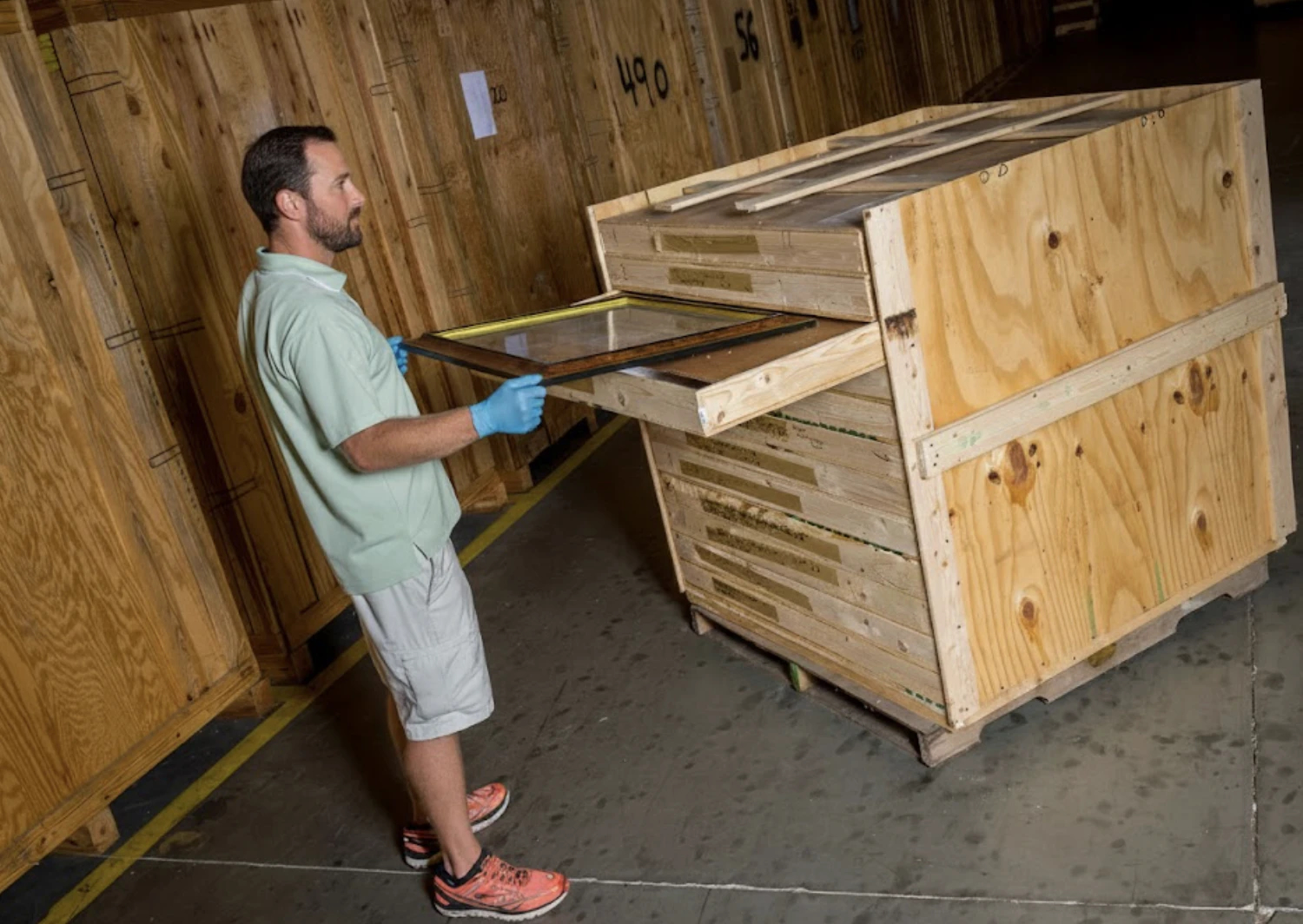
• Packing that suits the object: custom crates or padded, acid-free materials, never newspaper or bubble wrap pressed against a painted surface.
• Climate control that holds steady all year, with monitoring that someone actually checks.
• Racking that keeps frames upright and apart, off the floor and away from exterior walls.
• A retrieval process that is documented, so you know who has handled what and when.
The paperwork matters more than people expect. A dated condition report with photographs is the record that supports an insurance claim, an appraisal or a resale years later.
Where weather fits in
For collectors in hurricane country, the building matters as much as the climate control. William C. Huff, a moving and storage company founded in 1908, builds its newest fine art storage space to withstand Category 5 wind speeds of over 177 mph. Its storage service comes with a detailed inventory, condition reports and photographic documentation for each piece. You can read how the service works on the William C. Huff fine art storage page.
The short version
Choose a space where the temperature and humidity stay stable. Keep light and pests out. Cut down on handling. And keep records good enough that you could prove the condition of any work on the day it went into storage. Art that is stored well comes out looking the way it went in, and that is the whole job.