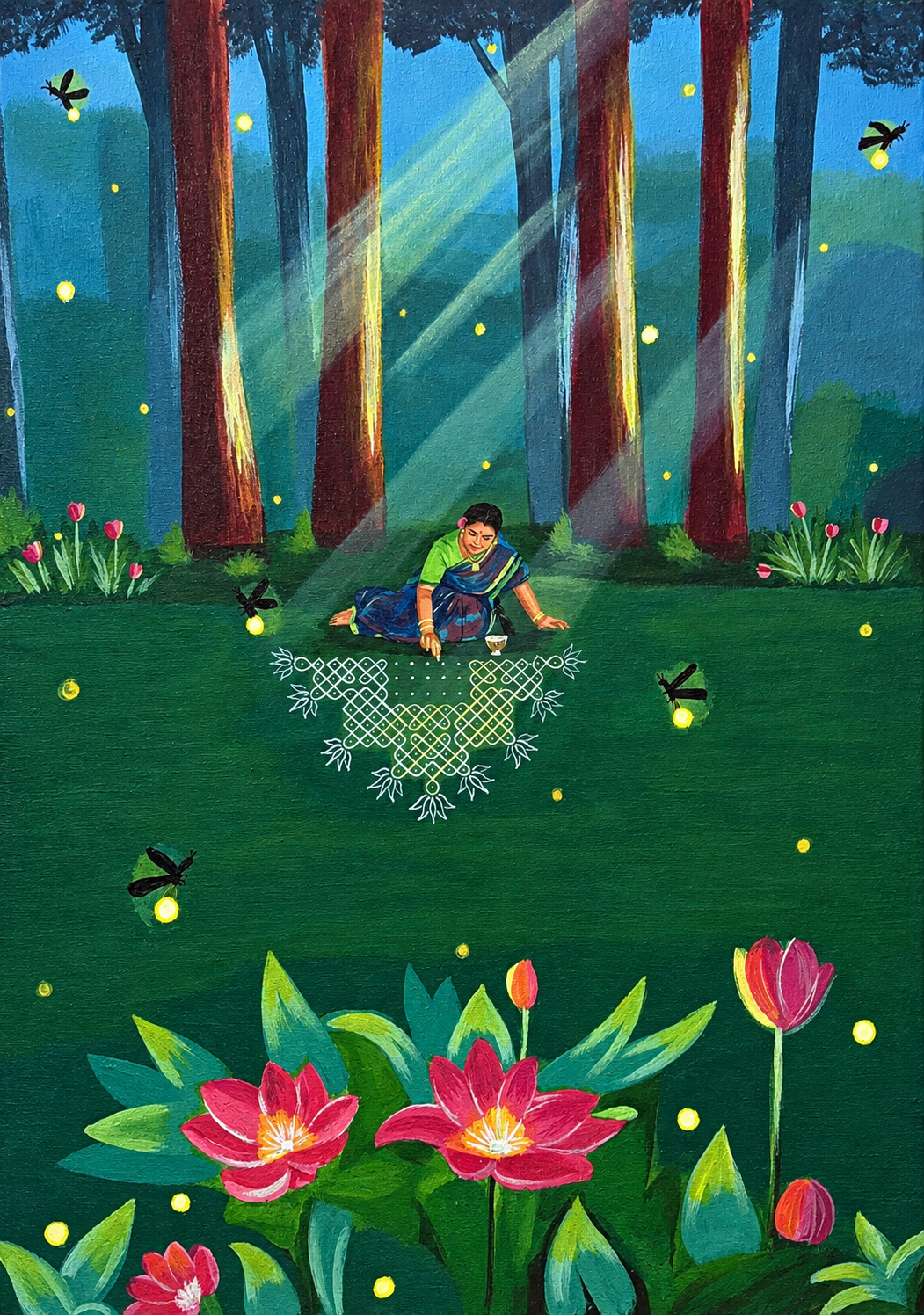
East London-based artist Bala Ayyappa’s painting turns a childhood memory of fireflies, a mother’s daily creative ritual and a changing South Indian landscape into a canvas of memory and cultural inheritance.
When was the last time you saw a firefly?
It is a simple question, but one that carries a surprising sense of loss. For many people, fireflies belong to childhood, small points of light appearing briefly in the darkness, familiar once but increasingly difficult to encounter. In this painting, the firefly becomes a way of thinking about something much larger: childhood, motherhood, cultural memory and the gradual disappearance of everyday experiences.
First exhibited at Tower Gallery, Plaistow, from March 6th to 29th, 2026, as part of a group exhibition “Women by Women” marking International Women’s Day, the painting has now been sold and returned to South India, the landscape from which its inspiration comes. Yet its story remains with the Artist still, travelling across borders through memory and conversation.
The painting places a solitary woman within an expansive natural landscape. Seated on the earth in a blue and green saree, she appears absorbed in the delicate act of creating kolam, a traditional floor art. Around her, tall trees rise vertically through the composition, their trunks catching shafts of light. Small fireflies glow throughout the forest, while lotus flowers emerge from the lower edge of the scene. The scene feels suspended between memory and dream.
There is also a sense that time has slowed down here. The woman is not presented as an isolated figure but as part of a larger ecological and cultural world. Her body, the earth, the flowers, the insects, the trees and the pattern she creates appear connected through an invisible network of care.
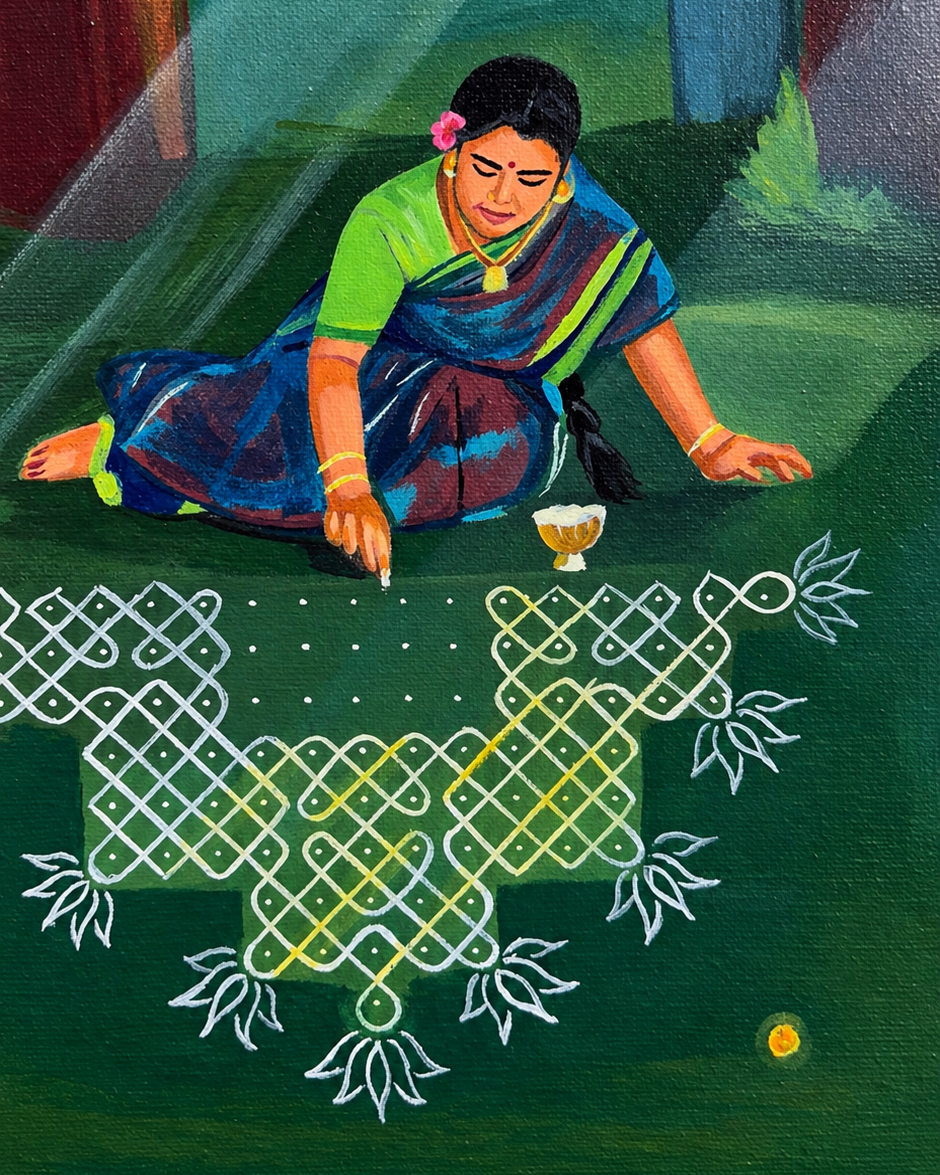
This connection is central to the artist’s understanding of the work. Speaking about the memory that inspired the painting, Bala Ayyappa recalls:
“I never woke up without the sound of my mom cleaning the home’s threshold with a sweeper made out of dried coconut tree leaves, preparing the floor ready to draw. That was my alarm. When I woke up, I could see she would have already made very complex geometrical patterns using rice flour, completely freehand.”
The artist continues:
“That is called kolam in Tamil language. It was a symbol to welcome positivity into the home and also feed insects and birds. She drew that pattern every single dusk and dawn, always creating different creative patterns. That was my first inspiration to draw.”
Looking deeply at the painting, at the centre of the composition, the woman bends towards the ground. Her posture is quiet and concentrated. There is no sense of performance for an audience. She is engaged in an act that appears to belong entirely to herself, the earth and the ritual she has inherited.
The surrounding landscape intensifies this feeling. Bala’s painting style is particularly effective in creating this space between the real and the imagined. The work combines figurative representation with an expressive handling of paint. The trees are not rendered with botanical precision; instead, broad vertical strokes and layered colour give them a tactile, atmospheric presence. Their trunks move between deep maroons, browns and muted greens, while the foliage dissolves into loose, gestural marks. This painterly treatment prevents the forest from becoming merely illustrative. It becomes an emotional landscape.
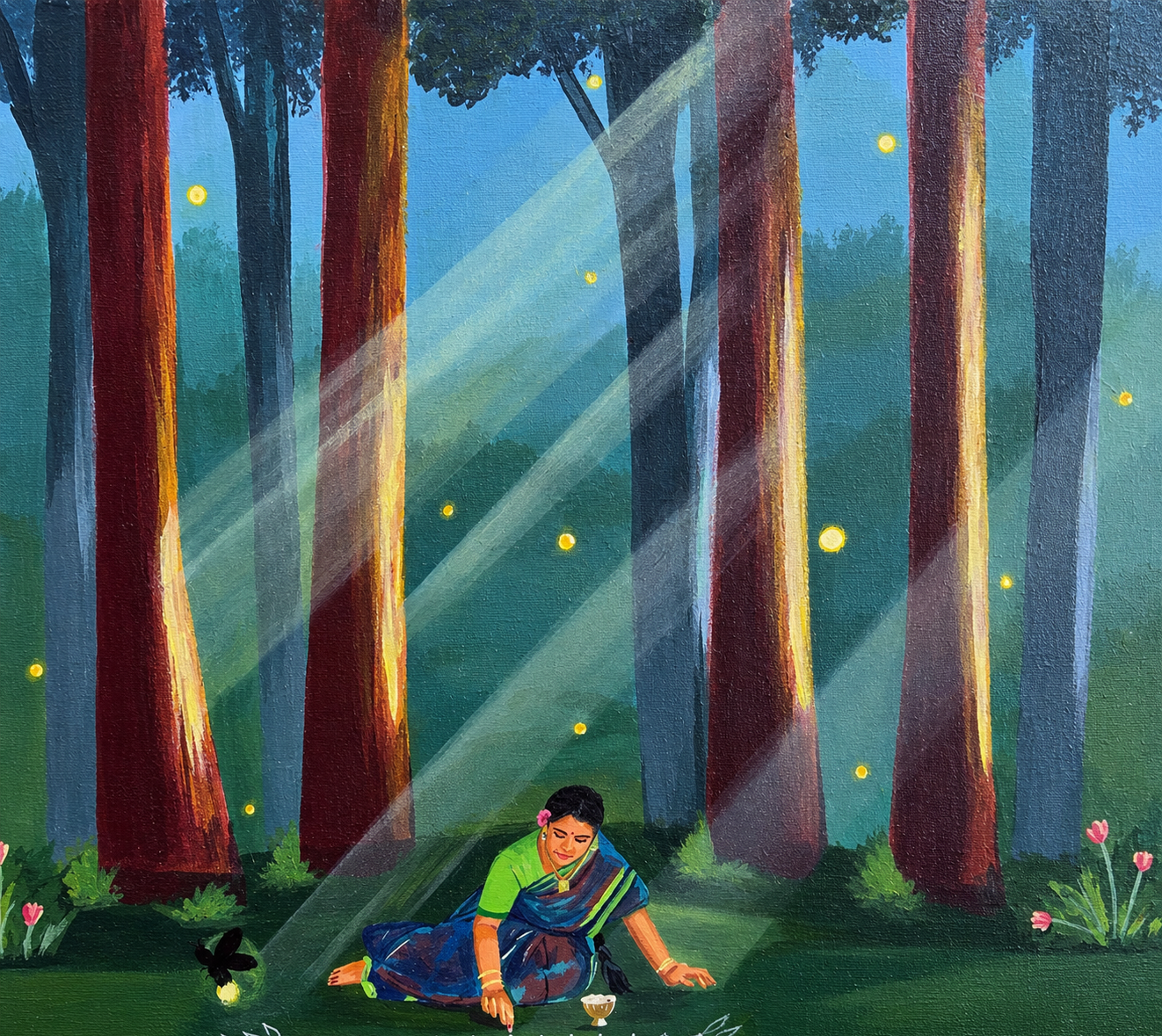
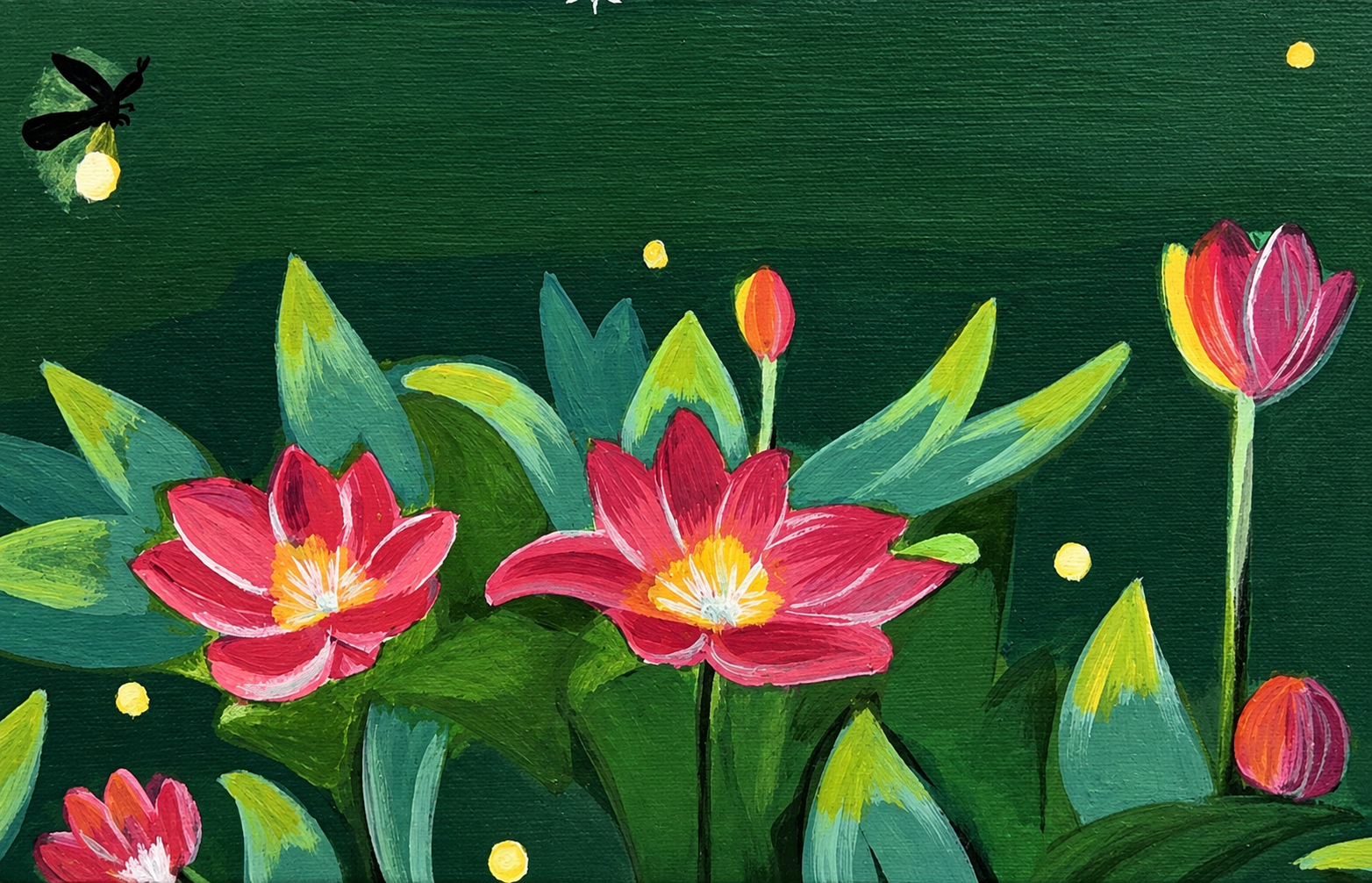
The artist’s use of colour is equally significant. Deep greens dominate the composition, establishing a sense of enclosure and natural abundance, while turquoise and blue passages create coolness and depth. Against these darker tones, the yellow fireflies function almost like points of illumination. The pink lotus flowers introduce a warmer, more intimate register in the foreground.
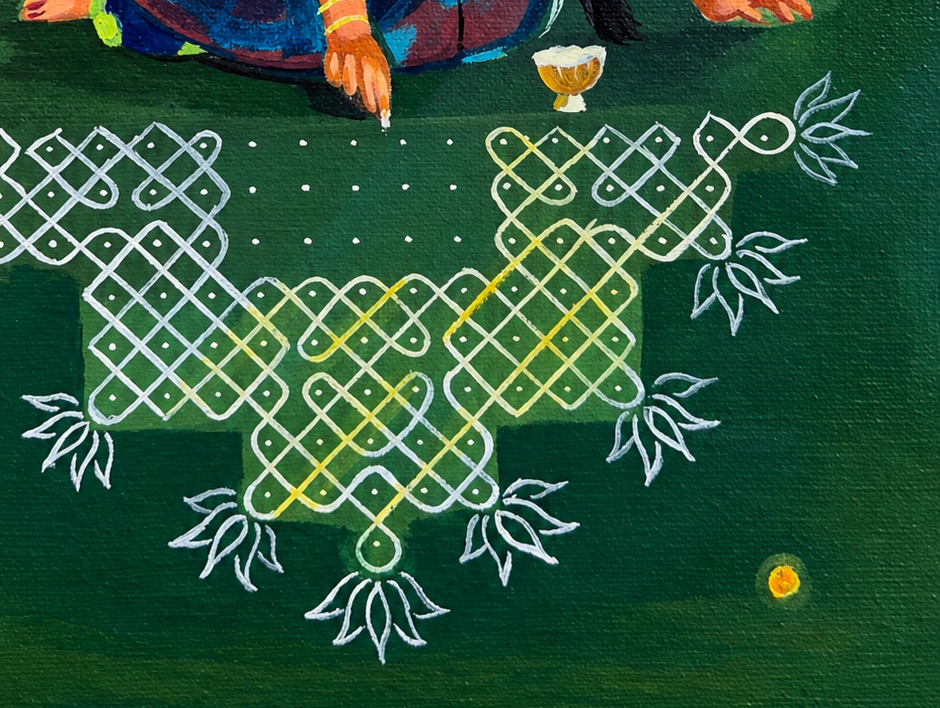
There is also a striking tension between looseness and precision. The surrounding landscape is painted with energetic, visible brushwork, whereas the kolam is carefully articulated through fine, interconnected lines, occupying a fascinating position within the painting. The pattern almost becomes a second landscape. Its intricate white lines spread outward from the woman, suggesting that her creative action has consequences beyond the immediate space of her body. The act of drawing creates a temporary world. It marks the ground, welcomes life, feeds creatures and establishes a relationship between home and the wider environment, insisting that culture does not stand outside nature but can exist within an ongoing relationship with it.
Small yellow points of light appear throughout the painting. The fireflies are perhaps the most emotionally charged elements of the work. For the artist, they are connected directly to memories of their mother by giving symbols of guidance, affection and distance. The firefly is small compared with the enormous trees surrounding it, yet its glow is impossible to ignore.
This creates an interesting visual relationship between scale and significance.
The painting asks us to look again at the forms of labour and creativity that can disappear into ordinary life. A mother waking early, preparing the ground, drawing intricate patterns and repeating the gesture again at the end of the day may not be described as an artist in conventional terms. Yet the practice requires patience, concentration, imagination and an intimate understanding of place. This everyday labour becomes a language through which womanhood was remembered in South India.
The Artist’s interpretation of the practice as an ecofeminist art form is particularly significant. Ecofeminist thinking has often explored the relationship between the treatment of women and the treatment of the natural world, while questioning systems that separate human life from ecological interdependence. Within the painting, this relationship is not presented through an abstract theoretical argument. Instead, it emerges through the memory of a woman creating something beautiful from a material that can return to the earth, where a simple threshold of the house becomes a point of exchange between domestic life and the natural environment.
The painting therefore locates ecological consciousness within domestic memory.
There is also something important about the temporary nature of the kolam. Unlike a permanent monument, it is made with the understanding that it will eventually disappear. Rain, footsteps, wind and time can erase it. It must then be drawn again. This repetition gives the practice a cyclical quality, connecting creativity to everyday life rather than separating art into a fixed object.
The artist says:
“I now live oceans away from the landscape of my childhood. The physical distance from my mother has changed the conditions under which these memories exist. Yet distance has not erased them. Instead, memory has become another place where the relationship continues.”
The fireflies that are no longer regularly encountered become part of an imagined landscape. The mother who cannot always be physically present remains within the artist’s creative vocabulary. And the kolam, once drawn at the threshold of a home, becomes transformed into a fixed painting that can travel across borders.
This movement from lived ritual to contemporary artwork is one of the most compelling aspects of the painting. The threshold is no longer only the entrance to a house. It becomes the space between past and present, mother and daughter, memory and imagination, human life and the natural world. It considers how a woman’s understanding of herself can be shaped by another woman whose creative labour may have been treated as ordinary. The mother’s daily practice becomes the daughter’s artistic inheritance.
In the painting, When Was the Last Time You Saw a Firefly?, Bala Ayyappa has thoroughly transformed a deeply personal memory into a wider reflection on care, ecology and womanhood. The painting reminds us that some of the most enduring forms of artistic inheritance do not begin in galleries or institutions. They begin at home, on the ground, in repeated gestures that may appear ordinary until someone chooses to remember them.
And like the fireflies scattered through the forest, those memories continue to glow.