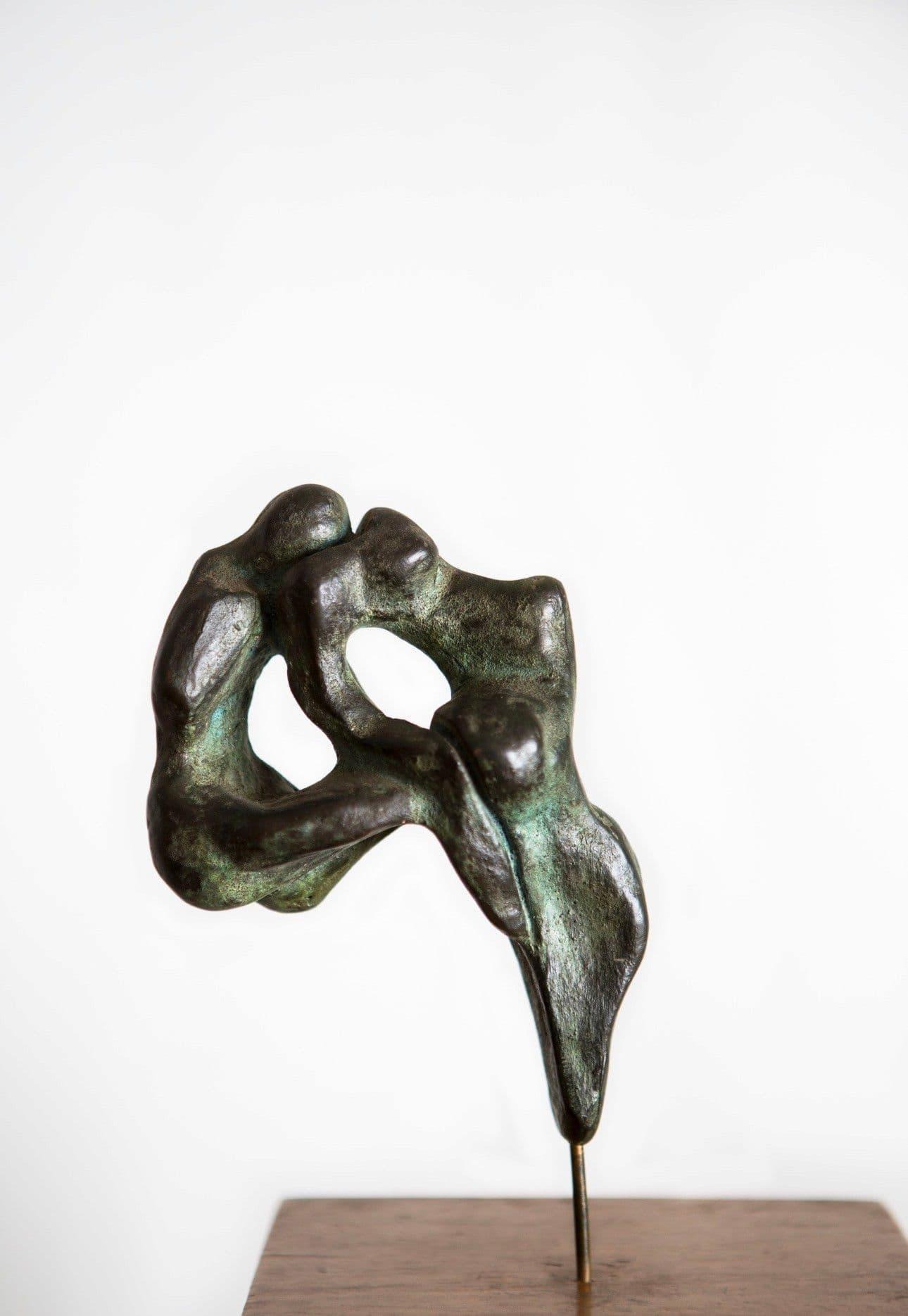
The digital exhibition is usually discussed as a substitute, and judged accordingly. Measured against a room, it loses. Scale collapses: a canvas of two metres and a small preparatory study occupy identical dimensions on a screen. Surface disappears, and with it the behaviour of light across impasto or graphite. Sculpture suffers most, since a bronze photographed against a white wall is documentation of a sculpture rather than the sculpture. There is no adjacency, no sequence, no curatorial argument assembled by placing one work beside another.
None of this is in dispute, and there is little value in pretending otherwise. But treating the online exhibition solely as a diminished version of a physical one obscures the fact that it performs several functions the physical exhibition performs badly, or cannot perform at all. Those functions are worth examining on their own terms.
A jury that could not otherwise be assembled
The most consequential difference is not visible to the viewer at all. It concerns who does the selecting.
A physical juried exhibition draws its panel from those who can be in one place at one time. In practice this means locally, or from a small pool prepared to travel. The result is a coherent but narrow evaluative position: a London panel assesses through the assumptions of the London art world, and a regional panel through its own.
The online format removes that constraint entirely. At Curatone.art, a Berlin-based platform running international juried competitions, the current panel comprises twenty-three practitioners across Argentina, Bulgaria, Canada, Germany, Ukraine and the United States, among them recipients of Red Dot, IDA and comparable awards, holders of advanced degrees, and members of recognised professional associations. Assembling that panel physically for a single exhibition would be prohibitively expensive and, for most organisers, simply impossible.
The effect on evaluation is substantive rather than decorative. A work is scored independently by jurors trained in different traditions and reading different visual references, and the divergence between those scores is itself informative. Consensus across such a panel indicates something different from consensus among colleagues who share a professional formation. For an artist, an assessment arrived at from several distinct positions is a more robust reading of the work than a strong opinion from a single one.
Evaluation separated from logistics
Physical exhibition applies two filters simultaneously, and they are rarely distinguished. The first is curatorial judgement. The second is logistical capacity: the means to ship, insure, travel, frame, and absorb those costs against the mere possibility of selection.

The second was never described as a filter. It was simply the cost of entry. It nonetheless operated systematically, favouring artists in wealthier countries near established art centres, independently of the quality of the work.
Removing it changes the composition of the applicant pool immediately. Recent competitions on the platform have drawn entries from sixteen to twenty countries per edition, with a substantial proportion from regions with little or no commercial gallery presence, and recent award recipients have included artists from Chile, Bulgaria, Azerbaijan, Morocco, the United States and Ukraine, assessed within the same cycle against the same criteria. Whether this constitutes an improvement depends on one’s view of what a juried exhibition is for. If it exists to identify strong work, then a filter that excluded artists on grounds of freight costs was never serving that purpose.
Permanence, and the problem of the vanished exhibition
A physical exhibition ends. What remains afterwards is whatever documentation happened to be produced, which varies enormously and is often minimal. An artist may hold nothing more durable than a line on a gallery website that will not survive the site’s next redesign.
This is a genuine deficiency, and it falls hardest on artists at an early stage. Such artists are generally not short of work. What they lack is verifiable history: evidence that people with relevant expertise assessed the work comparatively and selected it. Galleries, funding bodies and residency committees all request that history, and none can supply it to someone who has had no opportunity to accumulate it.
The digital format produces this as a by-product of its own operation. A named panel, a scored assessment, and a public archive recording who was selected and on what basis cost almost nothing to maintain and remain checkable years later. On Curatone.art, results are retained permanently with artist, country, medium and award level, and certificates carry numbers verifiable against that record, on the straightforward principle that a claim which cannot be checked is of limited use to the person making it.
Physical exhibitions could do this and mostly do not. The online format does it by default.
Reach without a private view
Attendance at a physical exhibition is bounded by who walks through the door during the run. For emerging artists exhibiting outside major centres, that figure is frequently small, and the audience is drawn almost entirely from one city.
An online exhibition is available continuously and internationally, and does not close. This is not equivalent to an audience standing in front of the work, and should not be described as though it were. It is, however, a different and useful thing: sustained accessibility rather than concentrated encounter.
The reasonable conclusion
The two formats are not competing for the same ground, and the persistent framing of one as a replacement for the other has obscured what each is actually for.
Physical exhibition remains unmatched for encounter, for scale, and for the curatorial argument that only a room can make. The online juried exhibition is better at assembling an evaluative panel that would otherwise be unassemblable, at separating judgement of the work from the applicant’s logistical means, and at producing a durable public record.
An artist would be poorly advised to choose between them. The more useful observation is that the second has quietly become competent at several things the first was never designed to do.