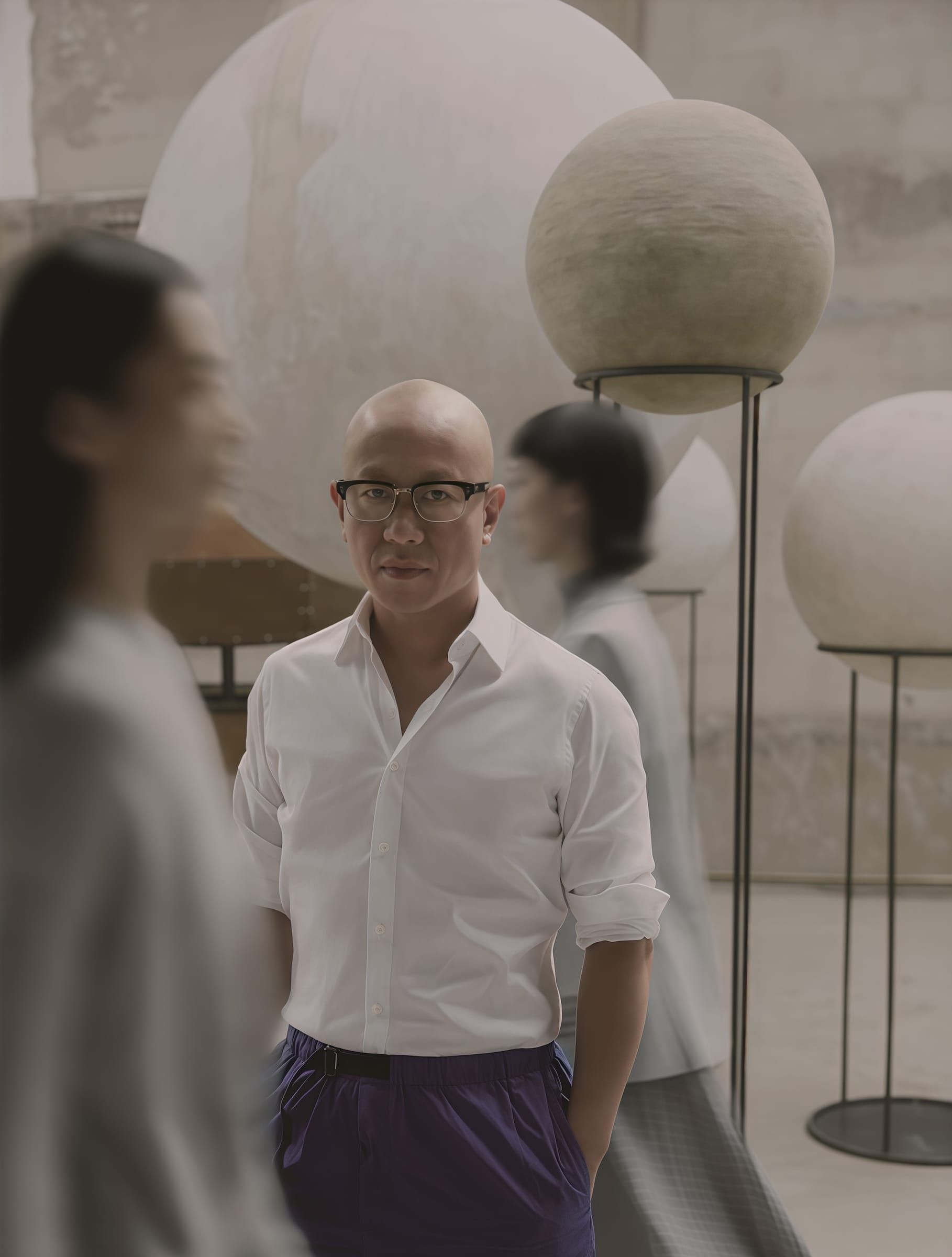
Chinese artist Liu Wei is to create four monumental sculptures for the facade of The Metropolitan Museum of Art in New York, marking his first major project in the United States and The Met’s first commissioned work by an artist from China since 2006.
Opening on 17th September 2026, the site-specific commission will occupy the four niches of The Met’s Fifth Avenue facade, responding both to the museum’s Beaux-Arts architecture and its encyclopedic collection.
The Beijing-based artist, known for large-scale sculptures and installations exploring urbanisation, transformation and social change, will use assemblage and reconfiguration to create four new works examining ideas of fragmentation, rupture, repair and renewal.
Two towering sculptures will flank the museum’s main entrance, while the two outer works will be more delicate in scale. Combining organic and geometric forms, different textures, finishes and colours, the sculptures will incorporate references to historical architecture and monuments while moving between microscopic and monumental perspectives.
Liu describes his vision for the works as
“ A pile of still life objects brusquely sutured together.”
A recurring motif across all four sculptures will be the human hand, used by Liu as a bridge between recognisable and fantastical forms and as a symbol of making, transformation and connection.
Max Hollein, The Met’s Marina Kellen French Director and Chief Executive Officer, said:
“Liu Wei’s sculptures for The Genesis Facade Commission are sure to reflect the curiosity, innovation—and even humor—he is known for. This commission also reflects the spirit of The Met’s Tang Wing for Modern and Contemporary Art, opening in 2030, where global perspectives and boundary-pushing artistic practices like Liu Wei’s will be at the heart of how we present art of our time. We are honored to work with Liu Wei to expand the possibilities of the iconic Fifth Avenue facade with his first major project at an American institution.”
Titled Speculation, the commission draws partly on Liu’s experience of living through the rapid transformation of China during the era of globalisation. Unexpected combinations of forms and references reflect the contradictions and uncertainty accompanying periods of economic, political and social change.
Rather than sitting comfortably within The Met’s classical niches, the works are intended to disrupt expectations of both the building and traditional public sculpture.
Lesley Ma, Ming Chu Hsu and Daniel Xu, curator in The Met’s Department of Modern and Contemporary Art and curator of the project, said:
“For this commission, Liu Wei will use his dynamic language of reconfiguration and assemblage to address conflicts and contradictions in society. For me, his work always compellingly pierces through perceptions of reality with a blend of rawness and refinement. I look forward to seeing how he challenges our expectations for the classical niches and for public sculptures.”
The project will be the seventh contemporary commission created for The Met’s historic facade, following presentations by Wangechi Mutu, Carol Bove, Hew Locke, Nairy Baghramian, Lee Bul and, most recently, Jeffrey Gibson.
It also arrives as The Met prepares for a major expansion of its presentation of modern and contemporary art. The museum’s new Tang Wing, due to open in 2030, will provide new galleries dedicated to art from 1890 to the present.
David Breslin, Leonard A. Lauder Curator in Charge of the Department of Modern and Contemporary Art, said:
“The Genesis Facade Commission allows us to continually rethink how The Met introduces itself to each visitor and to the world. Liu Wei’s clever remixes of readymade motifs transform the everyday into the miraculous, and his sculptures’ beguiling interplay between contemplation, surprise, and revelation is also the very business of The Met.”
He added:
“As we look ahead to the opening of the new Tang Wing in 2030, The Genesis Facade Commissions stand as The Met’s most visible and dynamic platform for contemporary art, bringing our present and future ambitions to the fore.”
For Liu, creating work for one of the world’s most recognisable museum facades comes with both excitement and a certain amount of pressure.
“To dialogue with the tremendous legacy of human civilization through The Met’s Genesis Facade Commission makes me so excited and anxious,”
Liu Wei said.
“What a challenge and a blessing.”
The Genesis Facade Commission: Liu Wei, Speculation, 17th September 2026–8th June 2027
The Metropolitan Museum of Art
About the Artist
Since the late 1990s, Liu Wei (BFA, 1996, oil painting, China Academy of Art, Hangzhou) has addressed realities of our time through a wide range of media—including photography, painting, video, sculpture, and installation. A key figure of a pioneering generation of artists from China who sought to define “conceptual art” on their own terms against the backdrop of rapid societal transformation, Liu has developed an oeuvre that challenges art historical tropes of abstraction, figuration, and the readymade. Known for his virtuosic command of sites and scale, he reconfigures fragments from the urban environment, historical sources, and bodily forms to create sculptural installations that evoke awe and agitation. With a sense of urgency, his work captures and critiques the reoccurring conflicts and contradictions in society with which we must contend.
The Genesis Facade Commission at The Met will be Liu’s first major presentation in the United States, following solo exhibitions in important museums in Beijing, Shanghai, Seoul, and Cleveland in the past decade. He has been featured in prestigious and historic group exhibitions, including the inaugural China Pavilion at the 51st Venice Biennale (2005); Shanghai Biennial (2004, 2010); Lyon Biennale (2007, 2015); Sharjah Biennial (2013); Art and China after 1989: Theater of the World, Guggenheim Museum, New York, and San Francisco Museum of Modern Art (2018); The Allure of Matter: Material Art from China, Los Angeles County Museum of Art (2019); and the 58th Venice Biennale (2019), among others. Liu lives and works in Beijing, China.