Through the dual lenses of St. Bede’s seventh-century sparrow parable and the silent landscape of Venice’s cemetery island, San Michele, the multidisciplinary exhibition Return | Ritorno treats human experience as a brief flash of consciousness caught between two infinite voids. In this framework, 21st-century existentialism intersects with the emotional magnitude of the Romantics as Arch Hades explores how we live, love, and inevitably disappear.
Reading Julian Barnes’ essay “Death” in Nothing to be Frightened Of (2008) had a seismic impact on Hades, who had conceptualized life in similar terms since childhood. The idea centers on St. Bede’s Ecclesiastical History (731) and his metaphor of the sparrow, in which he compares a human life to a lone bird darting out of a winter storm into a warm, brightly lit banquet hall, only to fly right back out into the dark unknown. In bridging this text with a modern existential outlook, Hades’ work reframes our personal archives—our diaries, letters, and early poems—as the artifacts we leave behind while inside that illuminated room. They become proof of a consciousness asserting its presence against the void. Ultimately, reviewing these records turns us into quiet observers at our own feast. As we watch our past selves, we are caught in that all-too-human contradiction: the desperate urge to leave a permanent mark, and the knowledge of how brief our time here really is.
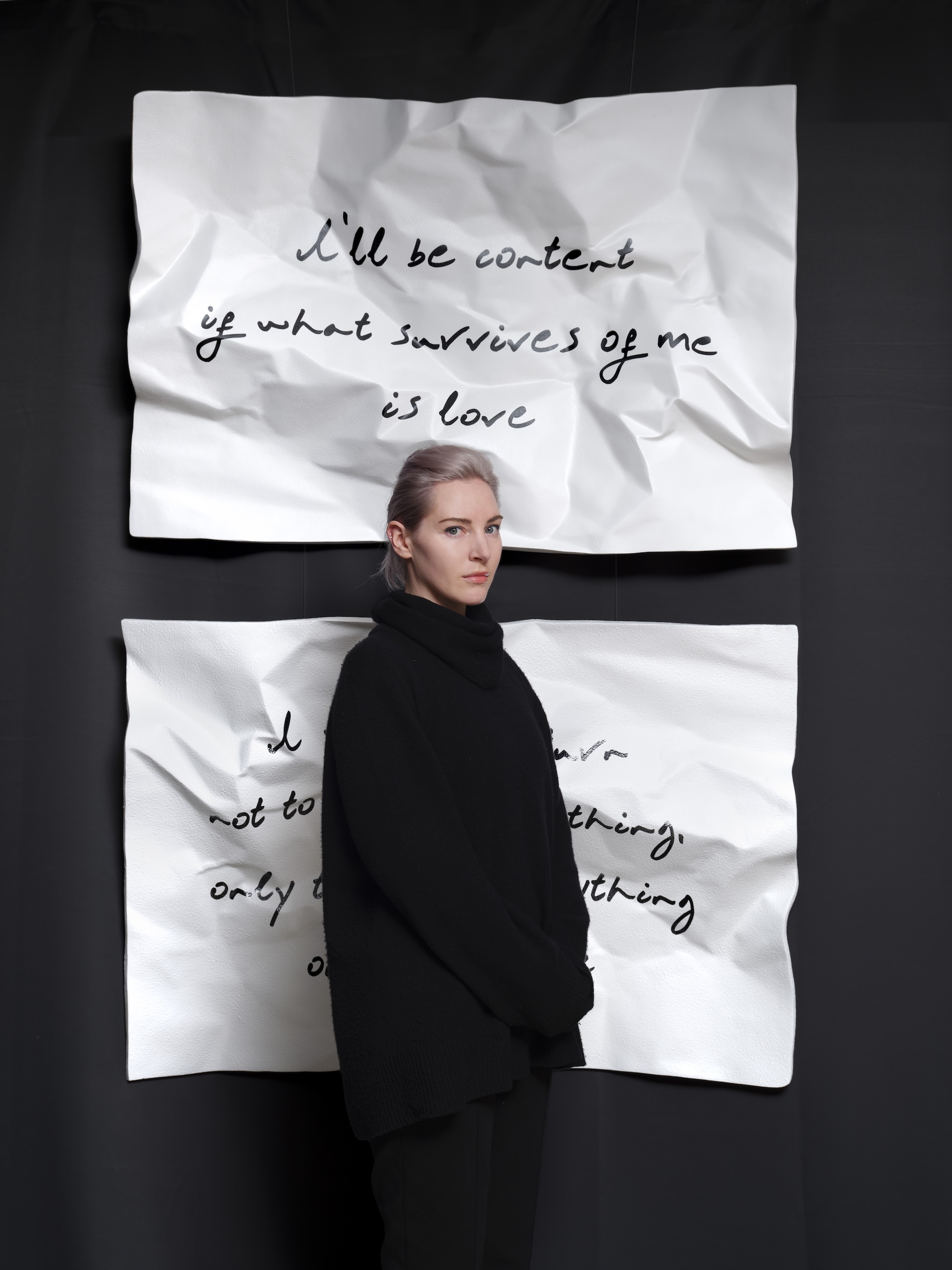
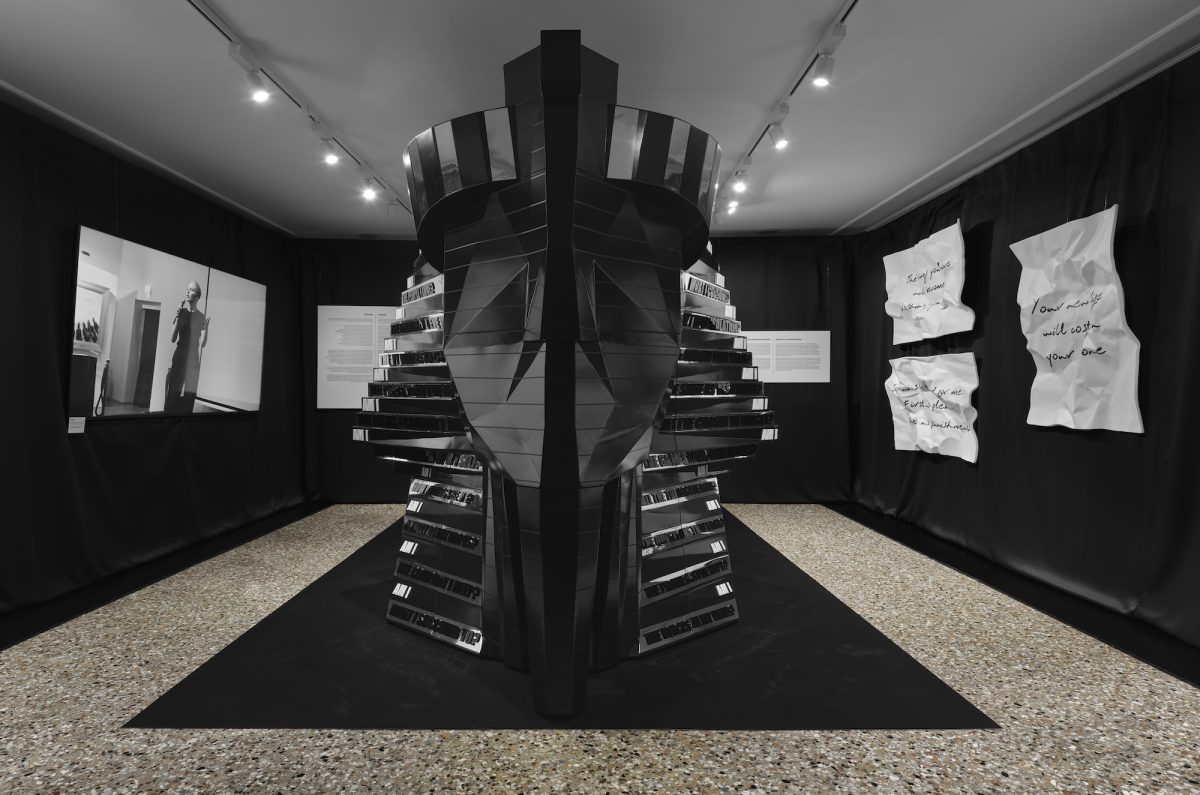
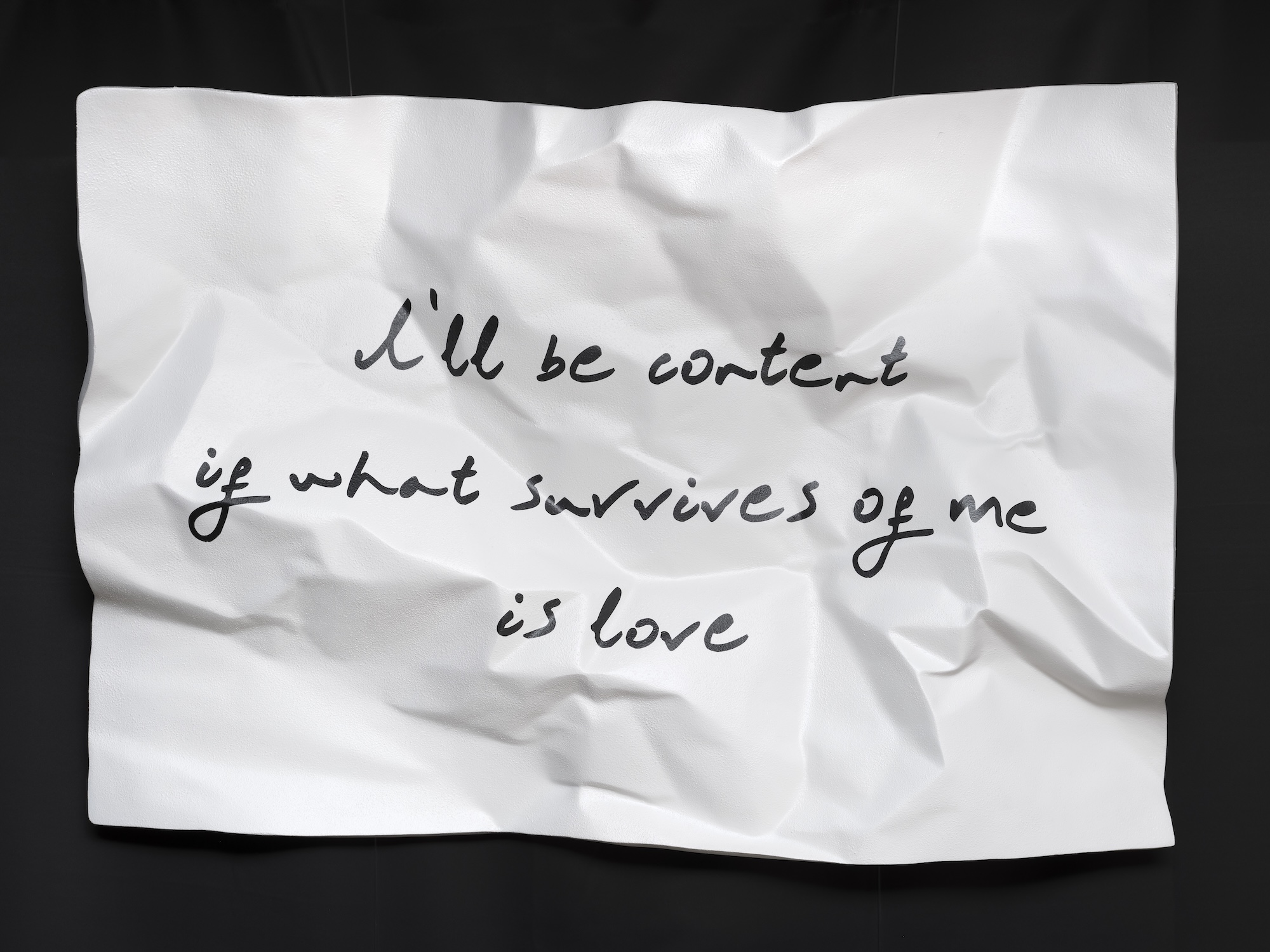
This tension between the fleeting nature of life and the desperate desire to leave an indelible mark is physically embodied in Hades’ Confessions (2025-26) series: fibreglass sculptures that resemble crumpled, discarded notebook pages. There are universal truths to be found in these monumentalized pithies. By immortalizing the fragments of real journal entries in these heavy, cold monuments, the abstract concepts of nostalgia and past longings are given a skin shaped by an intensely personal hand.
So too are memories buried safely within the confines of poetry in the work Isle. Verse becomes a cemetery, a protective vault designed to save the memory of the loved from the absolute oblivion of the void. Loss is thus transformed into an enduring aesthetic landscape. Known colloquially as the “island of the dead,” San Michele stands as a literal boundary between life and the void, holding the bones of the historic poets, musicians, and artists who flew through the banqueting hall before us. Hades’ interpretation features a stark, white-shrouded figure standing precariously against a dark, highly polished lagoon plane. Crucially, the island upon which this figure stands is constructed out of books rather than bricks.
Longing and nostalgia shape the mood of Isle, feelings summed up by the artist’s own words: “poems are like gravestones, marking where love lies” (first published in ‘Paper Romance’ 2021, Black Spring Press). When human relationships fracture, eras end, or loved ones pass away, Hades safely buries these griefs within the confines of her poetry. For Hades, poetry acts as a burial ground for endings—whether it’s a fractured relationship, the close of an era, or the death of a loved one.
Hades’ artistic practice bridges the gap between text and form, allowing the Romantic lyricism of her verse to shape a multidisciplinary body of art deeply rooted in surrealism, loss, and existential inquiry. Within this space, a clinical existential logic harmonizes beautifully with the grand emotional magnitude of Romanticism. For Hades, emotion and intellect are never in opposition; rather, they are complementary pillars of her practice. As she notes, “Logic is often the result of our emotional experiences, like empathy. We must harmonise them together in each of us.”
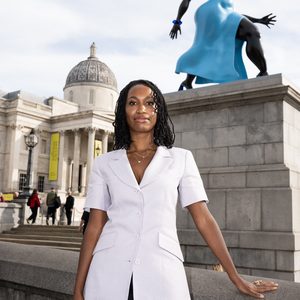
The ultimate test of this emotional and logical harmony is found in the exercise of human agency, a theme brought to life in Sphinx (2026), Hades’ “ode” to Existentialism. Rendered in a traditional Egyptian silhouette, the sculpture operates much like the mythic riddle itself—a space where a traveler’s fate hangs in the balance, forcing an encounter with the consequences of an un-dictated universe. Operating on Sartre’s premise that existence precedes essence, Sphinx rejects the comfort of a pre-written destiny. As the artist notes: “We get to choose who we are and what we do with our lives. But for every choice we make in this freedom, we bear the responsibility of its consequences.”
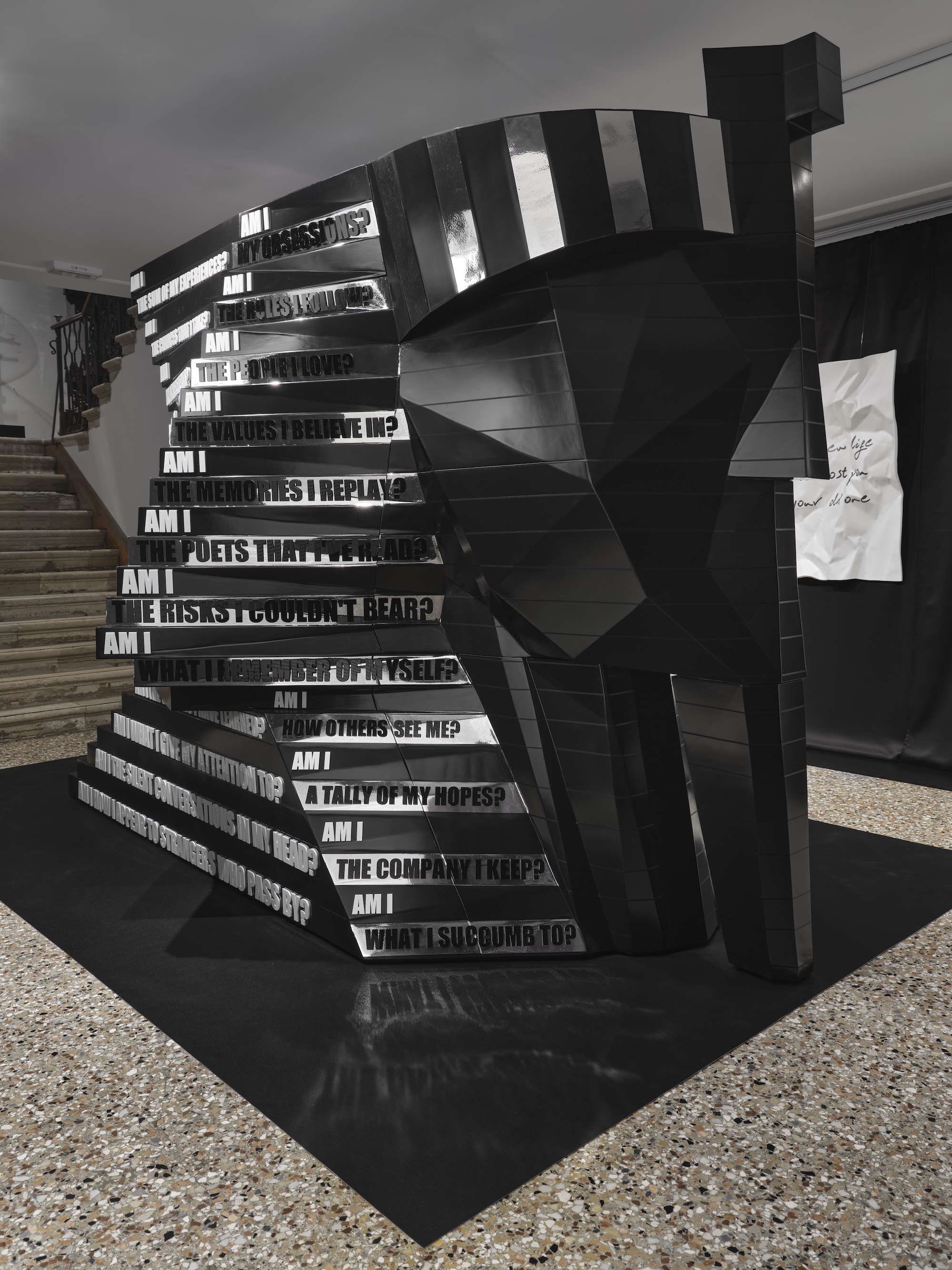
On the outside, Sphinx is etched with the searching, anxious questions of her poem Patchwork (first published in 21st Century Human, Volume 5, 2023). Yet, once you step inside the sculpture, the space itself offers a grounding answer to all that doubt: “You are the sum of your choices.” At its core, the work is about the line between external chaos and internal control. We can’t predict what the world will throw at us, or how other people will act—but we completely own our reactions, our choices, and our capacity for empathy. In the end, freedom and responsibility are exactly the same thing.
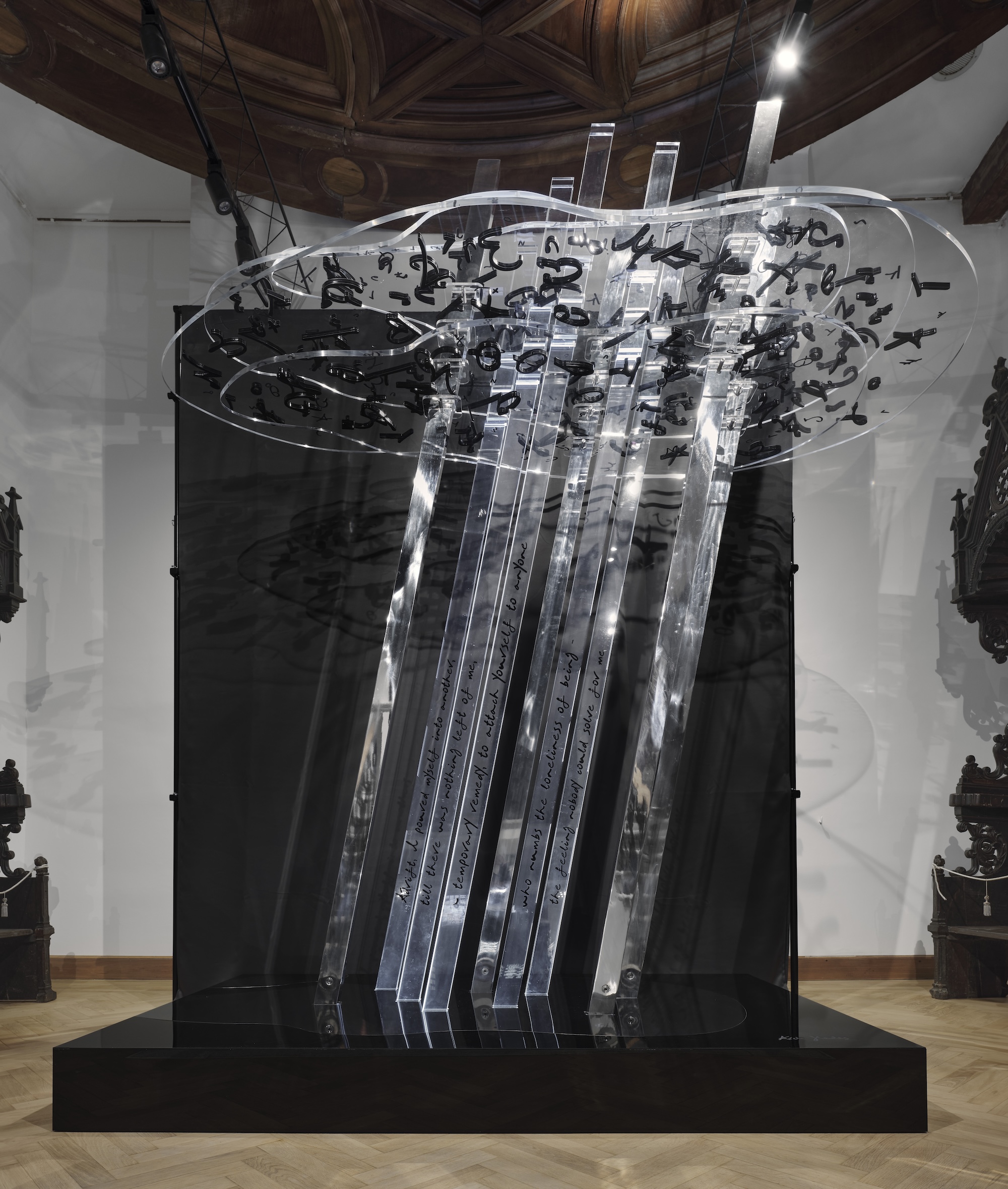
Where Existentialism provides the logical framework of choice, Romanticism provides the deep, elemental connection to nature and shifts attention outward. In pieces that incorporate environmental forces—such as Rain (2025), where full sentences are rained down before melting into a puddle, or the subtle whispers of the forest in Murmuring Bark (2025)—the artist calls for a radical return to nature. For Hades, centering our perspective is the entire point: “Nature demonstrates that the world contains magnitudes other than us, which are just as interesting as us.” Encountering this sublime scale effectively shrinks the human ego, underscoring the brevity of human existence.
This brief and full human experience is captured in what the artist refers to as a ‘river’ of life, depicted in the Return (2025) triptych, which borrows its form from the medieval altarpiece, a form traditionally designed to map out sacred narratives, divine salvation, and the promise of an afterlife. By adopting this heavily codified religious framework, Return establishes a profound structural and emotional tension. Within this tryptich, we encounter a striking parade of classical archetypes, from the Three Graces to Bernini’s Rape of Persephone, Lucifer of Liege (1848), Epigonus’s The Dying Gaul and so many portrayals of human love in all its forms. There is a brilliant subversion here. By placing everyday figures into a format traditionally meant for gods and icons, Hades shifts the focus of the sacred away from the divine and down to earth. She uses a structural language designed for eternity to capture a philosophy of total fleetingness.
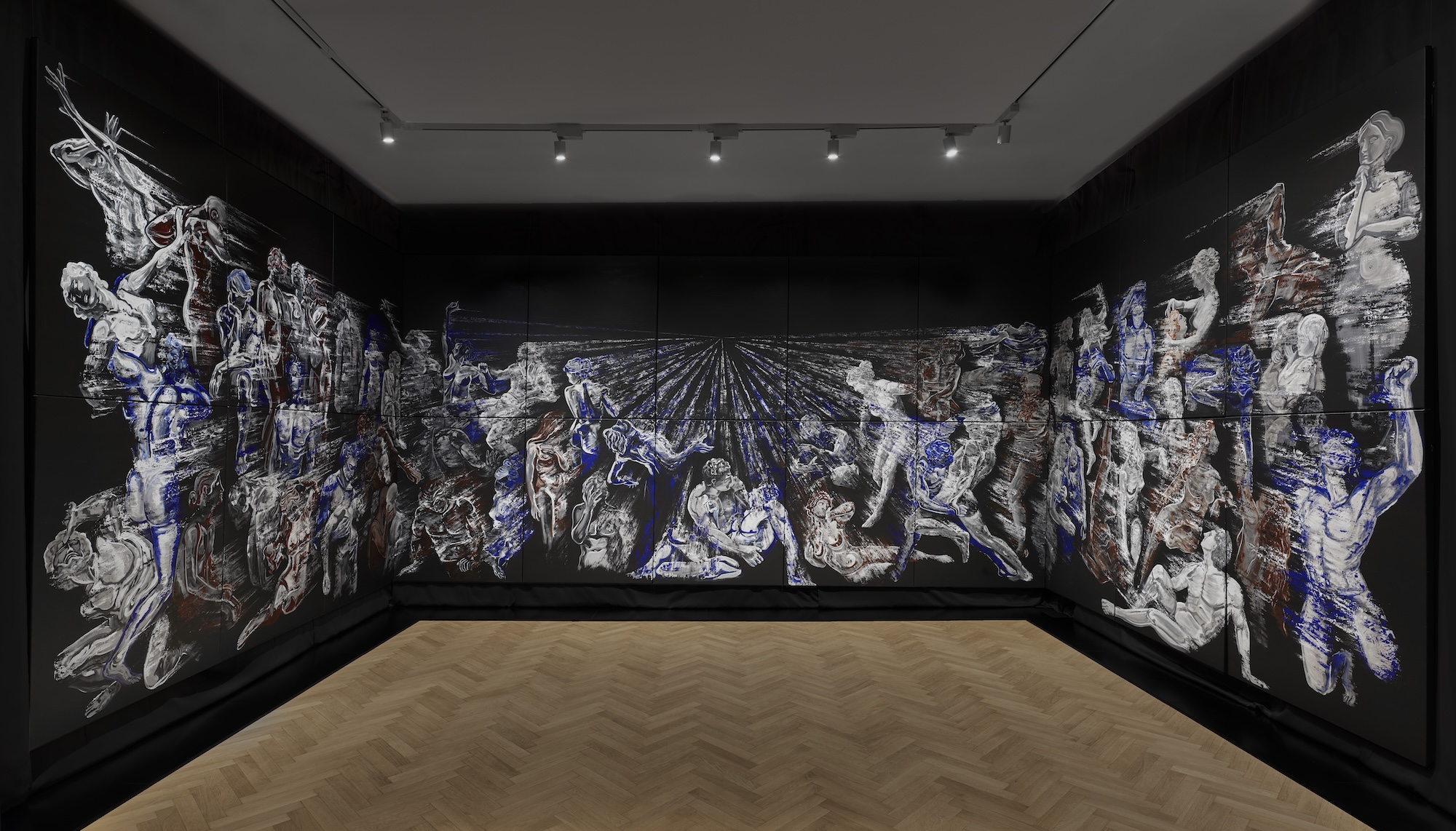
Ultimately, the act of looking back, be it in the faded ink of an old diary, through time or across the reflective waters of the Venetian lagoon towards San Michele, is an exercise in tracking our own disappearance.
An excerpt from her poem “The Flowers Bloom” (first published in 21st Century Human, Volume 5, 2023) is displayed in Rain, but the full weight of the piece lands in its later lines:
To be human is to embrace the things
I do not want to touch
— failure, loss, entropy and gloom
But as I get through them
I am free, unconsumed
And finally, I feel the flowers
while around me, they bloom
The true sublimity of Return | Ritorno lies in the liberation to be found within impermanence. To accept that we possess no eternal home on Earth, and that we are all merely passing through, is to find peace within the transition. The value of our longing, our fears, and our creative outputs does not depend on their ability to outlast the universe. Instead, it rests entirely on the fact that they happened at all in a brief, brilliant flash of consciousness, singing before slipping gracefully back into the quiet dark.
Arch Hades, Return | Ritorno, 7th May – 1st November 2026, Scoletta Battioro e Tiraoro di Venezia
Supported by Erarta Foundation