
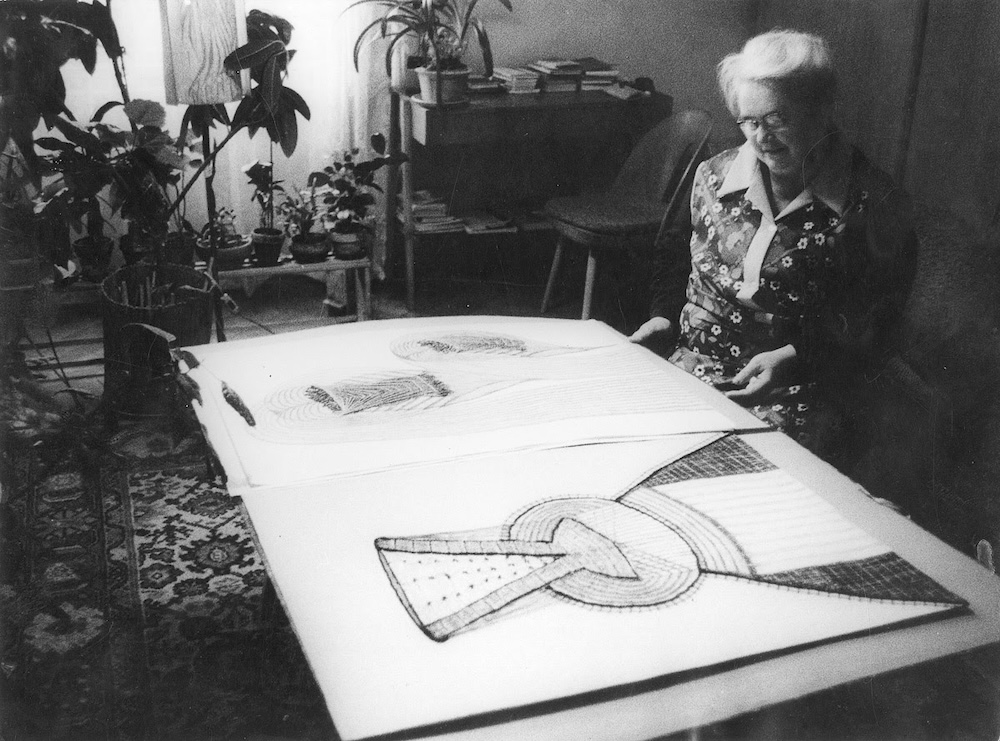
Gladstone has announced the representation of The Estate of Anna Zemánková, the self-taught Czech artist whose work wielded a trailblazing influence on modern-day painters seeking to expand the psychological and spiritual realms of abstraction. The gallery’s representation of the Zemánková Estate, in collaboration with Cavin-Morris Gallery, reflects Gladstone’s ongoing championing of important artists whose practices have shaped modern art history. The gallery will present a solo booth of the artist’s work at TEFAF New York from May 14th–19th, 2026, following the spring 2025 Gladstone exhibition in New York, which featured the artist’s rarely seen incandescent botanical drawings and works on paper.
A pivotal figure in the Art Brut pantheon, Zemánková channeled life’s multiplicities into creations that defy categorization. While often compared to mediumistic artists such as Kunz or af Klint, Zemánková’s work rarely touches on spirituality directly, instead rooting itself in the subconscious, which the Surrealists termed “pure psychic automatism.” Her refusal to title works, a deliberate act of liberation, invites viewers to project their own narratives onto her wildly imaginative botany. Cleaving open otherworldly spaces with her art, Zemánková’s legacy lies in her fantastical elsewhere.
“Anna Zemánková was a visionary who created a universe of form and color that remains unparalleled in Outsider Art, resulting in meticulous, otherworldly works. We are committed to showcasing the profound spiritual and aesthetic intensity of her work to global audiences, institutions, and collectors, and to affirming her place alongside the major modernist masters of the 20th century,”
said Max Falkenstein, Gladstone’s Senior Partner.
Gladstone’s solo presentation of Anna Zemánková at TEFAF New York comprises more than 15 pastel works on paper. Spanning from the 1960s through the 1980s, these works reflect the active decades of Zemánková’s artistic career, when later in life she revisited her childhood love of artmaking, with her family’s encouragement, and pursued her passion for experimentation in abstraction. TEFAF New York is on view at the Park Avenue Armory from Friday, May 15, through Tuesday, May 19, with a preview on Thursday, May 14.
Born in Moravia, Zemánková came of age during the collapse of the Austro-Hungarian Empire and the birth of an independent Czechoslovakia in 1918. This era fostered a fervent patriotism, marked by a devotion to preserving cultural traditions such as folk costumes, songs, fairy tales, and ornamental drawings. These influences ignited Zemánková’s early passion for painting. Though gifted in depicting colorful, realistic landscapes, her parents discouraged her from attending art school, redirecting her toward dentistry. Amid the turmoil of political and social upheaval, Zemánková followed a conventional path: marriage, motherhood, and grandmotherhood—roles that temporarily eclipsed her artistic ambitions.
Zemánková’s artistic rebirth began in the late 1950s, when her sons Slavomír and Bohumil discovered a forgotten suitcase filled with her early paintings in the family basement. Recognizing the vitality of these works, they encouraged her to resume painting. In the quiet hours before dawn, she would rise in her Prague apartment, surrounded by real and artificial flowers, and listen to the classical music of Beethoven and Janá?ek or the jazzy blues of Charles Lloyd. These solitary sessions became her sanctuary, during which her drawing conjured a universe of pulsating tendrils, succulent petals, and coiled organic forms, a paradise of biomorphic flowers that blurred the boundaries of reality. Zemánková’s work invites the viewer into a kaleidoscopic garden where beauty and the grotesque intertwine, where music morphs into matter, and where creation itself becomes transcendence.
Zemánková’s work has been featured in international solo and group exhibitions since 1971, preceding appearances at the Venice Biennale (2013 and 2024). Among her most significant exhibitions are Outsiders at London’s Hayward Gallery (1980) and the São Paulo Art Biennial (1981). Posthumous retrospectives include the High Museum of Art, Atlanta (1997); Slovak National Gallery, Bratislava (2007); Museum Montanelli, Prague (2011); Saarland Gallery and European Art Forum, Berlin (2011); Hy?go Prefectural Museum and Hiroshima City Museum of Contemporary Art (2012); and Collection de l’Art Brut, Lausanne (2017). Her work resides in leading public collections such as the American Folk Art Museum, New York; Arnulf Rainer Museum, Baden; Centre Pompidou, Paris; Collection abcd, Paris; LAM, Musée d’art Moderne, d’art Contemporain et d’art Brut de Lille Métropole, Villeneuve-d’Ascq; Milwaukee Art Museum; Musée National d’Art Moderne (Pompidou), Paris; Museum of Fine Arts, Boston; Museum of International Folk Art, Santa Fe; The Museum of Everything, London; and Mumok Museum in Vienna.