The climate emergency is one of the most pressing contemporary issues. Many artists are making work related to it, but can an exhibition shed new light on it that hasn’t been covered elsewhere? At Jupiter Artland, a sculpture park just outside Edinburgh, they’ve decided to keep it focused on the local environment and its ties to the wider climate crisis, through their group exhibition, Extraction.
John Gerrard’s flaring flag references the oil and gas industry, which in the UK is largely off the coast of Scotland. Marguerite Humeau’s sculptures integrate elements of the natural world, and Carol Rhodes’ aerial views show how humans terraform the natural landscape.
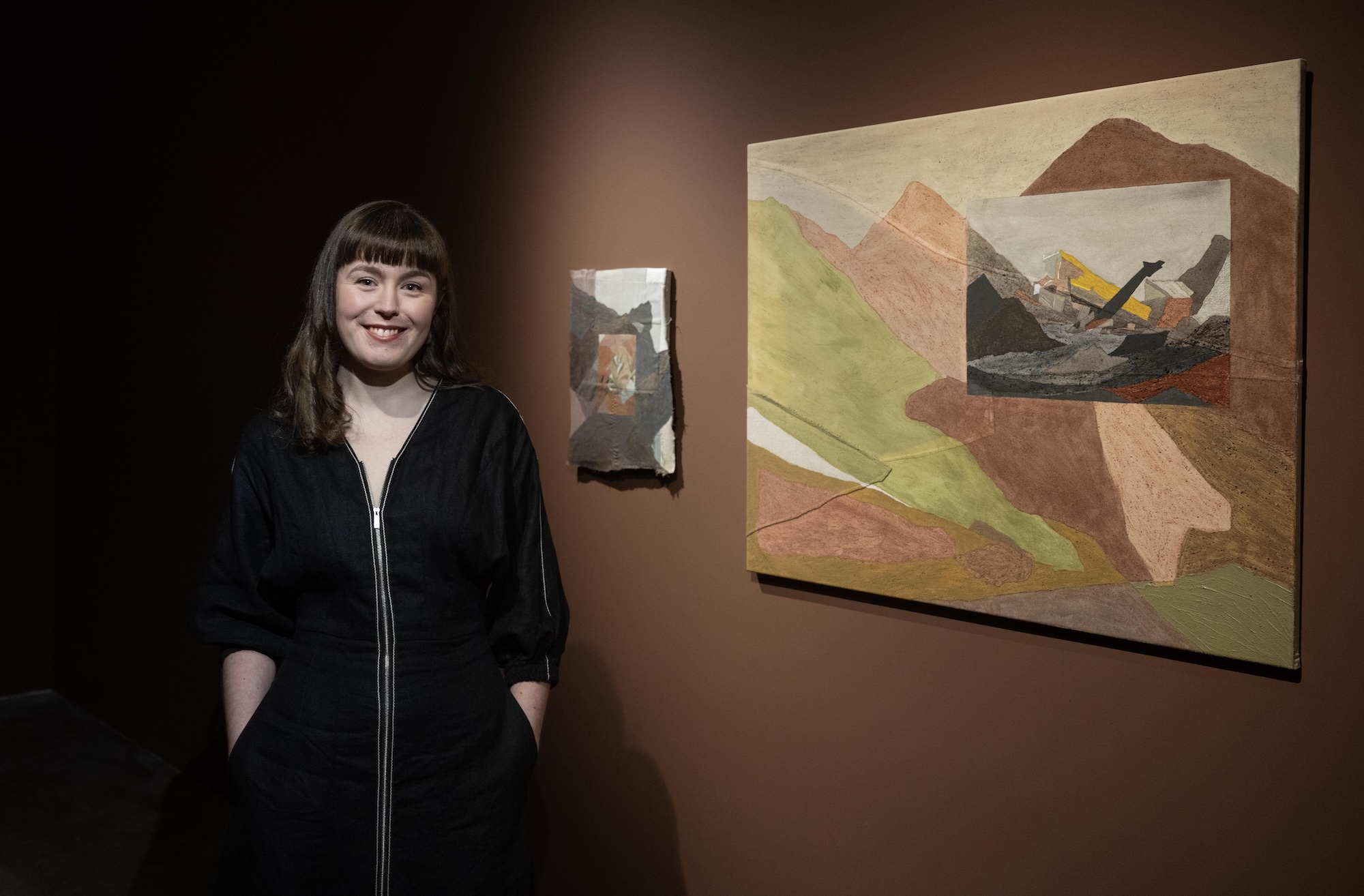
Siobhan McLaughlin creates paintings using earth pigments gathered from the nearby Five
Sisters Bing. Bings are spoil tips from the nearby oil shale industry; they can be almost 100 metres tall, and can be seen from the grounds of Jupiter Artland. We discussed her practice as we walked around the grounds of the sculpture park, examining her work and how it has been tailored specifically for this exhibition.
Can you describe your practice and how you make your work?
“It all starts with walking. I can sketch while I’m walking to gather abstracted forms of the landscape. I often ask people I meet to walk with me in their favourite landscape, because I find it a really nice way to meet people and experience the landscape. As I speak to people, I often get gifted fabrics or find different textiles”.
In making her canvases, “I sew together remnant materials that I’ve gathered while I’m walking in the landscape, whether that’s a fisherman’s smock cloth from Cornwall or a bit of Barbara Hepworth’s curtains from her studio in St. Ives. I’m really interested in sewing the histories of these textiles into landscape paintings … I then stretch it as if I’m stretching a traditional canvas”.
“On top of that, I’ve got my paints, made from Earth pigments. Increasingly, over the past five years, I’ve used more Earth from mining waste. So whether that’s in yellow ochre from mining runoff in the river Leven in Fife or the shale. The red shale creates these incredible colours in the painting, and the works in the show are roughly 90% Earth pigment. The only Earth pigment that’s really difficult to source is a blue, so the green in the paintings is created with a very small touch of blue”.
“Because I only use the Earth that I’ve extracted myself, I’m really conscious of that extraction and the implications that it has, and I’m mindful of the land. In the case of the yellow ochre, it was created by the runoff from the mining industry, and it’s damaging the fish population. Extracting the ochre from the river will essentially help the fish population, so I enjoy that aspect. I’m interested in how a handful of rocks can tell us something about the social and cultural histories and the land’s ecology”.
What can you tell us about the works in the show?
When describing the landscape works in the show, which depict the local land, she adds, “The bings have kind of existed in the background of a lot of people’s lives in Scotland, and while travelling between Edinburgh and Glasgow, I’ve always wondered: what are these? What are these monumental heaps of rock? People from younger generations aren’t aware of what they are, as the oral histories of mining are dying out, and people don’t really know what they are.
I’m interested in the idea of colour being a way to access knowledge. So, looking at those hills and thinking: why are they kind of orangey, red, or pink, and what can that tell us? The idea that you can access knowledge intuitively in a way that doesn’t require an academic degree. It was through colour that I learned so much about the social, cultural, and political histories that are tangled up in them”.
Once she found out what the bings were, she says, I’ve always thought of them as negative in a way, because they’re a result of extraction, they’re a kind of waste rock. However, they’ve become an incredible site for biodiversity. And I’m really interested in the hopeful possibilities of derelict land and the new species that can grow. The bings are among the most biodiverse areas in Scotland, ecologically speaking, and the bing that you can see from Jupiter Artland has more species of plant life than Ben Nevis. I find that fascinating”.
Can you tell us about your wider practice, and about your previous project in which you worked with fashion offcuts?
“A recent series of work I made was kind of sparked by discovering a box of textiles that belonged to my grandmother, who died the year before I was born. So I never met her, but my dad has held onto this box and never cleared it out. My family is Catholic, and she had these textiles that included contact relics. It’s a piece of linen that’s the size of an iris, that’s said to have been touched by the hand of Saint Edmund Arrowsmith, who was a Saint of giving.
I became interested in the idea of textiles, touch, and imprint. I was given a travel award to work in Orkney, where they had just discovered at the Ness of Brodgar archaeological dig this fragment of pottery that’s the earliest evidence of Neolithic textiles in Scotland. The textile no longer exists because it was a natural fibre, but it left an impression that archaeologists believe was the potter’s sleeve on the inside of the pot.
I like the idea that the potter obviously didn’t see it. If the imprint was on the outside, they might have noticed and smoothed over it. Yet this hidden imprint holds great significance, linking back to the idea of these contact relics and the meanings people place in textiles”.
For a previous series of work, which was how I first came across Siobhan’s work at the London Art Fair, showing with Ruup & Form, “I collaborated with Strathberry handbags, and they gave me the offcuts from the production process. The fashion industry has improved a lot, but it can still be wasteful. Designers get sent an enormous amount of samples, and then they all just go in the bin.
I was friends with someone in the costume department, and I noticed their remnant waste bin. I started picking out materials from there and sewing them together into a hand-sewn, two-meter square piece. I was really pleased with that, thinking of sewing as a kind of repair, and how my own struggles with chronic pain are also a form of repair”.
Alas, in our walk around Jupiter Artland, we didn’t find any fabric or earth that could be made into canvas or pigment, even if Siobhan was on the lookout. However, I did learn a lot about Siobhan McLaughlin’s thoughtful and layered practice, and I look forward to her next series of works and learning about the landscape that inspires it.
Siobhan McLaughlin’s work is part of the group exhibition ‘Extraction’, which is on at Jupiter Artland until 26th July. More information on Siobhan’s practice may be found on her website and Instagram.
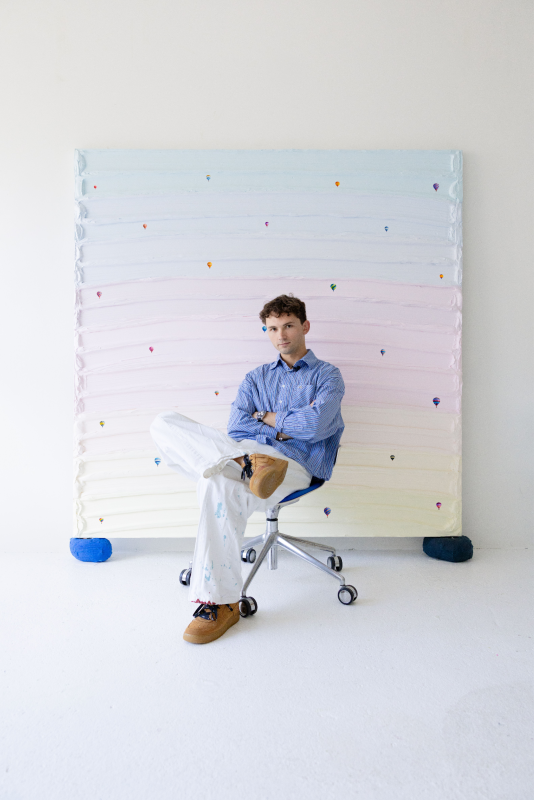
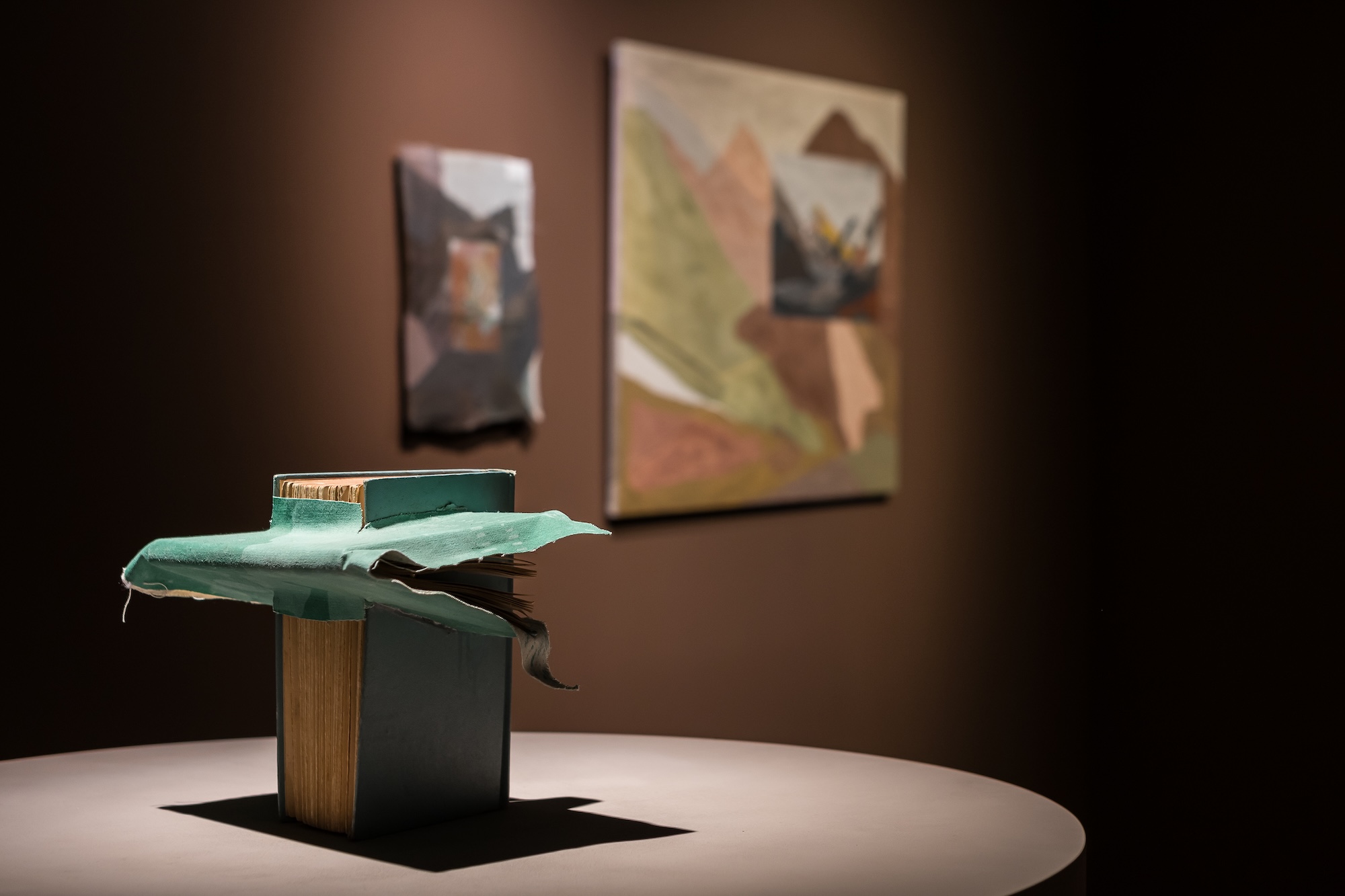
The first image is of Siobhan McLaughlin with her work at Jupiter Artland. Photo: Neil Hanna. The second image shows her work alongside John Latham’s (in the foreground) at Jupiter Artland. Photo: Sally Jubb.