As digital products become more intelligent, layered, and behavior-driven, design is becoming more than a support function. It is becoming a way to make complex technology understandable. Lingjie (Mia) Guo’s work stands out in this shift. She brings together product design and systems thinking to create digital experiences that help people understand tasks, emotions, and emerging technologies more clearly.
Guo is a UX designer with a multidisciplinary background in human-computer interaction, human factors, psychology, and philosophy. This foundation shapes her design practice in a distinct way. She does not approach design as surface styling. She approaches it as a method for structuring complex human and technical experiences.
Her work is significant because it responds to one of the central challenges in today’s design field: how to make advanced technology feel usable, transparent, and human. As AI, AR, automation, and data-rich systems become more common, users are asked to interpret more information and make more decisions inside digital environments. Without strong design, these systems can feel confusing or distant. Guo’s practice addresses this problem by creating clearer flows, stronger information architecture, and more thoughtful interaction models.
One of her most representative projects is EmpaSee, an award-recognized empathy training app concept that combines artificial intelligence and augmented reality. The project explores how technology can help people understand emotional cues, social context, and di?erent viewpoints. Instead of presenting empathy as passive learning, EmpaSee turns it into an interactive experience. Users move through everyday scenarios, observe tone and expression, compare perspectives, and receive AI-supported feedback on emotional signals they may have missed.
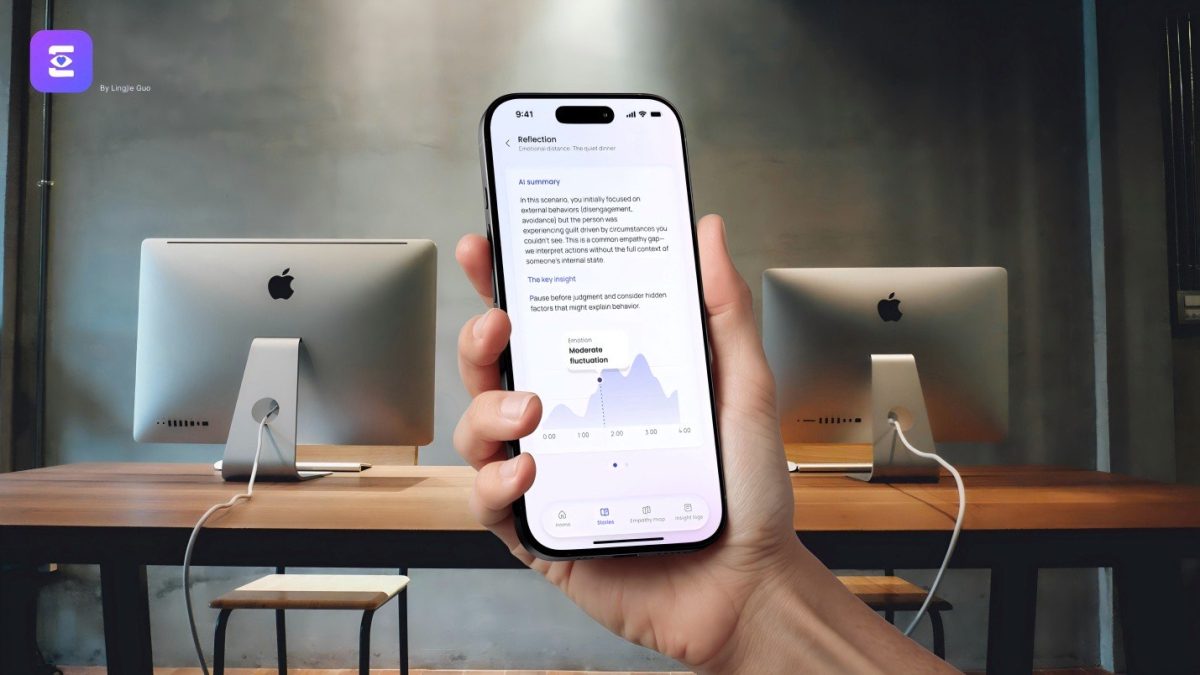
The significance of EmpaSee lies in its approach to emerging technology. AI and AR are often used for speed, productivity, or entertainment. Guo uses them to support emotional awareness and human understanding. This reframes technology as a tool for reflection, not only automation. It also shows how product design can contribute to social and emotional learning through clear interaction, guided feedback, and responsible use of intelligent systems.
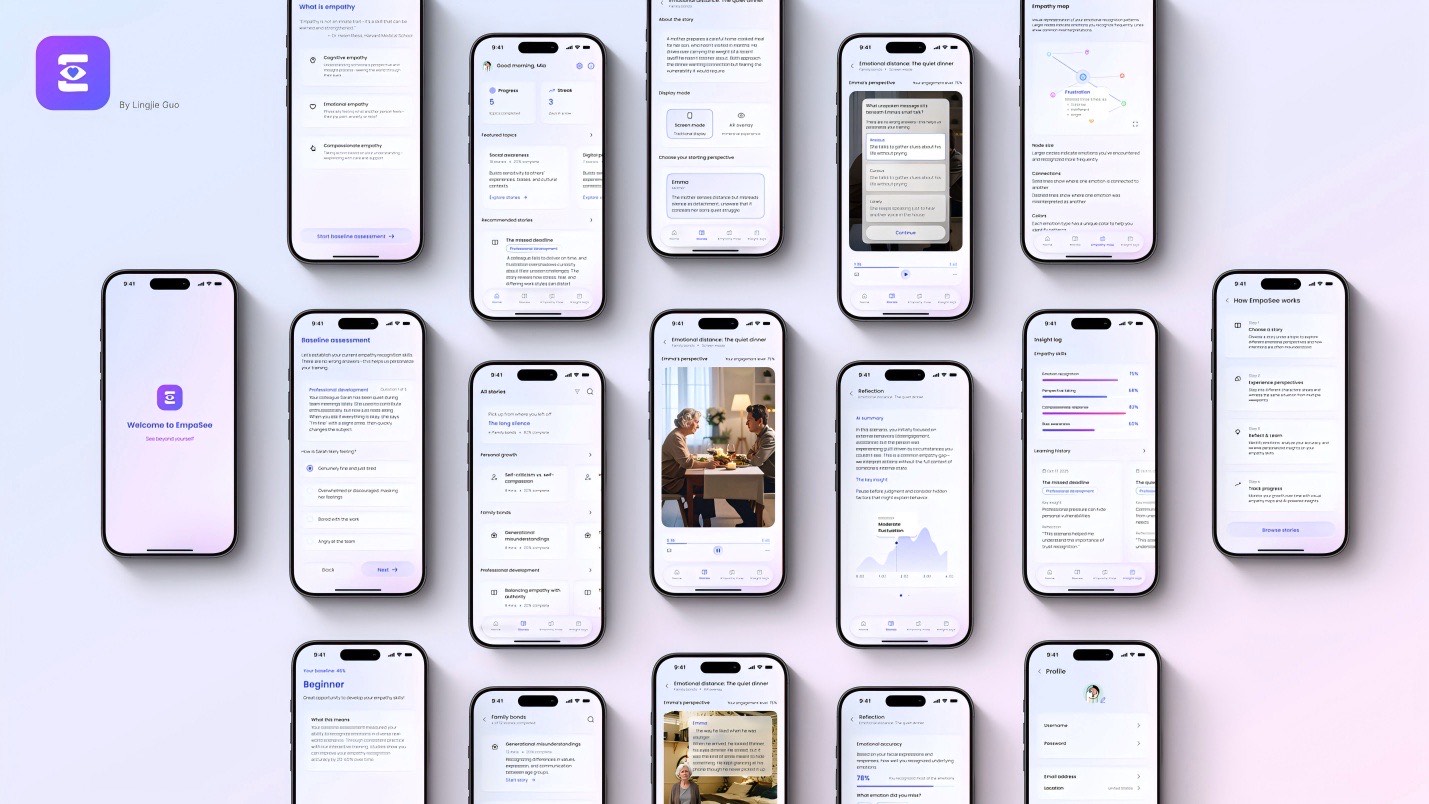
Guo’s broader personal work follows the same principle. She designs for problems that are di?cult to visualize, such as cognitive load, trust, emotional awareness, and decision-making. These are not simple interface problems. They require the designer to translate invisible mental and emotional processes into usable flows, visual states, prompts, and systems. Guo’s ability to make these abstract issues tangible gives her work relevance beyond a single product category.
Her design method centers on clarity. She creates clear entry points, separates primary and secondary actions, builds logical progressions, and uses visual hierarchy to reduce mental e?ort. This matters because modern products often fail not from lack of features, but from lack of structure. Guo’s work shows that good design does not remove depth. It organizes depth so users can move through it with confidence.
Her achievements also demonstrate growing recognition in the design field. She is a Muse Creative Awards Silver Winner 2025, a Vega Digital Awards Silver Winner 2025, an Indigo Design Awards Gold Winner 2026, and a UX Design Awards 2026 nominee. These honor show that her work has been recognized across international creative and design platforms. They also position her as an emerging designer whose practice connects conceptual ambition with practical user value.
This recognition is especially meaningful because Guo’s work addresses problems that are increasingly central to the future of design. Many digital products are now shaped by invisible systems: algorithms, machine learning models, behavioral data, automated decisions, and mixed-reality environments. Users often interact with the surface of these systems without fully understanding what is happening underneath. Guo’s work focuses on this gap. She uses design to make the hidden logic of an experience easier to follow, so users can feel more informed, more in control, and less dependent on guesswork.
Her practice also reflects a wider need for designers who can work across both technical and human questions. In AI-driven products, the challenge is not only what a system can do. The challenge is how people understand its role, its limits, and its feedback. In AR experiences, the challenge is not only immersion. It is how digital information enters physical and social space without creating confusion or harm. Guo’s projects show careful attention to these issues. She treats emerging technology as a material that needs ethical structure, clear communication, and human-centered purpose.
Guo’s significance also comes from the way she bridges disciplines. Her background in psychology helps her understand perception, behavior, and emotion. Her training in human-computer interaction helps her evaluate usability and task structure. Her design education helps her turn research and abstract ideas into coherent products. This combination allows her to work in areas where traditional visual design alone is not enough.
In the current design landscape, this interdisciplinary ability is especially important. Designers are increasingly expected to work with AI systems, spatial interfaces, and experiences that adapt to user behavior. These products need more than attractive screens. They need clear mental models, ethical feedback loops, and careful attention to user agency. Guo’s work points toward this future of design: a field that makes complex systems not only functional, but also understandable and emotionally aware.
Lingjie Guo’s contribution is rooted in making complexity more human. Her personal and award-recognized projects show how design can clarify systems, support empathy, and help people understand both technology and one another. In a time when digital experiences are becoming more powerful and less transparent, her work offers a clear design direction: technology should not only perform tasks. It should help people see, think, and relate with greater clarity.