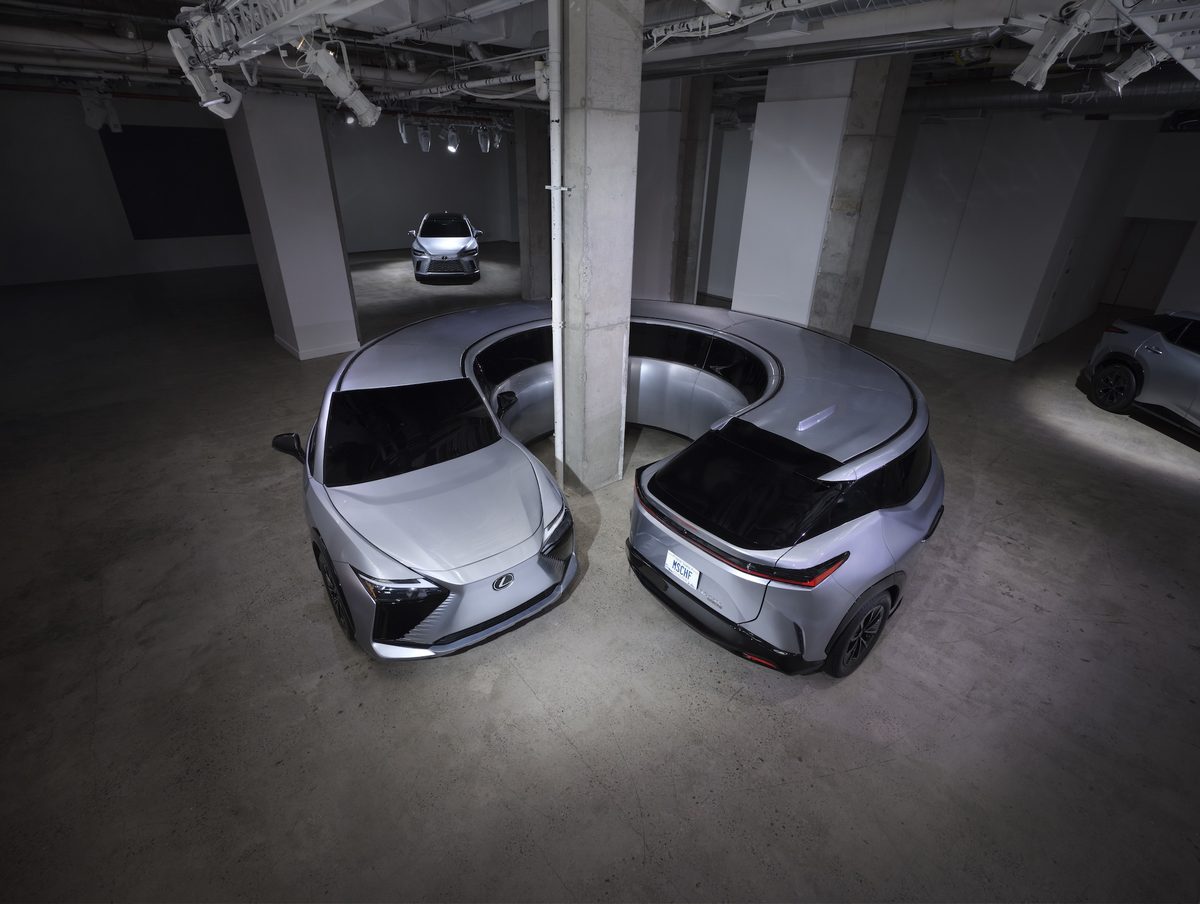
Music was thumping when I entered Chelsea Industrial. Spotlights fell across silver cars on a concrete floor, with exposed columns rising between them. For a moment, I felt as though I had walked into an auto show. Two production Lexus vehicles stood alongside two sculptures by MSCHF, but the distinction was not immediately obvious. They shared a color, a finish, and the same exhibition space. Only as I moved around them did the transformations become clear.
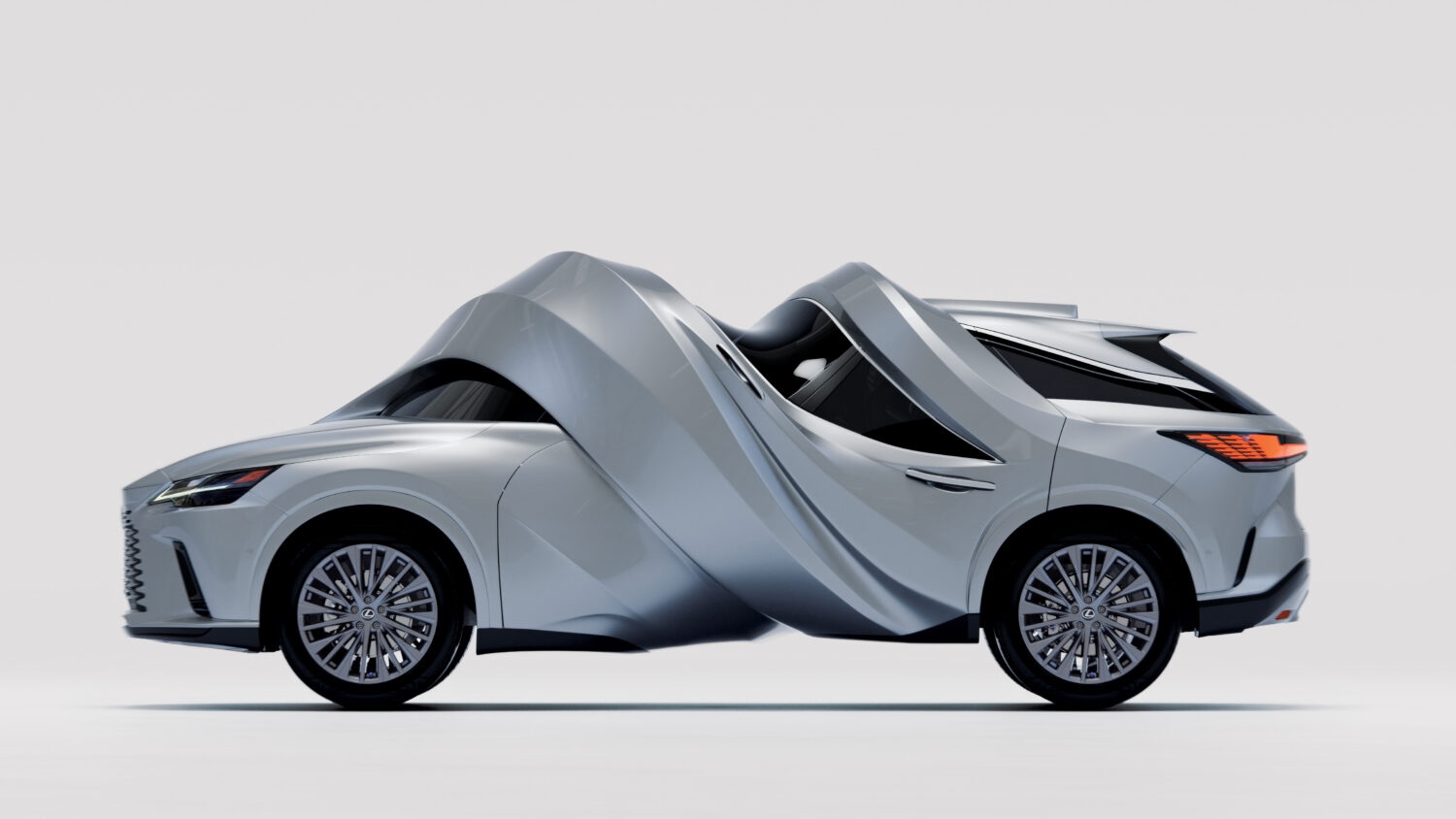
Commissioned by Lexus, MOTOMORPHOSIS pairs an all-electric RZ 450e and a plug-in hybrid RX 450h+ with their sculptural counterparts. Circle Car appears to stretch the RZ into a long, curving form, bringing its front and rear toward each other. In Twisted Car, the body of the RX spirals through the middle like a giant screw. The sculptures look less like imaginary cars built from scratch than familiar cars transformed into unfamiliar shapes. Both retain recognizable details of the original vehicles: their fronts and rears, windows, wheels, and Lexus bodywork. According to Wiesner, the sculptures combine parts from the original cars with separately fabricated structures.
The two works, however, did not produce the same sensation. Looking at Circle Car, I imagined a vehicle that could drive forever without getting anywhere. From one angle, its elongated, curved body even suggested a spacecraft. Twisted Car was different. Despite the spiral through its middle, its front and rear looked unexpectedly intact. Seen from behind, it looked like a striking new Lexus model. For an instant, I wanted to drive it.
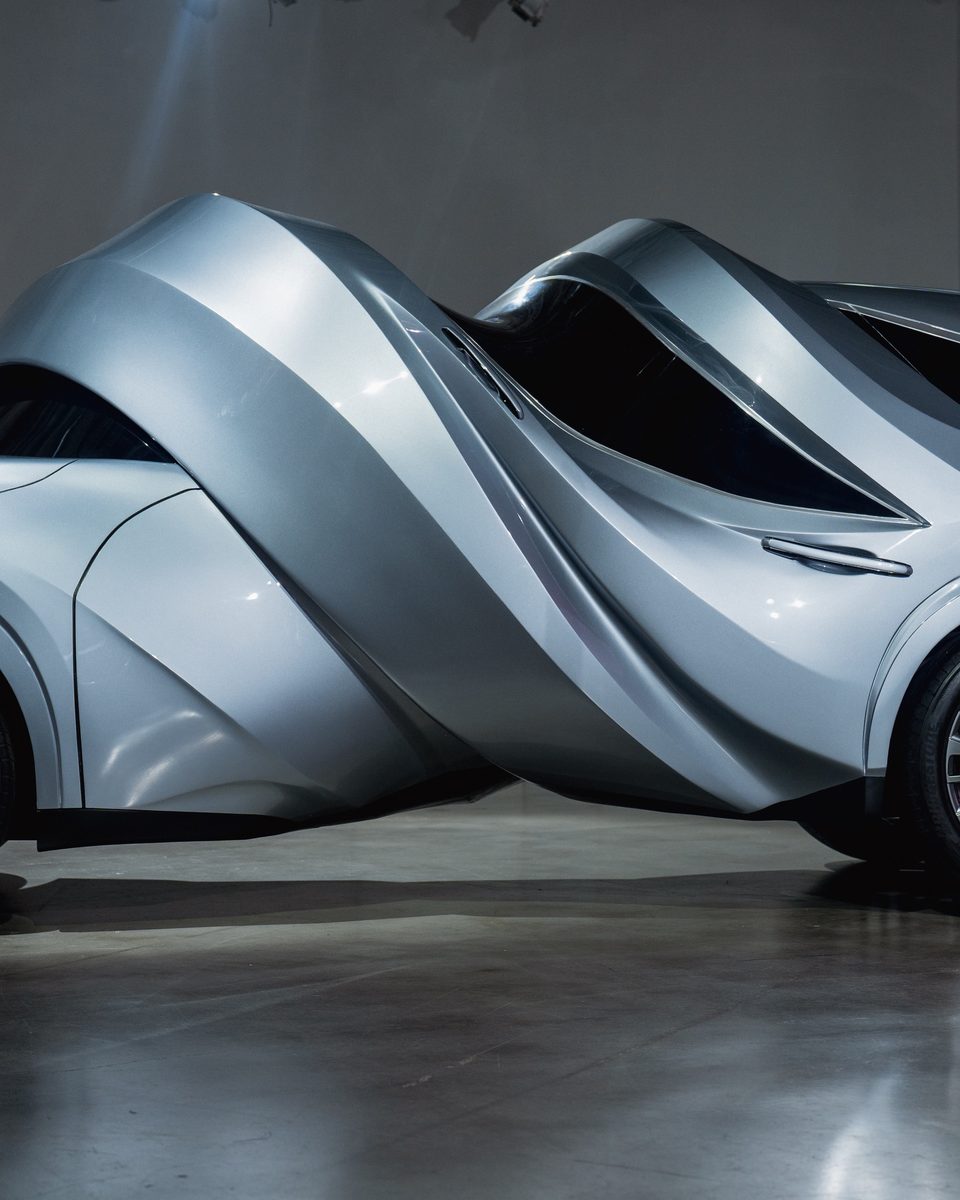
That impression of a familiar car changing into something else made me think of Transformers. In a brief conversation at the exhibition, I mentioned the film to MSCHF’s chief creative officer, Kevin Wiesner: its rapid changes of shape seemed to have been stopped mid-transformation. Wiesner, who calls these works “Form Cars” rather than concept cars designed to suggest the future of transportation, spoke about the exaggerated forms used to convey movement in animation. On a screen, an object can stretch or twist in an instant. Here, that passing distortion has the scale and apparent weight of an automobile.
The exhibition does more than demonstrate how far a car’s shape can be altered. Circle Car turns movement into an endless circuit; Twisted Car retains the posture of a vehicle poised to depart. Neither proposes a future model, yet neither lets go of the idea of motion. Even when their practical use has been removed, the cars’ familiar details keep suggesting what they were made to do.

The auto-show atmosphere also helped make the sculptures look like actual cars. Twisted Car looked briefly like a new model partly because of its shape, but also because an actual Lexus stood nearby, under similar lights, in the same silver finish. The sculptures made the production cars look unfamiliar; the production cars, in turn, encouraged me to look at the sculptures as cars. MSCHF needs the Lexus to remain recognizable for its distortions to register. Lexus benefits when those distortions make a familiar vehicle newly compelling. But the exchange has a further twist: the same intervention that disrupts the car’s function can heighten its appeal as a product.
MOTOMORPHOSIS offers no answer to what the car of the future should look like. Instead, it shows how strongly the image of a car persists even when its ability to travel has been taken away. I left thinking that one of the most desirable cars in the room was a sculpture.
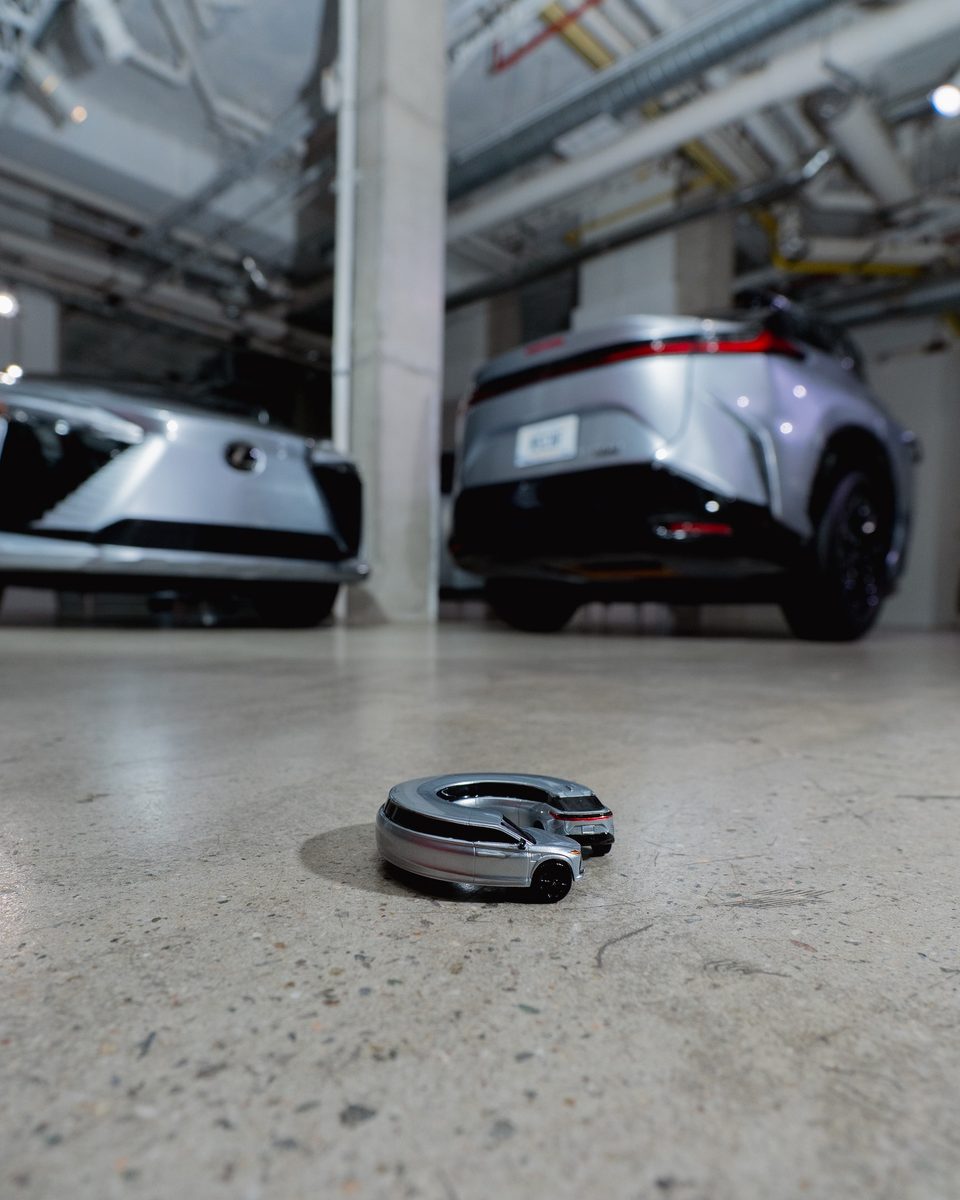
MOTOMORPHOSIS is on view at Chelsea Industrial, 545 W. 28th Street, New York, through September 26th, 2026.
All Photos: Max Hartz for Lexus
About
MSCHF is a Brooklyn-based conceptual art collective known for provocative interventions that move between contemporary art, fashion, technology, consumer products and internet culture. Rather than working within a single medium, the group produces objects, performances, websites, games and elaborate public stunts designed to expose the absurdities embedded in cultural, economic and corporate systems.
Founded in New York, MSCHF operates through a model closer to a creative company than a conventional artist studio, releasing projects as “drops” and deliberately collapsing distinctions between artwork, product, marketing campaign and viral event. Its projects frequently appropriate familiar brands, commodities and cultural symbols, using humour and disruption to question authenticity, ownership, value, luxury and the mechanics of consumer desire.
Among its best-known projects are the Satan Shoes, customised Nike Air Max 97s created with Lil Nas X and containing human blood; the microscopic Microscopic Handbag, modelled on a Louis Vuitton bag; The Persistence of Chaos, a laptop loaded with malware; and Severed Spots, for which the collective cut apart a Damien Hirst spot print and sold the individual dots. The works often generate their own secondary narratives through lawsuits, auctions, resale markets and online reaction, making the public response part of the project itself.
MSCHF increasingly operates within the institutional art world while continuing to test its structures. Its first gallery exhibition, No More Tears, I’m Lovin’ It, opened at Perrotin New York in 2022, transforming the gallery into a strip mall in which sneakers became investment vehicles, video games became artworks and art itself became merchandise. The collective subsequently presented its first museum exhibition, NOTHING IS SACRED, at Daelim Museum in Seoul, and is represented by Perrotin.
Across its practice, MSCHF treats contemporary culture itself as material. Advertising, intellectual property, corporate power, celebrity, social media and the art market become systems to be entered, manipulated and redirected. The result sits somewhere between conceptual art, institutional critique and mass entertainment — work designed not simply to be viewed, but to circulate through the same cultural machinery it sets out to disrupt. @mschf