Glenn Brown returns to Bath this spring with Brown in Bath: Arrows of Desire, a new exhibition at the Holburne Museum that sees the artist insert his distinctive, illusionistic paintings into the heart of the museum’s historic collection.
Opening as part of a dual presentation across the city—including Grottoesque at No. 1 Royal Crescent—the exhibition marks a kind of homecoming for Brown, who studied at Bath School of Art and Design in the 1980s. Decades later, he returns to a city steeped in history, bringing with him a practice that thrives on reworking the past into something strange, seductive and unsettling.
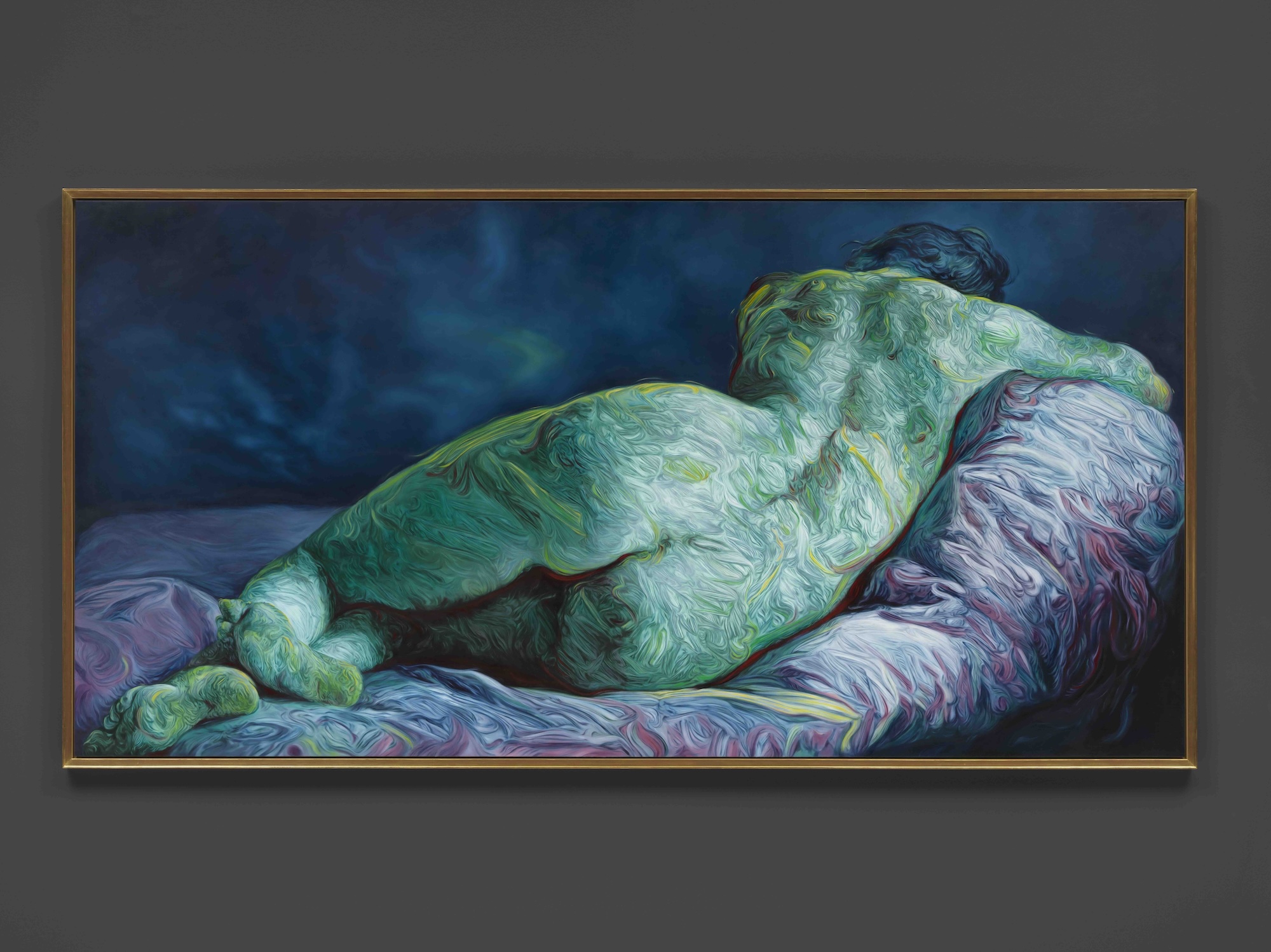
Known for his signature trompe-l’oeil technique—where thick, expressive brushstrokes are painstakingly rendered into flat, glossy surfaces—Brown builds his paintings from borrowed images, drawing on art history, popular culture and beyond. The result is a body of work that feels at once familiar and disorienting, balancing beauty with distortion and humour with unease.
At the Holburne, Brown’s paintings are interwoven with works from the museum’s collection, creating unexpected dialogues across centuries. Figures echo the poses of 18th-century portraits, gestures are mirrored and exaggerated, and details are lifted, warped and reinserted. These juxtapositions sharpen the viewing experience, encouraging visitors to look again—both at Brown’s work and the historical paintings that surround it.
Elsewhere, smaller drawings presented in antique frames extend this conversation, reinforcing Brown’s fascination with the visual language of the past and its enduring influence on contemporary image-making.
Across town at No. 1 Royal Crescent, Grottoesque expands this exploration into the architecture of the Georgian house itself. Here, Brown transforms a gallery into a shell-like grotto, complete with new large-scale paintings and bespoke wallpaper, pushing his immersive approach further into spatial and decorative territory.
Chris Stephens, Director of the Holburne, said:
“Glenn Brown is one of the most important and most successful painters of an extraordinary generation of artists. We are all thrilled to be welcoming him back to Bath with a series of exciting interventions that promise to disrupt the usual order of the city’s 18th century heritage.”
Brown added:
“From 1985 to 1988 I was a student in Bath and so this beautiful city, built for pleasure, for me became a place of learning and discovery… 40 years after my student life, it is an extraordinary pleasure to return to Bath and show it some of the delightful journey, to which it was the genesis.”
Arrows of Desire offers a sharp and playful rethinking of painting’s relationship to history—one that blurs the line between homage and parody, illusion and reality.
The Holburne, Brown in Bath: Arrows of Desire, 16th May – 6th September 2026 @holburnemuseumbath
No. 1 Royal Crescent, Brown in Bath: Grottoesque, 22nd May – 6th September 2026 @no1royalcrescent
About the artist
Glenn Brown, CBE, (born 1966) is a British artist. He is known for the use of art historical references in his paintings. Starting with reproductions from other artist’s works, Brown transforms the appropriated image by changing its colour, position and size. His grotesque yet fascinating figures appear to be painted with thick impasto, but are actually executed through the application of thin, swirling brushstrokes which create the illusion of almost photographically flat surfaces. The effect is powerful–often unsettling–creating an artistic language that transcends time and pictorial conventions. Brown sees these appropriations and oppositions as key to his approach.
Brown also places sculpture as a central point of his practice. They are created by accumulating thick layers of oil paint over structures or found bronze casts. His sculptures, deliberately emphasizing the three-dimensional quality of oil brushstrokes, stand in stark contrast to his flat paintings. The forms of his sculptures and the colour combinations used reference other artists’ paintings and sculptures.
In the last few years, Brown has extensively embraced drawing. Still conceptually rooted to art historical references, he stretches, combines, distorts and layers images to create subtle yet complex line-based works.