


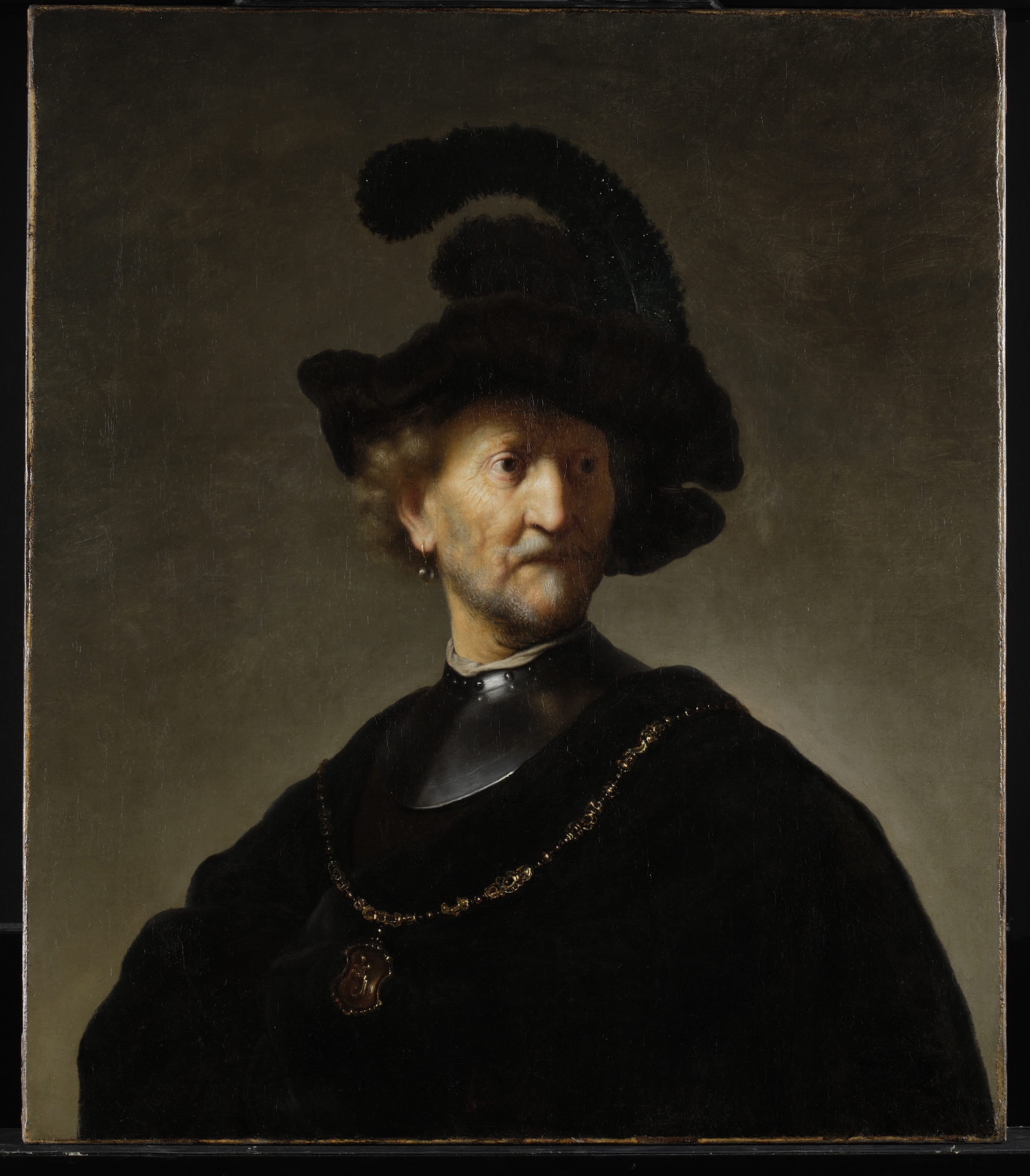
Rembrandt van Rijn is back at the centre of an art historical debate, as a leading scholar challenges the attribution of a long-dismissed painting currently on view at the Art Institute of Chicago.
In a muted corner of the museum, two near-identical paintings—both titled Old Man with a Gold Chain—hang side by side under the exhibition Double Dutch: A Rembrandt and a Workshop Copy. One, painted on oak panel around 1631 and held by the museum, is widely accepted as an early work by Rembrandt. The other, slightly smaller and painted on canvas, is on loan from Sir Francis Newman and has long been attributed to an unidentified artist in Rembrandt’s workshop.
But according to renowned art historian Gary Schwartz, that second painting may in fact be something far rarer: an autograph replica by Rembrandt himself.
Mr. Schwartz says,
“If Rembrandt had a customer for a replica of his attractive Old Man, what would be the most effective and efficient way of making it? Assigning it to a pupil, whose work would have to be corrected – and the Newman painting shows no sign of corrections – or re-enacting the steps he had just taken, when they were still fresh in mind and hand? Surely the latter makes more sense. This assumption accounts for the outstanding quality of the canvas, which no one, starting with Wilhelm Bode, denies. Neither he not anyone else has put his finger on weaknesses in the Newman painting. The small differences in execution that the Chicago researchers have found between the two paintings do not disprove this. They are more likely to be freedoms that the master could allow himself and that a pupil copyist would not.”
The distinction is subtle but significant. While workshop copies were a standard feature of 17th-century studio practice, autograph replicas—repetitions executed by the artist’s own hand—occupy a different category altogether. As the French critic Roger de Piles noted, “There is hardly any painter [in the Netherlands] who did not repeat one of his works.” Whether Rembrandt followed this same practice has long been debated.
The current attribution rests in part on a judgement made in 1912 by Wilhelm Bode, who rejected the possibility that Rembrandt would have produced replicas of his own compositions. Yet, as Schwartz argues, that assumption lacks substantive grounding—and may have shaped more than a century of misattribution.
Recent technical analysis at the Hamilton Kerr Institute adds fresh weight to the discussion. The canvas, pigments and ground layers align with materials used by Rembrandt and his studio in the early 1630s. Even more compellingly, compositional mapping shows the central figure in both paintings corresponds almost exactly.
For Schwartz, the logic is pragmatic. Rather than delegating a replica to a pupil—whose work would likely require correction—the master may simply have repeated the process himself while it remained fresh. The assured execution of the canvas version and the absence of visible revisions, support that possibility.
What emerges is not a definitive resolution, but a shift in perspective. If Schwartz is right, the Art Institute may be in the rare position of displaying both an original and its autograph counterpart—two works separated not by authorship, but by intention.
For now, the second Old Man with a Gold Chain remains officially a workshop painting. But the question of its true authorship is once again open—and potentially transformative.