This autumn, the National Gallery turns its attention to one of Impressionism’s most seductive subjects: love. Renoir and Love gathers 45 paintings by Pierre-Auguste Renoir, forming the most significant exhibition of his work in the UK for two decades and the first devoted to the artist at the museum since 2007.
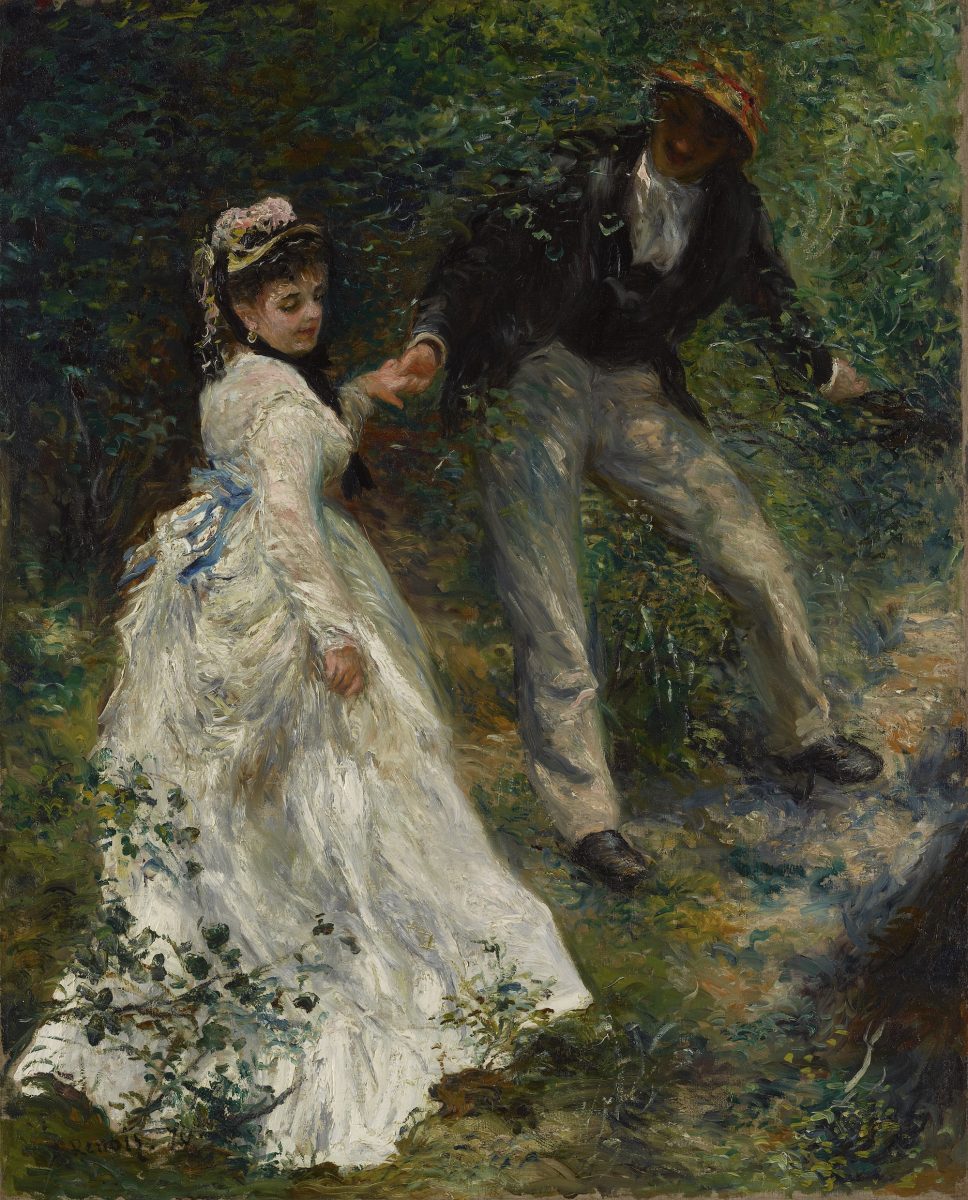
Organised with Musée d’Orsay and Museum of Fine Arts, Boston, the show focuses on the crucial years from the mid-1860s to the mid-1880s, when Renoir developed his distinctive vision of modern intimacy. More than a third of his paintings from this period depict flirtation, companionship, family bonds and fleeting encounters staged in the newly redesigned public spaces of Paris — cafés, boulevards, parks and riverside retreats where modern life unfolded.
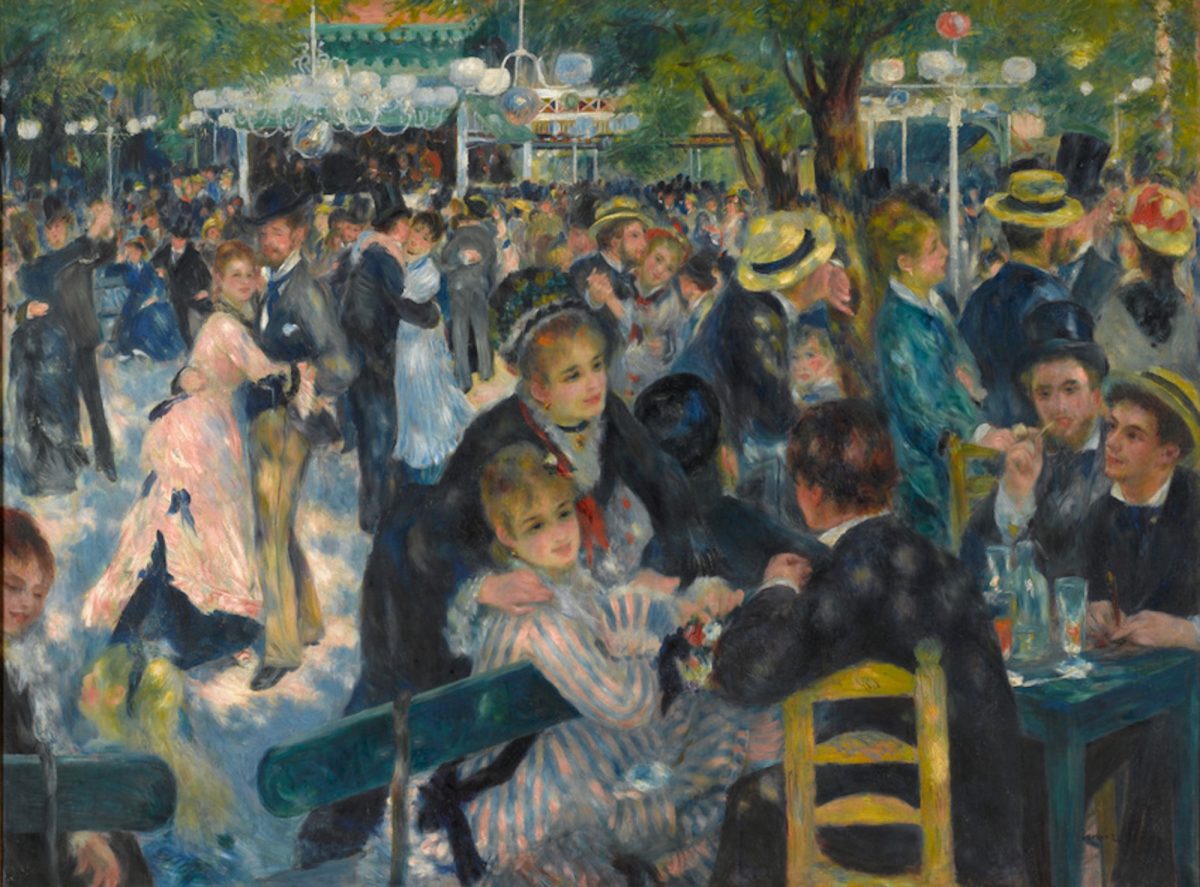
Musée d’Orsay, Paris (RF 2739) Gustave Caillebotte Bequest, 1896 © photo Grand Palais RMN (Musée d’Orsay) / Mathieu Rabeau
At its centre is the exuberant masterpiece Dance at the Moulin de la Galette (1876), travelling from Paris to the UK for the first time — a sun-flecked panorama of youthful pleasure that has come to define the spirit of fin-de-siècle Paris. Nearby hang equally beloved works such as The Umbrellas and Renoir’s celebrated dance scenes, paintings that transform everyday sociability into luminous theatre.
Rather than sentimental narrative, Renoir offers something more elusive: emotion as atmosphere. Lovers brush shoulders in crowded streets, friends gather at café tables, families drift through gardens, and bodies lean toward one another in gestures that feel both spontaneous and carefully choreographed. His touch — flickering, sensual, almost tactile — captures desire as something fleeting and radiant, as transient as sunlight itself.
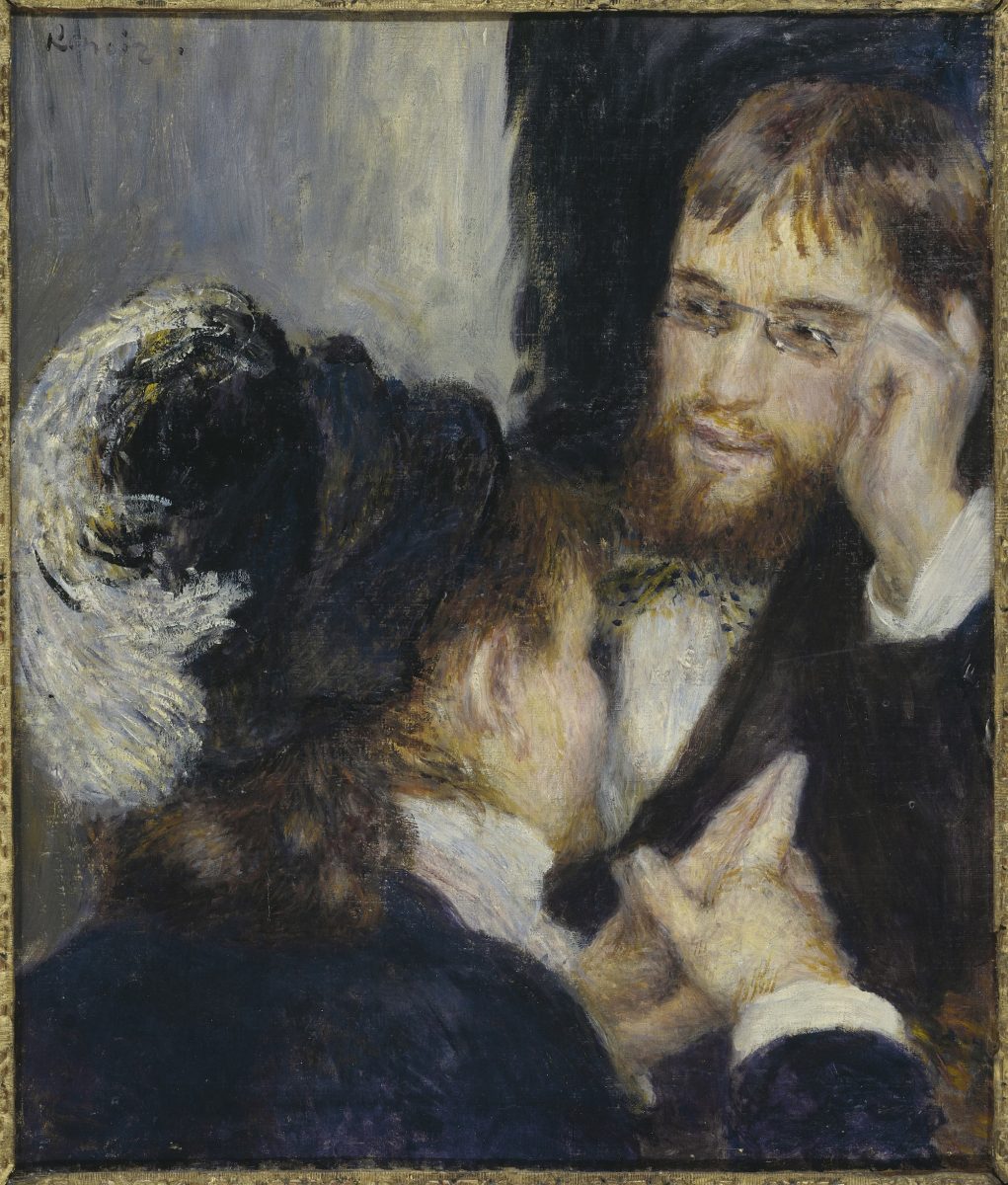
The exhibition unfolds thematically. Early works explore his break from academic tradition, treating scenes of ordinary life with the gravity once reserved for mythological subjects. Later rooms trace gallant flirtations of the 1870s, bustling urban encounters, riverside leisure culture on the outskirts of Paris, and intimate family scenes. A section devoted to intellectual and physical closeness — conversations, theatre boxes, shared interiors — reveals Renoir’s fascination with proximity as a visual language.
The final gallery marks a turning point. By the mid-1880s Renoir began moving away from Impressionism’s dissolving light toward more sculptural forms and classical themes. Monumental works such as The Great Bathers signal a new ambition: to reconcile modern life with timeless ideals of the human body.
Seen together, these paintings chart not just the evolution of an artist but the emergence of modern romance itself — public, performative, urban and inseparable from the rhythms of everyday life. In Renoir’s hands, love is not a grand drama but a social condition: a glance exchanged across a table, a hand resting on a shoulder, a dance under lantern light.
Following its debut at the Musée d’Orsay (17th March – 19th July 2026) and before travelling to Boston (20th February – 13th June 2027), the London presentation promises a rare chance to experience Renoir at his most intimate, ambitious and quietly radical.
The curators are: Paris Paul Perrin, Chief Curator and Director of Conservation and Collections at the Musée d’Orsay, Paris; with the participation of Lucie Lachenal-Taballet, Archival Research Assistant at the Musée d’Orsay, Paris. London Christopher Riopelle, former Curator of Post-1800 Paintings at the National Gallery, London, and Chiara Di Stefano, Associate Curator of Post-1800 Paintings at the National Gallery, London. Boston Katie Hanson, William and Ann Elfers Curator of Paintings, Art of Europe, Museum of Fine Arts, Boston; with the participation of Julia Welch, Arthur K. Solomon Assistant Curator of Paintings, Art of Europe, Museum of Fine Arts, Boston.
Renoir and Love, 3rd October 2026 – 31st January 2027, The National Gallery