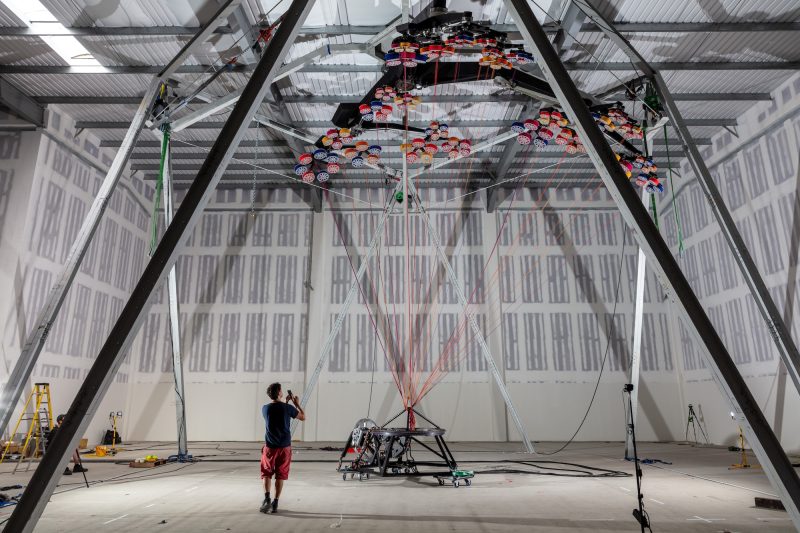
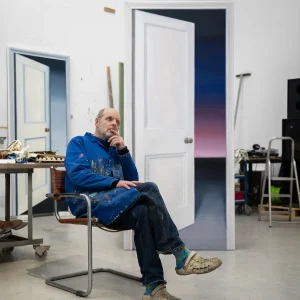
The Nervous System Umbilical, 2025, is the most ambitious machine in Conrad Shawcross’s Rope Makers series.
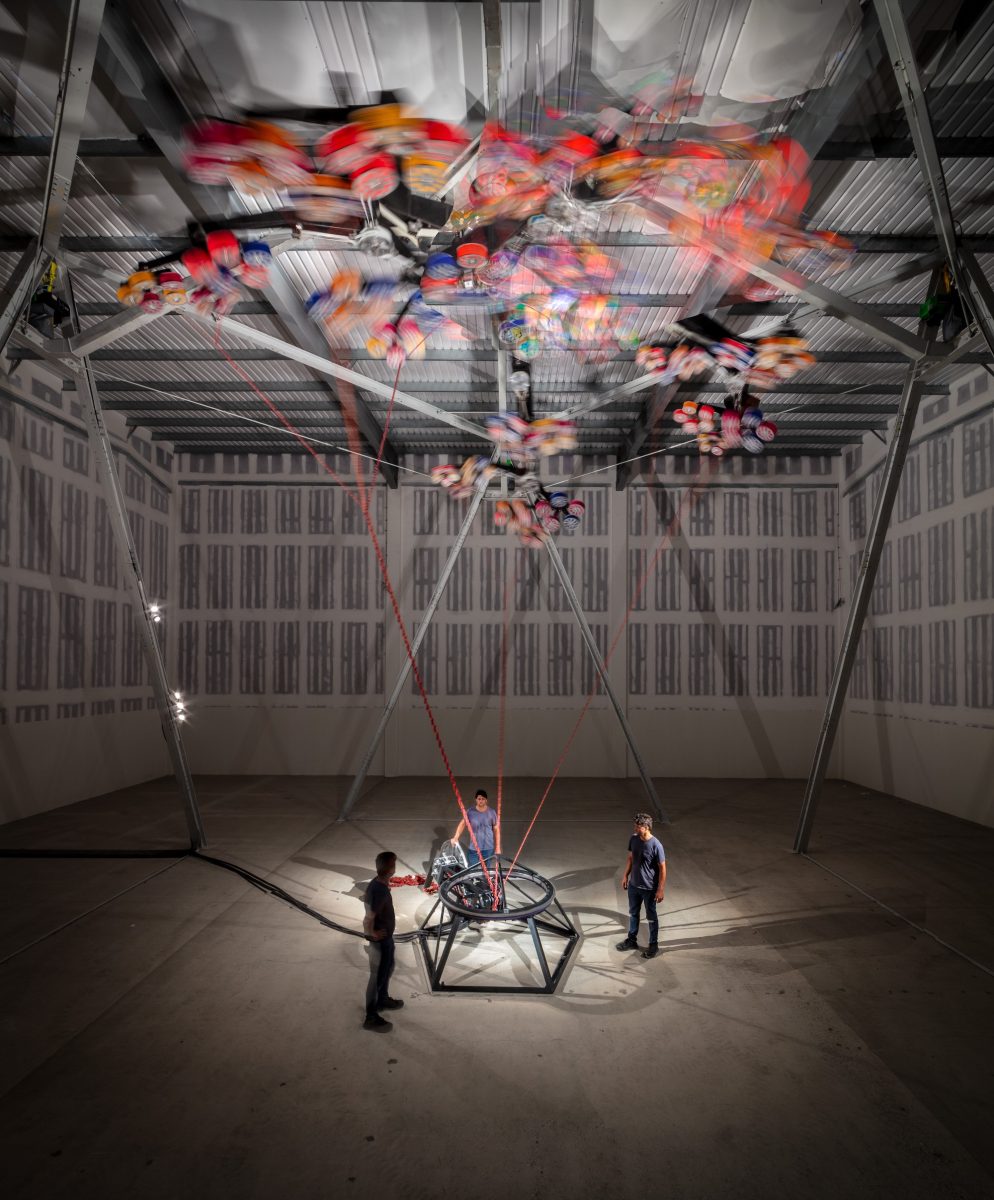
At 10 metres high and 12 across, it’s a vast mechanism of 40 interlocking arms that weave an endless rope in orbits that never repeat. Engineered in his Hackney studio, the work fuses art and mechanics with cosmic analogy: the rope drawn through its centre echoes the sun’s path across the galaxy, trailed by planets and their spiralling moons.
We spoke with Shawcross about the scale, the science, and the speculative thinking behind the piece.
You mentioned that the work came about from a challenge David Walsh* set you – could you explain what the challenge was?
It was a mischievous challenge, as David didn’t believe what I was suggesting was possible so he agreed to this commission as he found the idea of me suffering to achieve something unachievable was amusing. But despite the challenges I have managed to pull this off. I think David is delighted and I proved it was possible. It has not been easy, its been full of setbacks, hardships and challenges but I made it work.
You mentioned that no one else could have produced the work – what specifically makes it technically so difficult?
It is a complex mechanical machine that needs to run for over 50 years continually and furthermore it needs to operate above people’s heads so the health and safety challenges are enormous.
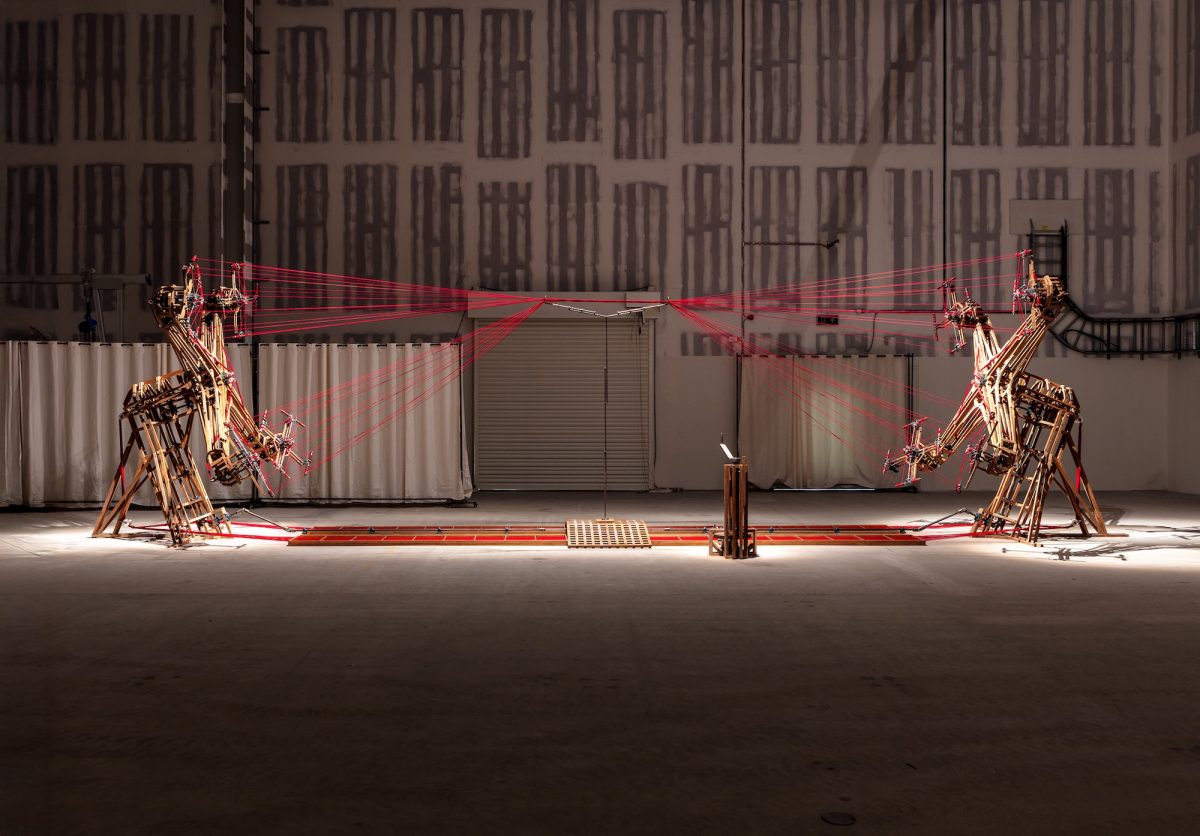
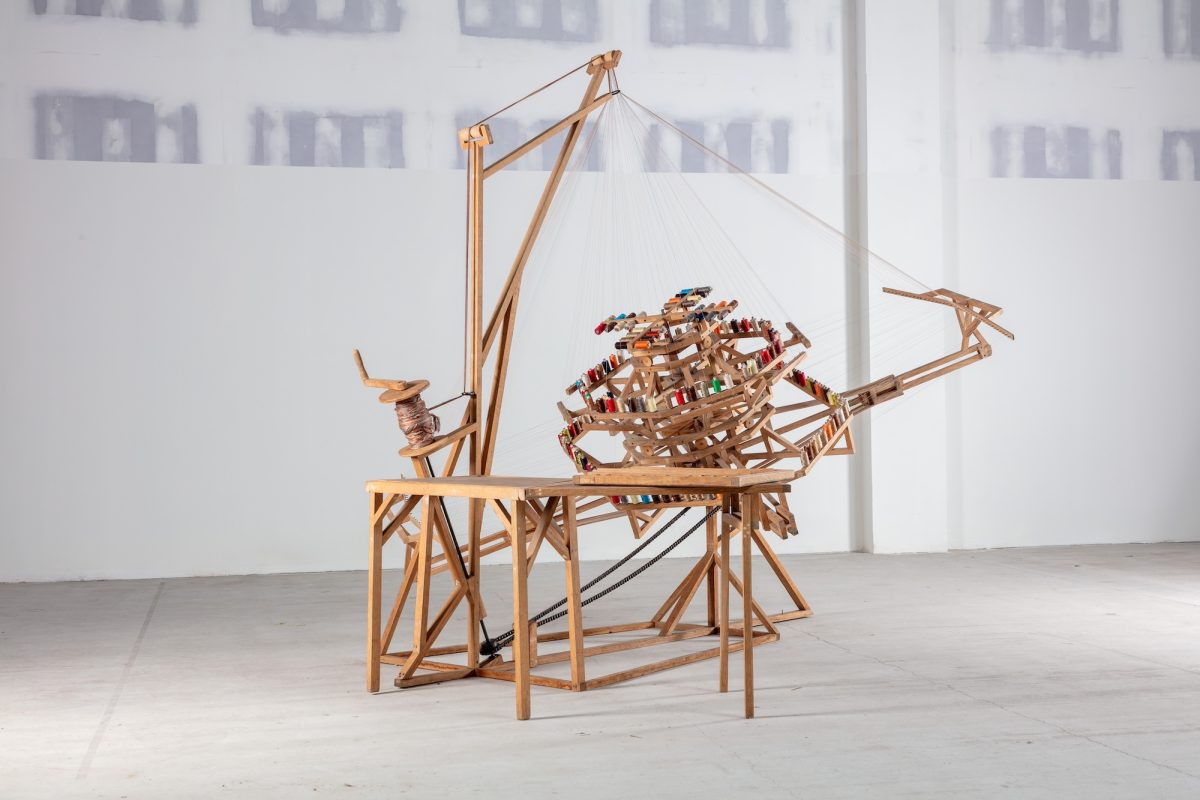
Umbilical is presented with two earlier works from your series of ‘Rope Makers’ – Do you see (apart from size) there being a progression in the work, and if you do, what is it?
All of the previous rope machines have repetitive motions. This machine whilst weaving a rope, will never repeat. The 135 spools will never come back to the same rotation – one primary, three secondary arms, nine tertiary arms, 27 quaternary arms and 135 spools all driven by one motor.

The work produces a rope/cord, what affects the colour configuration/composition of this.
The colours have been cosmetically chosen but it’s very difficult to find a combination of 5 colours that are not political or nationalistic.

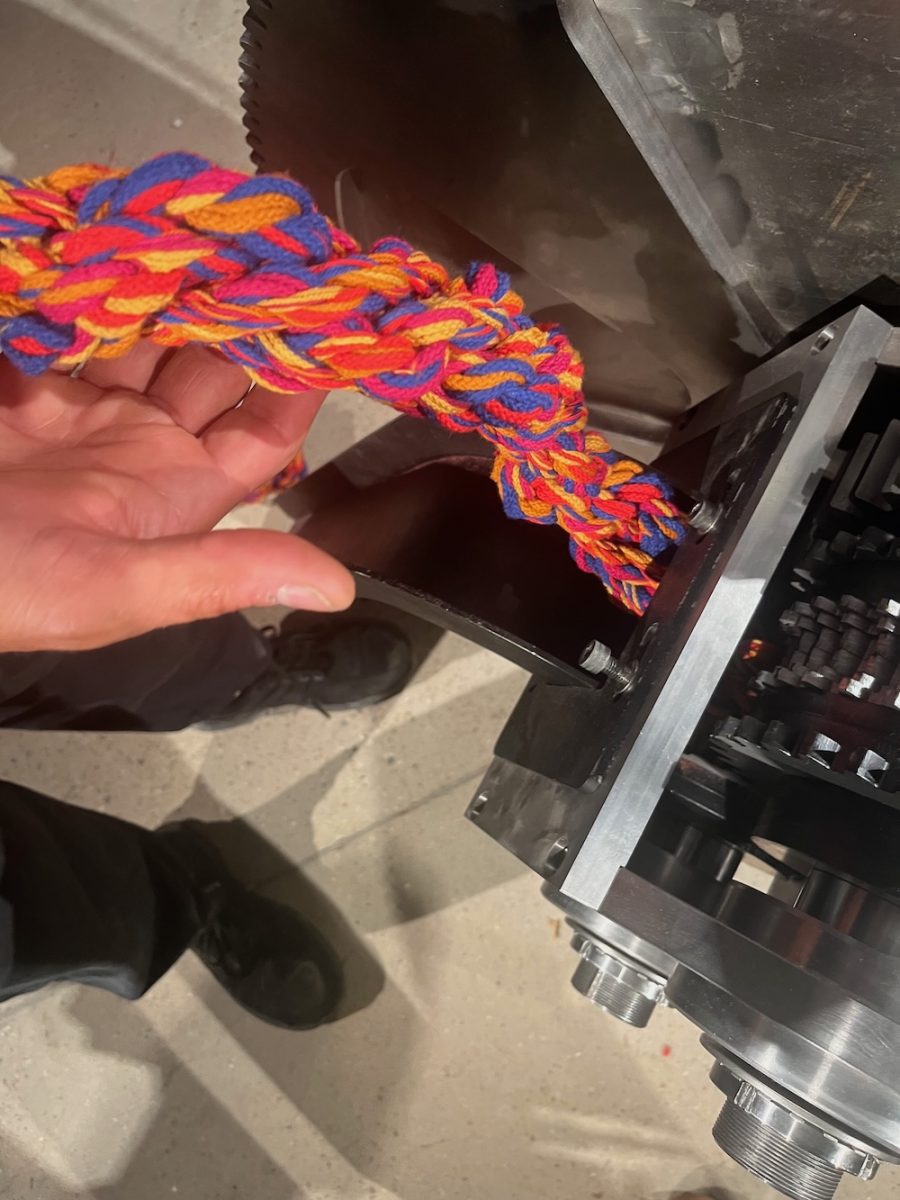
When you started Umbilical, did you always envision that the work would produce /create something that could become unique art
The machine has a product so there is an interesting conversation about what happens to this product that is made incrementally slow. It makes something much slower than a human can, so it defies logic or rationality because all machines aside from musical instruments are either conceived to make something faster or more accurately than a human can.
Why do you want to understand our universe /time and everything? And more importantly, why do you want to visualise it?
The piece in its complex motion and cycles within cycles, the piece is akin and analogous in many ways to our own solar system. There is no midnight in the solar system so I hope through experiencing this work it brings the viewer closer to the realisation that our sense of time is extremely limited and that time in essence does not exist in a planetary scale but on a cosmic one, in which we are a tiny dot in an ocean of stars and solar system.
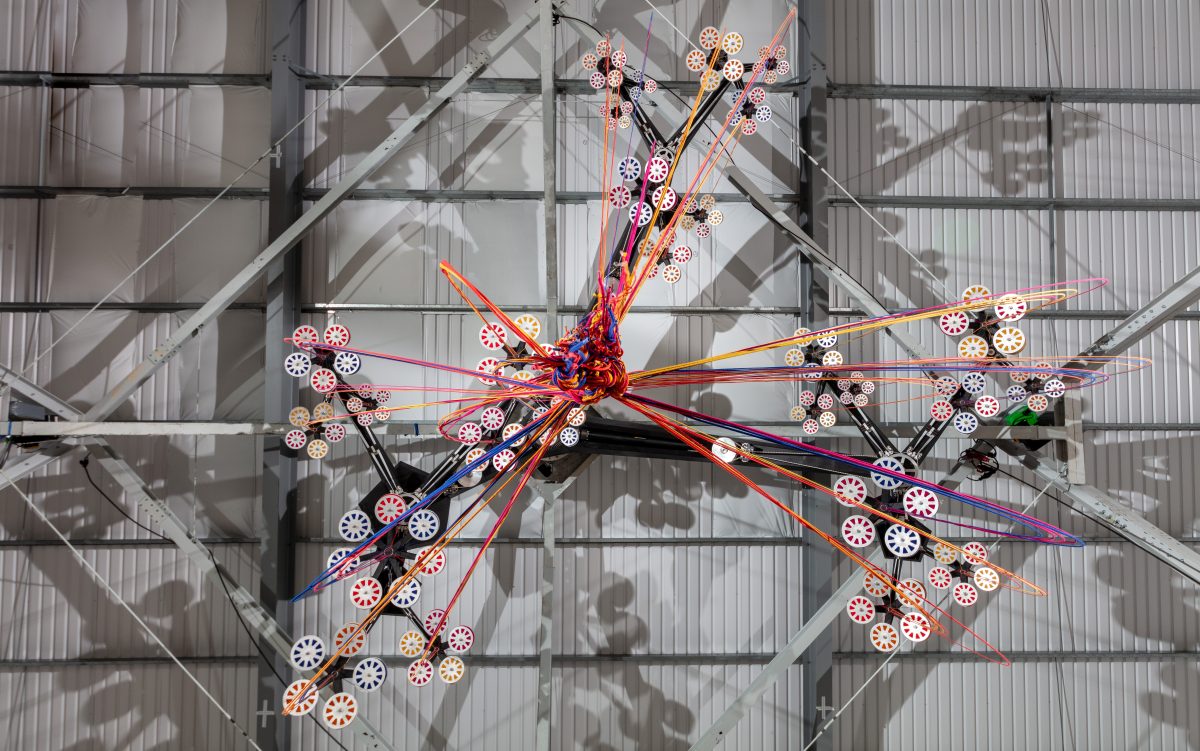
The great thing about the work from my point of view is that you dont need to think about it, you can lie back on a bean bag (provided) look at it, and kind of feel it, see the motion and drift off
I hope the unpredictability, movement and phases of the machine are relaxing to watch.
In the press release, it says – The Nervous System (Umbilical) offers a visual embodiment of past, present, and future and challenges our assumption that the world and our reality are stable.
Does anyone think the world is stable anymore?
All my work is about challenging our constructed realities and our sense of what is real, but yes the world has become less stable and we are less complacent about the systems which govern and control our lives.
Conrad Shawcross UMBILICAL – 2nd November 2025 Here East
Daily: 10AM – 6PM FREE to visit – updates of news of talks & events HERE
• David Walsh, the visionary behind MONA (Museum of Old and New Art)
About the artist
Imbued with an appearance of scientific rationality, Conrad Shawcross’ sculptures explore subjects that lie on the borders of geometry and philosophy, physics and metaphysics. Inspired by various technologies, the artist’s work may retain in appearance the authority of machinery – yet, it remains enigmatic, filled with paradox and wonder. Some works have an absurdist melancholy feel, while others tend towards the sublime, substituting the purely functional for phenomenological experience. Ultimately, Shawcross’ art questions what we take for granted and encourages us to see beyond the physical.
Throughout his career, Shawcross has experimented with ideal geometries and topologies; these constructions are conceived as systems, sometimes modular, sometimes mechanical, which could be theoretically extended infinitely into space. In these and other sculptures, Shawcross has paid tribute to some of the great pioneers and analysts, and considered specific moments or figures from the past. A further evolution of Shawcross’ practice has seen the development of static works that contain both an internal dynamic and an idea movement. In tandem, the artist has developed the scale of his practice, taking on architectural and public space with work that combines epic scope and poetic grace.
Via Victoria Miro